Monday, June 30, 2008

Britain Refuses to Take No for an Answer

Earlier in June we brought you the story of Britain's rail minister's nonsensical rejection of HSR. Tom Harris rejected plans to build an HSR link from London to Scotland arguing against the evidence that HSR isn't a green form of transportation.

Far from closing the door on HSR in Britain, it has instead energized activism. Over the last two weeks British HSR advocates have stepped up their criticisms of the Labour Government's rail policy and particularly its preference for a third runway at Heathrow over HSR. They're refusing to take no for an answer:

The campaign for a British high-speed rail network has gained further momentum after it emerged that 2.5 million transfer passengers a year fly into Heathrow airport from British destinations.

Transfer passengers, who fly into a hub airport in order to connect with a long-haul flight, have become a battleground in the debate over building a third runway at Britain's largest airport.

Opponents of the proposals claim that the latest figures prove that many Heathrow slots are used for unnecessary flights that could be replaced by high-speed rail routes....

Executives at airport owner BAA have admitted privately that the transfer passenger debate is crucial in the PR battle over a third runway, with Tory leader David Cameron among the influential figures who believe that connecting travellers add nothing to the UK economy.


British Airways is leading the push for a third runway, but Britain's environmental and rail groups are rejecting their claims, noting that HSR can service the same passenger load in a much more sustainable way (and give Britain's ailing rail network the boost it needs to catch up with their continental counterparts). The Liberal Democrats and the Conservatives are piling on, as seems to be happening with pretty much everything in British politics these days.

But the underlying point is sound. Britain is being impacted by the same fuel crisis we are, and it is hitting British air carriers as well, with several on the verge of bankruptcy. Since fuel costs are only going to continue to rise, it doesn't make sense for Britain - or California - to reject sustainable, climate-friendly methods of travel like high speed rail that aren't dependent on the fluctuating price of oil.

Nations around the world are developing high speed trains - from Morocco to Vietnam to Iran to Argentina. It's a matter of global competitiveness now, as California businesses will have higher costs that overseas competitors if we remain dependent on oil to move around our state.

Sunday, June 29, 2008

June 2008 CHSRA Meeting Report

Dennis Lytton attended the CHSRA board meeting in Los Angeles on June 11, and wrote up this report of the meeting. The next meeting is July 8 in San Francisco. Thanks to Dennis for writing this! - Robert

HSR Board Meeting in LA:
The Spain/California Connection and the Coming Campaign


Early this month the High Speed Rail board traveled to Los Angeles Metro Headquarters for their monthly board meeting.

Newly appointed board member Tom Umberg was at the meeting. The board also voted, wisely, to keep Judge Kopp as chair.

It was also heartening to hear Republican appointee to the board Curt Pringle rail against UP’s opposition to the project. This is an opportunity for both the state and UP, Pringle opined. Things seem to have changed in the last several months as climate change and oil prices have brought mainstream Republicans in Congress together on boosting rail and public transit recently (see below). Maybe the state’s Republicans will finally come around.

In other business, the Authority entered into an agreement with Fresno COG to cooperate on their project to consolidate the two freight railroads together, BNSF and UP. Potentially, like the Alameda Corridor, this could lead to better passenger and freight train service while reducing the rail lines' already small footprint (compared to freeways) through their community.

There was a fascinating presentation from the Infrastructure Management Group and Lehman Bros. They were hired as consultants by the Authority for the issue of bringing private equity investment into HSR. Their presentation to the board was based on the responses they received to their Request for Expression of Interest (RFEI), sort of like a pre-RFQ (request for qualifications). Diverse operators and contractors, including SNCF (the French National Railway), Britain’s Angel Trains, and giants like Alstom, Parsons, and Goldman Sachs responded.

Long story short, there's lots of interest in it but it would require at least 60% public financing. Probably at least 75%, IMHO. The good news is that if we get both the bond money and a matching federal amount under veto proof legislation (S.294 and HR 6003) pending in the Congress we are there. $20 billion S.F. to L.A. and beyond to Sacto and San Diego.

There was also a presentation from the L.A. to Palmdale consultant team on their planning work for the first several miles of the alignment north of Los Angeles Union Station. The Taylor Yards region around the current Metrolink yard has been a social justice issue for the neighboring Glassel Park neighborhood in Los Angeles. The consultants recognized the need to expand the developing Taylor Yards Park and also access to the L.A. River and are working with local stakeholders and elected officials staff to this end.

There was also a great presentation on the Spanish HSR system presented by Spanish HSR contractors and train manufacturers Talgo, Insolux Corsan, and Renfe. The Spanish will soon have the largest HSR system in the world. They have the added complication of having multiple track gauges in Spain, which we don’t have. More importantly however, Spain and California are comparable in terms of area and population. Spain's conventional railways were also in poor shape by European standards 20 years ago.

At the end of the meeting I made public comment for my two groups, the National Association of Railroad Passengers (NARP), and the Rail Passenger Association of California (RailPac). We are supporting getting the bond passed this November and are looking forward to working with the campaign and the grassroots/netroots on this important issue.

Also, reportedly, the campaign machine for HSR is ramping up. Kopp and Umberg are looking forward to a vigorous and well funded campaign for the project and expect some Republican support to be garnered up by board member and former Assembly Speaker Curt Pringle.

Just a few months ago I would have been doubtful about California Republican support. However, with the way gas and climate change have gone lately, and with Congressional Republicans recently joining House Democrats to pass a bill to aid local transit agencies to the tune of $1.7 billion over two years by a vote of 322-98, you’re got to wonder whether the anything-but-transit/trains Republicans like Tom McClintock will still dominate.

Dennis Lytton

Saturday, June 28, 2008

The Airline Crisis Deepens

Persistently high fuel prices are worsening the crisis facing US airlines. The New York Times reports carriers are going to slash 10% of their flights this fall:

With more reductions coming next year, all the domestic industry’s growth over the last decade will most likely be lost. “The U.S. industry is undertaking a historic restructuring,” Gary Chase, an industry analyst with Lehman Brothers, wrote in a research report Friday.

Air fares, which are up about 17 percent this year on average, may rise as much as 40 percent within the next four years, Mr. Chase predicted.


The NYT article focuses on smaller towns that are being cut out of the US air network, including San Luis Obispo. The article might make it sound like it's just the small fish being hurt. But an LA Times article on the impact of $200/bbl oil, which we are fast approaching, notes that the LA-SF route is in for cuts:

Travelers can also expect much fuller and much more expensive airplanes -- when flights are available at all. Delta Air Lines Inc., for example, recently said it was cutting about 13% of its flights from Los Angeles International Airport to save fuel.

It also could mean shifting flights from outlying airports such as Ontario to LAX to cut overhead costs, said Jack Kyser, chief economist for the Los Angeles County Economic Development Corp. Carriers probably would also trim flights in highly competitive air corridors such as L.A. to the Bay Area.


Unfortunately the LA Times article totally neglects to mention high speed rail and Prop 1 as the solution to that crisis - but that is indeed the answer. The era of cheap oil is over for good, and it's time we looked to long-term solutions that provide clean, sustainable transportation free from the vagaries of oil prices. High speed rail is necessary if Californians are going to get around their state, if our economy is going to have a shot at competing in the globalized 21st century.

We're not the only ones seeing this. Southwest Airlines has stayed afloat this long only through the use of complex fuel hedges, which will expire within a few years. Recognizing the problem their CEO, Herb Kelleher, had this to say last month:

Herb Kelleher, the iconic co-founder of Southwest Airlines who stepped down as chairman Wednesday, said flying could become something that only business travelers or the affluent can afford, much as it was in the 1950s and '60s.

"You may see a lot less air service across the United States, and that's really a shame," Kelleher said. "We are heading back in that direction."


HSR is our only chance to provide affordable, frequent, high capacity intercity travel for California.

Friday, June 27, 2008

Yes on Prop 1

Get used to hearing that:

Secretary of State Debra Bowen has assigned numbers to the 11 ballot measures that will appear on the Nov. 4 ballot, starting over with No. 1, which was assigned to the oft-delayed $9.95 billion bond issue to partially finance a high-speed rail system in the state.


Prop 1 it is. It has a nice ring to it.

Although AB 3034 has been delayed in the Senate for two weeks I do not believe that even if it passes it would change the numbering. I've seen studies arguing that ballot placement matters - that's why the order of candidates is done by random draw - so perhaps this matters, perhaps it doesn't.

But there it is. Prop 1. Yes on Prop 1!

Thursday, June 26, 2008

CARB Endorses High Speed Rail to Meet Global Warming Targets

The California Air Resources Board has released its draft scoping plan for implementation of the AB 32 greenhouse gas reduction law. This is the law that was passed in 2006 that requires California to reduce carbon emissions by 25%, to 1990 levels. It is rightly seen as a landmark national, even global law.

And as CARB recognized, its goals cannot be accomplished without high speed rail.

The cornerstone of the CARB plan to implement AB 32 is to use a cap-and-trade system. I prefer an outright carbon tax, but cap-and-trade is what we're likely to see initially here in California. This is where the overall amount of carbon emissions is capped, and credits are created to allow pollution up to that cap limit. Those credits can be traded - so if, say, a factory wants to pollute, it must purchase more credits, causing those who sell them to reduce their emissions. Over time the number of available credits is steadily reduced to achieve lower emissions.

Transportation is one of the capped sectors of the economy - meaning we can no longer just fly around or drive around endlessly; there will be increasing limits and at the same time rising costs as the cost of the credit purchase is passed on to consumers. To achieve the required lower emissions, and to provide sustainable and cleaner forms of transportation CARB endorsed high speed rail as one of its recommendations.

Their explanation was not particularly detailed - basically an endorsement of the concept of HSR and a projection that it would save around 1 million metric tons of CO2 in 2020. That's around 22 billion pounds per year, close to the figure of 17.6 billion pounds that Quentin Kopp has been quoting.

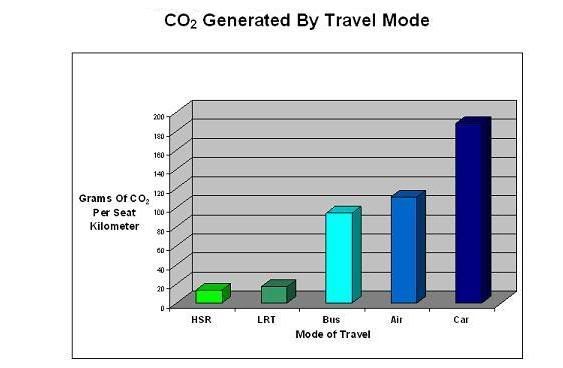
This also gives me a chance to reuse one of my favorite graphics, from Alberta High Speed Rail:


The amount of carbon emissions savings for HSR is really quite dramatic. And let's put this in context. Airline emissions are much higher than initially believed. CARB doesn't mention airline emissions, which is one of several reasons I believe their plan will ultimately be inadequate. But that just makes HSR all the more important a method of greenhouse gas reduction - if we are to have any hope of making the AB 32 targets, which are modest targets, we need to be constructing alternatives such as HSR. Without HSR it just will not be possible to make meaningful reductions in transportation emissions - and those emissions are the single largest category of emissions in the state.

Some might ask about the electricity generation for the HSR project. The CHSRA is currently undertaking a study of how to power the system with zero greenhouse gas emissions that should be ready any moment now. Given the potential for thermal solar in the Central Valley and wind power in some of the mountain passes and the Delta, a carbon neutral high speed rail system is entirely possible.

These facts are more than compelling. They demonstrate why high speed rail is an absolutely necessary part of California's solution to the great crisis of the 21st century - global warming and its effect on our environment. Although there are several other important reasons for HSR, on the environmental basis alone this project is something California cannot afford to reject.

Wednesday, June 25, 2008

Oooo! Shiny Maglev Toy!

One constant feature of HSR activism are the folks who don't think it's a good enough idea. These people turn up their noses at HSR as being too mainstream, too boring. No, what we really need is some gee-whiz technological solution that has never really been tried successfully on a large scale anywhere, but looks cool. Personal Rapid Transit (PRT) is one of these - the Facebook HSR groups often get visited by these folks who try to convince us we're wasting our time with HSR and that PRT is going to solve all our problems.

Even more common than PRT acolytes are the maglev promoters. They like the idea of fast passenger trains but conventional HSR technology just isn't fast enough for them (I guess 200 mph trains are old hat to some). So they insist on exploring maglev technology - and for some it's maglev or nothing.

Maglev is an interesting concept, but notoriously difficult to construct, and a real budget-buster (the HSR deniers really should focus their attention on maglev, where they might actually have a point). Such was the fate of Munich's maglev project - intended to link central Munich to the airport, the project costs doubled and when the German government refused to increase its contribution, private backers pulled out. Shanghai's maglev line is experiencing ridership problems and China has chosen to use conventional HSR technology to connect Beijing to Tianjin (which is set to open on August 1).

But that doesn't stop the American media from fawning all over maglev. They've been doing it for as long as I can remember - it was in the late '80s or early '90s that the Southern California media was all over a proposal to link Anaheim to Vegas via maglev. The media loves nothing more than a neato piece of technology, which seems to explain MSNBC's maglev article:

Could America’s fastest train whisk us away from $4-a-gallon gas guzzlers?

Thanks to a $45 million infusion from a transportation bill signed by President Bush in early June, there could someday be a magnetic levitating train, or “maglev,” soaring from Disneyland to Las Vegas at a maximum speed of 310 mph — 180 mph on average.

After the research phase is complete in about three years, the private partnership behind the effort, American Magline Group, comes to its biggest crossroads: obtaining $12 billion in funding for construction.


The article goes on to discuss some of the pros and cons of maglev, selling it as a solution to high gas prices but concerned about the construction cost and the routing. But nowhere are the other HSR lines on the American drawing board - including ours here in California - discussed, even though they're much closer to reality.

And it's not like HSR lacks for technological interest. Assemblywoman Fiona Ma was on the record-setting Alstom TGV journey in 2007, reaching a top speed of 574 kmh, or 357 mph. The California system is planned to hit 220 mph, which would be the fastest train in North America by far.

It's unfortunate, though not surprising, that it's the shiny new toy that gets the media attention. Californians deserve to hear more information about high speed rail, especially realistic explanations about what it is, how it works, and how it has succeeded around the world. I guess we'll just have to do that on our own.

I'm not against PRT or maglev per se. But Americans need high speed rail to connect their cities, especially with the environmental and energy crises we face. HSR is a tried and true technology, and 220 mph isn't anything to sneeze at. Let's focus on the task at hand, and if folks want to continue researching and testing maglev, have at it - but it doesn't need to compete with HSR.

Tuesday, June 24, 2008

HSR Benefits Property Owners

We all know that many of the HSR deniers are property owners who live in Menlo Park and Atherton, two of the wealthiest communities in our state. They worry that HSR is going to lower their home values - although exactly how is not clear. As Matthew James Melzer pointed out to me today, HSR would most likely increase their property values - providing for electrified trains (no more diesel fumes) and a fully grade-separated track that would dramatically lower the number of accidents along the route. Their property values seem to be holding up just fine even with frequent Caltrain service - so what are they worried about?

As Trains 4 America pointed out today the benefits would extend beyond the Peninsula. Spain's AVE system has produced significant property values gains. They didn't provide Here's a link to the actual article, but and here's the portion that Trains 4 America quoted:

To prove this theory Kyero has launched a new Spanish house price index, which shows property prices in towns and cities served by AVE stations outperform their provincial averages. For example, house prices in Málaga, which is served by the AVE line, are currently 24.7 per cent more expensive than in Andalucia and 23.7 per cent higher than the national average across Spain. Prices in Seville and Córdoba also show a similar trend, where properties are within easy reach of AVE stations.


Currently California cities such as Stockton, Modesto, and Fresno lead the nation in home foreclosure rates. As energy prices soared beginning in 2006 it became difficult to pay the cost of driving and the mortgage, causing the housing bubble to finally burst. HSR will help these cities provide economic growth and jobs that will be desperately needed. And because of the ongoing high prices and HSR's propensity to produce transit-oriented development that growth is likely to come within the city centers themselves, instead of in the form of exurban sprawl.

California's homeowners ought to be looking to projects like HSR to help them meet their 21st century needs, instead of continuing a foolish 20th century "rail merely hurts us" attitude.

Monday, June 23, 2008

Mind the Gap

I've been running this site for just over three months now - the first post was on March 6 - and one thing has become extremely clear to me.

There is an enormous gap in this state between those who support the HSR project and those who do not. It's not really about HSR. It's about what kind of state, what kind of economy, what kind of society we will have.

This blog has consistently argued that we must assess HSR in context. We need to consider the of high oil prices on transportation and the economy. We need to consider the ongoing airline crisis caused by the high oil prices and what it means for intercity travel in our state. We need to realize that the cost of doing nothing isn't zero. We need to make realistic ridership assessments that include the high cost of oil instead of assuming against all available evidence that folks won't ride trains. We need to keep in mind the importance of cutting pollution and dealing with global warming. We also need to consider the economic stimulus HSR construction will provide to our economy.

Those who oppose the project never discuss any of the above. At all. It just doesn't figure into their thinking. To these opponents it is forever 1995. Oil prices are cheap, folks won't ride trains, global warming is something to doubt, the economy is doing fine. Instead of the energy-environmental-economic crisis facing our state, to them everything's just fine, so how dare HSR advocates threaten a handful of Peninsula homeowners with HSR? How dare we ask the state to drop $10 billion on this project? While the state faces a crisis as deep as any we've faced since the 1930s, the opponents seem to think we shouldn't do anything at all to meet the challenges of our day. They don't even acknowledge their existence.

California needs to be dragged kicking and screaming into the 21st century. HSR will be a neat system with lots of cool bells and whistles but that's no reason to support it. No, the reason to support it is that without HSR California will not meet the challenge of the 21st century, and we will fall behind the rest of the world. Hell, we might even fall behind Texas!

We owe it to Californians to ensure this system is built right - with the right routing, the right equipment, and the right oversight. But we also owe it to Californians to be honest about what this state must do to survive in the 21st century. Our recent prosperity, now coming to an end, was enabled by earlier massive infrastructure projects, from the bay bridges to the State Water Project. It is time for California to show foresight - or be left eating dust.

Over the next few weeks we will be rolling out more activist opportunities to help HSR to victory in November. If you have not already done so, fill out the pledge form to the right. Tell your friends what HSR is and why it matters. Together we will rebuild California.

Sunday, June 22, 2008

Quentin Kopp's Latest HSR Defense

Been a busy weekend, so I've just got a brief amount of time to point out Quentin Kopp's op-ed in today's Sac Bee. It addresses some of the financial risk questions the Sac Bee asked a few weeks back - clearly Kopp is trying to reassure the media opinion makers that the HSR project is on sound footing. Personally I think Kopp would do well to include the fact that the cost of doing nothing is not zero and that any true assessment of financial risk has to include a comparison of the cost of building HSR with the cost to the state's budget and economy of relying on air and road travel alone to get around our state.

But at least Kopp understands the importance of fuel prices. Here's how his op-ed began:

Gasoline costs almost $5 per gallon; airline fares increase while service declines; congestion chokes freeways; air quality worsens. What's missing? High-speed electrified 200-mph trains, and the time has never been more propitious to launch a travel option recognized and used worldwide for decades.

High-speed trains use one-third the energy of air travel and one-fifth the energy of automobile travel. High-speed trains will reduce our dependence on foreign oil by 22 million barrels a year.


Whereas HSR deniers have no solution at all to the problem. To them the answer is just grin and bear it - pay the high gas prices, because god forbid a few Peninsula property owners have to give up part of their backyard.

Saturday, June 21, 2008

You're Not Credible If You're Not Talking High Gas Prices

I've been traveling around California a lot in the last few weeks - mostly by train - and everywhere I go the most common topic of conversation is gas prices. The relentless march to $5 continues - we blew right past $4 a few weeks ago - but more important than the volatile day-to-day price is the underlying fact that gas prices have risen by nearly 400% in the last nine years. This is due to the phenomenon of peak oil - the shrinking supply and rising global demand for oil. Since the production of oil is at or near its all-time peak, we will have to either reduce our demand or pay ever-rising prices. Simple supply and demand law.

So you would naturally think that any effort to assess the high speed rail project - whose primary selling point is that it allows people to travel between metro areas within our state without being beholden to the ever-rising price of oil - would consider this point. Of course you would be mistaken - the State Senate didn't mention it at all in their report. Most newspaper editorials on HSR neglect the issue as well.

Not surprisingly the issue is completely ignored by the group that passes for HSR opposition in California. DerailHSR.com is founded by a group of Menlo Park property owners who don't want high speed trains running near their homes, even though the trains were there LONG before they were (the SP Peninsula route opened to passenger train service in 1863). If these folks wanted to have a discussion about the impact of the train on their property, that's a fair discussion to have out in the open. But they realize most Californians won't be moved by their "plight" - the median household income is $84,000 and most homes are valued near or above $1 million. So instead they try to "derail" the HSR project by making spurious claims about its ridership projections, its leaders, even its basic concept.

Recently these opponents published a paper that supposedly debunks the ridership projections on which the HSR project depends. But nowhere in this paper are fuel prices discussed. Nowhere at all. This despite the fact that passenger rail in America is setting ridership records due to high fuel prices.

It is simply not credible to discuss ridership and not include fuel prices in that analysis. On that basis alone the HSR deniers' paper is worthless.

But the paper is so full of half-truths and misstatements that I would be remiss if I didn't call those out. After all, if this is what passes for HSR opposition in California, it's best we nip these ridiculous claims in the bud, before they spread any further. The article states:

Construction costs could be 2 to 3 times projections or $80 to $120 billion instead of $40 billion. Ridership and revenue will probably be one-half to one-third of forecasts.


Nowhere is any basis for these figures given. The author, Arthur J. Ringham, appears to have made up these figures entirely. He goes on to cite a Danish study that purports to examine an "inherent forecast bias" in transit ridership projections - in other words that transit systems overestimate their projected riderships. But we can look to California to see this is not so. The Metro Orange Line saw 20,000 daily boardings in 2007 - a level they were not expected to reach until 2020! The pro-transit group Light Rail Now! offers a list of light rail lines that exceed their projected riderships - and that study was done in 2001. New lines in Minneapolis and Charlotte, opened in the last few years, have also met projections.

Demand on intercity rail lines in California is also soaring, stretching available capacity to the breaking point as ridership skyrockets. Finally, the airline crisis suggests that high fuel prices will mean fewer flights and higher fares on the LA-SF route, yet another indication that HSR ridership will have little trouble meeting expectations. Taiwan's new HSR system exceeded ridership projections and turned a profit earlier than was anticipated, and there is every reason to believe the same will occur here in California.

The DerailHSR folks admit that "most claimed benefits depend on ridership" - and so if their criticism of the ridership numbers has little merit, does any of the rest of their argument have merit? Of course not:

California and Japan are quite different. Japan has far higher population density and shorter distances between major cities, conducive to train travel. Their Bullet train system was well established before freeways, and gasoline has been about twice as expensive in Japan as here. Air fares between major cities within Japan are much higher than rail and a lot more than California air fares for the same distance. Californians have been wedded to cars and freeways for over two generations. It is absurd that California high speed rail travel can even approach its popularity in Japan.


What isn't said here is that in Spain - where population densities and distances between major cities are very much like California's - HSR is a stunning success, having little trouble attracting riders.

The only basis for their ridership claims is a belief that "Californians are wedded to cars and freeways." As a cursory glance at reality shows, this just isn't so. Californians were wedded to cheap oil, which made commuting and driving between cities a reasonable proposition. But with the end of cheap oil, Californians are showing themselves to be quite flexible and adaptable. The demand for passenger rail alone, whether in cities or between them, should remove all doubt.

The rest of the HSR deniers' essay mentions rising costs (yes, the costs will rise, but that is due to global inflation in construction materials - an argument for beginning construction ASAP), and even the threat of derailments along - you guessed it - the Peninsula corridor (no HSR trains have ever caused damage to surrounding homes via derailment). But since their claims on ridership were shown to have no merit, even those easily debunked points don't matter. If you don't assess the impact of high gas prices on transit, you are just not credible.

Thursday, June 19, 2008

"A New Manhattan Project"

A Georgia oil company executive, Tex Pitfield (really, with a name like that, how do you NOT go into the oil business?!), has an op-ed in today's Atlanta Journal-Constitution calling for a massive national investment in alternatives to oil. And of course, high speed rail figures centrally in his argument:

History provides wonderful insight. Could we possibly reinvent the Eisenhower interstate system in the form of a nationwide high-speed rail system like they have in Europe? Needless to say, it would be powered by electricity or hydrogen, fossil fuel being a thing of the past. Not only do we create a huge beneficial infrastructure, but we put likely hundreds of thousands of people to work. The economy desperately needs jobs and a base to support them.


Way too many Californians have forgotten the role of massive infrastructure investment in the prosperity we enjoy today. Without the bay bridges built during the Depression, the State Water Project that was approved during a budget crisis in 1960, Eisenhower's foresighted (if ultimately flawed) Interstate Highway System, the construction of and paying the operating costs for schools and colleges - all those were acts of government that without which California would never have enjoyed the prosperity it did.

But those investments either need to be renewed, or in the case of transportation, remade. The era of cheap oil is over and instead of wasting money on trying to prolong our oil dependency - at a huge cost to our environment and therefore to our lives - why not do what our predecessors did, and invest in our future?

Those who attack the high speed rail project, those who say we should not build it, are saying we should do nothing at all to plan for our future. They offer no solution to high gas prices. No solution to the airline crisis. They have no plan for addressing climate change. They believe, against all evidence, that the status quo can continue indefinitely.

We need a new investment in our nation's infrastructure - to build a sustainable America. It begins here in California. We can show the rest of the country the way forward - or we can stick our heads in the sand and deny reality. The choice is ours and ours alone - if we don't make the right one this year, we're not going to get another chance to put it right. We've already squandered too many of those opportunities.

Wednesday, June 18, 2008

What Do You Want in 10 Years: Oil Rigs or HSR?

The news cycle today is heavy on the Bush-McCain plan to lift the moratorium on offshore oil drilling. It's a junkie's fix of an idea - even though cheap oil is vanishing for good, let's risk major environmental and economic damage so we can have another few years of oil, and maybe bring the price of oil down by a couple bucks per barrel!

Along with that objection, the oil from these offshore sources won't even reach consumers for ten years, according to a recent US Energy Department study. "Production would not begin until 2017," the study says of offshore oil specifically. All while global demand continues to rise and production from major fields such as Mexico's Gulf fields and the North Sea drops dramatically. To visualize the impact of Arctic National Wildlife Refuge oil, for example, on supply:


By 2017, however, at least a few segments of high speed rail will be open. And if the politicians can keep their act together and ensure that LA-SF remains a focus of the HSR project, Californians will be able to take the train between those two cities soon after 2017.

So what option makes sense for California in ten years' time? Extracting a relatively small amount of oil off the coast which will not provide much if any cost savings at a major financial risk (from oil spills), or building a high speed rail system that runs on sustainable energy thereby liberating Californians traveling within their state from dependence on oil?

I don't see how there can be any debate on this.

PS: Matthew James Melzer of the NARP was on Warren Olney's Which Way LA? show tonight to discuss high speed rail, along with Quentin Kopp and Stuart Flashman. Although it's impossible to drink Warren's milkshake Kopp did a good job shooting down the "Union Pacific objections will screw with the HSR system" by pointing out that UP ROW was never going to be relied on - we're going to use their corridor, which is of course not the ROW. Flashman ridiculously argued that HSR can't be so close to freight rail incase of derailment, which as Kopp pointed out is not a problem in Europe.

Melzer nailed the case for HSR - shifting the discussion back to the big picture and reminding people that the cost of doing nothing is not zero. Melzer said that these kinds of conflicts - that over UP, over AB 3034 - are common to large public works projects and that they'll be worked through. We need to attend to the details, but not let the details distract us from the bigger picture. Well done.

Tuesday, June 17, 2008

What's Going to Happen in the State Senate?

In the comments on yesterday's post rafael, one of HSR's strongest and most knowledgeable supporters, gave a list of changes to AB 3034 and the overall project that the State Senate is likely to consider. It's a good guide to how the politics may play out over the next week and I wanted to give my commentary on the specific details.

- an explicit phasing policy that prioritizes bottleneck sections that must enable high growth in freight and/or commuter rail in addition to separate tracks for HSR. In practice, that means the Caltrain and LOSSAN corridors.


I fear rafael is right that the State Senate is going to suggest this. To me this is gutting the HSR project as it delays the intercity aspect of HSR indefinitely. Faster service on the Caltrain and LOSSAN corridors would be valuable, but it should not come at the expense of the overall concept of giving Californians an affordable and sustainable alternative to driving and flying between north and south while also providing for commuters as well.

- priority for LA-San Diego over crossing Tehachapi Pass, based on ridership considerations. One option would be to switch from an SF-LA starter line to two shorter ones in Northern and Southern California, respectively. See this map for details.


I also think we are likely to see this - but we shouldn't. Someone has to take the lead in funding a Tehachapi Pass crossing. It is likely to remain the "missing link" for quite some time, unfunded and seemingly without priority, unless we step up now to ensure it gets built. This goes to the core of my objection to the commuter HSR-first strategy - it doesn't help us make the necessary leap. Californians already understand the role of trains in commuting, but what we really need is intercity rail capacity. That's the harder project to build, but also the one that can transform the state the most dramatically.

Further, the State Senate report acknowledged that commuter trips will only be 30% of the overall ridership, and that the LA-SF route offered the most lucrative revenues. If the State Senate suggests deemphasizing LA-SF, they cannot credibly use ridership as justification for doing so.

- an external engineering review of construction feasibility and SF-LA line haul time estimates for Altamont Pass variation 9 (excl. spur to Oakland), separately for San Jose Diridon and Santa Clara/SJC station options. Target date: ASAP


rafael has been arguing for a few weeks now that Altamont option 9 - which goes through San Jose but not across the bay - should be reconsidered. I'm willing to see the results of such a study, even though I continue to believe what's most important is resolving Altamont vs. Pacheco and sticking with one or the other. It's becoming like the Obama vs. Hillary thing - strong cases can be made for either one, but eventually we have to choose and focus on the bigger picture, in this case getting the bonds passed.

- updated cost estimates for all sections of the network, including especially the sections down to San Diego and up to Sacramento (the latter separately for Altamont only, Pacheco only and Pacheco+overlay options). Target date: October 2008.


I would suggest absolutely no later than October 1 for delivery of these estimates - which are certainly necessary. Ballots go in the mail in early October and we're going to need to have coverage of the estimates turned around pretty quickly.

- a prospectus aimed at investors, itemizing not only the many benefits and business opportunities but also known project risks. These include but are not limited to tunneling, ridership projections, the FRA waiver for running off-the-shelf European/Asian equipment and, land acquisition in urban/suburban areas and at stations. The prospectus should also quantify the opportunity cost of failing to construct HSR, itemized for each phase of construction. Target publication date: early October 2008 - CA voters should be considered investors, it's important to set realistic expectations.


I really, really like this. Especially quantifying the cost of NOT building HSR. The State Senate failed dramatically by not asking or even seeming to understand that question, but Californians deserve to make a fully informed choice. Only a comparison of the cost of building HSR and the cost of not building it allows that kind of informed choice to be made.

- explicitly tasking CHSRA with planning railroad operations, especially tools for optimizing the express/local mix and, processes and technologies for handling emergency situations involving both HSR and other railroad operators.

- formally tasking a separate organization responsible for day-to-day quality assurance of CHSRA research and decision-making, especially with regard to major expenditures such as finalizing the network structure and San Mateo county station, choosing trainset vendors and especially, awarding construction contracts.


These are good practices that an amended AB 3034 ought to embrace.

- spelling out the consequences of the outcome of the ballot initiative for CHSRA and HSR in California. If it's now or never, voters must be told as much.


Absolutely. This is an opportunity that isn't going to come back around again, and we're not going to get any federal money for HSR unless we take the first step. By voting against the bond Californians would be voting to shackle the state to soaring gas prices and an airline industry in crisis.

Needless to say, CHSRA will need sufficient funds to do all this extra work at such short notice in addition to actively marketing the project to investors. Any amendment by the State Senate should ensure it doesn't run out of money before the November ballot.


An excellent point. If CHSRA is being tasked with additional projects they will need the money to properly deliver these studies and updates. Otherwise the State Senate is setting them up to fail.

I would close by saying that any alteration of the construction plan - if LA-SF is to be abandoned as the first phase - MUST, absolutely must, ensure that the north-south link will be built. The State Senate cannot change this project into commuter rail alone. It needs to keep in mind the need to connect north and south without missing links. It needs to keep in mind the need to provide a truly statewide alternative to oil, which only intercity HSR can offer.

What else should the State Senate include in an amended AB 3034?

Monday, June 16, 2008

HSR and the November Ballot

The High Speed Rail bond is going to be on the November ballot regardless of what happens to AB 3034 - unless of course the legislature and Arnold Schwarzenegger decide to postpone it again. But as no such postponement is being discussed (at least as far as we know) it's worth looking ahead to the politics of the November ballot.

A few months ago it looked like HSR was going to be the only bond measure on the ballot. That has now changed. There will also be a $1 billion children's hospital bond and a controversial $5 billion solar and alternative energy bond. The other propositions include round three on parental notification for abortions, several dealing with prisons and justice, and the odious effort to roll back equal marriage rights.

It is also highly likely that the state budget solution this year will involve something being placed on the November ballot. It may be Arnold's deeply flawed lottery bond, a sales tax increase, or some other proposal. There may also be a multibillion water bond, although it will require either Dems to accept new dams or Arnold to be willing to live without them. Republicans intend to build their state legislative campaigns around an attack on "tax and spend" Democrats and while that frame is getting them zero traction on the federal level it may still, unfortunately, be able to move votes in the state legislative races (although I believe the chances of significant Democratic gains in the legislature are high).

That combined with the other $6 billion in bonds being proposed on the November ballot might make voters - especially low-information voters - skittish about all the proposed taxes and spending plans. There's a possibility that voters might just throw up their hands and vote down all the proposals - including the HSR bond - in a fit of pique. True, voters approved around $30 billion in infrastructure bonds in 2006 but that was before the economic downturn and the return of our perennial budget crisis.

Pushing back against this will require the following:

1. A strong grassroots effort to explain the merits and need for HSR, why it is cheaper and less financially risky than not building the project. This blog is intended to do exactly that.

2. A similarly strong grassroots effort to organize and turn out pro-HSR voters. We're already starting to roll this out - see the form on the right side of the page. But more will be necessary.

3. Emphasizing the environmental and energy savings of HSR as well as the 450,000 jobs it will create - green-collar, unionized, high-wage non-offshorable jobs that California desperately needs.

4. Going after HSR deniers and uninformed media reports. Again, we're doing that here, but it would be wonderful if more outlets would join in that fight.

The California Democratic Party this weekend endorsed a yes vote on the HSR bond, which is helpful in building a political coalition for HSR. It would also help if the budget were resolved by, say, Labor Day - and if gas prices remained above $4. Gas prices will be rising for the rest of our lives, but they won't always rise this fast, and it is probable that we'll see a retreat from $5 by the fall. I doubt the prices would ever go below $3.50, but the higher they are, the more likely voters are to see the merits of HSR.

Still, we should not and do not have to rely on external forces - whether it's the state government or the vagaries of the crude oil market - to determine whether HSR becomes a reality this November. This is a once-in-a-lifetime chance, and if California approves HSR, it will open the way for the rest of the nation to follow suit. If we organize, and get involved, then we can make it happen. Sign up using the form on the right and look to this blog for further information about HSR activism in the weeks and months to come.

Sunday, June 15, 2008

Close But Not Quite in Modesto

It's HSR editorial season, it seems, and the latest entry comes from the Modesto Bee. It's certainly not the sad joke of an editorial the Contra Costa Times put out, but it still demonstrates many of the common flaws the state media uses to assess the project - particularly an inability to examine the project in context. The Modesto Bee at least opens the editorial mentioning $4.50 gas, but unfortunately they don't consistently apply that all-important point in their commentary. A quick examination follows.

the Senate Transportation Committee conducted hearings on the rail concept in December and January, and recently released a report with six recommendations -- none of which are yet addressed in Galgiani's bill. Perhaps the most important is to require the commission to produce a business plan "consistent with a standard financial prospectus." We also agree with the committee that construction needs to take place on regional segments before the long-distance rail is built.


I've consistently been arguing against using that report as a guide for assessing the HSR project - the report is very deeply flawed, especially in its total failure to assess HSR in the context of permanently high fuel costs and the financial risk that poses to the state. I also have argued against lowering the priority of the long-distance segments unless there are ironclad guarantees that those WILL be built after the regional segments. Without such guarantees there is no point to approving the bond.

Quit low-balling. The cost for this all-new railroad has been set at $33 billion, with $7 billion more needed to add service from Merced to Sacramento and from Anaheim to San Diego. These estimates haven't changed in six years -- and no one believes them. A 2005 World Bank policy study shows that major rail projects usually cost 44 percent more than budgeted.


This is not a useful statement. What did the World Bank study point to as the cause for the increased costs? Rail projects in California such as the Metro Gold Line are being delivered on-time and on-budget. Without an understanding of the mechanisms behind those cost increases it is dishonest to use that study to predict the HSR project will go over budget.

Who will pay? Proponents say the federal government will be an important partner, but Wednesday the House of Representatives approved only $1.75 billion -- $350 million a year over five years -- for all the nation's high-speed rail projects. The rest, say backers, will come from private investors. But large banks and hedge-fund investors are reeling from the mortgage crisis. That leaves taxpayers and riders.


This is deeply misleading - and I'm putting that generously. The House bill was an Amtrak bill. The HSR money was gravy, unexpected and unplanned. It was thanks to the work of Jim Costa, Fiona Ma and Nancy Pelosi that the money is there at all - but it is NOT intended to be the final amount of funding Congress will give HSR. In April we reported that Congress is anticipating $60 billion for HSR in the 2009 transportation bill. Barack Obama is a vocal supporter of HSR and would likely support and help pass such an investment. There is NOTHING to suggest $1.75 billion is all Congress will give to HSR. The Modesto Bee surely knows this, or they should have done their research before publishing that part of the editorial.

As to the banks and large investors, the credit crisis won't help. But neither is it crippling. There is a lot of overseas capital looking for long-term stable investments, and CAHSR would be a natural site for them to park their money. And if they don't then we can and should sink more money into it. Of course the Modesto Bee, like every other media outlet that has pontificated on HSR, has refused to ask what the cost of doing nothing is - it is certainly higher than the cost of building HSR.

Get real about ridership. Proponents say that by 2030, they expect to generate $1 billion in profit based on 100 million riders a year. That means every Californian would have to ride the train three times a year. When asked about the validity of such numbers, a person familiar with the details whispered, "crazy." Another called them "black box" figures.


This is more of the anonymous sourcing and vague reporting that the media is way too often passing off as journalism. Who claimed the numbers were "crazy"? How is the public to assess the validity of such a statement? The Modesto Bee is irresponsible in not sourcing or explaining that claim.

Further, who says HSR will only be used by Californians? We do still get a lot of tourists, many of whom will use the system. Business travelers will use it far more often than three times a year.

But the most important aspect of the ridership question is fuel costs. The Modesto Bee led off the editorial mentioning high gas prices - so why ignore it here? Ridership may not hit exactly 100 million by 2030 - though I am certain that it will, as ALL HSR lines around the world have rapidly hit their ridership expectations - but with permanently high fuel prices and the resulting airline crisis it strains credibility to not expect ridership to be sufficient and high.

Be careful where you dig. The commission has hired Parsons Brinkerhoff to manage the program. Earlier this year, the company was forced to pay $458 million for problems with its "Big Dig" project in Massachusetts, whose final cost ($14.6 billion) doubled original estimates.


I was not under the impression Parsons Brinkerhoff had been given any permanent contracts. We plan to watch this aspect of things quite carefully.

The Modesto Bee concludes "High-speed rail is a good idea that should be pursued." We strongly agree. But we wish the Modesto Bee would take a more informed approach to assessing the project - and stop trafficking in unsourced, unverified, specious claims in order to raise doubts about the project.

Saturday, June 14, 2008

Airlines "Heading Toward A Catastrophe"

While the state media and the State Senate stick their fingers in their ears, cover their eyes, and ignore the reality around them actual business observers are sounding the alarm about the growing crisis in the airline industry. Via the Dallas Morning News comes a Business Travel Coalition report examining the "catastrophe" that the airlines are headed for - and their belief that a "national energy policy" is needed to deal with the looming disaster:

As a consequence of the skyrocketing price of oil, the U.S. commercial aviation industry is in full-blown crisis and heading toward a catastrophe.

In the hopes of bringing attention to the magnitude of the oil crises, Business Travel Coalition (BTC) commissioned AirlineForecasts, LLC to provide an analysis of what oil at several different price points means in terms of lost airline jobs, reduced seat capacity and increased fare levels.

AirlineForecasts concludes that if oil prices stay anywhere near $130/barrel, all major legacy airlines will be in default on various debt covenants by the end of 2008 or early 2009. The implication is that several large and small airlines will ultimately end up in bankruptcy, and of those, some will be forced to liquidate.

While economic theory suggests higher and unsustainable fuels costs will lead to a smaller industry, it does not necessarily follow that the industry will reach its smaller size before collapsing along the way under the weight of higher fuel prices.


In other words, high oil prices are going to cause higher fares on fewer flights on fewer airlines. Not exactly a ringing endorsement - and as we know that fuel costs are going to remain high for the foreseeable future, this problem is only going to get worse - as the report recognizes:

The U.S. airlines, and those who depend upon them, are watching with growing alarm as their cash reserves fall precipitously toward zero as the price of oil, already at unsustainable levels, continuously spikes into uncharted territory. These airlines and their stakeholders have never faced a darker future.


I don't see how the state media and the State Senate can continue to ignore this crisis. Neither group has paid any attention whatsoever to the issue. The media continues to prattle on about "financial risk" with the HSR bonds whereas the true risk lies with doing nothing as the airline industry collapses. And the State Senate, which could not be bothered to even mention the airline crisis or the oil price issue, is equally ostrich-like in its approach to HSR and the overall transportation environment in California. The BTC, which knows much more about that transportation environment, is not so sanguine:

The consequences of the hole this will leave in our nation's transportation grid will be extremely profound for our economy, society and culture.

A catastrophic result for U.S. airlines can be averted if policymakers, particularly in the White House and Congress, step up purposefully to address this monumental challenge. There is still time to make a difference. This is important not only for airlines and their passengers, but also for every business that uses oil products.


The BTC did not provide specific suggestions aside from calling for a "national energy policy" and Congressional action to stabilize the airlines. My guess is they'd like another bailout. Subsidies are OK for airlines even though their basic business model is collapsing but god forbid we spend some money on a proven travel system that takes the burden off of airlines and provides sustainable travel that is independent of oil prices - HSR.

But at least the BTC is sounding the alarm. It's an alarm that is growing louder. Who in California will hear it?

Friday, June 13, 2008

Clueless in Contra Costa County

Today's Contra Costa Times editorial on high speed rail is one of the most ignorant things written about the project in the state media this year. There really is no other way to put it.

CALIFORNIA FACES A huge budget shortfall, a weakening economy, a home foreclosure mess, a drought and the need to expand its reservoir system. Tax increases loom even as businesses are downsizing and inflation threatens a comeback.


Problems are apparent right from the start. They frame the budget shortfall as a force of nature, instead of a product of political failure. The deficit can be closed with some tax solutions here and there - it's not a difficult project. More importantly, as I explained last month, the budget deficit and the high speed rail bonds are totally separate. The CC Times isn't the only outlet to conflate them - all the time when discussing the project with Californians I hear folks say "sure, but what about the budget deficit?"

The problem we face in California is the mistaken assumption that the budget deficit is the product of a spending problem. The LA Times is the most egregious offender here but it's a problem shared by the rest of the state media. The result is that even though California faces a profound crisis - our economy is on the verge of a severe and prolonged recession thanks in large part to the high cost of transportation, not to mention the impact of climate change - our unwillingness to solve the budget deficit is going to lead us to not undertake necessary projects for our long-term future. Because California's political leaders and the media that cover them prefer the slow decay of the status quo to positive change, they would have us sit here and do nothing.

Amid all these challenges, California voters will be asked to approve $10 billion in bonds in November to open the way for the Boondoggle Express. It's a high-speed, high-hopes rail line from San Francisco to Los Angeles that is short on planning and long on fantasy.


This suggests the editorial writer does not know what he or she is talking about. At all. It's a growing problem with newspaper editorials, which are becoming seen as an area where normal journalistic standards and basic intellectual honesty no longer apply. The HSR project has been the subject of extensive studies, none of which the editorial writer bothered to read. The notion that HSR is "fantasy" ignores decades of global HSR success. The only fantasy here is that California can avoid catastrophe by NOT building HSR.

Of course, $10 billion is only the beginning. Another $23 billion will be sought from a deficit-ridden federal government and private investors wary of a recession. The cost of the high-speed train is estimated at $33 billion for the main line, with an additional $7 billion for spur lines to Sacramento and San Diego.

Does anyone who has followed the saga of the Bay Bridge debacle really believe the high-speed rail system will cost less than $60 billion, $80 billion?

But even at $40 billion, this is a boondoggle that would dwarf the Big Dig in Boston and the Bay Bridge fleecing combined.


This is part of the usual carelessness with facts that we see from the state media. They assume that big projects inherently run over budget, just because they're big. But they don't. The Bay Bridge East Span, which is being referred to here, soared to a $1.4 billion cost because of a series of design changes and errors, as well as inflation in the cost of construction materials. They ignore the rail projects, such as LA's Gold Line or Seattle's CenterLink, which are being delivered on-time and on-budget. Further, they cannot just pull random figures out of their air - there will be inflation in construction materials, that impacts projects around the globe, but where do they get off using $60 or $80 billion?

The US government maybe "deficit-ridden" but that should not stop a necessary infrastructure project. If that logic had applied 70 years ago we wouldn't have even built the Bay Bridge. Nor the Hoover Dam. Nor the Grand Coulee Dam. Deficit spending to provide jobs in a recession and long-term growth to ensure economic recovery is smart economics. Spending billions on HSR will have exactly the same long-term impact that the bridges and dams did.

The fantasy of duplicating a 200-plus mph rail system like the one in Japan or France through the Central Valley has been around for awhile. But soon voters will be asked to approve real money to fulfil it.


Again, the only fantasy here is that California can survive without building an alternative to oil-based transportation. Nowhere in this editorial are gas prices mentioned. Nowhere is the airline crisis mentioned. This editorial sounds like it was written in 1995, not 2008.

One might think by now that the high-speed rail plans for construction, operation and investment have been worked out in great detail with considerable confidence in their success. Even after spending $58 million over a decade in planning, that is decidedly not the case.

A week ago, a California Senate panel blew what should be a warning whistle for voters. Its report questions the financial assumptions made by the California High-Speed Rail Authority and urges significant changes to its plan to develop a 700-mile bullet train system.

"Neither the authority's 2000 business plan nor any of the agency's subsequent documents discuss the risks that might be associated with the project," charges the 27-page report by the Senate Transportation and Housing Committee.


As we discussed last week that Senate report is extremely flawed. Its assessment of financial risk is worthless, because it did not actually assess financial risks. Had it done so it would have graphed the supposed risks of HSR against the risks of not building it - of letting our airlines collapse and the state become paralyzed by a lack of affordable transportation. That the HSR deniers at the Contra Costa Times are using that report to attack HSR suggests how flawed the report was, and how important it is we push back against it.

The report says the rail authority needs to demonstrate greater financial transparency and accountability. In addition, the report urges CHSRA to present an updated business plan prior to the November election so that voters are fully aware of financial risks before they vote on the $10 billion bond measure.


We support an updated business plan, although we do not believe it to be necessary for approval of the November bond. Of course, being "fully aware of financial risks" involves including an assessment of the cost of doing nothing - which neither the State Senate nor this editorial offered. By their logic, the editorial is flawed, since it lacks that risk assessment.

These risks go to the heart of the system, including construction cost increases, less-than expected ridership or revenue, difficulty attracting private financial backers or acquiring land and the possibility that the state might have to subsidize the service.


Construction costs WILL increase if we delay. Approving the bonds now is actually the far less risky approach, as it would allow contracts to be signed sooner and locking in more affordable prices.

But here they give away their real concern: omg subsidies!

EVERY form of transportation in this state is subsidized. Every last one. Amtrak CEO Alex Kummant, in an excellent Reuters interview I'll cover more this weekend, has a brilliant response to this:

"I think it is absolute mythology that there's any national system that is profitable. And I think the naysayers just have to get over it. There is no example. If you peel apart the British rail privatization, there were a tremendous numbers of problems with that. People say Oh look at these wonderful new trains running around here. It's all because of the miracle of the private market.' That's complete nonsense. There's a bunch of new trains running around there because they spent five times as much tax money today as they did in 1990. And actually if you look at the subsidy structures, we are awash in subsidies for all modes of transportation. There's a $10 billion a year cash transfer from the general fund to the Highway Trust Fund. FAA gets $2.7 billion. We pay all security at Amtrak and yet there is a $1.5 billion subsidy that goes beyond any user fees for security in air travel.

There's $8 billion that goes into security and life safety for cruise ships. There's four-plus billion dollars that goes to waterways. Let's not even get into airport construction which is a miasma of state, federal and local tax breaks and tax refinancing and God knows what. And then there's private aviation which gets huge subsidies in accelerated depreciation loss for small aircraft. So I always get a good chuckle, if I'm in a good mood, when people talk about subsidized Amtrak. It's always a lot of fun then to reel off every other mode that is subsidized. And one final point. If you actually look at the amount of public capital that flows into the rail network per passenger, it's like $40 a passenger for Amtrak and $500 to $700 per automobile out there through the highways.


Of course, their concern is that HSR subsidies might break the CA budget. But all other HSR systems in the world generate surpluses and do not require subsidies - in fact they subsidize other rail services. There is every reason to expect this will occur here in California - unless of course you're the Contra Costa Times and ignore $4.50 gas. More from their silly editorial:

f the Senate panel that studied the high-speed rail system is uncertain of its costs, investors, federal aid and income, certainly voters should be.

We have long been wary of high-speed rail in California. It would make more sense in a more densely populated area like the Boston-to-Washington, D.C., corridor than in California.


Nonsense. Spain's AVE system, which has high ridership and generates surpluses, serves a much less densely populate corridor. And of course this assumes that folks won't ride HSR between California's major metro areas, even though the State Senate HSR report they put so much stock in claimed this would generate the most riders and profits for the system.

Besides, this state has a poor record of completing huge construction projects anywhere near budget or estimated date of completion.


We do? Care to give some examples? There are one or two outliers - like the East Span of the Bay Bridge - but they ignore those I mentioned above that were quite successful, such as the West Span of the Bay Bridge or the Metro Gold Line.

We also have no confidence in claims that the train could carry passengers at a lower price than the airlines without subsidies, nor nearly as quickly.


Of course you don't have that confidence - because you're ignoring the fuel price problem that is causing the airline industry to enter its most severe crisis since 2001. And during that crisis, how did airlines survive? With a $15 billion subsidy. Even Southwest Airlines CEO Herb Kelleher doesn't think affordable airfare is going to last much longer. What does the Contra Costa Times know that he doesn't?

Then there is the major problem with the route, which serves the 1.3 million people in San Francisco and the Peninsula far better than the 2.5 million residents of the East Bay.


A statement conveniently ignoring the HSR corridor along the Altamont route, or the millions of others in California who this will quite easily serve.

Adding to the uncertainty about the bullet train project is Union Pacific Railroad's unwillingness to sell its right of way for high-speed rail routes. That could delay construction and be a major financial setback.


And if the editorial writer knew what he or she was talking about he might know that the CHSRA never counted on that ROW.

This report is a loud and clear warning to all California voters not to be too eager to get aboard the Boondoggle Express.


Whereas this editorial is a loud and clear warning to all California voters that the state media cannot be trusted to reliably report on and understand the high speed rail project, and would prefer to protect a failing status quo by ignoring the transportation crisis being created by high fuel costs. The editorial fails to assess the true risk of the project - the risk of doing nothing. It's the equivalent of editorializing against the Bay Bridge in 1933 or the State Water Project in 1959 - shortsighted and damaging to this state's needs.

Thursday, June 12, 2008

Answering the Sac Bee's HSR Questions

Yesterday the Sacramento Bee said "answers are needed before November" on high speed rail. Let's see what we can do, shall we?

But the authority's preferred route for high-speed rail between the Central Valley and the Bay Area has always been the Pacheco Pass. To win over environmentalist opponents who worry that a new rail corridor through sparsely populated Pacheco Pass will induce sprawl, the authority wants to add Altamont as a potential recipient for funding. Thus the Galgiani bill. Because it's closer to Sacramento, Altamont has the added advantage that it would likely bring high-speed rail to the capital city earlier.


The sprawl opponents' main concern was addressed when a station at Los Banos was deleted. I've not encountered any environmentalist or enviro group that believes Altamont would be better from a sprawl perspective. If that belief is out there it's not driving the effort to revisit Altamont - that instead is being done by Central Valley lobbying organizations and of course, Cathleen Galgiani herself, whose district lies along the Altamont corridor.

While the Galgiani bill may improve high-speed rail bonds' chances at the polls, it does not resolve all the issues surrounding it. As Sen. Alan Lowenthal, the chairman of the Senate Transportation and Housing Committee recently observed, the high-speed bond act is not "a conventional public works project" – a dam or road, for example, built with borrowed money to be repaid with taxes or fees on the users or beneficiaries. Voters are being offered a "business proposition" – and a highly speculative one.


Alan Lowenthal is wrong. There is not much difference between a dam, a new freeway, and high speed rail. HSR is a commonplace public works project. It's only "not conventional" if you deny the existence of the rest of the world. Yes, it's new for California, but that does not make it some sort of totally crazy and unpredictable new idea. It's been perfected over the decades into a rather humdrum and normal project.

The High Speed Rail Authority assumes that the $9.95 billion in state bond money when combined with an unknown and uncertain amount of federal and local funding will attract enough private investors to finance the full $33 billion cost of the first phase of the project, between San Francisco, Los Angeles and Anaheim.


The private investment issue is uncertain, that I will grant. But who really believes federal funding is uncertain? Veto-proof majorities just supported $14 billion for Amtrak in the US Congress including some for HSR. Yes, it would be smart of Barbara Boxer, Dianne Feinstein, Nancy Pelosi, or some other California leader in Washington DC would direct some funds to the CA HSR project as a down payment on federal support, but given the broad support for passenger rail in the Congress, and Barack Obama's outspoken support for high speed rail the chances look very good for federal funding.

And as the Sac Bee editorial board surely knows, the feds aren't going to commit funding until California does. Someone has to make the first move here, otherwise we all just stare at each other.

The authority also assumes that high-speed rail operated by a private consortium will generate enough revenue to repay investors, cover annual costs and provide a profit. And, the authority says, high-speed rail won't need operating subsidies from the state.


That assumes operating subsidies are a bad thing. But even if we said they were, HSR lines around the world show operating profits. None require subsidies. SNCF, the French government train operator, is going to pay the government a €131 million dividend. As ridership is soaring on all rail lines in California surely there is cause to believe California HSR will be as successful as lines around the world.

Those are a lot of questionable assumptions. While there are obvious benefits to a modern high-speed rail network, particularly with fuel prices soaring, the Senate Transportation and Housing Committee outlined a number of potential risks and unknowns associated with this project. It raised doubts about the authority's ability to gain access to rights-of-way necessary to build a new rail corridor, especially through parts of Southern California already heavily congested with conventional passenger and freight rail networks. It noted that the financing plan relies on outdated estimates of construction costs.


But as a commenter explained a few days back these concerns are overblown:

It is quite surprising and upsetting that the media and nay-sayers are portraying this right-of-way issue as a deal killer when the CHSRA is already aware of these obstacles and trying to address them.

The CHSRA is not as of yet absolutely counting on using the freight rights of way. They acknowledge that doing so will minimize impacts and probably reduce, but according to the Bay Area to Central Valley EIR/EIS, they are not planning to try to seek agreements until the high-speed rail project has been given a go ahead by the state and the voters.

Doesn't this make sense? Why would we have this state agency make agreements that it can't back up? Hopefully there will be a successful negotiation between UPRR and CHSRA, but if not there is nowhere in the studies that indicated this will irrevocably hamper the project.


Well said. The Bee continues:

In the face of the state's big deficit, Lowenthal asks the key question: "What assurance can the authority provide that California taxpayers will not be stuck with a massive bill in the future if they approve the bond measure on the November ballot?"

It's a question high-speed rail advocates must answer for this measure to have a chance of passage.


Here the SacBee has shown it does not understand this issue at all. The key question is NOT what the financial cost of HSR will be - but instead what is the cost of not building HSR? The Bee's implicit assumption is that either we take a supposed risk on HSR or we save money by not building it.

Nothing could be further from the truth. Not building HSR consigns Californians and their economy to reliance on methods of travel that are undergoing major stress from high fuel prices - prices that are not expected to come down anytime soon, if ever. The SacBee should answer that question: what are they prepared to pay if we do not build HSR? Have they considered that not building HSR might in fact be the more costly and risky option?

Probably not. But then that's why we're here. To ask the questions our state's media won't. And to provide the leadership few else seem interested in providing. California's high speed rail project won't just be a boost for sustainable, affordable transit here, but will open the doors to high speed rail across the country. It's time for Californians to act like leaders again - and not fall prey to obsolete and disproved assumptions phrased in the form of a question.

Pledge Your Support for HSR

On the right you'll notice a new feature. Ryan Loney put together that form, designed to put together a list of pro-HSR voters to use as a basis for organizing ahead of the November bond vote. Put down only as much info as you want, although it would be useful if you could give us an email address.

If you haven't done so already - and if you're on Facebook - join the Support High Speed Rail Facebook group. There are some other pro-rail Facebook groups worth a look:

I'd Rather Be On The Train

Advocates for a Eugene-Vancouver BC High Speed Rail Corridor

Coast Starlight

Metro Westside Extension

Any other rail-related groups, let me know in the comments. And look for a CAHSR-specific post later tonight...

Wednesday, June 11, 2008

Veto-Proof Majorities Support Amtrak/HSR Bill in Congress

Congress threw down on rail today in a big way:

A nearly $15 billion Amtrak bill passed the House Wednesday as lawmakers rallied around an alternative for travelers saddled with soaring gas prices.

The bipartisan bill, which passed by a veto-proof margin of 311-104, would authorize funding for the national passenger railroad over the next five years. Some of the money would go to a program of matching grants to help states set up or expand rail service.

Besides the $14.9 billion provided for Amtrak and intercity rail, an amendment to the bill would authorize $1.5 billion for Washington's Metro transit system over the next 10 years.


The US Senate also passed an Amtrak reauthorization by a veto-proof majority. But there are some big differences between the House and Senate versions, and as Congressional Quarterly reports it might not find an easy resolution:

The $14.4 billion reauthorization measure passed 311-104, but future prospects for the legislation are less certain. An expected conference committee with the Senate could be tough...

Republicans acquiesced in the price tag exchange for language prompting privatization of a high-speed rail line in the Northeast Corridor.

The line between Washington and New York would move passengers between the metropolitan cities in less than two hours. Private companies would bid on the construction of the line, which lead proponent John L. Mica , R-Fla., says is a gold mine....

The Senate version does not have privatization language and Amtrak supporters in that chamber, such as Frank R. Lautenberg , D-N.J., are unlikely to accept it easily.


Let's be clear: the Acela, and any HSR line between DC and NY, should not be privatized. Amtrak runs that line quite efficiently. It has grabbed 40% of the market share on the Northeast Corridor and its ridership is rising dramatically. Acela could be improved, but not by privatization - instead by upgrading the overhead catenaries and the tracks so that the system can provide even faster service.

Still, the votes are a significant vote of confidence in passenger rail. It should suggest to Californians that Congress is very interested in supporting our own high speed rail project - and that as Democrats will gain much larger majorities in Congress this November, and with a President Obama (we hope), passenger and high speed rail will get enormous federal subsidies.

It would be nice if California's Senators - Barbara Boxer and Dianne Feinstein - would step up and direct some of this money to our own HSR project, even if it's just a few million dollars, as a sign of support and to help shore up political support ahead of the November vote. But let there be no mistake - the feds are ready to invest in high speed rail. It's now California's turn to step up and do the same.

Tuesday, June 10, 2008

Britain's Wrong Turn on HSR

We're bound to hear about this from our local HSR deniers, so might as well deal with it ourselves. The British government has killed a plan to link London to Scotland because HSR supposedly is "not a green option":

In a letter obtained by The Times, Tom Harris, the Rail Minister, said: “The argument that high-speed rail travel is a ‘green option’ does not necessarily stand up to close inspection. Increasing the maximum speed of a train from 200kph [125mph – the current maximum speed of domestic trains] to 350kph leads to a 90 per cent increase in energy consumption.”


It's a controversial rationale, one that will be repeated by the usual folks who argue HSR isn't necessary. It's already drawing fire from British environmental groups:

[Chris Davies, Lib Dem MEP] said that Mr Harris had failed to acknowledge the environmental benefits of persuading domestic air passengers to transfer to high-speed rail. He added: “It is very disappointing to see the minister scrabbling around for excuses for the Government’s inaction on high-speed rail, especially when those excuses are so weak.”

A high-speed train produces about 90 grams of carbon dioxide per passenger-kilometre, compared with just over 50g/km for a conventional electric train. But a domestic flight produces 225g/km.


Moreover, the claims that British HSR would increase carbon emissions assume Britain will never move away from coal-fired electricity, and that HSR would not draw more passengers away from airlines, creating a net carbon savings. The British government's decision is completely ass-backward, although such things are now standard with the Labour government.

The situation here in California is even more stark. Intercity trains in California are all diesel-powered. And of course most intercity travel is still made with cars and airplanes, which spew enormous amounts of carbon into the atmosphere. High speed rail, powered by electricity, is estimated by the CHSRA to reduce carbon emissions by 17.6 billion pounds per year - a truly stunning savings. Compared to the other transportation systems we use in California HSR is by far the most environmentally friendly, as this image from Alberta High Speed Rail shows:


Additionally HSR is expected to reduce carbon dioxide emissions equivalent to removing 1.4 million cars from the road, and take the place of nearly 42 million annual city-to-city car trips and reduce California’s oil consumption by up to 22 million barrels/year. According to the Final EIR over 63% of trips over 150 miles in California are taken by car, and HSR would help take a significant chunk of those trips off the road, a significant carbon savings.

That in turn will also help the San Joaquin Valley in particular meet its air quality goals - the Valley has some of the most polluted air in the state, due largely to vehicle trips.

Of course, the most carbon emissions savings would be realized if HSR could be powered by renewable and sustainable resources. The CHSRA is undertaking a study on exactly that issue and it should be ready shortly.

What all of this demonstrates is not just that the British government is wrong - but that their rationale is completely inapplicable to California. HSR deniers, like their global warming denier cousins, prefer to ignore or dismiss the truth and the need to reduce carbon emissions. We know that Californians reject global warming denials. It's my belief they'll reject HSR denials too. California needs HSR if we are to meet our carbon emissions reduction goals, and I am confident that voters will recognize that fact this November.

Monday, June 9, 2008

Fresno Bee Slams Union Pacific

In their Saturday editions the Fresno Bee ran an editorial criticizing Union Pacific's efforts to block high speed rail. They didn't pull any punches:

There are several possible explanations for the railroad's move:

Union Pacific is positioning itself for negotiations on any future sale of right of way to the California High Speed Rail Authority.

Union Pacific, in the historically civic-minded nature of railroads in California, is genuinely concerned about the safety of rail passengers.

Union Pacific doesn't know what it's talking about.

The high-speed rail authority has never considered buying existing Union Pacific right of way. Instead, the proposed route would carry trains near the existing tracks in some areas -- not on them. High-speed rail requires dedicated tracks, with grade separations and barriers that keep the trains away from all other trains, as well as other vehicles and pedestrians.


Ouch. Personally I doubt the UP is being civic-minded - it's not really in their nature - but I understand where the Bee is going with this formulation. The editorial also makes a crucial point - we're not talking about putting HSR right next to freight trains, at least not on the sections UP owns.

Union Pacific is correct to preserve its ability to expand. Increased rail freight capacity is as important to California and the nation as building high-speed passenger lines. With the cost of diesel fuel soaring even higher than gasoline, and considering the tremendous pollution that diesel engines cause, we're all better off when freight moves by rail rather than by truck.

But Union Pacific's "safety concerns" might be more usefully focused on the dangers its trains and tracks pose in the neighborhoods they travel through, here in Fresno and elsewhere.


The Bee is right to point to freight rail's importance to our economy. I agree that UP ought to be able to expand - and the Bee is right that HSR doesn't impede that ability.

I also think we should keep in mind the relationship of the UP and the public. They were the original public-private partnership - we gave them huge land grant subsidies in exchange for building the transcontinental rail infrastructure that we realized was needed for the economic growth of the West Coast. Since then government has given them numerous subsidies and perks, such as protection from certain kind of state regulation, their own police force, deregulation of labor rules in recent years, and massive publicly-funded construction projects like the Alameda Corridor.

We need to keep in mind that UP isn't any random private company, but a company created specifically to serve the public interest. There is nothing wrong with insisting they not impede the public, and reminding them of that obligation is a good idea right about now. Political leadership, especially from our Congressional delegation, would help UP understand this - and that if they want to expand their freight operations, they should help us expand our passenger rail services.

Sunday, June 8, 2008

Reid Gets $45 Million for Maglev

The transportation bill was signed by President Bush last week and it included $45 million for Sen. Harry Reid's maglev project to link Vegas to Anaheim:

Derided by critics as pie in the sky, the train would use magnetic levitation technology to carry passengers from Disneyland to Las Vegas in well under two hours, traveling at speeds of up to 300 mph. It would be the first MagLev system in the U.S.

The money is the largest cash infusion in the project's nearly 20-year history. It will pay for environmental studies for the first leg of the project.


It doesn't make much sense for the US government to be proceeding with maglev studies. It's an extremely expensive and untested technology that isn't even necessary to provide high speed rail service on that corridor - off the shelf technology can accomplish speeds that would cut the drive from SoCal to Vegas in half (and cut it by 3/4 on the busy weekends).

Even a revival of Amtrak's Desert Wind train would be sensible. It was killed in 1997 due to "low ridership" during the cheap oil era but as Trains4America points out that rationale might not hold today.

Still, at least Reid took the lead in securing federal money for a Nevada-California HSR project, even if we here at the HSR blog believe it would be wiser to link a non-maglev HSR line to the California project at either Mojave or Palmdale Airport. Why haven't California's powerful senators, Barbara Boxer and Dianne Feinstein, worked to provide similar federal funding for our project? Even $45 million for studies would not only help the CHSRA's work, but would be a signal that the Congress really will help pay for the cost of our HSR line. That would ease the "financial risk" concerns the State Senate and others have pointed out. Senators Boxer and Feinstein could also play a key role in brokering an agreement between Union Pacific and the CHSRA on ROW.

Once again political leadership is absent, seemingly blind to the crisis of high energy costs and unserious about providing affordable, sustainable alternatives.

Saturday, June 7, 2008

High Speed Politics

High speed rail is an inherently political project. We can - and should - discuss the technological and transportation merits of the plan, defend its purpose, its value, its need. But to make it reality we must navigate the politics of California - never an easy thing no matter what the issue - as we've seen this week.

The main obstacle facing high speed rail is this state's political inertia. For the last 30 years California has slowly but steadily fallen apart as its public services are hollowed out from a lack of investment. Californians don't like $4.50 gas and are flocking to rail travel - but without massive investment this can never become the viable alternative to oil-based travel that we need to stay afloat and economically competitive.

That investment - in rails, in schools, in health care - hasn't been forthcoming despite the obvious need for it because politicians always find it easier to avoid having to solve the state's structural revenue shortfall. The state's media, convinced that the #1 problem facing government is how to keep spending down, certainly doesn't help matters, but state politicians from both parties remain locked in an obsolete view of financial risk, predicated on the belief that anything new, anything that requires a substantial investment, is a bad idea.

Perhaps it is - from their perspective. California politicians like taking the easy way out, using cheap and easy budget "solutions" to kick the state's underlying revenue problem a few years down the road. HSR threatens them because it demands a solution - a spending solution - right now.

This problem is compounded by their inability or unwillingness to accept new realities. I've spent the last two days on California's trains - the Coast Starlight, the Pacific Surfliner, the Metro Red Line. All were packed, no matter the hour of the day. Gas prices are on everyone's mind and virtually everyone I talk to here - conservative, moderate, liberal - agrees on the need for non-oil alternatives.

California is changing before our eyes, as I explained earlier this week. The desire for new investment is there and if the state's politicians and media understood this, we wouldn't have this HSR problem. The ridiculous notions of "financial risk" wouldn't be discussed with no reference whatsoever to soaring fuel prices, to the airline crisis, to the cost of doing nothing. HSR's finances must be examined in context - and weighed against $80 billion for new runways and freeways, or the far larger economic cost of high oil prices, HSR's finances look pretty damn good.

Still, the project isn't completed, and the CHSRA hasn't yet nailed down other funding sources. This is a chicken-and-egg problem - how can CHSRA get federal and private commitments unless we've staked our $10 billion? We have every indication that Congress will pony up big money for HSR but not unless we prove we're willing to do so as well.

The absence of these guarantees, combined with their unwillingness to seek new revenues, led the State Senate Transportation Committee to suggest spending the state's money on commuter HSR and abandon the long-distance trains. The thinking is that by building the commuter segments first, voters will flock to HSR, building public support for it, and helping earn federal money to finish the system. Many strongly pro-HSR people have supported this idea in the comments on the last post, but I am more skeptical.

Here's why:

  • I don't believe the commuter HSR approach will succeed in its goal because it doesn't address the core political problem I outlined above. It would essentially leave the middle section unfunded, including the expensive Pacheco Pass and Tehachapi tunnel segments which will be difficult to find leveraged funding to support. If we can't get it now, what's to ensure that funding will materialize in the future?


  • It will not be as lucrative as long-distance rail. The State Senate's own report is inconsistent - they note that commuters will bring in just 9% of the profits, whereas most money will be generated by the long-distance riders. If "financial risk" is really their concern isn't it more risky to try and build the system on commuters alone? Commuter rail in California, wonderful as it is, remains subsidized by government, and insufficiently at that.


  • It won't generate the necessary public support to build out the system. Look at all the HSR activism that exists. 27,000 members of the Facebook group. Thousands of calls and letters generated by CALPIRG. The CHSRA's own popular online animations. All this was generated not by support of high speed commuter rail, but high speed intercity rail. Folks get excited and active about linking north to south - not by a faster Caltrain (as valuable as that certainly is). I am not confident that commuter HSR can be easily translated into long distance HSR. It serves a very different group of riders, and does not bring rail travel into a new area of life the way intercity HSR would.


  • And it may torpedo the fall HSR bond. As wu ming, a Central Valley resident, explained in the comments on the last post, Valley voters are suspicious of big-ticket infrastructure projects that benefit the Bay Area and SoCal and leave them out. Voters, cities, and businesses there have been counting on HSR to lead them into a 21st century economy. Cutting them out with a commuter HSR system will hurt the bond vote there, and we're going to need every vote we can get.


I think that HSR is on much more solid ground by maintaining the LA-SF core, and guaranteeing a phased approach to construction. We have every reason to expect federal support. And if not, then we reexamine how to pay for it ourselves. That might cause the usual suspects to freak out - but their concerns are based out of their desire to see as little government spending happen as possible.

Our concerns are to grow the California economy, provide an alternative to skyrocketing gas prices, provide green jobs and help fight pollution and global warming. I will put that up against the small government zealots any day - because California is changing, and people now understand the need to make the right investment.

I'm willing to be convinced that a commuter HSR approach as Phase I - with guarantees on finishing missing links - is a smart solution to our political problem. We're all on the same side here - getting HSR built is one of our state's highest priorities.

Thursday, June 5, 2008

Gutting the HSR Project

The recent concern over AB 3034's emphasis on regional construction and the UP's resistance to sharing its ROW may not be such separate matters after all - once their combined political effect is assessed. And the final piece in this is the State Senate Transportation and Housing Committee's Final High Speed Rail Report which, in my reading, suggests that the core of the HSR project - linking SF to LA - is about to be gutted.

The report argues in its opening summary that recreational and commuter trips are going to make up the bulk of HSR trips. The most revenue is likely to come from business travelers - the folks who have flocked in huge numbers to European HSR lines, and who would dearly love a fast and convenient travel system between LA and SF that helps them avoid crowded airports in favor of wi-fi enabled trains that serve city centers. In fact, the report says that the LA-SF connection is "the most lucrative segment" of the projected route.

So what does the report conclude about how the system should be constructed?

6. Ensure that the Authority stages its construction program so that state funds are used on regional segments of the high-speed rail corridor, before developing the long distance link between the state’s major urban centers, i.e., Los Angeles and San Francisco. It is possible that the rail bond program could be approved by voters before the Authority has an approved financial plan that includes state, federal, and private resources. In that case, it is important that the first expenditures of state money should be used for improving regional travel segments where rights-of-way may be shared with commuter operators, Amtrak, freight railroads, and eventually high-speed rail.


In other words, the State Senate Transportation Committee led by Alan Lowenthal wants to turn the HSR project into commuter rail, and gut the "killer app" aspect of HSR - providing sustainable, non-oil based travel within the state of California. It flies in the face of the stats listed in the study suggesting that the long-distance link is what will make HSR financially viable.

The report raises concerns about ridership and notes that other "mega-projects" have gone over budget, naming the Chunnel, the Big Dig, and the Denver Airport as examples. But nowhere are the successful, on-budget HSR projects mentioned, and nowhere at all are fuel costs or the airline crisis mentioned. It is a document published in 2008 but that reads like something from 2003, or 1995 - almost completely failing to adequately grasp the whole context of the system.

Further, nowhere is the cost of doing nothing examined. As I argued in that post, the cost of not building HSR isn't zero - it's likely to be several times as much as the HSR project alone, once added airport and freeway capacity, fuel costs, lost jobs and lost tax revenue are added up.

Ultimately the report suggests to me that the State Senate Transportation Committee is unserious about HSR. They don't get why this project matters and have not fully assessed the overall context in which HSR would be built and operated. This leads them to head down the path of gutting the HSR project, as suggested above. I'm all for commuter rail, but HSR provided both commuter rail AND intercity rail - which we badly need. Why not do both at once?

The report is not a complete loss. It provides suggestions for risk management and oversight of the CHSRA that are useful. Regarding the UP issue, the report specifically suggests "A venue should be provided to enable the regional commuter rail agencies and the two major freight railroads operating in the state to review and comment on any of the Authority’s plans that would impact their operations," and given the UP's concerns this is a wise suggestion.

But in the report's failure to assess the oil issue, which is putting enormous stress on the state's transportation system and therefore on its economy, the committee has done a disservice to the State Senate and to Californians, particularly in its short-sighted suggestion that the intercity portion of HSR be delayed. This recommendation, when viewed in concert with AB 3034 and the UP's reluctance to share Central Valley ROW, may help create a political atmosphere where HSR's "killer app" - the link from LA to SF - is gutted.

That would be a catastrophe for the state. Californians deserve the chance to vote on the original HSR plan, as they likely have a better understanding of the project and the wider transportation context than do Senators who stunningly did not mention the fuel crisis. Hopefully wiser heads prevail in the State Senate when they debate AB 3034.

Wednesday, June 4, 2008

Union Pacific's HSR Games

According to an article the LA Times just put up on their website, Union Pacific Railroad is balking at sharing its right of way with high speed trains. For context, the CHSRA plan has always involved building HSR-specific tracks alongside existing rails currently owned by UP, to minimize environmental impacts and disruption to existing urban development. So this has the potential to be a serious problem:

Officials at Union Pacific railroad recently told the California High Speed Rail Authority that they have safety and operational concerns about running a bullet train close to lumbering freight trains.

"Just look at what happened in L.A. a few years ago," said Scott Moore, a Union Pacific vice president, citing the 2005 crash of a Metrolink passenger train that killed 11 and hampered rail operations.

"Those accidents happen."


This rationale is flatly ridiculous. As UP well knows, the accident referred to is the subject of an ongoing trial of Juan Manuel Alvarez who tried to commit suicide by parking his truck on the Metrolink tracks near Glendale. He did this on an at-grade crossing, which will be eliminated as part of the HSR project. And as is the case around the world, the HSR tracks will be fenced off from the public, making it difficult for a similar accident to occur. In fact, accidents of any kind are very rare on HSR systems, and it is very uncommon for HSR trains to hit passenger vehicles.

Further, I know of no specific problems where HSR trains have ever had an issue sharing tracks with any other trains - and I find it interesting that UP had to cite the 2005 Metrolink crash, since they couldn't come up with any actual issues of HSR and freight running in close proximity. Trains commonly share multiple tracks next to each other without any problems.

So we have to ask what UP is really up to with this statement. I believe they are holding out for more money. They've done it before - several years ago Santa Cruz County resolved to purchase the branch line from Pajaro to Davenport, running through Santa Cruz and paralleling Highway 1, from UP. The negotiations dragged on for years as UP tried to overstate the value of the line and get the county to assume responsibility for all repairs of tracks and bridges - and when the county balked, UP threatened to refuse to sell the line. UP's statement may well be a ploy for more money, some role in operations or profits from HSR, or other assurances from CHSRA and the state.

And of course, UP had no objection to - and has benefited greatly from - government-funded projects such as the Alameda Corridor. For them to turn around and try and screw HSR is inconsistent at best. The state and federal governments should play hardball with UP over this - if they continue to drag their feet on negotiating with CHSRA, then perhaps UP doesn't need the Alameda Corridor East, or the Colton flyover, or continued deregulation of the industry.

Some want to believe this is a crisis for HSR. If UP holds firm in its refusal to share ROW, there's always eminent domain, but that would involve a long and drawn-out court process. If the CHSRA has to abandon the ROW-sharing plan, then they'll need to completely redo the environmental impact reports, which could add 3-5 years to the construction time on the project.

That would be inconvenient, but it is long past time for us to get started on HSR. Gas prices and global warming have finally given urgency to HSR, and that should in turn give the public and their representatives the clarity of vision and sense of purpose to ensure that UP doesn't hijack the project for their own concerns. State and federal political leaders need to ramp up the pressure on UP - and we need to do the same. High speed rail is too important for one company - even Union Pacific - to block. We can find ways to assuage their concerns while staying on track to get the high speed rail system approved and under construction by 2010.

Monday, June 2, 2008

California Changing Before Our Eyes

Recycling this for Tuesday June 3 - follow our state election coverage at Calitics

It wasn't really that long ago that rail travel was the primary method Californians used to get around the state - and even around the country. Even into the late 1950s passenger rail was thriving, although facing a growing challenge from airlines and the interstate freeways. By the 1960s and 1970s Californians came to believe that rail was dying and cheap oil would last forever - but the rumors of passenger rail's demise were exaggerated (if not greatly). It's clear now that the late 20th century dismissal of rail's role in transportation was shortsighted and based on temporary conditions like cheap oil, and as Californians watch global warming, congested freeways, and soaring fuel prices, they're reevaluating passenger rail. Ridership on Amtrak California's intercity routes are soaring - standing room only on some trains - making a mockery of claims that there isn't the demand to make high speed rail work:

"In the last three months, we've seen a phenomenal increase in all three corridors," said Bill Bronte, chief of Caltrans' division of rail. "Particularly on the San Joaquin and Capitol Corridor."

For the first seven months of this budget year, which ends in September, ridership is up 13.6 percent on the Capitol Corridor, 11.1 percent on the San Joaquin and 4.7 percent on the Pacific Surfliner compared with last year. The Surfliner, the state's busiest train, carried 2.7 million passengers in the 2007 budget year, while the Capitol Corridor hauled 1.45 million and the San Joaquin carried 805,000.


Such was the focus of a feature article in today's San Francisco Chronicle, Trains gaining as sensible alternative to cars, from where the above quote was taken. Newspapers tend to be lagging indicators, catching up on shifts in public opinion well after they are underway - but they're also helpful in solidfying a narrative - in this case, that Californians now see passenger rail as a valuable, viable part of their transportation infrastructure:

Zac Zacarias, 40, works for Cisco Systems as a financial analyst from his home in El Dorado Hills, near Sacramento, most days. But about twice a week he commutes to Santa Clara for meetings and to show his face. Riding the train not only spares him the frustrations of a long drive through some of the Bay Area's worst chokepoints, it allows him to get some work done.

While on his way home Thursday, Zacarias sat at a table in front of his laptop computer, pecking away and waiting to call in and join a conference call.

"I have a Prius, but I would rather just sit on the train and work - or sleep," he said. "It just depends on what's important to you - time to work, time to sleep or being able to leave when you want."

The frustration for Zacarias is that the trains, which often have to yield to freight trains and occasionally have to stop when there's something on the tracks, are sometimes late - usually, he said, on the trip home.

"The biggest problem is being late," he said, "because everyone wants to get home. Three hours on the train is enough."


Zacarias' arguments show the value of passenger rail, over driving and over flying. Especially considering that high speed rail will have wi-fi service, faster trains on dedicated tracks (i.e. no more yielding to freight) and connects to city centers, there is every reason to believe that Californians will continue to see that passenger rail provides a higher quality transportation experience, whether one's a commuter or a business traveler or riding the train for personal reasons.

And as the article shows, in its stats and its stories, the demand is clearly there for passenger rail. We spend a lot of time talking up the value of passenger rail here but I am beginning to suspect that Californians already grasp this. The key, however, is providing the service - if you build it, they WILL come. This seems to be at the core of the rising ridership on Amtrak California lines - an increase that actually dates to 2005:

Trains have seen year-over-year increases exceeding 9 percent for each of the past 18 months. Eugene Skoropowski, who manages the Capitol Corridor service, says the boom in ridership can be credited to an increased frequency of service as much as to rising gas prices and a desire to escape the tyranny of traffic.


The Capitol Corridor has added a number of new trains and brought new cars into service over recent years - without which the increased ridership would simply not have been possible. HSR would dramatically increase the frequency of passenger rail service in the state and increase the available capacity, which would induce demand (a theory borrowed from freeway planners).

Right now California has ONE train a day that links LA to SF - the Coast Starlight, which takes 10 hours to link LA to San Jose. It too has witnessed soaring demand, despite ongoing problems with freight delays and the slow travel time. Given the underlying conditions - long-term high gas prices, traffic, climate change and pollution - we can expect the HSR line that connects the Bay Area to SoCal to attract a significant, high level of ridership.

But more important than the numbers, more important than the physical capacity and the dedicated rails, is the changing attitude that Californians are exhibiting. We do love ours cars, and I'm no exception - but we're coming to realize that doesn't have to stop us from embracing passenger rail as a method of travel. Californians not only WILL ride trains, they're already doing it. HSR will make those trips more numerous, more easy, and more beneficial to our economy.

Sunday, June 1, 2008

High Speed Rail isn't a Toy

A growing phenomenon in media commentary on high speed rail seems to be an embrace of the necessity and value of the system, but an unwillingness to part with 20th century dogma on taxes and government spending in figuring out how to pay for it. We saw that with Bruce Reed's HSR op-ed last week, and we see it today with Thomas Elias' op-ed in the Long Beach Press-Telegram. Elias opens by recounting fast, efficient, and comfortable trips in France on the TGV, and then examines the California plan:

The question: In a day when the state may run a $15 billion deficit or more and when Gov. Arnold Schwarzenegger has tried for across-the-board 10 percent budget cuts, how can we afford a massive new toy? Many equate the high-speed train idea to a family that wants to buy a new Ferrari when it can only afford macaroni and cheese for dinner.

But high speed trains may be more than a mere luxury. They can make business travel between urban centers easier and more comfortable, without many of the restrictions and complications terror fears have brought to air travel. They can also restore California's aura of leading the way toward a better lifestyle for all Americans. The trains would be instant tourist attractions, with reservations booked months in advance.


Elias would be a stronger advocate of HSR if he more strongly discounted the "HSR is an expensive toy" claim - in fact, the price of gas is turning ALL cars into Ferraris, at least in terms of cost, and HSR is the affordable mac-and-cheese alternative. Yes, HSR is more comfortable, but it won't be just for tourists and businessmen - it will be the most affordable way for average Californians to visit mom and dad at Christmas, to go to their child's graduation in June, to get to work in the morning. All HSR advocates need to internalize this thinking - our cause is MUCH stronger if we show people that HSR is the affordable workaday transportation solution for the 21st century, instead of taking a "gee whiz" attitude that was outdated even in the 1970s.

That quibble aside, Elias' op-ed is primarily concerned with funding:

These realities suggest the financing plan now proposed, with a conventional bond to be paid off by all state taxpayers, might not be the best way to finance a massive project like high speed rail.

Why should all taxpayers pay for a toy that will be used only by a few? Why should taxes from people in Redding or Chico be used for a rail system that will never approach those cities, even as it serves the likes of Bakersfield, Fresno, Madera and Stockton?

The plain answer is that residents there should not be taxed for this. Nor should poor Californians in Los Angeles, the San Joaquin Valley or the San Francisco Bay area who will rarely if ever ride these trains. For it is reality that - just as in Europe or Japan - fares on high-speed trains would be considerably higher than on conventional ones.

So unlike dams or highways or public hospitals or sewers, high speed rail should be built neither with general obligation bonds, as now proposed, nor with general fund revenues on a pay-as-you-go basis.

Rather, revenue bonds are the answer. Many an American stadium, toll road, bridge, airport terminal and short-cut tunnel has been built this way, with borrowed money that is eventually paid back by users of the project.

In short, since high-speed rail is not as essential as freeways or ordinary passenger and freight trains, why finance it the same way? Just as air fares are now taxed to pay for increased airport security, high speed rail tickets could be priced to meet bond payments. Just as hotel guests are often taxed to pay for improvements and services intended for tourist use, why not make high speed train riders pay in full for the service they are enjoying?


The framing here is absolutely atrocious. HSR isn't as essential as freeways? Or ordinary passenger trains?! Most Californians will never use it?! While I welcome Elias' support of HSR his assumptions are completely wrong. Freeways are the true luxury - they are an astronomical cost in subsidies, pollution, global warming, congestion, and fuel. Elias wants us to believe that this is "reality" but instead it's a 1970s worldview passed off as fact. Ordinary Californians, including those in the working-classes, use intrastate air travel rather frequently, and will also use HSR frequently - especially as they won't be able to afford air travel or long-distance road travel for much longer.

The reality is that HSR is exactly like a dam, a highway, a public hospital, or a sewer. It will be an essential piece of public infrastructure without which society will have a hard time functioning. Just as the State Water Project in the 1950s enabled the state's economic prosperity of the late 20th century, so too will HSR enable growth and prosperity in the 21st century. Without it the state will be dependent on oil-based transportation that the rest of the world is already abandoning - leaving California uncompetitive and making it difficult to get around the state.

Elias' awful framing aside, I'm not opposed in theory to using a revenue bond to pay for HSR. I have no doubt that HSR will attract enough riders to pay back the bonds. One advantage of a general obligation bond, however, is that it makes it more likely to attract the private investment that state politicians are demanding before they sign off on HSR. Investors see a general obligation bond as a safer risk than a revenue bond, which is especially important against the backdrop of a global credit crunch.

And despite my criticisms of the way Elias is selling HSR, as with Bruce Reed's op-ed I am again pleased that we seem to be moving away from a debate over whether HSR is necessary to one of how we should pay for it. It's a sign of real progress.