Showing posts with label Fresno Bee. Show all posts

Monday, March 9, 2009

Fresno Bee: Fund the High Speed Rail Project

NOTE: We've moved! Visit us at the California High Speed Rail Blog.

The looming cash crisis facing the California High Speed Rail Authority - which, I must repeat, is not the Authority's fault but instead the product of a flawed state budget process that has caught the CHSRA within its grasp - is the subject of a great Fresno Bee editorial today that calls on state lawmakers to find a solution and prevent the new national support for HSR from passing California:

The California High Speed Rail Authority is out of money, and may have to call a halt to all the planning efforts now under way. That could put the state at risk of losing out on federal funds in both the stimulus bill and the omnibus spending bill....

California is currently ahead of the rest of the states in planning its high-speed system. We're the only state whose voters have approved spending our own money on such a project, and the environmental and engineering studies required for the massive project are already well begun.

But that lead could evaporate quickly if California's efforts are stalled by money woes. Not a day passes without news of the enthusiasm that's rising in other states and regions to build high-speed systems -- the Midwest, the Northeast corridor, Texas, Florida.

In the meantime, some of the private contractors doing the engineering and environmental reviews in California have already stopped the work because they aren't getting paid. Most of the work of planning, designing and building the high-speed system will be done by private sector companies -- but they won't work for free, nor should they.

California's budget crisis is growing worse, and the US Senate's decision to tell the states to "drop dead" by cutting the state stabilization funds is a huge part of the problem. Still, $29.1 million is not an enormous amount of money and is a smart investment in enabling billions in federal money to come California's way.

State legislators and administrators must find a way to ensure the CHSRA has the money it needs to do its work. Otherwise we're going to see an emboldened NIMBY and HSR denier movement that will destroy high speed rail in the absence of the kind of information, charts, graphics, and public meetings that the CHSRA can offer.

Getting voters to approve Prop 1A was the easy part. Changing the underlying politics that frustrated passenger rail projects for over 40 years is the hard part. We have an opportunity to do that now. We cannot afford to let it pass us by.

Monday, December 1, 2008

"All Of A Sudden We're Popular"

NOTE: We've moved! Visit us at the California High Speed Rail Blog.

Last week the Fresno Bee had a good overview of the funding issues our high speed rail project still faces. The article includes some good details that we haven't discussed before:

Three days after the election, the authority published an update of its 8-year-old business plan. It estimated construction costs at $23.5 billion in 2008 dollars, plus $3.2 billion to $4 billion for trains and about $6.1 billion for design work, rights of way and other expenses.

Besides the $9 billion authorized by Proposition 1A and the hoped-for $12 billion to $16 billion in federal funds, the authority also is counting on $6.5 billion to $7.5 billion from pension funds and other investors, plus $2 billion to $3 billion from local governments along the route.

If it all comes together, the plan says, the authority will be ready for final design and construction in 2012, a little more than three years from now. But that's a big if.

This is the first mention of pension funds, but they are an intriguing and I would argue sensible source of money for the project. The stock market crash has hurt some of the larger public funds, like Cal-PERS, and it makes sense that they'd want a more stable long-term investment. It's worth keeping in mind that it's not anticipated that pension funds would make up even half of the $7 billion or so from private investors, and that the California High Speed Rail Authority has letters of interest from over 40 large investors.

As the US looks to recover from what is already the longest recession in over 25 years sustainable infrastructure projects will be a major part of future growth. It makes sense to use HSR as a 21st century version of the Depression-era projects that did so much to put California back to work. Private investors will find security in our project that has been lacking elsewhere in the economic landscape.

And of course economic stimulus is a major reason why we can expect to see some considerable coin coming out of Congress for HSR in the next year. As the Fresno Bee points out, though, we're not the only ones in line:

An Amtrak reauthorization bill that President George W. Bush signed in October puts the state in competition with 10 other potential high-speed rail corridors for a pool of money currently limited to a modest $1.5 billion. The Washington-to-Boston corridor -- home to Amtrak's Acela, a sort-of-high-speed train that tops out at 150 mph -- is at the front of the line.

California is fighting for second place with nine others, including virtually all of the nation's population centers from Florida to the Pacific Northwest.

That $1.5 billion is the first drips from the faucet - John Kerry is proposing a much larger package for the 2009 session. Still, the Northeast Corridor has powerful allies. There are at least sixteen Senators representing the eight NEC states from Massachusetts to Maryland (damn seventeenth century borders!) as compared to just two from California.

However, California is in a VERY strong political position with San Francisco's Nancy Pelosi as Speaker of the House and Dianne Feinstein and Barbara Boxer wielding significant power in the US Senate. Jim Costa, a member of the House of Representatives from Fresno and the author of the 1998 bill creating the High Speed Rail Authority while a state legislator, is confident that we'll get federal money:

Rep. Jim Costa, D-Fresno, a current San Joaquin Valley congressman and longtime high-speed rail advocate, predicts that any federal help will come in several chunks.

Besides the Amtrak bill, Costa said, funds could come from other legislation on surface transportation and climate change as well as an economic stimulus bill intended to relieve the recent credit crunch and recession.

Lynn Schenk, a CHSRA board member, was also quoted as saying that our possession of state matching funds will put us in a very good position when lobbying Congress - outside the NEC no other state has matching funds for an HSR project (though some states, like Washington, have funds to upgrade existing tracks to reach higher speeds).

The upshot is that California has an opportunity to get HSR funded in 2009. I would prefer that the federal funds come all at once, but Costa is probably right that chunks are more likely. I just hope that doesn't mean we get hung out to dry if control of the federal government shifts in 2012 or later. My own view is that a maximalist strategy is best - we should lobby Congress to contribute the entire federal match at once, and be willing to accept a smaller amount if necessary.

The article also discussed where the first section of HSR track will go:

At some future date, [the Authority] will begin construction on the first section of track, extending about 160 miles from Merced to Bakersfield.

The longest, flattest stretch of the proposed route, that segment is intended for use in testing trains at their maximum speed so that their use can be approved by federal regulators.

Along with expected upgrades to the urban Bay Area and SoCal portions of the route, this suggests that the final pieces are also going to be the most difficult - Pacheco Pass and the Tehachapis. The tunneling work alone will take years, but once completed it should mean that the entire first phase will be open. 2018 is still the ballpark date for SF-LA-Anaheim, and as Kopp pointed out in the article, the sooner we get moving the better.

We won the battle in California for high speed rail this year. Now we must prepare to do battle in the Congress. Our high speed rail project is exactly what this country needs in a recession like this. Let's make sure California gets the federal support we deserve.

Wednesday, November 5, 2008

All Aboard!

NOTE: We've moved! Visit us at the California High Speed Rail Blog.

There are still some votes to be counted in the Inland Empire, and my own home county of Monterey still has not fully reported, but with 95% reporting and a 422,000 vote lead Proposition 1A looks to have passed. Remaining votes in San Bernardino and Riverside counties will have to run much more strongly against Prop 1A than the current results indicate for us to lose.

I have to admit my joy at this is somewhat tempered by the abomination of Prop 8 passing as well, but Prop 1A's passage is an enormous victory for Californians and their future. We stood up to the NIMBYs, the new Hoovers, the oil companies, the right-wing think tanks, and told them "you can't take away our future."

It is especially nice to see Prop 1A joined by other successful transit measures, such as Measure Q - the SMART passenger train from Sonoma to Marin, and Measure R which will provide passenger rail expansion in the LA area (including new connections to Union Station, which will become one of the busiest HSR stations in the state).

The $950 million contained in Prop 1A will also provide immediate benefits to other passenger rail service in the state, from Caltrain and Metrolink to existing Amtrak California lines. It will also likely help get the Coast Daylight service funded, which will serve the SF-LA corridor via the coast (Salinas, San Luis Obispo, Santa Barbara).

Several folks need to be thanked for their work in getting Prop 1A approved, especially the staff of the California High Speed Rail Authority - Mehdi Morshed and Dan Leavitt in particular. Quentin Kopp and Rod Diridon did an excellent job explaining the project to the public and defending against some ridiculous criticisms from HSR deniers in the Legislature. Emily Rusch at CALPIRG also did excellent work helping build a coalition for Prop 1A, as did that entire organization and their on-campus supporters - I'm sure Dan and Cynthia at UC Santa Cruz are celebrating this morning. The Sierra Club deserves thanks, especially those who ensured that the statewide organization endorsed Prop 1A.

The last-minute campaigning by Speaker Nancy Pelosi and Senator Dianne Feinstein was a needed shot in the arm, reassuring Californians of the project's soundness and showing that it is very likely to get the federal funding it needs, especially under President Obama. Fiona Ma has been a key figure here in California for high speed rail, from her high profile public activism to her work in the state legislature. The folks at the "official" campaign are to be congratulated as well for putting together this victory. The Fresno Bee has been a great source of pro-HSR commentary and they should be pleased that Fresno County approved Prop 1A by a 10 point margin.

And of course everyone who helped make this blog the center of Prop 1A and HSR activism online. Matt Melzer and Dennis Lytton have provided invaluable support and information over the last few months. Bart Reed of The Transit Coalition has much to celebrate this morning and I thank him for all his support and help with this site.

Our commenters deserve a special shout-out. rafael has forgotten more about trains than I'll ever know, and has been a key resource for all of us with his information and insight on the technical details and the big picture. Michael Kiesling has provided useful information as well and informed commentary. "mike" has provided some valuable commentary, especially his smackdown of the Reason Foundation's lies. Nikko, spokker, bossyman15, tony d., and other commenters have kept our spirits up and also helped spread pro-HSR information as it was needed.

Now it's time to think about the next steps. This blog isn't going anywhere, although we will move to a unique URL and install a better blog software, which will happen by the end of the year. There is still a lot of work to be done for California High Speed Rail, especially securing federal funding and maintaining a close eye on the planning decisions that will be made in the coming years. We can also expect to see a raft of lawsuits; every major project has them, and we'll be here to provide insight or debunking as needed.

I look forward to being on that first high speed train rolling out of the Transbay Terminal, destination Anaheim, and hope to see as many of you as possible on there with me.

UPDATE: There are still absentee and provisional ballots out there. We don't yet know where or exactly how many, which is why the news outlets have not yet called it for Prop 1A. We are confident of victory but I felt I should make that note. The Secretary of State expects to have these reported tonight or tomorrow.

UPDATE 2: LA Times calls it for Prop 1A. We very nearly won San Diego County - 48%-52%, with a 35,000 vote difference.

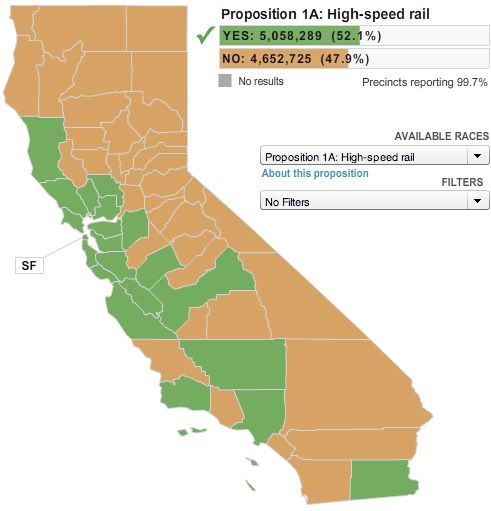
UPDATE 3: The LA Times map of Prop 1A:


Apparently Del Norte County's early reporting was flipped, so no they didn't vote for the SUPERTRAIN. But every county that is getting a station in Phase I did vote for it, except Orange County. That's OK, we'll give them a station anyway. San Bernardino and San Diego counties were fairly close, and the vote was extremely close in Riverside County. The county with the widest margin of victory was SF, 80-20. The strong pro-HSR vote here in Monterey County (58-42) bodes well for when it comes time to fund the Monterey Branch Line.

Friday, October 17, 2008

Fighting Back Against the New Hoovers

NOTE: We've moved! Visit us at the California High Speed Rail Blog.

Not content with denying to Californians the numerous tangible benefits of high speed rail, Prop 1A opponents have retreated into a revival of Herbert Hoover's economic policy in order to try and defeat the most important project Californians have considered in nearly 50 years. Their argument is that in an economic crisis, we should turn to austerity instead of following the tried and true path of deficit spending on infrastructure that provides short-term job relief and long-term economic value.

For a couple weeks this blog has been doing yeoman's work in fighting back against this nonsense, one of the few voices directing Californians to learn from our past successes instead of repeating our mistakes.

No longer.

Today we have numerous articles and media outlets starting to push back against the New Hoovers. From newspaper editorial pages to leading economists there is a growing consensus that we must use deficit spending - in our case, bonds - to spur economic growth through infrastructure projects.

Even conservative observers and federal deficit hawks are seeing the need for deficit spending, as the conservative Washington Times reports:

Conservative Financial Times columnist Samuel Brittan said the fears that short-term stimulus spending by governments will raise deficits miss the point. Even the $700 billion Wall Street rescue plan approved by the U.S. government — part of a more than $2 trillion international bailout of banks by governments around the world — does not change the equation.

"Maxims about debt that might be prudent for families can be the height of folly for government," he wrote.

British economist John Maynard Keynes is credited with the basic insight, arguing that the Great Depression was prolonged because Western governments insisted on balancing budgets, raising taxes and cutting spending at a time when private economic activity had ground to a halt.

Maya MacGuineas, president of the Committee for a Responsible Federal Budget, a nonpartisan research group, said both candidates must put together a credible long-term plan to deal with the exploding deficit, but that the government should be priming the pump in the short term.

These conservatives are joined by Nobel laureate Paul Krugman, who writes in today's column:

And to provide that help, we’re going to have to put some prejudices aside. It’s politically fashionable to rant against government spending and demand fiscal responsibility. But right now, increased government spending is just what the doctor ordered, and concerns about the budget deficit should be put on hold....

All signs point to an economic slump that will be nasty, brutish — and long....

And this is also a good time to engage in some serious infrastructure spending, which the country badly needs in any case. The usual argument against public works as economic stimulus is that they take too long: by the time you get around to repairing that bridge and upgrading that rail line, the slump is over and the stimulus isn’t needed. Well, that argument has no force now, since the chances that this slump will be over anytime soon are virtually nil. So let’s get those projects rolling.

The growing unanimity of opinion on the need for deficit spending for infrastructure projects is striking. Krugman, MacGuineas and Brittan join leading economic figures like Nouriel Roubini and Lawrence Summers in calling for bold action to mitigate the deepening economic crisis.

They are joined today by the Fresno Bee editorial in favor of Prop 1A which clearly understands the need for infrastructure stimulus, and directly refutes some of the fiscal arguments against HSR:

Sadly, much opposition has come from people who say they like the idea of 220-mph trains zipping up and down the state, but don't think we can afford it right now, in a time of budget disaster and economic crisis.

That sounds prudent, even reasonable, but it ignores an important fact of American history: Many of our most important public works projects have come in times of deep economic distress -- and they have been crucial elements in our recovery in those times.

Recall the Great Depression, when voters in the Bay Area passed bonds to build the Golden Gate and Bay bridges -- projects that lightened the impact of the Depression on that region and were critical to the postwar economic boom. Shasta Dam was built during the Depression, and remains a linchpin of the state's water system.

The closing paragraph of the editorial is a powerful, stirring statement that deserves to be quoted in full:

The high-speed rail project is immense, and that can be daunting. The current economic situation is likely to get worse before it gets better. In the past, Californians have risen to such challenges with vision and determination. Voting "yes" on Proposition 1A is a declaration that we still possess those qualities, and have not surrendered them to a timid faith in a status quo that is no longer sustainable.

I've never seen it put so well. The Fresno Bee clearly understands that our state's very future is at stake and that Californians should be able to meet that challenge just as we have done in the past.

And what about the arguments that the financial crisis makes this a bad time to float bonds? The Sacramento Bee reports "unprecedented demand" for California's short-term bonds:

California has secured commitments for nearly $4 billion in short-term loans thanks to unprecedented demand from individual investors Wednesday, averting a need for federal assistance and allaying fears of a cash shortage....

California secured orders for $3.92 billion in short-term bonds from individual investors Tuesday and Wednesday, 98 percent of its original $4 billion goal, according to state Treasurer Bill Lockyer....

This week's bond sale reassured state officials that traditional lending markets would suffice.

Translation: capital markets WANT state bonds. If we float Prop 1A bonds they will be quickly gobbled up by a hungry market desperate for a safe investment.

All the HSR deniers have left is what was at the core of their belief all along - opposition to passenger rail:

"This is like losing your job and then using your credit card to put in a new swimming pool to help provide work for others," said [Kris] Vosburgh [of the Howard Jarvis Association] of the jobs argument.

Have fun with that ridiculous "swimming pool" analogy in the comments...

Tuesday, August 26, 2008

Arnold Changes His Mind, Will Sign AB 3034 Today

NOTE: We've moved! Visit us at the California High Speed Rail Blog.

Even though everyone believed Sunday was the real drop-dead date to modify the fall ballot, the governor's office believes "we have a few days left" - and so Arnold will drop his petulant "I'm not signing anything until there's a budget" and will sign AB 3034 today. Presumably this really does mean Prop 1 will be replaced with Prop 1A. Guess we're gonna have to change the stationery.

"Any measures that must be placed on the November ballot must be acted upon quickly," the governor said in a letter dated Monday to legislative leaders. "I urge you to send me these measures that must be placed on the November ballot immediately."

The governor specifically references four measures, but only one of them — the high-speed rail bill — has been agreed upon by lawmakers....

The governor had repeatedly vowed to veto any bills sent his way until lawmakers agree on a state budget, now 57 days late. He changed his mind because "the governor believes that Californians should have the opportunity to vote on these specific measures," said his press secretary, Aaron McLear.

Quentin Kopp had already given up on AB 3034 and put out a statement yesterday stating that the Authority planned to adopt "most" of the AB 3034 recommendations. Now it seems like that's been superseded by AB 3034 itself.

As we explained last week this has been a sorry business with the legislature and the governor both failing to move quickly and effectively on the bill. One huge question mark is the updated business plan - AB 3034 mandates it be released by September 1, which is six days from now. Hopefully the Authority has been working on it, but I doubt anything they produce will satisfy the usual HSR deniers.

Nothing's certain until we see the printed ballots, but it does look like we're going to have to get used to "Yes on 1A." Thank god I didn't order those bumper stickers yet...

Sunday, August 3, 2008

The Sierra Club Loses Focus

NOTE: We've moved! Visit us at the California High Speed Rail Blog.

It wasn't the article I was hoping to read upon my return from my honeymoon, but it's not that surprising to read in the Fresno Bee that the Sierra Club and the Planning and Conservation League are hesitating on backing Prop 1 and even considering a lawsuit - and for the nonsensical reason that the choice of the Pacheco route might "induce sprawl." That objection is bad enough, for reasons I'll discuss in a moment.

But what's really disturbing about this move is that it suggests the Sierra Club and the PCL have lost their focus - instead of looking at the big picture of high speed rail and emphasizing the game-changing environmental benefits it brings, they're focusing on a small non-issue instead. They've lost sight of the forest for the trees and instead of providing leadership on this issue they may instead cast their lot with the far right and leave Californians with no viable alternative to soaring fuel prices and a transportation system that is making our environmental problems far worse.

First, their criticisms as reported by E.J. Schulz:

But the environmentalists are still seething over the selection of relatively undeveloped Pacheco Pass as the route to connect the Central Valley to the Bay Area. They favor the more urban Altamont Pass to the north because they say it would induce less sprawl....

Environmentalists would rather see trains run farther north in the Valley before heading west so that more populated cities are served. They like the Altamont route because it would bring trains closer to Modesto, Dublin, Pleasanton and Livermore in the first phase.

By contrast, the Pacheco route -- roughly following Highway 152 -- is in a less populated area. Environmentalists worry that a planned station in Gilroy would induce sprawl in surrounding rural areas.


These worries are baseless. Gilroy and much of southern Santa Clara County have strict urban growth boundaries. If those places were going to sprawl they would have already done so given their proximity to the job center and hot housing market of Silicon Valley. HSR doesn't change that dynamic.

Nor does it change the fact that sprawl is facing hard times. Sprawl is bad, but it isn't a force of nature. It is instead a product of three major factors: cheap oil, cheap credit, and favorable land use laws. The first is disappearing for good, thanks to peak oil. The second doesn't exist now, and may never return. Certainly land use policies need to change to limit sprawl, but those changes have long ago been made in southern Santa Clara County. Why should HSR alone carry that burden? AB 32 carbon reduction goals should be applied to new housing developments, and ultimately, localities will have to change their ways.

The loss of cheap oil and the shortage of cheap credit together will lessen sprawl dramatically in the coming decades. I fully support land use changes to further kill off sprawl, but it's not worth holding HSR hostage to produce the changes that need to happen anyway at the state and local level.

The death of sprawl has already made itself manifest in Gilroy. The Westfield shopping center developers had a plan to convert a significant amount of farmland acreage east of Gilroy along Highway 152 into a huge mall. The plan aroused the opposition of the community and it was dropped earlier this year. High fuel prices, the credit crunch, and public defense of urban growth boundaries all combined to kill that sprawl project. Those factors will do so again.

A Gilroy HSR station would produce strong incentives for transit-oriented dense development in Gilroy, the kind of development that California cities need to focus on instead of sprawl. Gilroy is already partway there, and an HSR station where the current Caltrain station is located at 8th and Monterey would actually discourage sprawl because there would be viable alternatives to building on new farmland. The combination of infill development and strict urban growth rules are what have made Portland's anti-sprawl plans a success - you need both for the anti-sprawl measures to work. And high capacity mass transit is a necessary component.

Further, since the Authority has rejected plans for a Los Banos stop, and since as Mehdi Morshed explained in the Fresno Bee article that the communities along the Altamont route were not supportive of HSR, what on earth explains the ongoing refusal of the Sierra Club and the PCL to throw their support to Prop 1?

The only answer is a very depressing one, but an answer that is becoming more widely accepted among many environmental activists, sustainability activists, transportation activists, and folks on the left more broadly: the Sierra Club and the PCL have lost their way, and have lost sight of the big picture. In case folks haven't been paying attention, this country faces a climate crisis and an energy crisis. It's not like we have a whole lot of time to be fighting over objections that are not grounded in fact. At Netroots Nation two weekends ago Al Gore explained that we need to stop burning carbon and make a bold move to power our society with renewable energy. An electrically-powered high speed train system won't achieve that 100% renewables goal itself, but it would provide significant environmental benefits:

-Reduce carbon dioxide emissions equivalent to removing 1.4 million cars from the road, and take the place of nearly 42 million annual city-to-city car trips (Final EIR p. 92)

-Reduce CO2 emissions by up to 17.6 billion pounds/year (Quentin Kopp op-ed)

-Reduce California’s oil consumption by up to 22 million barrels/year (same as above)

According to the Final EIR 63% of intercity trips over 150 miles in California are taken by car (scroll to page 12). HSR would provide a huge dent in that figure.

High speed rail is one of those game changing proposals. How can the Sierra Club and the PCL overlook the cars taken off the road? How can they overlook the CO2 reductions? How can they overlook the reduction in pollution, especially in the Central Valley?

Four years ago Michael Schellenberger and Ted Nordhaus criticized the Sierra Club directly in their seminal essay The Death of Environmentalism. In their view the environmental movement, by focusing on small battles, has totally failed to address global warming, and that organizations like the Sierra Club "have little to show" for nearly 30 years of environmental activism after the big victories of the late '60s and early '70s. One of their specific criticisms is that the Sierra Club, for example, often eschews big policy changes for a niggling incrementalism that has done nothing to arrest the rate of warming. This has led them to refuse to articulate a bold vision for addressing the global warming crisis that of course hurts the natural environment, and it has led them to ignore the politics of producing change.

The Sierra Club's failure on high speed rail proves each of Schellenberger and Nordhaus' controversial charges. Instead of helping change the way Californians get around their state, shifting them away from oil-burning methods of travel to clean methods of travel that limit sprawl and generate urban densities, they are focusing on a small objection that doesn't even hold up on close examination. They have endorsed the concept of high speed rail in the past but if they don't endorse Prop 1, what other opportunity will they have to get it passed? If the HSR bonds don't pass this year, they aren't coming back anytime soon. It might take 10 years to revive the project - it's taken 15 in Texas - and that means completion of the line wouldn't happen until close to 2030.

By then it may be too late. Instead of refusing to support Prop 1 out of pique that they lost the Altamont vs. Pacheco argument, the Sierra Club and the PCL should follow Van Jones' advice and move from opposition to proposition. We have a proposition - literally - before us. Instead of being on the constant defensive the Sierra Club and the PCL can help California take a bold step in the right direction with Proposition 1. If we pass these bonds in November it will then be a signal to other states and to Congress that HSR is a politically popular project and it will spur similar projects around the country - projects that we desperately need.

Why would the Sierra Club and the PCL oppose these things? They have let their opposition to the Pacheco alignment blind them to the bigger picture. That decision has been made and even though the Sierra Club and the PCL lost, they can still be big winners. Let's hope they recognize the pressing environmental need for high speed rail before it's too late.

Thursday, July 10, 2008

Arnold Embraces Prop 1

NOTE: We've moved! Visit us at the California High Speed Rail Blog.

So reports NBC11:

Gov. Arnold Schwarzenegger has placed his support behind a costly high-speed rail system in California.

Schwarzenegger told NBC11 he wants California to lead the way in transporting commuters across the state at near-record speeds while reducing global warming at the same time....

On the very spot where the Transcontinental Railroad was established nearly 140 years ago, Schwarzenegger told Luery that a less-than-three-hour trip from San Francisco to Los Angeles represents the type of progress that can take place in the Golden State.

"I think we need high speed rail," Schwarzenegger said. "If you think right now our trains in America are running the same speed as 100 years ago. That's not progress. I think we can do much better than that."


Arnold has been playing footsie with high speed rail for a while now. He tried to gut the funding for the Authority last year, only to then publish an op-ed in the Fresno Bee expressing support for the project. His support appeared to be dependent on HSR providing public-private partnerships, which AB 3034 would help produce.

His approval rating has been dropping, but he still remains the dominant political figure in the state, and his support for Prop 1 is certainly more welcome than opposition. Whether Arnold will campaign for Prop 1 around the state remains to be seen, and it would certainly do much to both prove the depth of his commitment to the project and to build a stronger consensus for Prop 1 across party lines.

Of course, Arnold's longtime Republican rival and dedicated train hater Tom McClintock was quick to attack high speed rail:

"It just doesn't pencil out," said state Sen. Tom McClintock, R-Thousand Oaks. "It's $40 billion just in construction. That's more than $1,000 for every man, woman and child in this state -- all for a train that will go from L.A. to San Francisco in about two hours longer than it takes to fly there."

McClintock called the system a boondoggle and said that the money would be better spent improving California's highways.


$1,000, perhaps, but that is spread out over 30 years - which is $33 a year, or 64¢ per week. I might be able to dig that out of my couch cushions. In the life of the HSR project most Californians will recognize well beyond $1000 in savings at the pump and at the ticket counter.

It's also no surprise McClintock raises the old "airplanes are faster" claim. In fact, if you include travel time to the airport, and the wait in the terminal (including security) a flight from LA to SF will take roughly the same amount of time as the high speed train - just over two and a half hours. What's more, HSR offers a far more convenient form of travel - business travelers can conduct cell phone conversations, perhaps use WiFi or even videoconferencing, instead of being crammed into a plane where cell phones and WiFi are verboten.

McClintock also shows his total ignorance of the airline crisis which will make air travel within this state more expensive and less frequent. For most Californians, HSR and feeder rail lines will become the primary method they use to get around the state.

Instead McClintock wants to shackle Californians to soaring oil prices. I mean really, $40 billion in highway expansion? Not only will that not buy you very many new freeway lanes, but it would be doubling down on California's reliance on oil. The McClintock solution to high gas prices simply doesn't exist - he thinks we should just pay it and continue driving as if everything's normal.

Thankfully not all Republicans agree - Curt Pringle, Arnold Schwarzenegger, and others recognize the value of HSR. With their support voters will too.

Monday, June 9, 2008

Fresno Bee Slams Union Pacific

NOTE: We've moved! Visit us at the California High Speed Rail Blog.

In their Saturday editions the Fresno Bee ran an editorial criticizing Union Pacific's efforts to block high speed rail. They didn't pull any punches:

There are several possible explanations for the railroad's move:

Union Pacific is positioning itself for negotiations on any future sale of right of way to the California High Speed Rail Authority.

Union Pacific, in the historically civic-minded nature of railroads in California, is genuinely concerned about the safety of rail passengers.

Union Pacific doesn't know what it's talking about.

The high-speed rail authority has never considered buying existing Union Pacific right of way. Instead, the proposed route would carry trains near the existing tracks in some areas -- not on them. High-speed rail requires dedicated tracks, with grade separations and barriers that keep the trains away from all other trains, as well as other vehicles and pedestrians.


Ouch. Personally I doubt the UP is being civic-minded - it's not really in their nature - but I understand where the Bee is going with this formulation. The editorial also makes a crucial point - we're not talking about putting HSR right next to freight trains, at least not on the sections UP owns.

Union Pacific is correct to preserve its ability to expand. Increased rail freight capacity is as important to California and the nation as building high-speed passenger lines. With the cost of diesel fuel soaring even higher than gasoline, and considering the tremendous pollution that diesel engines cause, we're all better off when freight moves by rail rather than by truck.

But Union Pacific's "safety concerns" might be more usefully focused on the dangers its trains and tracks pose in the neighborhoods they travel through, here in Fresno and elsewhere.


The Bee is right to point to freight rail's importance to our economy. I agree that UP ought to be able to expand - and the Bee is right that HSR doesn't impede that ability.

I also think we should keep in mind the relationship of the UP and the public. They were the original public-private partnership - we gave them huge land grant subsidies in exchange for building the transcontinental rail infrastructure that we realized was needed for the economic growth of the West Coast. Since then government has given them numerous subsidies and perks, such as protection from certain kind of state regulation, their own police force, deregulation of labor rules in recent years, and massive publicly-funded construction projects like the Alameda Corridor.

We need to keep in mind that UP isn't any random private company, but a company created specifically to serve the public interest. There is nothing wrong with insisting they not impede the public, and reminding them of that obligation is a good idea right about now. Political leadership, especially from our Congressional delegation, would help UP understand this - and that if they want to expand their freight operations, they should help us expand our passenger rail services.

Friday, May 30, 2008

The Growing Concern over AB 3034

NOTE: We've moved! Visit us at the California High Speed Rail Blog.

AB 3034, the bill that makes some changes to the November HSR bond, sailed through the Assembly today on a 57-0 60-3 vote. Apparently Mike Villines got the message. The bill heads toward the Senate, where I am told it will be taken up in about two to three weeks.

But there is growing concern among HSR supporters about this bill - specifically, the provision that eliminates the rule that LA-SF had to be built first and replacing it with a nebulous "competitive bidding" process where HSR bond funds will instead go to those portions of the proposed route that can leverage the most funding. Although it's not clear how this might work in practice, it runs a very high risk of leaving us with an HSR system that is built with a missing link in the Central Valley, defeating the main purpose and selling point of the system - that it will connect the state's two largest metro areas, providing an alternative to the collapsing airlines system and the impact of soaring fuel prices.

This blog advocates a clearly planned phase approach, where LA-SF is the first route constructed and opened, but where extensions to SD and Sacramento are guaranteed, not merely promised, as Phase II. This would give Californians the confidence that the system will not only be built as planned, but built to its fullest potential. The ridership projections, and therefore the financial promises, all hinge upon a system that completely connects LA and SF. To compromise that connection, to sever the LA-SF link, is to compromise the entire project.

Unfortunately there is a risk of that happening. For example, this is from today's Fresno Bee:

As envisioned, the rail line would eventually run from San Diego to as far north as Sacramento, with trains reaching top speeds of more than 200 mph. Under the bill, route segments that draw the most financial support from local governments and private and federal sources would get top priority.

The provision could potentially delay some Valley segments -- if nonstate financial support does not materialize. But Mehdi Morshed, executive director of the High Speed Rail Authority, said the Valley remains a top priority because the wide-open region is the only place where trains can reach top speeds.

"We cannot do 220-mile [an hour] service or test the 220-mile-an-hour train .... without building a significant section in the Central Valley," he said.

Galgiani's bill drew support from San Joaquin Valley leaders because it increases the likelihood that a Valley-to-Sacramento route will be included in the first phase.


Since few "local governments" can front the necessary money for this, especially in the Valley, that term seems to me to refer to mass transit agencies, such as Caltrain, VTA, Metrolink, LACMTA, and others.

Nobody can argue that this blog hasn't been aware of this problem - it was in fact the subject of the very first post back in March - but at the same time we missed a chance to amend the bill in the Assembly. We will now need to focus on getting the Senate to fix the bill and ensure that HSR is not built in pieces - and we will also focus on getting some information out of the CHSRA and legislative leaders about their commitment to building true HSR and not glorified commuter rail in a few unconnected parts of the state.

Friday afternoon is a bad time to try and get info out of Sacramento - but it also gives us two wide-open days to organize. Anyone interested in helping put some activism together to help ensure the integrity of the HSR system, send an email to my last name at gmail dot com.

Thursday, May 29, 2008

Fresno Bee Calls on Republicans to Back High Speed Rail

NOTE: We've moved! Visit us at the California High Speed Rail Blog.

The Fresno Bee has emerged as one of the state's leading media voices in support of the high speed rail project - and rightly so, since it will transform Fresno for the better. Today they wrote an editorial calling on Assembly Minority Leader Mike Villines to support AB 3034 and high speed rail. Villines' support is key because AB 3034 requires a 2/3 vote, and since Democrats do not have 2/3 in either chamber, Republicans like Villines will need to vote for AB 3034 if the HSR bond on the November ballot is to be amended. Here's the key part of the Bee's editorial:

But the GOP caucuses in both the Assembly and state Senate have been curiously indifferent to the high-speed rail proposal -- if not downright antagonistic. That's troubling.

AB 3034 would rewrite the $9.95 billion November bond measure to make it more politically palatable to various factions, including the governor, Southern California voters and environmentalists. All are essential to the bond's passage.

High-speed rail would bring vast benefits to the state, but no region would be better served by the system than the Valley.


The Bee goes on to mention jobs, replacing high-cost car and airline trips, economic revitalization efforts in the Valley, and making it easier for Valley residents to travel to the rest of the state as the key reasons for backing HSR. And they rightly call out Republican "indifference" and "antagonism" to HSR.

Once upon a time not so long ago, Republicans were the party of economic growth. They promoted government efforts to help grow California business, to help the state meet its various challenges. Over the last two decades, however, the party has become a vehicle for rabidly anti-tax, anti-government folks who delude themselves into thinking that the 20th century can last forever, that California can thrive without innovating or evolving. As high fuel costs begin to cripple the state's economy, HSR and the jobs and affordable transportation it will provide become essential to California's 21st century economic fortunes. Chambers of Commerce up and down the Valley - groups that are usually solidly Republican - have lined up to endorse HSR.

AB 3034 isn't a perfect bill, and we have growing concerns about the bill's language that might compromise the core LA-SF portion of the system. While we investigate those concerns, we also believe that the concept of HSR must be supported, and unless we find anything in AB 3034 that is a poison pill, we second the Bee's call for California Republicans to join the 21st century and help build our state's future. Republicans backed the bay bridges and the massive state water project, both of which helped create the 20th century prosperity the state's been living off of until now. If that is to be renewed, HSR must be built.

Sunday, May 18, 2008

The Cost of Doing Nothing is not Zero

NOTE: We've moved! Visit us at the California High Speed Rail Blog.

One of the points I have repeatedly tried to make on this blog is that the choice is not between spending $40 billion on HSR or spending $0 and doing nothing. The cost of not building the high speed rail project is very high - at least double the cost of building HSR, if the $80 billion figure for road and airport expansion that the CHSRA has offered is accurate.

So it's good to see this crucial point get picked up by the state's media, including the Fresno Bee. In today's excellent editorial they write:

High-speed rail makes sense for a number of reasons -- economic development, environmental improvements, reducing highway congestion, smarter growth patterns -- but here's one more: The cost of not building the system would be much greater than $40 billion.

Opponents of the high-speed system often sound as if this is a choice between spending the $40 billion or spending nothing. That notion is just dead wrong.

Take just one instance. Expanding existing highways and airports to meet the transportation needs projected to come with growth in the state's population would cost two or there times as much -- and would make air quality and congestion even worse. In some cases -- San Francisco, Los Angeles -- existing airports can't be expanded. Bigger and better freeways? Expanding Highway 99 in the Valley to an eight-lane interstate would cost as much as $25 billion alone -- and that's just to serve the Valley, not the entire state.


And as that editorial rightly suggests, the cost of not building HSR isn't limited to the construction costs on new freeway lanes - but should also include the cost of pollution that is already causing health problems in the San Joaquin Valley. To that we can add the cost of fuel for drivers and airline passengers, the cost in lost economic development, and the cost of carbon taxes or passed-on cap-and-trade fees.

It is possible that through no fault of the CHSRA - as global inflation in construction materials continues and as the US dollar loses value - the overall tab for HSR might rise above $40 billion. Of course, Californians will only be asked to front $10 billion, in the form of long-term bonds to be repaid from fares. Can the same be said of the alternative? Without HSR Californians will have to shell out billions in higher fuel costs, freeway and airport expansion, and will have to do so from the worsening environmental and economic position that would result from not having built HSR.

As countries around the world - including Iran, Morocco, and Vietnam - plan high speed rail systems, surely Californians would want to remain economically competitive AND save themselves money by building HSR. Of the many good reasons for building the system, fiscal responsibility and economic common sense are among the strongest.