Showing posts with label Nevada. Show all posts

Monday, November 9, 2009

Western Rail Alliance Proposes HSR Routes, Including LA-Phoenix

NOTE: We've moved! Visit us at the California High Speed Rail Blog.

Over the last year or so, since the passage of Prop 1A and the election of a high speed rail-friendly president, there has been a surge of interest in high speed rail across the country, and new organizations and consortiums have come together to propose new projects - as well as to revive ones that had been left for dead (looking at you, Florida).

One of these groups is the "Western Rail Alliance," a semi-official group that includes land-use planners from Arizona, Colorado, Nevada, and Utah. Late last week this group unveiled their list of proposed routes, one of which includes California:

The idea, in a nutshell, is that planners in each state can best negotiate rail routes within their cities and have the expertise to find funding to develop high-speed rail between those cities. The current participants in the alliance are the local RTC [in Clark County, NV], the Regional Transportation Commission of Washoe County in Reno, the Maricopa Council of Governments in Phoenix, the Utah Transit Authority in Salt Lake City and the Denver Council of Governments. The organizations also have made overtures to the Mid-Region Council of Governments in Albuquerque, but it has not signed on to the alliance yet.

They also have made contact with planning organizations in Tucson and Boise as potential future members.

Right now, the alliance is working toward turning itself into a legal non-profit organization. It also will move toward expanding membership to include prospective suppliers and service providers that could be a part of the effort to build high-speed rail in the Southwest.

Recently, Skancke made the first public presentation about the alliance, speaking to a lunch meeting of the North Las Vegas Chamber of Commerce.

At that session, Skancke outlined the first five routes the alliance will focus on: between Los Angeles and Phoenix; between Las Vegas and Phoenix; between Las Vegas and Salt Lake City; between Salt Lake City and Denver; and between Salt Lake City and Reno.

Now, before you all run off to the comments to criticize this, let's be clear: these routes aren't going to be built anytime soon. They don't appear on the USDOT HSR map, nor are they likely to anytime soon. This certainly isn't going to get funded in any official way, aside from very preliminary studies, for many years.

And that's as it should be. Of these five routes, only LA-Phoenix made it onto The Transport Politic's Interstate Rail Network proposal (in the last of four phases). There are many higher priority corridors that should come before these five.

Yet that shouldn't cause us to dismiss the concept out of hand. My interest in high speed rail isn't specific to California, although this blog is. I quite strongly believe this country should invest in building a national HSR network, proceeding first along the highest priority corridors and over the next 2-3 decades, filling in the gaps so that by 2040 or so, there would be a much improved passenger rail network that could get one from coast to coast faster than you can today. Doesn't mean you'd have a 220mph bullet train going from SF to NY, but one could stitch together a network of long-distance trains that could have faster and more reliable travel times than Amtrak's current routes.

In any case, it can't hurt to take an evening and consider what the Western Rail Alliance is proposing. LA-Phoenix could be a very valuable route for California, depending on the alignment. Any LA-PHX train would include stops in San Bernardino and Palm Springs, reaching a part of the state with a growing population. The train could follow Interstate 10 east toward Phoenix over a relatively easy alignment, with only the climb out of the Coachella Valley posing engineering challenges. Or it could continue southeast to the Imperial Valley, which sports the highest unemployment rate of any California county at 30%, hit Yuma, and then find a path back into Phoenix. This route would be less direct and therefore more costly and with a higher travel time, but there's pretty much nothing between Indio and Buckeye along the I-10 route, so it's worth at least a study.

Las Vegas-Phoenix is already witnessing a major transportation project, the Hoover Dam Bypass, scheduled for completion next year. Aside from Kingman and Wickenburg, this route would also be running through mostly empty land.

Las Vegas-Salt Lake City has the benefit of serving more actual settlements between its two endpoints, including the rapidly growing Utah city of St. George, along with several towns scattered along Interstate 15 before the Wasatch Range metropolis at Provo (and giving a boost to cities just beyond the urban edge, like Nephi). Salt Lake City-Reno would also connect some smaller towns, such as Wendover, Elko, and Battle Mountain, but would otherwise be passing through completely empty land. Would be interesting to see how fast you could crank up the trainsets over the Bonneville Salt Flats.

The most intriguing, and almost certainly the most difficult, is a proposed Salt Lake City-Denver HSR route. Perhaps this one will appeal to the people who think the Grapevine should have been the alignment for the SF-LA route. If you think the Grapevine is easy for HSR, you're gonna love the Rocky Mountains!

An earlier Las Vegas Sun article examined one subset of the SLC-Denver route, the I-70 Coalition which has been proposing passenger rail as a solution to the traffic problems through the Rockies on Interstate 70, especially from Denver to the ski resorts in winter. There's been some discussion of maglev for this corridor, but no firm plans as of yet.

As a relatively young person, I might actually live to see some of these projects get built. As China pours hundreds of billions of dollars into their HSR system as an economic stimulus measure, it's not silly to start thinking on a nationwide scale for HSR. Perhaps none of these corridors are yet deserving of federal money, which for now needs to go to the higher priority corridors. But if the western states wanted to start planning these routes, and were willing to start funding it themselves, I wouldn't object. Better we start thinking about this now, instead of continuing to delude ourselves into thinking the status quo is tenable.

Sunday, August 2, 2009

Vegas Maglev Supporters Strike Back

NOTE: We've moved! Visit us at the California High Speed Rail Blog.

On the heels of months of favorable publicity for the DesertXpress steel-wheel HSR project, crystallized by Senator Harry Reid's shift of support away from maglev and toward DesertXpress, the backers of the SoCal-Vegas maglev project have countered with a op-ed in the Las Vegas Review-Journal by Richann Bender, executive director of the California-Nevada Super Speed Train Commission, criticizing DesertXpress's claims and arguing that maglev hasn't been given a fair shake:

Construction on the first segment of the maglev train -- the fastest train in the world -- can begin in 2010 and would be built entirely in Nevada by hard-working Nevadans.

The backers of the high-speed, conventional-rail DesertXpress would like to "reprogram" this guaranteed $45 million away from Nevada, and instead expect us all to just wait five years for their privately owned train to nowhere to get taxpayer-backed loans. This is not in the best near-term or long-term interests of Nevada jobs or Nevada's economy.

Bender isn't starting off on a good note. The op-ed suggests that the maglev project is really about connecting Las Vegas to a proposed airport site at Primm (along the CA/NV border), undermining the claimed benefits of a train to bring people from Southern California to Las Vegas.

Worse in my mind is Bender's embrace of the deeply misleading anti-rail frame of a "train to nowhere." In fact, it was the Vegas maglev project that led Congressional Republicans to adopt that term during the February debate over the stimulus. While I can understand Bender's desire to undermine the rival DesertXpress project, employing this kind of framing is a monumentally stupid move, for it will merely fuel its usage - which will come back and bite the maglev project, especially when they go to Congress looking for more funding. I don't like to use the disparaging "gadgetbahn" term that is sometimes used to attack maglev, partly because I don't like using phrases and frames that are designed to serve an anti-rail agenda.

Bender lists some other claimed advantages of maglev - it's faster; it's a success in Shanghai; and:

Maglev is also greener than traditional forms of ground and air transportation, and unlike DesertXpress, it complies with all state and local land use and environmental regulations.

I would be curious to see substantiation of this claim. Obviously it's difficult to provide in-depth evidence in a short newspaper op-ed, but that kind of charge does need supporting evidence.

The heart of the op-ed are three points designed to raise fear, uncertainty, and doubt (FUD) about the DesertXpress project: lack of connectivity to SoCal urban centers, costs, and public funding. First up is the issue of the route:

The maglev project also addresses the primary reason for constructing a high-speed rail system: congestion on Interstate 15 throughout the region, connecting Las Vegas to the heart of the population and business centers in the Southern California Basin.

DesertXpress' proposed ending of Victorville, Calif., falls well outside of congested highway areas.

This isn't a fair criticism for two reasons. Number one is that ending at Victorville actually does include many of the primary congested highway areas on the trip to Vegas - where Interstate 15 narrows north of Victorville is where most of the traffic delays on the trip to Vegas commence. So a terminus of Victorville would do much to avoid most of the worst congestion, even if the rest of the journey into the SoCal metroplex won't yet be covered by DesertXpress.

But that journey could well be completed if DesertXpress built an extension westward across mostly empty desert to link up with the California HSR project at Palmdale. This has been discussed by the two projects, and while it would be fair to criticize this as being no guarantee at all of a future connection, neither is it right to exclude that possibility.

Next up is cost:

Second, maglev costs about the same as traditional high-speed, steel-wheel-on-rail trains. DesertXpress supporters have repeatedly cited a nonexistent $40 billion price tag as a reason for not building the maglev project. A March 2009 Government Accountability Office report lists the true estimated cost of the Las Vegas to Anaheim maglev project as $12.1 billion.

In fact, the Federal Railroad Administration also estimates the cost of traditional high-speed, steel-wheel-on-rail trains at $30 million to $50 million per mile, which would mean DesertXpress could cost up to $9 billion for the Las Vegas-to-Victorville route (far more than the $4 billion reported on the organization's Web site). If you put the two projects side by side, this puts maglev in the same cost per mile range.

There's been a lot of debate about the FRA's cost estimates. Certainly any project built in the desert between Victorville and Vegas would be on the low end of those estimates (once you go from Victorville into the SoCal megalopolis those costs will rise significantly). But maglev's history on costs is just not favorable. Consider the fate of Munich's maglev:

Plans to build a magnetic levitation train from the center of Munich to the airport were trashed on Thursday after construction costs almost doubled from €1.85 billion ($2.90 billion US) to €3.4 billion ($5.33 billion US). This is a major disappointment to Siemens, the company who exported the maglev to Shanghai, China, but cannot build a commercial maglev system within its home country.

And the Shanghai maglev has had ridership problems - running trains that are 80% empty, unable to recoup any part of the enormous construction costs.

Part of the problem in Shanghai was that the maglev system route isn't ideal - it doesn't connect the highly traveled corridors. This would seem to be a problem with the proposed Vegas maglev route. As noted above, the initial segment would run from Primm to Vegas - not exactly a high-traffic route. If/when a new airport is built there to relieve McCarran, then perhaps there will be high ridership on this maglev route. But without firm plans to build the entire line from Vegas to Anaheim, it is still much too likely that the costs on this first segment will balloon and kill the rest of the route, leaving Nevada with something of a white elephant.

Finally there is the issue of public funding:

Third, and perhaps most important, from the beginning maglev has made clear that it intends to use a combination of both private capital and government funding. To date, no high-speed rail project in the United States has been constructed solely with private capital.

This didn't stop DesertXpress from actively selling the idea of a privately funded train. In fact, advocates of DesertXpress have for years cited the "private" element as one of the primary reasons their project deserves support.

As recently reported by the Las Vegas Review-Journal, however, their focus has now shifted to seeking taxpayer funded federal loans to cover the majority of financing for the project.

I never thought it was good or beneficial that DesertXpress made a virtue of being privately funded, given the extreme unlikelihood that they would be able to keep that promise. That being said, the reason Bender mentioned this is to sow doubt about DesertXpress's claims and plans. There's nothing wrong with seeking federal funding for HSR or maglev, but the mere fact that DesertXpress has shifted its plans doesn't imply any inherent problem with their project.

It's a typical line of attack for critics of passenger rail - anytime the details change, they use that change as supposed evidence that the project is not viable, is being mismanaged, should not be trusted, etc. As with the "train to nowhere" frame, Bender is playing with fire here, especially since the op-ed hasn't offered any actual reasons or explanation as to why DesertXpress made the shift.

It's a shift that makes sense. It's become much more difficult to raise billions in private capital for anything, as banks hoard their funds and as the recession continues to deepen. That's not the same as being impossible to raise those funds, and private investors are much more willing to get involved with something that has federal financial involvement, as will the California HSR project. A good project with sound management will change parts of their plan when conditions warrant, instead of plowing ahead with an obsolete model. DesertXpress's shift is in itself not a bad thing, and shouldn't be taken as such.

I can understand why the Vegas maglev project feels the need to strike back at the DesertXpress project, which has all the momentum these days. Maglev backers have a much tougher case to make, particularly on the cost angle, and they are in very real danger of seeing their project fall apart. I'm all for a close comparison of the two plans to link California to Nevada, and all for criticism when the evidence supports it.

But Richann Bender and the Vegas maglev project haven't made that case here. Instead they have used anti-rail arguments to undermine a rival without offering solid evidence to back up their claims. It's an unfortunate and desperate move that isn't necessary and isn't welcome.

Tuesday, July 14, 2009

USDOT Announces HSR "Pre-Applications"

NOTE: We've moved! Visit us at the California High Speed Rail Blog.

by Robert Cruickshank

California has some competition - 39 competitors, if you're counting by state. Secretary of Transportation Ray LaHood made that statement at a press conference in Las Vegas yesterday:

On Monday Transportation Secretary Ray LaHood announced that 40 states had submitted 270 high-speed rail pre-applications seeking to qualify for stimulus money.


A total of $93 billion has been preliminarily requested. The Transport Politic offers a great overview of the state applications. California represents $22.3 billion of that total:

Caltrans met the Friday deadline to submit preliminary applications for $22.3 billion in passenger and high-speed rail projects in three main corridors: San Francisco-San Jose (which includes improvements to San Francisco's Transbay Terminal), Los Angeles-Anaheim and the Central Valley.

Many of these applications were for "regional" multi-state projects, such as the New England and the Midwest.

Nevada also submitted a multi-billion request, entirely for the maglev project:

Neil Cummings, president of the American Magline Group, the private consortium of firms that would develop the maglev line, said the commission proposed building the first, 40-mile segment between Las Vegas and Primm. The cost would be $1.6 billion.

The group also submitted a second application to the Transportation Department for planning money to continue developing the line to Anaheim.

DesertXpress, for its part, didn't put in an application for HSR stimulus funds, but intends to make use of the planned national infrastructure bank program to finance up to 70% of the estimated $5 billion cost, according to the Las Vegas Sun.

I confess I would be surprised if maglev got much money out of this. Ray LaHood has previously said that California and Florida are in the lead for HSR funds, and although that doesn't guarantee a thing, we've always anticipated CA could get as much as $3-$4 billion of the HSR stimulus funds.

As far as I can tell that should remain the case. The Midwestern application has its issues, including what Ray LaHood has described as a lack of leadership. New England's application is interesting but as they already have the Acela, one might expect USDOT to spread the money around a bit.

We'll find out later this fall what the USDOT's final decision is.

PS: Apologies for the spotty posting of late. I came down with the flu while in LA last weekend, and I'm only just now coming out of the worst of it.

Thursday, July 2, 2009

SoCal to Vegas to Become Official Federal HSR Corridor Today

NOTE: We've moved! Visit us at the California High Speed Rail Blog.

This image is about to get a makeover:


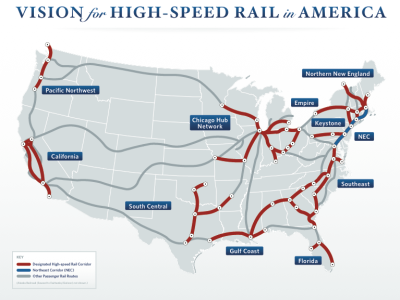
That's the map of the USDOT HSR corridors. One corridor that's not there is Los Angeles to Las Vegas. That is changing today:

The U.S. Transportation secretary will announce today the designation of a federal high-speed-rail corridor between Las Vegas and Southern California, a major assist that enables the long-imagined train route to compete for $8 billion in economic recovery funding and other federal support, the Las Vegas Sun has learned.

The announcement comes as two proposed fast trains are vying to connect Las Vegas and Southern California, a race that has intensified since President Barack Obama unleashed an unprecedented investment in high-speed rail as part of the stimulus bill approved by Congress.

It is unclear whether today’s announcement will favor one of the competing projects over the other. However, the federal designation improves the chances that a train will be developed between the two regions by opening the door to federal aid. Analysts think only one train system will be built.

DesertXpress has not as of yet planned to seek federal aid. I suspect that will have to change. Vegas is in the middle of a severe downturn, which means there's going to be much less private money available to fund it. The maglev is still alive, although with Sen. Harry Reid having switched his support to DesertXpress, I don't see the maglev plan lasting a whole lot longer. Some of its remaining backers include Bellagio CEO Bruce Aguilera, but the Bellagio and the other Vegas resorts are going to have their hands full riding out the recession.

I expect DesertXpress to be the "last project standing" along the Vegas HSR corridor. Whether it gets built, of course, is another matter entirely.

Tuesday, April 21, 2009

Is Vegas HSR Out of the Obama HSR Stimulus Derby?

NOTE: We've moved! Visit us at the California High Speed Rail Blog.

When President Obama announced his HSR Strategic Plan last week, the USDOT report that accompanied the announcement included this map of HSR corridors, based on the 2001 map:


One route you don't see on that map is LA to Las Vegas. Does that mean the project, which right-wingers tried to generate controversy around back in February, is ineligible for the HSR stimulus money? That's the topic examined in an article in the Barstow Desert Dispatch:

The Obama administration’s strategic plan for spending the $8 billion in stimulus funding allotted to high-speed rail projects makes no mention of a proposed rail line from Anaheim to Las Vegas that would stop in Barstow.

Project proponents are still hopeful that some of the funds may come their way.

The plan released Thursday by President Barack Obama and U.S. Department of Transportation Secretary Ray LaHood lists 10 designated high-speed rail corridors where projects are eligible to receive funding, none of which include the Anaheim to Las Vegas route.

So does this mean that the map shown above really will determine HSR funding priorities? Well...maybe not:

Lori Irving, a spokeswoman with the U.S. Department of Transportation, said projects that are not located in the existing corridors may still be eligible to compete for some of the stimulus funds.

And the backers of the maglev train are optimistic:

Bruce Aguilera, chair of the California-Nevada Super Speed Train Commission, which is tasked with moving the Anaheim to Las Vegas train project forward, stated via email that the project proponents still plan to file a request for stimulus funds and expect to be eligible.

“We have a plan and (are) moving fast to have the first leg built during the president’s first term,” Aguilera wrote.

Of course, unless they suddenly abandoned the maglev plan in favor of Desert Xpress and are planning to break ground this afternoon, I'm having a hard time seeing how they'll have the first leg built by the end of 2012.

I wouldn't be surprised if the LA-Vegas corridor got some amount of startup funds, to complete environmental design work - perhaps as much as $100 million or more (but certainly no more than $500 million). But with so many other corridors also looking for funds, with a much more developed and realistic plan - and sorry folks, maglev on this scale really is gadgetbahn - I am hard pressed to see how Vegas HSR is going to get very much out of the USDOT process.

The more I look at this, the more I think that if Vegas HSR is going to happen, the state of Nevada is going to have to take the lead in stepping up to fund a big chunk of it. If Obama is somehow able to create a stable funding source for HSR then that could put Vegas HSR in the pipeline - but it could also take 20 more years to bring it to fruition. If Vegas interests (that would be the casinos) want it to happen sooner, they'll need Nevada to help accelerate the timeline.

That will eventually raise the issue of how much California wants to spend on Vegas HSR. In the 1980s and 1990s there was a long standoff between Caltrans and NDOT over widening Interstate 15 between Barstow and the state line. California did not want to spend money on that project which benefits an out-of-state interest, especially with so many other road projects around the state clamoring for money. Eventually NDOT agreed to help pay and the widening projects were undertaken.

With Vegas HSR, Nevada and the feds could reasonably argue that California should put up more of the money since the route would serve California residents for in-state trips (especially if they use a Cajon Pass routing - Victor Valley residents would have a way to commute to and from jobs in the LA Basin). I'm not sure that's a high priority HSR corridor for this state, and I would be wary at this time of committing California to funding Vegas HSR. Ideally we could revisit the matter around 2020. But Vegas' timeline is much more aggressive, and I am betting we'll see Nevada leaders pushing California for financial commitments much sooner.

Something to keep in mind.