We're bound to hear about this from our local HSR deniers, so might as well deal with it ourselves. The British government has killed a plan to link London to Scotland because HSR supposedly is "not a green option":
In a letter obtained by The Times, Tom Harris, the Rail Minister, said: “The argument that high-speed rail travel is a ‘green option’ does not necessarily stand up to close inspection. Increasing the maximum speed of a train from 200kph [125mph – the current maximum speed of domestic trains] to 350kph leads to a 90 per cent increase in energy consumption.”
It's a controversial rationale, one that will be repeated by the usual folks who argue HSR isn't necessary. It's already drawing fire from British environmental groups:
[Chris Davies, Lib Dem MEP] said that Mr Harris had failed to acknowledge the environmental benefits of persuading domestic air passengers to transfer to high-speed rail. He added: “It is very disappointing to see the minister scrabbling around for excuses for the Government’s inaction on high-speed rail, especially when those excuses are so weak.”
A high-speed train produces about 90 grams of carbon dioxide per passenger-kilometre, compared with just over 50g/km for a conventional electric train. But a domestic flight produces 225g/km.
Moreover, the claims that British HSR would increase carbon emissions assume Britain will never move away from coal-fired electricity, and that HSR would not draw more passengers away from airlines, creating a net carbon savings. The British government's decision is completely ass-backward, although such things are now standard with the Labour government.
The situation here in California is even more stark. Intercity trains in California are all diesel-powered. And of course most intercity travel is still made with cars and airplanes, which spew enormous amounts of carbon into the atmosphere. High speed rail, powered by electricity, is estimated by the CHSRA to reduce carbon emissions by 17.6 billion pounds per year - a truly stunning savings. Compared to the other transportation systems we use in California HSR is by far the most environmentally friendly, as this image from Alberta High Speed Rail shows:
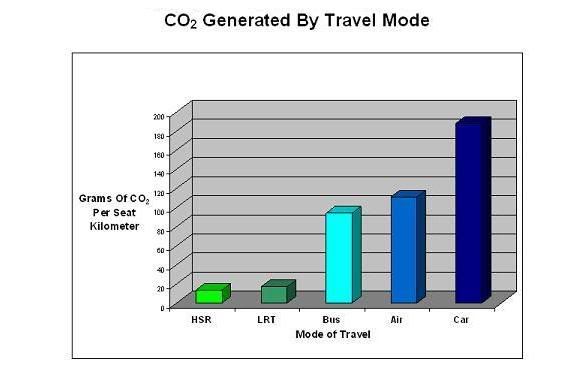
Additionally HSR is expected to reduce carbon dioxide emissions equivalent to removing 1.4 million cars from the road, and take the place of nearly 42 million annual city-to-city car trips and reduce California’s oil consumption by up to 22 million barrels/year. According to the Final EIR over 63% of trips over 150 miles in California are taken by car, and HSR would help take a significant chunk of those trips off the road, a significant carbon savings.
That in turn will also help the San Joaquin Valley in particular meet its air quality goals - the Valley has some of the most polluted air in the state, due largely to vehicle trips.
Of course, the most carbon emissions savings would be realized if HSR could be powered by renewable and sustainable resources. The CHSRA is undertaking a study on exactly that issue and it should be ready shortly.
What all of this demonstrates is not just that the British government is wrong - but that their rationale is completely inapplicable to California. HSR deniers, like their global warming denier cousins, prefer to ignore or dismiss the truth and the need to reduce carbon emissions. We know that Californians reject global warming denials. It's my belief they'll reject HSR denials too. California needs HSR if we are to meet our carbon emissions reduction goals, and I am confident that voters will recognize that fact this November.


