by Rafael
while CHSRA continues to face widely publicized opposition in the SF peninsula, there is active competition for the alignment that the phase 2 spur from LA Union Station to San Diego will follow. We already discussed the ROW issues in an earlier post.
The Riverside Press-Enterprise explains that the City of Riverside is competing with the much smaller City of Corona for a station, as both recognize the economic value of having a stop on the network. The Corona concept is based on an alignment alternative down I-15 and is supported by Riverside county as well as Lake Elsinore and Temecula. This would be the shortest option that still allows for a station close to Ontario airport, but the proposed station at Cajalco Rd would be several miles south-east of downtown Corona; an old freight spur could be leveraged for new Metrolink routes, but most passengers would presumably drive or take a bus to a giant parking lot in the middle of nowhere (cp. Victorville). The city could probably improve its chances by proposing instead a new station for both HSR and Metrolink at the intersection of the BNSF Transcon line and I-15, between Quarry St. and the CA-91 interchange in Corona proper.
On the other hand, CHSRA's completed and certified program-level EIR/EIS calls for trains to run further east past UC Riverside, before joining I-15 by way of I-215. Three separate connectors down from the I-10 corridor near Colton are being studied, but running above or below Iowa Ave, Chicago Ave or S Riverside Ave/Main Street is non-trivial. Note that the existing Riverside Metrolink station is located approx. 1.5 miles south of the CA-91/CA-60/I-215 interchange, rendering it useless as a regional feeder service to the HSR station for Corona, Perris and San Bernardino. This last city would very much like to have an HSR station of its own, but its downtown is out of the way of the preferred route described in the program-level EIR/EIS.
There is, of course, one heretical idea that might be worth considering now that DesertXPress looks like it may go ahead: continuing HSR along the BNSF Transcon line and/or CA-91 past the phase 1 section to Fullerton. Bullet trains would then run to San Diego via Corona without any need for additional HSR tracks along I-10. Eventually, a connector would put Riverside and San Bernardino on the spur to Victorville and Las Vegas. Anaheim ARTIC would also be on a spur, though there is a railroad ROW running north from Orange that could perhaps be used to allow a subset of trains to include that station on a run-through detour. The biggest problems are NIMBYs in the Santa Ana Valley and, the fact that this route would not run anywhere near Ontario airport. That would mean redoing part of the program-level EIR/EIS for this phase 2 spur, something I am sure CHSRA would prefer to avoid.
The above is meant to illustrate how integrated planning of the California network and DesertXPress line could open up new and possibly superior alternatives for HSR development. One slide at the recent press conference announcing the inclusion of Las Vegas in the federally designated California HSR corridor already included a connector between Palmdale and Victorville, though frankly one between Mojave and Barstow would be more useful for SF-LV and hew close to an existing road/rail traffic corridor (CA-58) The latter point is relevant for CEQA. For the moment, though, all of this remains wishful thinking: there appears to have been zero formal contact between CHSRA and DesertXPress to date and, neither planning body has taken ownership of getting any such connector funded and built.
Sunday, July 5, 2009
Making Tracks Down South


Friday, July 3, 2009
Orange County Takes Over The CHSRA Board
That's one way to look at the news that the California High Speed Rail Authority board has a new chair and vice-chair, and they're both from Anaheim. According to the press release:
Earlier in the meeting, the Board elected Anaheim Mayor Curt Pringle to be its chairman, replacing Judge Quentin L. Kopp who had served two terms as chairman. Former California Assemblymember Tom Umberg was elected vice-chairman.
Pringle is a moderate Republican; Umberg is a Democrat who narrowly lost a primary for a State Senate seat to Lou Correa in 2006. Both are well-known in Sacramento and may have better relations with the Legislature than Quentin Kopp. Pringle is a strong supporter of HSR:
“High-speed trains are needed in California,” said Pringle. “The state must find a viable surface transportation alternative to ease auto and air traffic congestion between major urban centers and high population growth areas like the Central Valley.
Pringle clearly understands the need for the HSR project and for it to be kept whole, unlike Sen. Alan Lowenthal who wants to chop it into a glorified commuter rail for the Bay Area and Southern California.
I wouldn't read too much into the change of leadership on the CHSRA board. Quentin Kopp has been the chairman for several years now, taking time away from his spot on the San Mateo County Superior Court bench. Kopp's term as chair was a clear success, as California voters approved Prop 1A and the federal government approved billions in HSR stimulus money - and California will likely be largest recipient of that money.
Now it's Curt Pringle's turn to lead the HSR project through this crucial moment. On the plus side the project has the support of the people of California, of the Congress and of President Barack Obama. It has as much as $13 billion ready (assuming we get $4 billion of the HSR stimulus, and that is likely to be the high end of the likely funds) and is well along the way of finalizing the project plans in some of the key corridors.
The HSR plan also has some challenges, from the Peninsula NIMBYs to people like Sen. Lowenthal who want to gut the project. Pringle can help sway more Republicans to support a project that will create a lot of jobs and opportunities for business up and down the corridor. And hopefully he can help navigate the project through the state legislature.
So this blog welcomes Curt Pringle and Tom Umberg to their new positions as leaders of the CHSRA board and of the HSR project. Besides, as an Orange County native myself, it's good to see leadership from OC stepping up for high speed rail.
Thursday, July 2, 2009
SoCal to Vegas to Become Official Federal HSR Corridor Today
This image is about to get a makeover: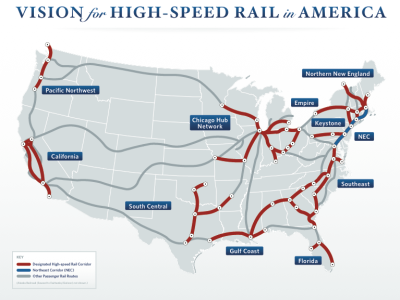
That's the map of the USDOT HSR corridors. One corridor that's not there is Los Angeles to Las Vegas. That is changing today:
The U.S. Transportation secretary will announce today the designation of a federal high-speed-rail corridor between Las Vegas and Southern California, a major assist that enables the long-imagined train route to compete for $8 billion in economic recovery funding and other federal support, the Las Vegas Sun has learned.
The announcement comes as two proposed fast trains are vying to connect Las Vegas and Southern California, a race that has intensified since President Barack Obama unleashed an unprecedented investment in high-speed rail as part of the stimulus bill approved by Congress.
It is unclear whether today’s announcement will favor one of the competing projects over the other. However, the federal designation improves the chances that a train will be developed between the two regions by opening the door to federal aid. Analysts think only one train system will be built.
DesertXpress has not as of yet planned to seek federal aid. I suspect that will have to change. Vegas is in the middle of a severe downturn, which means there's going to be much less private money available to fund it. The maglev is still alive, although with Sen. Harry Reid having switched his support to DesertXpress, I don't see the maglev plan lasting a whole lot longer. Some of its remaining backers include Bellagio CEO Bruce Aguilera, but the Bellagio and the other Vegas resorts are going to have their hands full riding out the recession.
I expect DesertXpress to be the "last project standing" along the Vegas HSR corridor. Whether it gets built, of course, is another matter entirely.
Wednesday, July 1, 2009
July CHSRA Board Meeting
The July meeting of the California High Speed Rail Authority board is tomorrow morning at 10 AM in Sacramento at the city council chambers. You can find the meeting materials here. The meeting will be streamed live at this link (kudos to the Authority for putting that together!).
The agenda includes a discussion of project phasing, an update on HSR stimulus funding and pending legislation in the state legislature relating to the HSR project, and a proposed disability access committee.

