HEADS UP: More on President Obama's strategic plan for HSR this afternoon.
 Remember ye olde threat level chart and the "chatter" that mysteriously reached a crescendo every time the previous administration wanted to change the subject? Ah, those were the days. Of course, nothing last longer than a temporary measure, so air travelers still have to subject themselves to ritual humiliation every time they want to board a plane. Next up: full body scanners based on terahertz lasers. And, being government employees, TSA officers will have no interest in anyone's privates. Except ...
By contrast, travel by train remains a very civilized affair from the passengers' point of view. Usually, you just board, sit down, stow your bags and show your ticket to the conductor when he/she asks for it. True, Amtrak has been conducting sporadic random searches on platforms for a year now, but that's about it. Like most railways around the world, it had previously kept its visible security measures to an absolute minimum.
The reason for the apparent lack of security at train stations is fairly simple: trains can't fall out of the sky, nor can they be made to crash into buildings. Even if he could reach the driver's cab, a would-be hijacker could not force him to go to a different destination, because the automatic train control system - if present - will force the train to stop before it can run a red light.
So, No Worries Then?
Instead, terrorist attacks based on bringing a device on board a train have tended to target crowded subways and commuter rather than long-distance trains in a perverse effort to maximize the carnage, though terrorists in Italy have in the past set bomb timers to explode while a regional train was traversing a tunnel (h/t to Devil's Advocate).
Examples include the Aun Shinrikyo sarin release on a Tokyo subway train in 1995, the Al Qaeda bombings in Madrid in 2004 and London in 2005 and the Islamic terrorist bombings in Mumbai in 2006. Chechen separatists are suspected of multiple suicide bombings on trains in Russia in recent years.
Another type of terrorist attack is directed against busy station halls, e.g. by neo-fascists (h/t to Devil's advocate) in Bologna in 1980 and ETA's foiled attempts in Spain on Christmas Eve of 2003. The venues of the Mumbai attacks of 2008 also included a train station.
The above list is not exhaustive, just intended to underline that trains and train stations have indeed been targeted by terrorists in a number of countries in the past. Recently, Spanish state airline Iberia has complained that RENFE's AVE passengers are still not subjected to the same level of scrutiny as its own, in spite of past terrorist attacks against Spanish trains by both Al Qaeda and ETA. Meanwhile, RENFE's market share on the busy Madrid-Barcelona route has increased at the airlines' expense. In other words, Iberia is complaining about the supposedly unfair competitive advantage trains still enjoy in terms of the customer experience. It's entirely possible that some US airlines will talk up security concerns once they start losing market share to HSR on medium-distance routes like SFO-LAX.
In 2007, a PhD student in Australia researched SNCF's security for the TGV system and identified weaknesses related to passenger and baggage screening. Note that Eurostar does perform passport checks and requires check-in, e.g. using an e-ticket with a bar code on it. In addition, passengers have to go through metal detectors and run their bags through x-ray scanners, just like they would at an airport. The railway has also hired outside security personnel to supplement its own staff. Premium fare passengers are asked to reserve just 10 extra minutes to pass through security, everyone else should arrive half an hour early. These procedures are a reflection of the fact that the UK is not a signatory to the Schengen convention, compounded by the strategic importance of the Channel Tunnel.
The bitter irony is that high speed rail systems are actually hardly ever the target of attacks based on devices smuggled on board. Meanwhile, security for the local commuter trains and subways that provide connecting transit for HSR remains comparatively lax - scanning every person and bag would severely constrain their capacity. While no politician or rail operator would ever dare say so, implementing the homeland security theater so selectively may actually deliver no more than marginal system-wide benefits. It may make the general public feel safer, but in reality it just shifts some risk from one type of train onto others.
You can always argue that doing something is better than doing nothing, but perhaps rigorous screening of every passenger and bag for HSR only isn't the best way to spend the limited security dollars available to rail operators. Amtrak's concept of random spot checks could deliver greater security at lower cost and inconvenience to passengers, provided it applies to anyone on any type of train operated by any company, on railroad property or loitering just outside it. In practice, that would mean replacing railway security staff with regular TSA or police officers. They would already have the legal authority to enforce checks, so attackers cannot just beg off and try again at some other time.
Infrastructure Surveillance
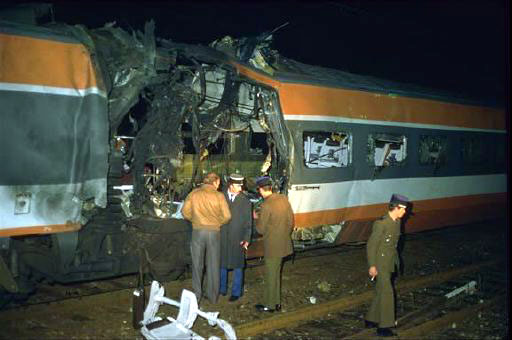
Some readers may consider anything less than the measures already in place at airport as inadequate. After all, back in 1983, Carlos the Jackal did plant a bomb on a TGV in France, killing three innocent people. However, afaik there haven't been any bombings on board high speed trains since, even though some now routinely carry over 1000 passengers at 300 km/h. The reality is that life is risk and, terrorism is a fact of life most people around the world are resigned to living with. They assess it in relation to other risks, e.g. accidents on the road or on the home. The US population may not have reached the same conclusion yet because it has mercifully suffered relatively few terrorist attacks to date. Sadly, there is no such thing as perfect security, nor is the price for anything approaching it worth paying.
More recent attacks against long-distance trains have tended to focus on the rail infrastructure instead, especially on the tracks, e.g. in Palo Verde, Arizona in 1995 or Russia in 2007. Some (attempted) attacks are suspected to have been perpetrated by terrorists, others by saboteurs (e.g. rogue elements during a strike), extortionists (e.g. disgruntled ex-employees) or simply vandals (e.g. misguided teenagers). In other cases, both the perpetrators and their motives remain unknown.
Again, this list is not meant to be exhaustive. Rather, my purpose is to highlight the simple fact that rail networks are huge, yet a small amount of explosives or even just some concrete slabs can be enough to derail a train. The resulting casualties can be minimized by choosing very stiff train designs with articulated frames, e.g. products from Alstom or Talgo. However, the primary objective should always be to make it as difficult as possible to trespass onto the tracks in the first place.
That means tall sturdy fences/sound walls plus video surveillance of the tracks along the entire route, plus a train control system that will force any trains approaching the site of an identified (potential) problem to perform an emergency stop. These measures make it more difficult to gain access to the tracks, easier to detect a breach of security and less likely that an attack will succeed. An important fringe benefit is that mentally confused or suicidal persons as well as livestock and wild game will all be less likely to wander onto the tracks.
In locations where HSR tracks run in close proximity to legacy tracks, these measures should be extended to them as well, perhaps with automatic gates at freight spurs. Video surveillance of the entire right of way means the HSR infrastructure operator may well be able to detect a minor derailment of a freight train before the its engineer does and take appropriate action. This capability could be enhanced by adding microphones and is worth discussing with e.g. UPRR, since they cited their trains potentially fouling an adjacent HSR track as a safety concern.
The downside is the cost of implementing and maintaining all of these measures on the entire network. Fortunately, ever-improving software is reducing both the overheads and the risk of human error through partial automation. CHSRA has already budgeted for this in the scope of the engineering work to be done for the California network (see p6):
"The line will be fenced and equipped with intrusion detection equipment that can detect persons, animals or debris entering the right-of-way and linked to a central train control center."
In addition, road overpasses will need to be fenced off. Typically, railway security operations are tied in with those of law enforcement and when appropriate, those of intelligence services as well. It's difficult to know how many lives anti-trespass and surveillance measures have already saved. What is certain is that they are almost completely transparent to passengers - which is as it should be.