Thursday's announcement by President Barack Obama of the HSR Strategic Plan got a lot of attention in the media and on the blogs - which is just what California's project needs at this time. Obama's high-profile leadership for HSR should help focus our state, especially those involved in the contentious debates over how to build the trains along the planned corridor, on the big picture and the need to move forward quickly and effectively in building the high speed trains that are so essential to our nation's future.
Yonah Freemark at The Transport Politic offered this assessment of the plan:
But I think the report’s basic outlines of the kinds of projects the federal government wants to fund with rail money are demonstrative of the administration’s seriousness in undertaking this project. By arguing that high-speed rail is most applicable for corridors between 100 and 600 miles in areas of moderate to high density, we can be assured that the government won’t be funding just any project with the limited funds available for rail. It’s good to know, in other words, that a line between El Paso and Phoenix isn’t going to get money over the connection between San Francisco and Los Angeles.
He also noted that a new National Rail Plan will be prepared and published in October. That plan may revise the list of HSR corridors, last updated in 2001:
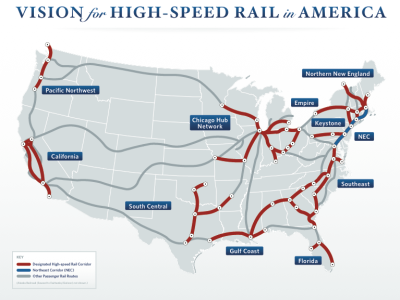
This map includes such outdated concepts as an HSR corridor along the Coast Route from San Jose to LA via Salinas and SLO (not that I'd personally mind such a corridor, but it was rejected in the CHSRA's 2002 plan and isn't being considered for anything other than some upgrades to enable the Coast Daylight to operate) or defining Dallas to Tulsa as a vital HSR corridor but not Dallas-Houston.
One of the most common responses to Obama's announcement was the all important question of "how will we pay for it?" That's the question the LA Times tackled in yesterday's editorial:
High-speed rail networks might very well be the "smart transportation system" of the 21st century, as President Obama declared Thursday. The trouble is, we're using a very 20th century method to pay for them....
"Now, all of you know this is not some fanciful, pie-in-the-sky vision of the future. ... It's been happening for decades. The problem is, it's been happening elsewhere, not here," Obama said, referring to countries such as France, Japan, Spain and China that have impressive bullet-train networks. But there was something he failed to mention: With the exception of China, whose government can spend any way it likes, all of these countries impose steep taxes on gasoline. The taxes have the dual purpose of providing the funding to build public transit and encouraging people to ride it because they make driving prohibitively expensive. Gas taxes in the United States are minuscule in comparison.
Instead of raising the money to pay for his vision, Obama proposes to fund it with debt. So does the state of California, where voters last November approved nearly $10 billion in bonds for the San Diego-to-Sacramento train Obama aims to support. That's all well and good, except that the California train alone is expected to cost in excess of $40 billion. Obama's $13 billion over five years won't go far in building a national network that would cost hundreds of billions. So where's the rest of the money going to come from?
The LA Times is basically calling for a higher gas tax to be part of the upcoming transportation bill, and to fund passenger rail - including HSR - through that mechanism.
I strongly support that concept. I don't oppose using debt to build trains - long-term infrastructure projects are the best use of debt there is, and it's hard to make a case against spending $50 billion or so on a national HSR network when over $1 trillion has been spent to bail out well-connected Wall Street bankers - but we DO need a higher gas tax, and it ought to be used solely for improving mass transit, with passenger rail at the center.
A higher gas tax would also help provide long-term stable funding for high speed rail, just as the federal gas tax provided the funds to build out the Interstate Highway System (which took nearly 40 years to complete), instead of making HSR projects dependent on a highly unstable annual funding appropriation from the Congress. The moment Republicans take control of Congress or the White House back from the Democrats, which is a distinct possibility over the next 10 years, HSR funding would be in serious jeopardy.
President Obama is likely to tread very carefully and cautiously here. Despite the cries of "socialist!" from his right-wing opponents, Obama is a moderate Democrat who has tried hard to avoid alienating swing voters. His tax policies are designed to cut taxes for the lower and middle-class while raising them for the upper class. That's the right move for income taxes, but the moment he proposes a gas tax increase, he risks the possibility of giving fuel to the right-wing attacks and pissing off swing voters.
A higher gas tax is a very smart and necessary policy for this country. But it's also a political decision that the president is going to weigh with an eye to the 2012 election. I'm far from convinced Obama will support it, but it's something he ought to do.


