Showing posts with label Barack Obama. Show all posts

Monday, November 23, 2009

California Leaders Call for HSR Funding to Create Jobs

NOTE: We've moved! Visit us at the California High Speed Rail Blog.

This is a welcome letter:

In an effort to deal with California's spiraling unemployment rate, Gov. Schwarzenegger and the state's two senators, Barbara Boxer and Dianne Feinstein, sent a letter Monday to President Obama urging funding of the state's high-speed rail project and improvements in its intercity rail service.

They urged Obama to fund the projects through federal stimulus funds, the $787 billion American Recovery and Reinvestment Act.

"With unemployment in California reaching 12.5 percent – the highest unemployment rate in nearly 70 years – the impact of providing 130,000 construction-related jobs statewide cannot be understated," the letter said.

As talk ramps up of a "second stimulus" in the form of a job creation bill, and as the jobs crisis continues to worsen, high speed rail funding becomes all that much more important to California and the nation's economic recovery. California simply cannot have recovery without jobs in sustainable infrastructure, and we aren't going to have a long-lasting recovery if we don't start moving away from oil dependence. And the nation as a whole cannot have meaningful economic recovery if California, a major part of the national economy, is lagging behind and mired in high unemployment.

Given that over $50 billion in HSR funding applications were submitted to the FRA for only $8 billion in available funds - all of it for projects meeting the federal guidelines of being "shovel ready" by September 2012 - the Obama Administration and the Congress ought to strongly consider fully funding every HSR application as part of its job creation efforts. There's no reason states should be fighting against each other for that money, since many of the states applying have significant job creation needs of their own.

UPDATE: The complete letter:

November 23, 2009

The President
The White House
Washington, DC 20500

Dear Mr. President,

We write in strong support of California’s applications for high-speed and intercity rail funding through the American Recovery and Reinvestment Act (ARRA). California has led the nation in its commitment to creating a statewide high-speed rail system.

Our state has been a leader and innovator in addressing environmental and transportation challenges on a national level. Last November, California voters approved nearly $9 billion in state bonds for high-speed rail construction, far outpacing other states’ efforts to secure local and state funding for these projects. California has completed design and planning for the nearly 800-mile system and made significant progress on the environmental review, making our state uniquely qualified to employ federal funding quickly.

California’s high-speed rail applications have broad support across the state, with backing from leading business, environmental and labor leaders. The California Chamber of Commerce, the Labor Federation of California and the Sierra Club have all endorsed California’s applications for funding. The success of California’s high-speed rail system is enormously important to our state. High-speed rail will help ease congestion and improve air quality. With unemployment in California reaching 12.5 percent – the highest unemployment rate in nearly 70 years – the impact of providing 130,000 construction-related jobs statewide cannot be understated.

We appreciate your attention to the needs of California and thank you for your commitment to this important issue. We stand ready to work with your administration in the coming years to ensure that high-speed rail has the resources necessary to continue to be a national priority.

Sincerely,

Barbara Boxer
Dianne Feinstein
Arnold Schwarzenegger

Good framing, good letter. Kudos to all three for writing this.

Friday, November 20, 2009

How Will the FRA Decide?

NOTE: We've moved! Visit us at the California High Speed Rail Blog.

As we await the Federal Railroad Administration's decision on awarding the $8 billion in HSR stimulus funds, some observers are wondering how exactly the projects will be selected - and what the role of merit and politics will be. Over at Railway Age, editor William Vantuono suggests the FRA will be caught between those two considerations:

Let’s assume two things. First, Administrator Szabo has every intention of sticking to the letter of the law, and to the intent of the program, by awarding project grants based on merit. Second, any program involving government dollars is going to involve politics. That’s just the way it is. Anyone who doesn’t believe this needs a serious reality check.

In the case of HSR—actually, “HrSR” (“higher speed” rail, incremental improvements to existing freight rail corridors to enable 90-125 mph passenger trains)—the political game-playing will mostly come from the states. Case in point: A project in one Midwest state, we’re told, does not meet all the FRA’s criteria, in terms of project management, environmental and ridership studies, financial plan, technical score, etc. The state agency in charge of submitting the grant application asked the FRA for guidance. The FRA basically said, “You don’t meet the criteria; don’t submit the application.” We’re told, however, that this state’s Republican governor ordered the agency to submit the application anyway. Why? Because if it’s rejected, the governor can go to his constituents and claim that the Democrats running Washington won’t give his state the funds for a project that will create jobs.

Partisan politics as usual? Of course. Did you expect anything different?

There's much less doubt about whether California's HSR project meets the criteria - it clearly does, AND it has widespread political support from the Transportation Secretary Ray LaHood, Vice-President Joe Biden, and the California Congressional delegation which, after all, includes the Speaker of the House. It is certain that California will get a big chunk of the stimulus money.

But how big? That's where these issues of the merit and politics of other HSR proposals will affect us in California. We submitted a $4.5 billion request, but can really only expect to get $3-$4 billion. Where we fall in that range will depend on how the FRA and the White House decide to allocate the rest of the money. If they feel the need to keep Ohio, Indiana, Missouri, and Florida happy (states that were key to Obama's 2008 victory and will be key to his 2012 reelection bid) then we may have to make do with $3 billion and not $4 billion. It's highly unlikely, of course, that they'll give it all to California.

As sources have described the FRA decision-making process to me, the FRA will determine which CA HSR projects get stimulus funding. It won't be a case of them giving us a set amount of money for us to use as we see fit. They may choose to fund the Central Valley test line (Merced-Fresno and Fresno-Bakersfield) and LA-Anaheim and not fund SF-San Jose. Which is actually what I expect will happen.

What I hope we avoid is a situation where CA gets less than $3 billion because Obama feels the need to shore up his position in some of those states I mentioned. Given the amount of stimulus money applied for - around $50 billion from 24 states - there will be the temptation to squeeze California. Especially since it's easy for those other 23 states to whine about California hogging all the money.

Thursday, October 1, 2009

Friday Rally for HSR Stimulus Funds in LA

NOTE: We've moved! Visit us at the California High Speed Rail Blog.

Friday morning at 9 AM supporters of high speed rail, including CHSRA board chair Curt Pringle, members Lynn Schenk and Richard Katz, and various unspecified "members of Congress, legislators, city and county officials, and representatives from labor, business and environmental groups" will gather at Union Station in LA to hold a rally in support of the state's application for $4.5 billion in federal HSR stimulus money.

Major newspapers in the state are getting into the act, including the San Jose Mercury News:

Friday's a big day for California's high-speed rail plan: Gov. Arnold Schwarzenegger will formally request $4.5 billion in federal stimulus dollars to advance the project that will create about 133,000 jobs, 15,000 of them in the San Jose to San Francisco area.

The U.S. Department of Transportation should find this compelling. California's plan is further along than any other high-speed rail project in the country, and the state will match every federal dollar. As to the stimulus intent, California's unemployment rate of over 12 percent is a powerful argument. Major questions remain about how the line from Los Angeles will traverse San Jose and Peninsula cities. But voters have approved nearly $10 billion in bonds for the project, a solid vote of support.

The best use of stimulus dollars is to not only create jobs but also to strengthen the economy for the future, just as the United States did during the Great Depression by constructing dams, bridges and the like. High-speed rail someday will seem as indispensable as the Depression-born Golden Gate Bridge, and stimulus dollars can make it happen.

Good to see the Merc picking up the right framing on this. Government spending on infrastructure is one of the best ways to pull California out of the worst recession since World War II. It worked for us during the Depression, and it can work for us now.

PS: Almost forgot that today is also a CHSRA board meeting. Watch it live here, and view the agenda here. Finalization of the updated Caltrain/CHSRA MOU is on the agenda, as is staff authorization to issue a Request for Expressions of Interest to potential private funders.

Sunday, September 27, 2009

Spain's Transport Minister Makes Progressive Case for HSR

NOTE: We've moved! Visit us at the California High Speed Rail Blog.

Although most Americans who know anything about high speed rail associate the trains primarily with France and Japan, it is Spain that has had some of the most dramatic success with high speed rail this decade. The AVE (Alta Velocidad Española) trains have attracted significant numbers of riders in a nation whose geography and population densities are quite similar to California, and operating profits from the existing lines have been plowed back into expansions of the system.

But there are bigger picture reasons to embrace HSR, as Spain's Minister of Transportation José Blanco López explains:

Someone could think that we, the political representatives in charge of looking after the public interests by assessing the opportunity costs of each choice, would be tempted to follow the easy path on those crucial crossroads. But this is not the case.

Maybe Spain, with the socialist party at the head of successive governments, is the best example of how a mindful combination of courageous decisions on difficult times, the power of a cabinet lead by egalitarian principles and the supportive effort of the taxpayers, can lead a country to new heights of economical and social progress.

Our high speed rail network reaches now several edges of the Iberian Peninsula, and connects some of the most important cities of Spain with the most sustainable transport mode and in a fast, safe and clean way: Barcelona, Madrid, Malaga, Seville and Valencia at the end of 2010. Its next objectives will be Galicia, the north coast, Portugal and France.

The effort under way is so big that, by 2012, Spain’s HS network will be the longest one in service in Europe. And only eight years later, by 2020, another historic landmark will be achieved when more than 90% of the country’s total population will have a HS train station at less than 31 miles away.

Sure, López is selling the PSOE as a good steward of a tough economy, but he raises the key points in how we consider high speed rail. HSR opponents have not offered any explanation of how they will grow the economy and provide economic recovery to the people of California. Whereas we who support HSR have history on our side. We built the Golden Gate and SF-Oakland Bay bridges during the Depression. We built Boulder and Shasta Dams. We built the Central Valley Project and countless other key pieces of infrastructure during the worst economic downturn in history. That spending, far from hurting the economy or making the Depression worse, provided job growth in the short-term and provides jobs and savings to this very day.

López explains that in Spain they too have had to battle conservative Hooverites who opposed AVE expansion:

Spanish conservatives even raised doubts and sowed distrust about a high speed system which finally yielded priceless benefits to the whole society.

’Boondoggle‘, ’Loss-making whim‘, ‘Monument to bad territorial planning’… Shielded behind overly simple, short sighted cost-benefit analysis, critics complained with those arguments against high speed projects over years, until the success of each one of the new corridors proved them wrong and showed that in troubled economic times, the best investments for a society are the ones which improve equality. Today, like we did over the last 20 years, we have to express our conviction in a brilliant future for high speed rail in Spain, with the extension of the network to each edge of the country, building a multi-node web in which each city is a centre. A network which draws territories together and grants equal opportunities to each citizen, no matter where he lives. A network which ties us strongly to Europe.

Now more than ever, we have to look towards the future and we shouldn’t slow down our pace, because each new high speed line carried out will be at the same time a retaining wall against the economic crisis and a lever to get the society ready for the incoming recovery.

López's article is produced in conjunction with this week's Labour Party conference in Britain, where the current British governing party is hoping to use high speed rail as part of its strategy to stave off electoral catastrophe in the spring 2010 election. Julian Glover, writing in the Guardian, makes the case:

High-speed rail can be justified as green if we sort out non-fossil fuel electric power, but the case is really as much social and economic. The unspoken aim of British politics is to make all of Britain middle class, and the middle classes travel – and will do so more and more. It's best if they go by train. Faster journeys are a bonus; the gains are as much about reliability and capacity – good links between Birmingham, Manchester and Leeds, as well as to London.

Transport routes north from the capital are full, or soon will be. England's great cities cannot enrich themselves in isolation and the harder it is to get between them, the poorer they will be. Rail investment is a progressive cause, if we don't want to see London as a sort of Singapore, a first world island isolated from – and perhaps one day refusing to fund – an impoverished hinterland.

We can say the same for California. High speed rail is essential to providing economic growth and prosperity to California in the 21st century. Driving and flying aren't going to be affordable for much longer, as the great gas price spike of 2008 showed. Since most jobs are going to be created in the urban centers, those who don't have the ability to live there, and other regions of the state, will be locked out of prosperity.

Those who oppose HSR are those who believe that the economic system of the latter half of the 20th century will persist forever, with a transportation system that hasn't evolved past 1985. They offer no arguments for how we will solve the gridlock on the freeways and the airports that would come with population growth, except presumably to spend twice as much money expanding those instead of building HSR. They offer no arguments for how we will wean California off of carbon emissions, to which transportation is a key contributor. They offer no real arguments at all about how California will generate jobs and economic opportunity - they just assume it will materialize out of thin air.

For the rest of us who have to live in the real world, we cannot put blind faith into a magical economic recovery based on a 20th century model whose failure has produced the present crisis. There is no reason for us to sit on our hands and refuse to follow the proven, successful model laid out by nations such as France and Spain, which have used high speed trains to provide sustainable economic growth and to try and battle a global recession.

And of course, Californians have already decided to reject the "lower your horizons and suffer" model being offered by HSR deniers. Californians knew what they were doing when they voted to build a high speed rail system in their state, and knew what they were doing when they voted to put Barack Obama in the White House, a president who understands the value of HSR and plans to fund it.

Still, we need to constantly remind ourselves and our fellow Californians of why we did that in November 2008, especially as the HSR deniers and those who would put small, parochial concerns over the needs of the state as a whole try and block HSR from getting built.

Sunday, August 30, 2009

CHSRA and UPRR Are Talking

NOTE: We've moved! Visit us at the California High Speed Rail Blog.

Whether it's a prelude to a grand bargain or not isn't clear, but Gary Richards is reporting in the Mercury News today that UPRR and the CHSRA have begun discussions about resolving the dispute over the ROW between San José and Gilroy:

Officials with the railroad and the California High Speed Rail Authority confirmed that they have held discussions in hopes of resolving their differences, which if not settled soon could cost the rail authority $3 billion in federal stimulus aid and state bond money, delay construction in Northern California and leave in doubt the electrification of Caltrain....

"Our position continues to be the same as what we've said in the past," Union Pacific spokesman Tom Lange said from Omaha, Neb. "The high speeds of these trains is simply not compatible in our right of way.

"We've had discussions with them, but the bottom line is that safety comes first and foremost."

There's been a lot of discussion in the comments about whether running HSR trains on tracks near the UPRR tracks, but not in their ROW, would pose a safety hazard of any sort. Maybe it does, maybe it doesn't, but UPRR's position is clear, and with the recent ruling in Atherton v. CHSRA it's clear that the issue has to be revisited. So it is good to hear that UPRR and CHSRA are talking, but it is quite unclear what are the substance of the talks and whether or not there's any hope of forward momentum.

One problem is that the judge that issued the ruling in Atherton v. CHSRA, Michael Kenney, did not actually indicate what remedies the CHSRA must undertake to address the three specific problems with the EIR the judge found. Despite claims from Peninsula NIMBYs and HSR deniers like Richard Tolmach, the judge has not ruled that the entire EIR must be redone or that the judge found the choice of Pacheco Pass to connect the Bay Area to the Central Valley was flawed. And as Richards' article makes clear, time is of the essence:

Timing is critical — and that has some officials saying the railroad's stance is a negotiating ploy, partly because the line is lightly used. Currently, just 14 trains run each day between Gilroy and San Jose — six freight, six commuter and two Amtrak trains.

On Oct. 2, the rail authority plans to submit its application for federal stimulus money. It needs approval of those funds soon to meet Washington's requirement that construction be under way by 2012.

If the judge rules that the entire environmental study be revisited, "that could be the death knell for construction on the Peninsula," said high-speed board member Rod Diridon. "If it's a remedial action, we can deal with that."

The recent ruling may also delay Caltrain's long-range plans to expand commuter service by converting its diesel trains to electric. This would enable the agency to speed up service and run more trains more quickly. It is relying heavily on stimulus cash to bankroll the $785 million initiative, $516 million of which is still unfunded.

Some will surely quibble, as they have in recent comments, that this shows the flaws of Diridon's insistence on including the Peninsula corridor in the CHSRA application for federal HSR stimulus funds. Personally I think the CHSRA was right to be aggressive in pursuing these funds. But this does make clear that more than the old Altamont vs. Pacheco dispute is at stake here. Federal stimulus funds are necessary to get construction underway on the Peninsula - construction that, as Mike Scanlon pointed out Wednesday night, is vital to Caltrain's survival.

As I have repeatedly predicted, the parties to this lawsuit have decided it is acceptable to risk the future of passenger rail in the Bay Area - including the HSR project and the very existence of Caltrain - to pick a fight over what is a comparatively small matter. True supporters of HSR would have accepted the Pacheco choice, worked to ensure it was built properly and with respect to the environment, rather than use that choice to try and blow up the whole project.

Still, it is good to see that CHSRA and UPRR are trying to be sensible about this and are talking to each other about the matter. These discussions can take quite a long time - UPRR has been dragging its feet on selling the Davenport-Pajaro line to Santa Cruz County for over 5 years now.

Tough negotiations with freight companies are nothing new. Twenty years ago, it took more than two years of talks before Caltrain agreed to buy the San Jose-to-San Francisco tracks from Southern Pacific for $242.3 million. Talks between the Valley Transportation Authority and Union Pacific dragged on for four years before the VTA agreed in 2002 to pay $80 million to run the BART-to-San Jose extension down the UP corridor between Fremont and San Jose.

"We've negotiated with them on several acquisitions, and they are very difficult negotiators," VTA General Manager Michael Burns said. "They are a private company out to protect their interests.

"But I will be very surprised if at the end they don't reach an agreement."

This is why I believe a federal role is absolutely necessary to ensure these negotiations conclude quickly and fairly to all sides. Current federal law gives UPRR all the negotiating power, enabling a freight railroad whose operations often seem stuck in the middle of the 20th century to hold up the development of a modern 21st century passenger railroad network.

President Barack Obama has made high speed rail a key part of his administration's vision for America's future. But so far he seems to have emphasized HSR funding over the other key policy aspects of implementing HSR. Now I'm not going to complain that Obama wants to change 60 years of federal transportation policy and finally direct some real funds to HSR. And yet that's not going to be enough to ensure HSR happens.

While I recognize that it is not Obama's style to force or pressure anyone into doing anything, both the White House and the Congress - particularly California's two powerful US Senators - need to be examining ways to modernize US railroad policy and legislation. In particular they need to redress the balance of power between the freight railroads, which are essentially private contractors for the federal government and who owe their very existence to the federal government, and the state and local passenger rail systems that the federal government wishes to promote and expand.

The best way to accomplish this would be to have Senator Feinstein or Senator Boxer help mediate these conversations, potentially alongside the Secretary of Transportation or even Vice-President "Amtrak Joe" Biden. They can encourage UPRR and CHSRA to quickly come to an agreement that satisfies both sides, while letting UPRR know that if they do not come to a quick agreement, then perhaps it would be time to change federal law to help provide entities like CHSRA a more level playing field - starting with eliminating the obsolete ban on states using eminent domain on federally-chartered railroads.

That would require a greater level of leadership from California's federal representatives than we have yet seen on HSR. But it is now time for them to step up and prevent a signature project from falling into a morass.

Friday, July 24, 2009

House Approves $4 Billion for HSR

NOTE: We've moved! Visit us at the California High Speed Rail Blog.

Congress is moving full steam ahead on HSR funding:

Yesterday, the House approved a $123.1 billion transportation and housing bill for fiscal-year 2010.

The measure would provide $4 billion for high-speed rail (HSR), $3 billion more than the Obama Administration had sought in the next fiscal year for HSR and intercity passenger rail. The bill also would appropriate $1.5 billion for Amtrak — in line with the national intercity passenger railroad’s current funding and the Administration’s request — and $150 million for the Washington Metropolitan Area Transit Authority.

The Senate has yet to begin addressing its version of the spending bill. The House and Senate eventually will have to reconcile any differences between their bills before a measure is presented to President Obama.

Not all of that $4 billion goes straight to HSR projects, as Reuters points out:

The spending bill passed by the House actually sets out $4 billion for high-speed rail, but Democratic officials expect to transfer half of that total to a national infrastructure bank that would give grants and make loans for large-scale transportation projects, another Obama priority.

All of this is a good start, but the big question - how to pay for a long-term project to build out a national high speed rail system - remains up in the air. Republicans are adamantly opposed to any new tax, and the Obama Administration is not exactly in a mood to go around raising lots of taxes (the health care tax increases will be a big enough battle).

Thursday, July 16, 2009

Why Is Obama Scared Of The Transportation Bill?

NOTE: We've moved! Visit us at the California High Speed Rail Blog.

by Robert Cruickshank

During the debate over the stimulus, it became clear that the Obama Administration planned to use the transportation bill reauthorization to offer the long-term changes in funding and modal priorities they had been promising. Unfortunately, the administration is getting cold feet on pushing the transportation bill this year, setting up a battle with two of the House's leading mass transit advocates, James Oberstar of Wisconsin and Peter DeFazio of Oregon (both are Democrats), as Streetsblog SF reports:

It's no secret that key leaders of the House transportation panel and the White House economic team don't get along -- from quips about shovel skills to a stimulus "shouting match," committee chairman Jim Oberstar (D-MN) and his top lieutenant, Rep. Pete DeFazio (D-OR), have become two of their party's leading Obama administration skeptics.

But the committee is now fighting a two-front battle, against an administration determined to put off a new six-year transport bill and a Senate that yesterday approved a "clean" 18-month extension of existing law.

Undaunted, Oberstar and DeFazio today pressed U.S. DOT undersecretary Roy Kienitz to clear one thing up: If the administration wants policy changes added to the 18-month stopgap, and if Kienitz agrees that the House bill's "goals are very similar" to the White House's, should the Senate be allowed to press on with its "clean" bill?

Kienitz answered carefully: "I don't think it's my place to try to make policy on that." A nonplussed DeFazio then wondered who would make policy on the transportation extension, if not senior DOT officials.

"I'm coming to learn that's a bit complicated," Kienitz said.

The problem is that the administration is skittish about the tax increases that would be necessary to fund the $500 billion bill Oberstar has worked out. Senator Barbara Boxer has offered support for indexing the gas tax to inflation, and DeFazio has proposed a 0.01 percent tax on oil speculators, but both are unpalatable to an administration looking at a major battle over taxes to fund the health care reform plan currently dominating the Congressional agenda.

Instead, Obama wants to extend the existing transportation bill for 18 months - kicking it into 2011, past the November 2010 elections. It's not exactly an act of leadership, but then this administration is making a mark for itself as being fundamentally reactive on virtually every major policy issue it is confronted with. Setting the agenda and systematically building support for it and selling it to lawmakers and the public - in other words, doing the stuff that every president has done since at least FDR - does not come naturally to the Obama Administration.

Oberstar is livid about the delay, but anger crosses party lines, with Ohio Republican Senator George Voinovich calling for at most a 12-month extension but would like Obama to get serious about the transportation bill itself. As Streetsblog's Elana Schor noted that the US Chamber of Commerce wants a new transportation bill and is willing to lobby to get it.

Another factor in the complicated fight is the fact that the highway trust fund is quickly becoming insolvent. This is not a new situation - it has been in trouble for nearly a decade owing to anti-tax sentiment - but it is another reason why an extension of the existing bill isn't itself a simple solution.

Ultimately the Obama Administration is going to have to resolve its budding identity crisis. Is it really an agent of change, as the inclusion of $8 billion for HSR in the stimulus indicated? Or is it dedicated to preserving the status quo, just without the insane misanthropy of the Bush-Cheney years? The transportation bill is one area where the administration is going to have to choose, and soon.

Monday, June 29, 2009

Congress Likely To Delay Transportation Bill To 2011

NOTE: We've moved! Visit us at the California High Speed Rail Blog.

The US Congress is getting a reputation as the place where good ideas go to die. Although currently held by the Democratic Party, the real power lies with center-right Democrats who are generally skittish about significant change, and certainly wary of either spending money, finding new revenues for programs, or both.

We can see this in the health care and the climate change bill - but we can also see it in the discussion of the reauthorization of the Transportation Bill, due in 2009. In the House, Jim Oberstar has been pushing to produce a bill that would better fund public transit and shift the government's priorities away from roads and sprawl. Transportation for America has an analysis of his efforts here - it's a mixed bag so far.

But the most contentious aspect of all is the matter of how to fund the federal government's transportation obligations. The US highway trust fund has been on the verge of insolvency for a while now, dating back to the early Bush Administration. When then-Secretary of Transportation Norm Mineta proposed a gas tax increase to fix the problem, President George W. Bush said no, as Mineta recounted earlier this month:

In 2001, knowing the next highway reauthorization was set for 2003, we developed a six-year funding mechanism that called for a 2-cent-a-gallon gas tax increase in the first year, a 2-cent-a-gallon increase in the third year, and another 2-cent-a-gallon increase in the fifth year. As I recall, that would have been a $330 billion proposal and left us with a $7 billion unobligated trust fund balance after six years. We went to the Oval Office, and after we went through the entire presentation, President Bush takes a marker, circles the gas tax increases, and says, "Norm, I don't want any of those tax increases. Get those out."

So we went back and put a CPI inflator on the gas tax in the fifth year. Keep in mind that the gas tax had not been raised since 1993. We returned to the Oval Office, went through the presentation, and afterward President Bush said, "Norm, that's a tax increase. Get that out."

Bush may be gone, but his attitude now dominates a Democratic Congress. As Yonah Freemark noted over at The Transport Politic, there is no consensus on how to fund transportation, and Barbara Boxer suggests the most likely outcome is an 18-month extension of the existing transportation bill, which would push the issue out to beyond the 2010 midterm elections. To Freemark, the problem is that Congress isn't willing to face up to the revenue problem:

More importantly, no one in Congress is being frank about raising revenues to support transportation. Mr. Oberstar’s bill left the funding sections blank, and Mr. LaHood has been openly lobbying against any increase in the gas tax. Ms. Boxer’s comments today reaffirmed her opposition to the same and expressed her unwillingness to support a VMT system, which she called “too intrusive.” No one on the invited panel at the hearing provided serious alternatives to those two funding sources, nor did any senator, though everyone seems convinced that a major program expansion is necessary. Funds from the climate change bill, which might incorporate a carbon cap-and-trade system, may come into play, but those dollars are far off and uncommitted for now.

Mr. Oberstar has been adamant in his desire to push forward the next transportation bill now, but this hearing made clear that the Senate is not going to play along. Ms. Boxer is chair of the Committee on Environment and Public Works, and her position will effectively block Mr. Oberstar’s bill even if that legislation passes in the House. Without the support of the White House, Mr. Oberstar is loosing ground. His inability to pinpoint a stable funding source is similarly problematic.

What hasn’t been suggested, but that which I will continue to bring up, is a simple abandonment of the idea that transportation must be sponsored by its “users.” We are all beneficiaries of a strong transportation network, and filling the Trust Fund mostly with general fund sources is a viable and long-term solution that would require none of the shenanigans that currently deteriorate efforts to raise the gas tax or impose a VMT. Whether now or in 18 months, we’re going to need something better than today’s non-proposals from Ms. Boxer.

I wholly agree with these statements, and it is certainly time to provide general fund support for transportation projects. Infrastructure, especially mass transit infrastructure including high speed rail, is at the center of this nation's economic recovery effort and our 21st century prosperity. Unfortunately, Congress seems to have totally abandoned any interest in economic recovery or long-term planning, and is instead dominated by obsolete 20th century concerns about the politics of taxes and user fees.

Barbara Boxer's reluctance to propose revenue solutions, and her desire to kick the can down the curb, is part of a growing trend in her approach to policymaking that is much more risk-averse and centrist than we are used to seeing from the more liberal of our two senators. Facing re-election in 2010, Boxer appears to have concluded that she needs to play to an assumed political center, seeking bipartisanship (with James Inhofe? ha!) and avoiding anything resembling a tax increase for fear of how it would play with California voters.

These concerns are misplaced. Californians have shown they will support raising revenue for sustainable transportation solutions, as the November 2008 election made clear. Not just in the passage of Prop 1A, which after all was a bond, but in the passage of outright sales tax increases in Los Angeles, Santa Clara, Marin and Sonoma counties. Those counties have nearly 15 million residents, and over 67% of voters in those counties supported the concept Yonah Freemark described above, of asking everyone to subsidize mass transit, not just those who use it.

Boxer's unwillingness to lead is sadly being matched by President Barack Obama. Over the first six months of the Obama Administration a disturbing trend has made itself clear. Obama likes to talk a big game, and will make public statements promising a new era, broad reform, and an embrace of policy change. He then leaves all the details up to Congress, refusing to get involved in the nitty gritty of the negotiations. As a result Congress's natural tendency to either do nothing or do the wrong thing is asserted, and we get outcomes like an 18-month postponement.

How this affects HSR is unclear. High speed rail will be a part of the new Transportation Bill. How it will be funded remains totally unclear. Obama wants to see a long-term HSR program come out of Congress, but as with so many other aspects of his agenda, Obama is going to have to learn that if he wants Congress to do something, he is going to have to force the issue and make it happen himself.

Until Obama does, the US Congress will remain a graveyard for common sense and smart, proven, effective policy.

Sunday, June 14, 2009

The NYT On California HSR

NOTE: We've moved! Visit us at the California High Speed Rail Blog.

Heads up: The Blogger service will be down for about 10 minutes of scheduled maintenance at 12:00AM PDT on Monday, June 15. We apologize for any inconvenience.

Also, I will be traveling to Germany this week for a few days on business. There will be Open Threads on both Monday and Tuesday, followed by the promised post on the new features and poll on the new banner options later in the week.


by Rafael

In his article "Getting Up To Speed" published in the New York Times magazine section on June 10, Jon Gertner discusses why California is pursuing high speed rail at all. He also mentions obstacles past, present and future and, looks into what HSR has done for other countries - notably France.

While I encourage you to head over to the Gray Lady for the full article, here are a few quotes:
  • Earlier this year, President Obama, who on a trip to France in April conceded he was "jealous" of European high-speed trains, submitted budget and stimulus plans that together allocated approximately $13 billion for high-speed rail over the next five years. It seems almost certain that at least some of that money, and perhaps a significant percentage of it, will go this fall to California’s project, which is the most developed of any U.S. high-speed-rail plan. Ray LaHood, the U.S. secretary of transportation, told me recently that Californians "are obviously way, way ahead of everyone else."

  • Judging by the experiences of Japan and France, both of which have mature high-speed rail systems, [California High Speed Rail] would end the expansion of regional airline traffic as in-state travelers increasingly ride the fast trains. And it would surely slow the growth of highway traffic. Other potential benefits are also intriguing: a probable economic windfall for several cities along the route, with rejuvenated neighborhoods and center cities; several hundred thousand jobs in construction, manufacturing, operations and maintenance; and the environmental benefits that come from vehicles far more efficient and far less polluting than jets, buses and cars.

  • As someone who never understood the zealotry of hard-core train enthusiasts, I found the project’s other selling points more compelling: center city to center city in a few hours without airport lines or onerous security checks. No bus connections. No traffic. And no counting on luck [for on-time performance].

  • On a plane at 30,000 feet or in a car on a highway whose inclines have been tamed and curves eased, you can forget the great sweep of California’s topography. Rediscovering it on the Surfliner is something to say in its favor.

  • The rail authority has never been especially popular; for years its cause has been criticized as a science-fiction dream and, more recently, a government boondoggle to dwarf all previous government boondoggles. Even for the less cynical — editorial boards and legislators, mainly — legitimate philosophical questions about its mission have never fully subsided. Can California really afford such a project? Shouldn’t transportation dollars be spent instead on upgrading urban mass transit or commuter rail, both of which would also ease freeway traffic? Over the past decade, specific parts of the rail plan — tunnels, mountain passes, stations, environmental impacts, costs, ridership estimates, the technologies needed, you name it — have been challenged at nearly every turn by officials and citizens alike, as have the motives and wisdom of rail-authority board members and staff employees.

  • One of the most crucial distinctions with the [bullet] trains, finally, is invisible: they have a signaling technology, called "positive train control," that keeps tabs on the location of the trains in operation. If a train gets close to the one ahead of it, it slows down automatically — or shuts down altogether if it gets too close. A big seismic tremor or act of sabotage trips the system, too.

  • [California High Speed Rail] will require an entirely new set of safety regulations from the Federal Rail Administration. The F.R.A. has largely focused on requiring trains to demonstrate crash worthiness, whereas in Europe and Asia the emphasis is on avoiding crashes.

  • By law — that is, according to the bond measure that authorizes the rail project — the California train has to travel between San Francisco and Los Angeles in 2 hours 40 minutes. Adding distance might add too much time. [CHSRA Engineering Coordinator Tony] Daniels showed me a printout of a computer model demonstrating how a particular German high-speed train, one of the best in the world, would do on the longer route. "It comes in at 2 hours 39 minutes and 53 seconds,” he said. “That’s too tight for me."

  • At some point soon, perhaps by 2012, the rail planners will start the procurement process, Daniels told me. The project calls for around 100 trains, each about 656 feet long, each holding 400 to 500 passengers and each costing $30 million to $35 million.

  • At peak times, double-decker trains carrying more than 1,000 people leave Paris every 30 minutes for Lyon. "Those trains are full, full, full," [President of Alstom Transport] Mellier told me.

  • When I spoke with LaHood, I asked what the administration learned from the experiences of Japan and France. "That these things can’t happen unless you have real intense involvement from the government," he replied.

  • When I asked Schwarzenegger about the social effects of a rail line, he quickly replied, "I think people will look at the state and not just say, 'Oh, my God, I have to go from the south to the north, what a schlep.' "

Minor quibbles:

  • CHSRA will not seek additional funds from the state of California, beyond the $9 billion in GO bonds that voters approved in November 2008
  • The revised definition of the starter line is SF - Anaheim, not just to LA. CHSRA has estimated the cost for it at $30-$35 billion.
  • The distance from Bakersfield to Merced along hwy 99/UPRR ROW is around 158 miles, not 58.
  • Kawasaki Heavy Industries (Japan), Talgo (Spain) and others also know how to build trains capable of running at 220mph. It's just that there are as yet very few track sections in the world designed to permit such speeds in commercial operation.

Considering that California will ultimately ask Congress for $12-$16 billion to supplement state and other funding in the starter line, it's good to see such extensive reporting about the project from an East Coast journalist. If nothing else, Mr. Gertner's article underlines how the success or failure of Express HSR in the Golden State has the potential to make or break future prospects for this clean, safe and efficient mode of medium-distance transportation in other states. After aborted attempts in Florida and Texas, it's all the more important that California stick to its plans while also fixing the state's dire budget crisis.

Wednesday, June 3, 2009

Joe Biden: CA Well Positioned For HSR Stimulus

NOTE: We've moved! Visit us at the California High Speed Rail Blog.

I'm here in Washington, DC for the week for other business, and unfortunately I wasn't invited to the big HSR confab that Joe Biden and Ray LaHood held today with state leaders. But the outcome was further evidence that California's HSR project is in line for a big windfall this year from the HSR stimulus:

Though California is in the throes of a budget crisis, Vice President Joe Biden said Wednesday that the state's high-speed rail project is well-positioned to compete for a significant share of the $8 billion that the Obama administration set aside in the American Recovery and Reinvestment Act for rail lines.

..."The reason why California is looked at so closely -- it's been a priority of your governor, it's been a priority of your Legislature, they've talked about it, a lot of planning has been done," Biden said in a conference call with reporters.

The vice president said the administration wants "to get shovel-ready projects out the door as quickly as we can. . . . So California is in the game," he said.

This reinforces Ray LaHood's previous comments that CA is going to get a ton of HSR money from the federal government. Again, we don't quite know how much, but the amount is likely to be significant.

There was some debate back in 2008 and early 2009 about whether the promised federal commitment to HSR would actually materialize. Clearly, it has. Obviously that needs to be an ongoing commitment, and that is where the battle over the 2009 Transportation Bill will become so important. But with Barack Obama, Joe Biden and Ray LaHood, we seem to have the right team in place to ensure that the feds will follow through on HSR.

Tuesday, April 21, 2009

Is Vegas HSR Out of the Obama HSR Stimulus Derby?

NOTE: We've moved! Visit us at the California High Speed Rail Blog.

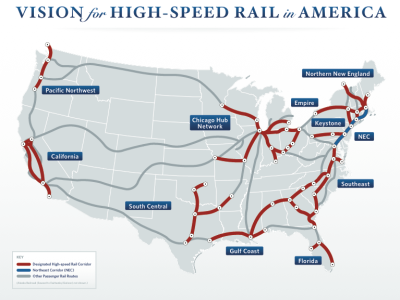
When President Obama announced his HSR Strategic Plan last week, the USDOT report that accompanied the announcement included this map of HSR corridors, based on the 2001 map:


One route you don't see on that map is LA to Las Vegas. Does that mean the project, which right-wingers tried to generate controversy around back in February, is ineligible for the HSR stimulus money? That's the topic examined in an article in the Barstow Desert Dispatch:

The Obama administration’s strategic plan for spending the $8 billion in stimulus funding allotted to high-speed rail projects makes no mention of a proposed rail line from Anaheim to Las Vegas that would stop in Barstow.

Project proponents are still hopeful that some of the funds may come their way.

The plan released Thursday by President Barack Obama and U.S. Department of Transportation Secretary Ray LaHood lists 10 designated high-speed rail corridors where projects are eligible to receive funding, none of which include the Anaheim to Las Vegas route.

So does this mean that the map shown above really will determine HSR funding priorities? Well...maybe not:

Lori Irving, a spokeswoman with the U.S. Department of Transportation, said projects that are not located in the existing corridors may still be eligible to compete for some of the stimulus funds.

And the backers of the maglev train are optimistic:

Bruce Aguilera, chair of the California-Nevada Super Speed Train Commission, which is tasked with moving the Anaheim to Las Vegas train project forward, stated via email that the project proponents still plan to file a request for stimulus funds and expect to be eligible.

“We have a plan and (are) moving fast to have the first leg built during the president’s first term,” Aguilera wrote.

Of course, unless they suddenly abandoned the maglev plan in favor of Desert Xpress and are planning to break ground this afternoon, I'm having a hard time seeing how they'll have the first leg built by the end of 2012.

I wouldn't be surprised if the LA-Vegas corridor got some amount of startup funds, to complete environmental design work - perhaps as much as $100 million or more (but certainly no more than $500 million). But with so many other corridors also looking for funds, with a much more developed and realistic plan - and sorry folks, maglev on this scale really is gadgetbahn - I am hard pressed to see how Vegas HSR is going to get very much out of the USDOT process.

The more I look at this, the more I think that if Vegas HSR is going to happen, the state of Nevada is going to have to take the lead in stepping up to fund a big chunk of it. If Obama is somehow able to create a stable funding source for HSR then that could put Vegas HSR in the pipeline - but it could also take 20 more years to bring it to fruition. If Vegas interests (that would be the casinos) want it to happen sooner, they'll need Nevada to help accelerate the timeline.

That will eventually raise the issue of how much California wants to spend on Vegas HSR. In the 1980s and 1990s there was a long standoff between Caltrans and NDOT over widening Interstate 15 between Barstow and the state line. California did not want to spend money on that project which benefits an out-of-state interest, especially with so many other road projects around the state clamoring for money. Eventually NDOT agreed to help pay and the widening projects were undertaken.

With Vegas HSR, Nevada and the feds could reasonably argue that California should put up more of the money since the route would serve California residents for in-state trips (especially if they use a Cajon Pass routing - Victor Valley residents would have a way to commute to and from jobs in the LA Basin). I'm not sure that's a high priority HSR corridor for this state, and I would be wary at this time of committing California to funding Vegas HSR. Ideally we could revisit the matter around 2020. But Vegas' timeline is much more aggressive, and I am betting we'll see Nevada leaders pushing California for financial commitments much sooner.

Something to keep in mind.

Saturday, April 18, 2009

Obama's HSR Plan (Mostly) Lauded - But How To Pay For It?

NOTE: We've moved! Visit us at the California High Speed Rail Blog.

Thursday's announcement by President Barack Obama of the HSR Strategic Plan got a lot of attention in the media and on the blogs - which is just what California's project needs at this time. Obama's high-profile leadership for HSR should help focus our state, especially those involved in the contentious debates over how to build the trains along the planned corridor, on the big picture and the need to move forward quickly and effectively in building the high speed trains that are so essential to our nation's future.

Yonah Freemark at The Transport Politic offered this assessment of the plan:

But I think the report’s basic outlines of the kinds of projects the federal government wants to fund with rail money are demonstrative of the administration’s seriousness in undertaking this project. By arguing that high-speed rail is most applicable for corridors between 100 and 600 miles in areas of moderate to high density, we can be assured that the government won’t be funding just any project with the limited funds available for rail. It’s good to know, in other words, that a line between El Paso and Phoenix isn’t going to get money over the connection between San Francisco and Los Angeles.

He also noted that a new National Rail Plan will be prepared and published in October. That plan may revise the list of HSR corridors, last updated in 2001:


This map includes such outdated concepts as an HSR corridor along the Coast Route from San Jose to LA via Salinas and SLO (not that I'd personally mind such a corridor, but it was rejected in the CHSRA's 2002 plan and isn't being considered for anything other than some upgrades to enable the Coast Daylight to operate) or defining Dallas to Tulsa as a vital HSR corridor but not Dallas-Houston.

One of the most common responses to Obama's announcement was the all important question of "how will we pay for it?" That's the question the LA Times tackled in yesterday's editorial:

High-speed rail networks might very well be the "smart transportation system" of the 21st century, as President Obama declared Thursday. The trouble is, we're using a very 20th century method to pay for them....

"Now, all of you know this is not some fanciful, pie-in-the-sky vision of the future. ... It's been happening for decades. The problem is, it's been happening elsewhere, not here," Obama said, referring to countries such as France, Japan, Spain and China that have impressive bullet-train networks. But there was something he failed to mention: With the exception of China, whose government can spend any way it likes, all of these countries impose steep taxes on gasoline. The taxes have the dual purpose of providing the funding to build public transit and encouraging people to ride it because they make driving prohibitively expensive. Gas taxes in the United States are minuscule in comparison.

Instead of raising the money to pay for his vision, Obama proposes to fund it with debt. So does the state of California, where voters last November approved nearly $10 billion in bonds for the San Diego-to-Sacramento train Obama aims to support. That's all well and good, except that the California train alone is expected to cost in excess of $40 billion. Obama's $13 billion over five years won't go far in building a national network that would cost hundreds of billions. So where's the rest of the money going to come from?

The LA Times is basically calling for a higher gas tax to be part of the upcoming transportation bill, and to fund passenger rail - including HSR - through that mechanism.

I strongly support that concept. I don't oppose using debt to build trains - long-term infrastructure projects are the best use of debt there is, and it's hard to make a case against spending $50 billion or so on a national HSR network when over $1 trillion has been spent to bail out well-connected Wall Street bankers - but we DO need a higher gas tax, and it ought to be used solely for improving mass transit, with passenger rail at the center.

A higher gas tax would also help provide long-term stable funding for high speed rail, just as the federal gas tax provided the funds to build out the Interstate Highway System (which took nearly 40 years to complete), instead of making HSR projects dependent on a highly unstable annual funding appropriation from the Congress. The moment Republicans take control of Congress or the White House back from the Democrats, which is a distinct possibility over the next 10 years, HSR funding would be in serious jeopardy.

President Obama is likely to tread very carefully and cautiously here. Despite the cries of "socialist!" from his right-wing opponents, Obama is a moderate Democrat who has tried hard to avoid alienating swing voters. His tax policies are designed to cut taxes for the lower and middle-class while raising them for the upper class. That's the right move for income taxes, but the moment he proposes a gas tax increase, he risks the possibility of giving fuel to the right-wing attacks and pissing off swing voters.

A higher gas tax is a very smart and necessary policy for this country. But it's also a political decision that the president is going to weigh with an eye to the 2012 election. I'm far from convinced Obama will support it, but it's something he ought to do.

Thursday, April 16, 2009

Obama Announces HSR Funding Plan

NOTE: We've moved! Visit us at the California High Speed Rail Blog.

Today President Barack Obama, Vice President Joe Biden and Secretary of Transportation Ray LaHood announced the DOT's high speed rail strategic plan. You can find the full details of the plan at the USDOT website.


It's an important announcement and contains some long-awaited policy changes that will help make HSR a reality across the nation. It's not yet clear how this will impact the California HSR project, but the way the funding allocation categories are set up appears to be quite favorable to us here in California.

First, I want to quote from both President Obama and VP Biden - these guys get it when it comes to HSR. It is a sea change from the last 25 years of refusal to speak openly and honestly about our nation's transportation needs.

“My high-speed rail proposal will lead to innovations that change the way we travel in America. We must start developing clean, energy-efficient transportation that will define our regions for centuries to come,” said President Obama. “A major new high-speed rail line will generate many thousands of construction jobs over several years, as well as permanent jobs for rail employees and increased economic activity in the destinations these trains serve. High-speed rail is long-overdue, and this plan lets American travelers know that they are not doomed to a future of long lines at the airports or jammed cars on the highways.”

He nailed it. This quote has it all - energy independence, job creation and long-term economic growth, and relieving congested airports and freeways. Joe Biden's quote is equally as good:

“Today, we see clearly how Recovery Act funds and the Department of Transportation are building the platform for a brighter economic future - they’re creating jobs and making life better for communities everywhere,” said Vice President Biden. “Everyone knows railways are the best way to connect communities to each other, and as a daily rail commuter for over 35 years, this announcement is near and dear to my heart. Investing in a high-speed rail system will lower our dependence on foreign oil and the bill for a tank of gas; loosen the congestion suffocating our highways and skyways; and significantly reduce the damage we do to our planet.”


I don't know who was writing their speeches, but they clearly understand the case for HSR.

That case is made strongly and powerfully in the HSR strategic plan document (PDF, 3MB). It is one of the best arguments for HSR that I've ever seen. This administration is serious about HSR. The plan includes a good overview of the history of rail funding in America, explaining that we have spent over $1 trillion on roads and airports in the last 50 years but have starved rail - even though, as the report makes clear, high speed rail is one of the best methods to move people over distances from 100 to 600 miles:


The report also recognizes the need to update the FRA's regulations to make HSR more of a possibility in this country (this should be music to Rafael's ears):

While most high-speed systems overseas have a good safety record, usually on dedicated track, U.S. railroad safety standards are designed to keep passengers and crew safe in a mixed operating environment with conventional freight equipment, which is much heavier than comparable
foreign equipment. The advent of Positive Train Control (PTC), crash energy management, and other advances provides the United States with an opportunity to revise its safety approach in a manner that accelerates the development of high-speed rail while preserving and improving upon a strong safety regime. This will be a challenge for the Federal Railroad Administration (FRA) as it seeks to administer its critical safety responsibility and facilitate high-speed rail development. The systems approach required to ensure safety of new HSR corridors will necessitate consideration of additional changes in several regulations, including equipment, system safety, and collision and derailment prevention.

The heart of the document is a three-pronged approach to funding HSR projects. I'll include the full text of the "tracks" below for folks to peruse:

1. Projects. Grants to complete individual projects eligible under Sections 301 (IPR projects) and Sections 302 (congestion projects) described above, for the benefit of existing services. Eligible projects include infrastructure, facilities and equipment. In order to qualify, these projects must: (a) be "ready to go" (i.e., environmental work required by law (National Environmental Policy Act, or NEPA) and preliminary engineering (PE) are complete), and (b) demonstrate "independent utility." For projects that meet the independent utility test but have not yet completed NEPA and PE, funding is available to conduct NEPA and PE work to make projects ready to go and, therefore, eligible under a subsequent grant solicitation. For rolling stock proposals, DOT will encourage acquisition of new, standardized, interoperable equipment
that incorporates modern safety features. Under this track, funds would be obligated for successful applications under standard grant agreement terms and conditions, including ARRA oversight and reporting procedures.

2. Corridor programs. Cooperative agreements to develop entire segments or phases of corridor programs eligible under Section 501 (HSR) and Section 301 (IPR), benefiting existing or new services. In order to qualify, these corridor programs must: (a) be based on a corridor plan that establishes service objectives and includes a prioritized list of projects to achieve those objectives; and (b) have completed sufficient corridor/ section/phase programmatic or project environmental (NEPA) documentation and sufficient planning to provide reasonable project cost and benefit estimates. For corridor programs that do not qualify under (a) and (b) above, funding is available to complete this work and make corridor programs eligible for subsequent solicitations. Under this track, funds for selected applications of a corridor program phase and/ or geographic section would be set aside at the outset, and provided at pre-specified milestone approval points. This approach would involve a higher level of Federal oversight and support than under even the
heightened scrutiny inherent in standard ARRA grant agreements.

3. Planning. Cooperative agreements for planning activities (including development of corridor plans and State Rail Plans) eligible for funding under Section 301 of PRIIA, using non-ARRA funds. This third track provides States an opportunity to prepare themselves for any funding remaining in subsequent rounds of ARRA, and/or future year appropriations. It is intended to help create the pipeline for future corridor development needed to build out a national HSR/IPR network.

As I read this, California's project is eligible for all three tracks. Of course, so would many other states. The plan also recognizes distinctions between what they call "HSR express" which is a California-style system that can achieve 150 mph or above; "HSR regional" which can achieve speeds of 110-150 mph; "Emerging HSR" where new corridors of around 90-110 mph are to be built, and "Conventional Rail" which is basically Amtrak outside the NEC. I hope that as the only true HSR express project on the drawing board (the NEC is in a somewhat different category as it already exists) that will give us a big boost, as other states fight over the rest.

So overall I think this is a huge boost for HSR, even though it does leave some things unclear as to how exactly our own project will fare. The DOT will be making the first project funding announcements later this year, for tracks 1 and 3 - track 2 will be announced toward the end of 2009 or in early 2010.

This announcement has gotten a lot of reaction around the blogosphere, but I want to single out for criticism Matthew Yglesias's take on the announcement:

My take on this is that the most promising projects on the merits, from a federal point of view, are probably those that upgrade the existing Northeast Corridor (where we know demand exists) and those that connect to the Northeast Corridor since the existing passenger rail corridor extends the utility of the new link. The Chicago Hub Network and the California Corridor concepts strikes me as very important for the long-term future of their regions, but for it to be useful will take a lot of time and money. I assume that the relevant state-level politicians for the Gulf Coast and South Central Corridors aren’t going to be interested in ponying up the sort of state funds that would make these projects competitively viable, and that may be for the best since I think those corridors may be a bit ill-conceived. It seems strange to build so much track in Texas and not manage to link Houston with Dallas.

This is a pretty flawed way to look at things. What Yglesias proposes is in fact the model Clinton eventually adopted. In 1993 he proposed a broad national HSR plan, but by the late '90s he decided to just focus on upgrading the NEC and rail was left to wither around the country.

Yglesias is wrong to say that we should prioritize the NEC and connections to the NEC. Significant improvements in speed and carrying capacity can be made in the Midwest with a few billion dollars, and the California project need federal cash infusion now to ensure completion by 2018. All of those will revolutionize rail transportation in America to a much bigger scale than upgrades to the NEC. Too much focus on the NEC is one of the primary reasons for the lack of passenger rail upgrades and improvements around the country. It's time we took HSR national.

And with President Obama's plan, that is exactly what will happen. Now, to make sure this all gets funded...

UPDATE: Rafael's comments:

Nothing particularly new here, except that USDOT will be sticking with the 11 already designated corridors (incl. the NEC). Disneyland to Las Vegas, the Texas T-bone and other hopefuls are not mentioned. So far, the President is talking about the $8 billion in the stimulus bill plus a measly $1 billion for each of the next five years. That's enough to get started, but not nearly enough to leave a legacy.

On the plus side, he mentions the need for long-term commitments from states. Presumably, that translates to a preference for those willing to put some serious skin in the game, e.g. California.

California's much more ambitious bullet train network would presumably fall into the second "track" but it's unclear if there will be anything left in the kitty at that point. Still, given the increasing amount of political capital the President is investing in HSR, it seems likely that future bills will increase the total amount available once USDOT has put in place a suitably technocratic process for evaluating grant applications on their merits. Washington being what it is, the notion that political considerations such as swing state status won't matter is probably more pious hope than realistic expectation.

In particular, additional federal funding for planning and development of additional HSR corridors will be sought in the context of the regular surface transportation bills. In plain English, that means rail proponents will have to duke it out with the highway lobby. Fortunately, the principle that transit projects will be eligible for up to 80% federal funding, putting them on par with highways, has already been established. Note that those regular bills would also be the appropriate place to make adjustments to the map of eligible corridors. The current one dates back to 2002.

In addition, FRA will need some additional funding for drawing up rules enabling mixed traffic on rapid rail routes as well as bullet train operations at speeds exceeding 150mph. The various HSR allocations do allow USDOT to retain a small fraction of the total grant volume for its own operations in support of HSR implementation.

Monday, April 13, 2009

Ray LaHood: HSR To Be "Obama's Legacy"

NOTE: We've moved! Visit us at the California High Speed Rail Blog.

NBC News interviewed Transportation Secretary Ray LaHood recently, and he gave a very good set of statements about high speed rail and the reasons to invest in the system:


Of course his statements also suggest we here in California are well positioned to get some of the $8 billion in HSR stimulus. Later this week President Obama will announce his plans for HSR including criteria by which the USDOT will allocate the $8 billion in HSR stimulus. As the Sacramento Bee reported over the weekend Mehdi Morshed of the CHSRA believes that California can get as much as $4 billion of that money, although the Bee did not list any specifics.

Instead of providing details on what the $4 billion would buy, the Bee decided to give space to one of the main HSR deniers, Joseph Vranich, to spout his usual nonsense:

Critics also contend that California's proposed system is riddled with greatly inflated ridership estimates and greatly understated cost projections.

"The California authority has ignored the lessons of Florida and Texas, and has repeated all the mistakes," said Joseph Vranich, a former Amtrak official and former president of the High Speed Rail Association. "It hasn't produced a single number or report or prediction that is true."

For example, Vranich argues, California should be disqualified from receiving federal rail aid because its environmental impact statements are outdated and inaccurate.

Morshed, who denied the state's project lacks accurate EIS documents, said a bigger fear is that federal transportation officials will adhere to political expediency and disburse the money in widespread, but tiny, amounts.

This is some rather poor reporting from the SacBee. They set up Vranich, whose hatred of passenger rail projects has been the subject of several exposés on this blog, as some kind of expert. I guess all you have to do is have a title that makes you sound like a rail expert to dupe credulous journalists into repeating your claims without question - and in fact using those claims to put Mehdi Morshed on the defensive when the charge, that the EIS documents are inaccurate, is complete nonsense and lacks a factual basis.

The ABC News article linked above on Obama's forthcoming announcement falls into a similar trap - except this time it's the other big HSR denier, the Cato Institute, that gets the ink:

"You might as well have the government invest in nuclear-powered bicycles," [Daniel] Mitchell added. "That's probably the only thing I could imagine that would be more of a waste of money than inter-city rail."

Riiiiight. Because god forbid we try to get America off oil, reduce carbon emissions, provide jobs and economic growth. Oh wait, Cato Institute doesn't believe it's government's role to provide any of those things. Sorry that our national priorities and the public will conflict with your nutty ideology.

It's a shame that the media sees its job as providing "he said, she said" stenography and passing it off as objective journalism, instead of actually drilling down to the truth of the matter. Still, with President Obama's extremely strong support for HSR, we have some powerful allies to help push back against this nonsense. Obama spoke highly of HSR on his recent swing through Europe:

"I am always jealous about European trains," Obama said April 3 in Strasbourg, France. "And I said to myself, 'why can't we have high-speed rail?' And so, we're investing in that as well."

I look forward to hearing the details of that investment later this week.

Saturday, March 28, 2009

Union Pacific Speaks

NOTE: We've moved! Visit us at the California High Speed Rail Blog.

Never let it be said that I don't give HSR deniers credit where it is due. Morris Brown has obtained a copy of a letter from Union Pacific to the California High Speed Rail Authority laying out their stance on HSR implementation between San Francisco and Gilroy. Their overall attitude is one of "we own the corridor, either through easements or outright ownership, and you're going to implement HSR according to our guidelines."

The SF-Gilroy corridor is broken up into three pieces:

1. SF to Santa Clara, owned outright by the Peninsula Corridor Joint Powers Board (PCBJPB - set up in 1991 to run Caltrain) but where UP has an easement to run freight

2. Santa Clara to Lick, "a point approximately three miles south of Diridon Station" - UP "owns and has primary operating rights on Main Track Number 1".

3. Lick to Gilroy (and ultimately to Moorpark in Ventura County), owned wholly by the Union Pacific Railroad.

UP's stance as laid out in the letter is, in essence and going in reverse order:

3: No way in hell will HSR trains use the UP ROW between Lick and Gilroy. Their specific language is:

Union Pacific has no intention of allowing or permitting the Authority to build or operate the HSR within Union Pacific's right of way southward of Lick. The Authority should take this into account as part of the EIR/EIS for the San Francisco — San Jose segment.

2: Depending on how freight trains are mitigated, UP is fine with HSR between Santa Clara and Lick - but UP will be the final arbiter of what this means. Their specific language is:

The Authority must not undertake any action that interferes with Union Pacific's ownership and operation of Main Track No. I without prior approval from Union Pacific and the commuter agencies identified above. All adverse impacts must be mitigated to Union Pacific's satisfaction.

1: UP expects to not only maintain, but potentially increase, freight service along the Caltrain corridor, insists that its easement be respected, and that HSR be built to not adversely affect freight operations in any possible form.

Specifically, UP demands the following, which is most directly applicable to the Caltrain corridor:

(i) Slow speed freight trains and high-speed trains are incompatible on the same
tracks at any time, including cross-overs. Union Pacific requires overhead clearance of 23 feet 6 inches, which is higher than the Authority contemplates for its electrical system. The Authority must provide grade-separated cross-overs for freight trains at necessary locations. The Authority must not contemplate operation of freight trains on any HSR trackage at any time (and vice-versa). If necessary, completely separate freight trackage must be provided. HSR must comply with all applicable FRA regulations.

As far as I can tell what UP is saying is that at least one track has to be set up for freight trains, and if that requires a totally separate track, so be it - CHSRA and PCJPB are UP's bitch when it comes to making changes on the Caltrain corridor.

What does this mean for the battle over HSR implementation on the Peninsula? Brandon in San Diego lays it out like this:

any proposal to retain freight's ability with any necessary tunneling having the intent to accomodate HSR + Caltrain at the expense of an above ground alignment accomodating freight...
...will mean:
1) more costly tunneling efforts (bigger/higher, longer due to softer grade changes, and/or... ventilation) or
2) the tunneling to accomodate Caltrain + freight cannot happen at all.

If so on #2, that means Caltrain may remain above ground and possibly at-grade where they already are... and our friendly peninsula bergs are SOL.

I think that's a pretty good summation. Ultimately I think this deals a pretty significant blow to the tunnel concept as being floated by the Peninsula cities, who have floated a concept of a two-track tunnel. Unless the tunnel has four tracks and is large enough to accommodate UP freight, it's not going to meet UP's standards. Another option is to build a two-track tunnel and let UP continue operating freight trains on the surface above the tunnel, which is an absurd solution and also makes it impossible for cities to sell "air rights" to develop land above the tunnel to pay for the tunnel's costs, as some have proposed.

The only other option for Peninsula cities would be to pursue federal law that would limit UP's negotiating power. UP notes that their freight operations in this region are regulated by the federal Surface Transportation Board. Congress and the White House could, if they wanted to, pursue new laws and regulations pushing or even forcing freight railroads to accommodate HSR and other passenger rail even if they're reluctant to do so.

I am not sure we should expect that to happen. President Obama has shown hardly any desire to piss off large corporations like UP, and Congress has shown little interest in modernizing railroad law. If the federal government is serious about implementing HSR, they're going to need to attend to both, and the dispute over the Caltrain corridor may be a good place to start. But I am not confident it will actually happen.

Sunday, March 1, 2009

Help Palo Alto Make the Right Choice

NOTE: We've moved! Visit us at the California High Speed Rail Blog.

On Monday night the Palo Alto City Council will meet to consider the comments it wishes to submit to the California High Speed Rail Authority on the Peninsula portion of the HSR line. Although this seems like a small point, Palo Alto has become a major flashpoint in the attempt by a small but vocal group of HSR deniers to kill the high speed rail project outright. Unfortunately, a recommendation by Palo Alto city staff appears to bolster these NIMBYs. It is therefore extremely important that all HSR supporters around California mobilize to ensure that Palo Alto does not suddenly decide to undermine the project in order to satisfy a few ignorant claims.

If Palo Alto succumbs to the NIMBY HSR denier crowd it will be a severe blow to not just high speed rail, but to mass transit, action to mitigate and reverse global warming, smart growth, energy independence and economic recovery. It would deal a blow to President Barack Obama's plans and give a boost to conservative Republicans like Bobby Jindal and Sean Hannity who claim that high speed rail is bad for America.

The basic issue is this: a few people in Palo Alto, who are almost totally uninformed as to the details of the project (whether this is deliberate or not isn't clear and depends on the individual), have become convinced that high speed rail is going to "destroy their community." They are spreading numerous lies and falsehoods about what HSR will do for Palo Alto. And although the Palo Alto City Council unanimously endorsed Proposition 1A last year, they are coming under intense pressure to join the frivolous lawsuit filed by Menlo Park, Atherton, Stuart Flashman, and other opponents of high speed rail.

One of the core arguments is that somehow an above-grade set of HSR tracks will ruin the community - harm property values, bring "blight". Some are even taking to calling the HSR tracks a "Berlin Wall" - an offensive claim that cheapens the lives of those Germans who died trying to cross the Berlin Wall to freedom.

In fact, along most of the Peninsula there is already sufficient ROW to add two tracks to the existing Caltrain tracks. This is true for much of Palo Alto, despite claims to the contrary.

More importantly, the HSR grade separation project would vastly improve the quality of life in Palo Alto. Electrified tracks mean no more polluting and smelly diesel fumes. Grade separations mean no more loud train whistles. They also mean no more accidents, making it safer for families to cross the corridor. Far from "dividing" communities it actually unites them.

Still, the huge levels of support in Palo Alto for Prop 1A and HSR would normally suggest to me that these ignorant claims from NIMBYs wouldn't be worth worrying about. Unfortunately, the City of Palo Alto staff are making a series of recommendations that could fundamentally undermine the HSR project if the City Council approved them. It is imperative that we let the Palo Alto City Council know that some of these recommendations are not only inappropriate, but deeply flawed and ought to be rejected. Instead the council should support HSR, and submit comments to the CHSRA indicating a desire to produce a sensible solution that will implement the HSR system as approved by California voters in November.

The objectionable recommendations include:

• Reopen the Altamont vs. Pacheco debate
• Explore routing HSR down Highway 101 or Interstate 280
• Consider terminating the HSR route at San José Diridon and forcing intercity travelers to transfer to Caltrain to complete their journey to San Francisco

Each of these are problematic, but it is the last point that is especially heinous. Let me explain.

First, Altamont is dead. That option isn't coming back. Californians voted for Prop 1A knowing that Pacheco Pass was the choice. That ship has sailed. An Altamont alignment means cutting out San José from the system, one of the state's largest cities.

It also means dumping the problem in the laps of Fremont and Pleasanton. Who are Palo Alto residents to say "we're too good to accept some small improvements in a rail line - some other town has to deal with it?"

The recommendation to build HSR along 101 or 280 is also deeply flawed. That would be a very bad move that violates almost every rule regarding sound transportation planning principles. HSR along the Caltrain route means stations in city centers, instead of along freeways. It would reduce ridership and seriously retard efforts to make California less car-dependent. In fact, the Palo Alto staff report notes that according the the CHSRA:

Station locations must have the potential to promote higher density, mixed use, pedestrian accessible development

By moving the line to 101 or 280 - which will never happen but I'm humoring the staff here - it ensures that these goals are impossible to meet. Further, it would embolden Palo Alto resistance to items necessary to improve Caltrain service - including electrification and grade separation.

Palo Alto staff are implying that it may well oppose efforts to improve Caltrain service as well. The city's draft scoping comments include asking to eliminate overhead catenaries in Caltrain electrification and preventing "visual impacts" that above-grade crossings would present. How many people are killed along Caltrain tracks? How many accidents have there been at grade crossings? If the goal is to eliminate any grade separations short of a tunnel - as this report appears to imply - then what city staff are proposing is an attack on any and all efforts to move more Bay Area residents to trains, all because they feel it would make their community look less pleasant.

The staff report suggestion of terminating HSR at San José and forcing riders to transfer to Caltrain is perhaps the most damning and foolhardy proposal of them all. This would severely undermine the HSR system as it would cause ridership numbers to plummet below the levels needed for the system to be financially viable. Caltrain is a commuter rail system and is not designed to handle intercity travelers. It does not have luggage facilities. It does not have spacious seats or a cafe car. Transfers reduce ridership, and cutting off the line at San José therefore constitutes a mortal threat to the entire system.

The staff recommendation is an implicit attack on California's strategy to finally build a 21st century model of transportation, and a de facto embrace of inaction on the multiple crises we face - a desire to maintain a failed status quo that is harming the environment, increasing dependence on fossil fuels, and blocking the development of sensible and sustainable alternatives.

Palo Alto's city council voted to endorse Prop 1A and the construction of HSR. They should reject this staff recommendation as both unrealistic and inappropriate, ask staff to strip those elements that constitute an attack on passenger rail and sustainable transportation, and instead submit more constructive comments, that would reflect the following realities:

• Very little if any eminent domain will be needed as much of the necessary ROW already is in Caltrain's hands

• Grade separations improve the community by making crossing the corridor far safer

• Most of the breathless "Berlin Wall!" comments are deliberate lies that ignore the landscaping and other design elements that will ensure an above-grade line will not look unappealing.

It must also be noted that the CHSRA has been a very good partner with the Peninsula on discussing this project, extending the comment period by a month (to April 6) in order to allow cities to have more time to produce their comments and feedback.

Palo Alto has previously shown support for both HSR and passenger rail. It is time for the cooler heads in that city to prevail. Palo Alto residents who both support HSR and who want to build this the right way need to speak up in support of a more constructive approach and against this staff report. Otherwise their city may wind up with nothing but a significant backlash that will cost the city more than it gains.

The 20th century is over. Palo Alto, which was built around an existing rail line, cannot reasonably expect that the conditions of the 1980s or 1990s will continue indefinitely. The HSR project calls for modest changes to the rail corridor and will leave most of Palo Alto untouched and leave the rest improved. Palo Alto should not join Bobby Jindal, John Boehner, and Sean Hannity in attacking the kind of mass transit solutions that we all need to meet the crisis of the 21st century and come through that crisis with better, more prosperous, and more sustainable communities.

And this is where you come in.

I have started an online petition that asks the Palo Alto City Council to endorse HSR and reject the inappropriate and anti-HSR staff recommendations. Please sign it, and make sure your friends sign it too. I am going to post this petition on major websites like Calitics and Daily Kos to help increase the number of signers, and to show Palo Alto that HSR has widespread public support that they should not ignore in order to keep a few fools happy.

As I said right after our election victory, the passage of Proposition 1A was just a first step. It is time to mobilize the network of HSR supporters to win another battle - a battle for mass transit, economic recovery, and environmental action, a battle against those who would sustain a failed status quo because of their selfish and ignorant beliefs.

This is not the equivalent of the Century Freeway, and Quentin Kopp is not Robert Moses. Palo Alto must do its part in helping California and America escape the failed policies of the 20th century. They can do so by endorsing HSR and rejecting the inappropriate staff recommendations that are designed to attack the project itself.

Help Palo Alto make the right choice. Sign the petition. And let's show Palo Alto that we want to work together, in a spirit of cooperation, to ensure HSR works for their community - and that none of us, Palo Alto residents or otherwise, will allow a small group of people to destroy our future.

Friday, February 27, 2009

Obama's Budget Plan and HSR

NOTE: We've moved! Visit us at the California High Speed Rail Blog.

President Barack Obama has released the basic outline of his FY 2010 budget plan (which would actually go into effect on October 1, 2009) and it includes $5 billion for HSR over 5 years - or, $1 billion a year. Obviously that's not going to be enough to build any HSR projects around the country, but would maybe possibly provide a few drops in the bucket. As Yonah at the Transport Politic notes, the proposal "doesn’t appear to mark sea change in vision for U.S. mobility" but is subject to change in Congress.

The budget fight may well resemble the stimulus battle in some key respects, as moderate Democrats and the small handful of sort-of-moderate Republicans could unite to try and pare back some of the more ambitious moves Obama is proposing, including the attack on 30 years of neoliberal economic policy signaled by Obama's plans to start going after wealth through taxation.

A key issue is whether the budget requires 50 votes or 60 votes to pass - the absurd and undemocratic filibuster rule was what caused the weakening of the stimulus plan (despite the $8 billion for HSR), and if the budget is subject to the same 60 vote requirement, then the end product is likely to be significantly weaker than what Obama is proposing here.

Ultimately the real transportation policy battle may come when the transportation bill comes up for reauthorization later this year. A Congressional commission is calling for a higher gas tax and ultimately a vehicle miles traveled (VMT) tax, and while the Obama Administration backed off Ray LaHood's suggestions along those lines earlier this week, I suspect that may have been because they weren't yet ready to go there. We will see what happens later in the year.

Finally, it's great to have seen a lot of pushback against Republican HSR lies this week. It helped that Bobby Jindal made himself look ridiculous with his "Disneyland ride" comments - what he's actually wound up doing is inoculating HSR against that kind of criticism by implying HSR deniers think like Jindal does. Sort of a Sarah Palin "I can see Russia from my house!" moment. With Obama's approval ratings through the roof, and his administration finally showing signs of wanting to chart a truly new course in American politics, that creates the conditions to both grow and consolidate public support for high speed rail. There's a lot of opportunity here, but we'll have to push it through.

Note: I usually don't mind thread drift in the comments, but for now I'd ask folks who want to discuss the Peninsula HSR plan to keep it in yesterday's post for the time being, until I post again on the topic, which will likely be this weekend.