by Rafael Talking Points Memo published an AP article on a new study that the Federal Transit Administration (FTA) compiled at the request of a group of 11 US Senators led by Dick Durbin (D-IL).
The scope included nine transit operators across the nation that together deliver 80% of all rail transit boardings, based on 2006 data. The largest of these was New York City Transit with 1804 million annual passenger boardings - about 48% of the national total of 3775 million. The BART network was also included, weighing in with 99 million, just ahead of the Long Island Railroad with 96 million.
Many of the agencies studied also operate buses and/or ferries but the focus was kept narrowly on rail services, a total of 14 modes. The objective was to highlight the huge backlog of maintenance works, called "state of good repair" in industry parlance. How the available funds are distributed was last defined in the TEA-21 law of 1998. Once new fixed guideways, including Bus Rapid Transit and HOV lane-miles, have been in operation for seven years, they become eligible for some federal funding to assist with maintenance. As a result, the share of funds available to the oldest and most heavily used systems, i.e. those included in the study, has declined even though a rising share of their assets are in urgent need of repair or replacement. In particular, failure to replace broken or worn out components in a timely fashion can compromise operational safety - it's not just a customer satisfaction and retention issue.
In total, FTA estimates that the operators included in the study have accumulated a total state of good repair backlog of $50 billion. After that is eliminated, they will need an additional $5.9 billion per year to maintain that status.
The study comes as Congress is gearing up to overhaul highway and transit programs over the next six years through soon-to-be-introduced legislation that some lawmakers estimated will seek about a half trillion dollars.
If passed, this new surface transportation bill would amount to $85 billion annually, of which only a fraction would go toward rail maintenance. Even that sum may not be nearly large enough: the American Society of Civil Engineers (ASCE) recently published a report card on the national infrastructure, concluding that some $2.2 trillion would need to be invested to bring all of it up from a D average to straight A's. Granted, ASCE is not a disinterested party in this context, but the sum being considered in Congress amounts to just 25% of the number suggested. The upshot is that the conflict between maintaining existing and building new infrastructure such as HSR will remain acute far beyond the next six years.
The concept of using local transit services as HSR feeders will only work if they offer an acceptable customer experience. How many potential HSR customers would be prepared to ride BART if its interiors looked as bad as this subway train in New York?
Friday, May 1, 2009
The Cost of Rail Transit Maintenance


Monday, March 30, 2009
To Catch A Train
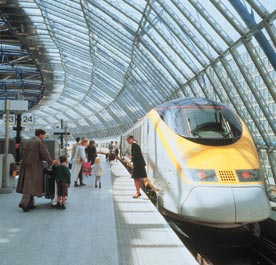 Trains are wonderful, but they usually don't stop at the origin nor at the destination of passengers' journeys. This is especially true of medium-to-long-distance itineraries. Instead, a train trip generally consists of at least three parts: getting to the station, riding the train and connecting transportation from the station at the other end. In addition, riding a train almost invariably involves (short) walks between vehicles and also at either end of any given trip.
Transportation planners like to scope these literally pedestrian issues out of their projects because there's a lot of work but relatively few construction dollars associated with them. Plus, addressing them would actually require co-ordination with other projects, a potential political minefield they prefer to avoid. However, allowing pedestrian access to fall through the cracks - e.g. between HSR stations and airport check-in counters or, between SF Transbay Terminal and Embarcadero BART/Muni - is a sure-fire strategy for failing to meet the ridership forecasts for the shiny new big-ticket services. Ideally, CHSRA should designate one member of its board to take on responsibility for adequate pedestrian facilities at transfer points. The state legislature should also insist that HSR feeder funds from prop 1A are used to optimize connections, rather than just local/regional transit capacity.
The general assumption on this blog appears to be that passengers could and would take local/regional transit to reach the nearest HSR station. Indeed, some $950 million of prop 1A are reserved for capital improvements to qualifying heavy rail "HSR feeder" services like Amtrak California, BART, LA Metro, Metrolink, Caltrain, ACE and NCTD. That's not nearly as much money as it sounds. For example, there will be little or no money left over for local/regional connecting bus services. Expect nothing at all to be available for improving pedestrian connections, e.g. between the Transbay Terminal in SF and Embarcadero, the nearest BART station.
However, like it or not, the vast majority of Californians never uses transit at all or at least, very infrequently. For the most part, that's because service tends to be infrequent and slow, except during rush hour. In addition, not everyone feels comfortable sitting or standing near strangers. Instead, decades of cheap gasoline/kerosene have enabled low-rise sprawl and got California residents used to either driving the whole way or else, driving to an airport, parking their car, flying and getting into another car at the other end. That other car might be an airport shuttle van, someone coming to pick them up or, a rental car. In short, travel within California is very oil-intensive and the hope is that HSR will make a dent in that.
However, a common objection to the California HSR project is that local transit should be put in place first, lest HSR cause massive traffic problems near downtown stations. The counter-argument is that politically, HSR serves as an anchor project big enough to prompt/accelerate the development/expansion of local/regional transit that's long been talked about but never properly funded. There is some evidence of this in that voters LA, Santa Clara, Marin and Sonoma counties all voted to increase local sales taxes to pay for improved rail transit, in addition to approving prop 1A on the statewide ballot.
Still, counting on local transit funding to ride the coattails of HSR is risky in that it forces both types of services to receive massive infusions of cash at the same time. If the political appetite for passenger rail were to dry up for any lenght of time, there's a good chance that funds intended for bread-and-butter local transit at the federal and state level would be raided to keep the politically sexier HSR project alive, with knock-on effects at the county and city levels. There is some evidence for this as well, in the shape of last-minute re-allocations of funds already within the transportation section of HR1, the stimulus bill. Indeed, the capital expenditure budgets of passenger rail and other transit services are liable to be raided at anytime by the politically entrenched highway-and-runway lobby.
These budget shenanigans will be going on all through the planning and construction phases of the California HSR project at both the federal and especially, at the state level. Urban traffic planners and station architects therefore need to anticipate a wider range of connecting transit options than just local transit. Moreover, the appropriate mix of options will be vastly different in the major HSR locations (SF, SJ, Fresno, LA, Anaheim, Sacramento, San Diego), at stations near airports (SFO, PMD, ONT, MER?) and at stations in smaller towns (Bakersfield, mid-peninsula, Gilroy, Modesto, Burbank, Riverside etc.)
Perhaps, then, we ought to take a closer look at connecting transportation from the customer's point of view. They will base their choice of vehicle on multiple parameters: door-to-door travel time, risk of delays, flexibility to reschedule, convenience, safety/security, comfort, privacy and fare cost - plus old habits that may be hard to break. No single strategy will work for every passenger, so station designers and local traffic planners have to reserve adequate room for multiple modes of connecting transportation.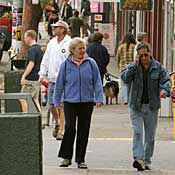 1. Walking: If you work in e.g. the financial district in SF and commute by BART, chances are you just hoof it for the last few blocks. There's no reason to assume that someone coming up from LA on a high speed train won't do exactly the same. Pedestrians average no more than 2.5 mph, less if they need to stop at traffic lights. That said, it is a little light exercise and you don't have to wait around for a bus to show up - one that might not drop you off exactly where you need to be anyhow. The converse is also true: in a number of places around the state, people are increasingly choosing to live in condos close to a subway or light rail line rather than chase after a McMansion out in the boonies, where the car is the only possible option for commuting to work, often dozens of miles away. Transit villages are a welcome new phenomenon, but their long-term popularity will depend on the future price of oil.
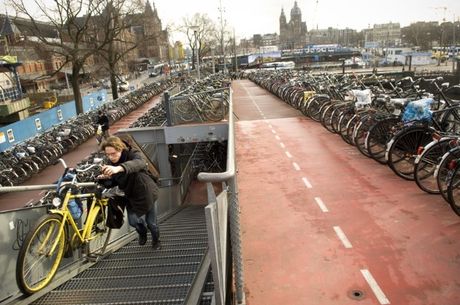 2. Cycling: In flat but crowded places like Holland and Denmark, China, Vietnam etc. bicycles are perceived first and foremost as modes of transportation. Sure, there are special bikes intended for strenuous exercise, but those are a separate category. In California, that category is almost all there is: road racers and mountain bikes. City bikes are often perceived as being strictly for kids too young to drive a car. This obsession with bikes as exercise machines may explain why pedelecs (bikes with electric assist motors) haven't really caught on yet in the Golden State, even though they let you climb hills and brave headwinds without working up much of a sweat - deal if you're about to board a train.
 There are plenty of folding designs on the market and, they're much easier to take along on any type of transit. Folding pedelecs are a new category that is only just emerging, thanks to recent advances in Li-ion battery technology, permanent magnet motors and control systems for the assist motors in these muscle-electric hybrids. China is arguably the world leader at the economy end of this emerging market.
Even in Europe and Japan, many railroads still think of all bicycles as equal and are only just beginning to wake up to the potential of folding bicycles and pedelecs to increase their catchment areas without having to sacrifice space for passengers who pay full fare. Just slide your under your seat (and perhaps the adjacent one, too) - done. At first, the notion of taking a folding pedelec along on a high-speed train may seem absurd, but if you travel light it's actually a perfectly sensible option, especially if there is a courtesy outlet to let you recharge. Pedelecs are limited to 20mph by law in California and you have to be 16 to ride one. Range on a single charge is typically on the order of 15-30 miles, depending on conditions and on how hard you pedal.
The biggest drawback is that bicycles are vulnerable in traffic unless there are designated bike lanes or better yet, segregated bike paths. In California, cities are loath to close traffic lanes or entire streets to motor vehicles without a special permit - pedestrian zones are almost unheard of (except in purpose-built shopping malls). The second biggest is that biking in wet or extremely hot weather is no fun at all, so transit planners tend to discount it as an unreliable ridership source. That may be a mistake, since pedelecs are by far the most affordable personal electric vehicles and the weather in California's population centers is reliably sunny for at least four months out of the year. 3. Local Transit: If you happen to live or work near a bus, light rail or subway stop with frequent and reliable service, then that may be the best option for either the first or the last leg of your trip. Unfortunately, it may not be on the other end - you may have to settle for one or more slow bus connections or else, shell out for more expensive direct service.
 Excellent connecting transit at one end a city pair only boosts HSR ridership if the same is true at the other end. In California, the volume and frequency of transit service varies greatly from county to county. The recent rapid run-up in gasoline prices prompted a renewed effort to spruce up transit services and, HSR stations provide a suitable anchor for multimodal hubs in major cities. Unfortunately, those same gasoline prices burst the housing bubble so it remains to be seen if these plans will come to fruition. Offering a single ticket valid on all transit services in a given region (e.g. the Bay Area) could boost off-peak ridership.
 4. Taxi/Limo/Sharecab Service: For those who place a premium on their time and/or their privacy, catching a cab or arranging for a limo may be the preferred option, much as it is at airports. Sharecabs (cp. airport shuttles) are not private and usually less comfortable, but they do get you to exactly where you need to be at more moderate cost. HSR stations will be excellent anchor locations for sharecab services based on vans that can transport up to 8 passengers and their luggage, supplementing fixed-route local transit or replacing it where none exists today. There is a case for subsidizing sharecab services, as they ease congestion and the related air pollution in downtown areas.
 5. Personal Car: Driving your own car to the station is often cited as the most convenient or even the only practical option. Sure, there's traffic and you need to pay for parking but you can get there fairly quickly, without having to wait for local transit, in comfort and privacy. Plus, you can take stuff along - it's especially hard to travel light with children or disabled persons in tow. Pets are another issue for anyone considering train travel. Fortunately, most railroads already operating high speed trains do permit them provided they don't bother other passengers. A leash and muzzle are often required to at least be on hand and, a half-price ticket may be required for large dogs.
However, the biggest downside is at the far end of the trip: either someone has to pick you up, you have to use a taxi/shuttle or, you end up renting a car. Add it all up and simply driving yourself all the way starts to look like a way more attractive option for a family of four. And therein, perhaps, lies the biggest challenge of all: persuading Californians to travel more frequently within their state but with less stuff, to make going down to Disneyland or up to San Francisco a simple weekend trip with just one night's stay rather than a major multi-day outing. For those living in the Central Valley, either destination could easily be an occasional day trip.
Conclusion: Getting the most out of HSR means adjusting the way way you work and play - it's not a drop-in replacement for the lifestyle you lead today. In particular, more frequent outings within the state will inevitably mean less frequent leisure travel to other states or overseas. The upside is that more tourism dollars stay in California, doubly so if HSR + connecting transit attract larger numbers of out-of-state tourists.
