Over at The Transport Politic Yonah Freemark has offered two insightful posts this week on the question of HSR fares as compared to those for air and automobile travel (including buses). The first, Getting the Price Right: How Much Should High-Speed Fares Cost? argued that Amtrak has set fares on the Acela too high, though faster speeds and higher-capacity trainsets would enable the operating costs and thus the fares to drop. Freemark compared the Acela to European and Asian HSR systems and found that those systems not only offer better fares than the Acela - they also offer better fares than airline flights on the same route. However, Freemark's analysis suggests that California HSR is poised to replicate the European experience, and not that of Amtrak and the Acela (at least in terms of fares):
The California High-Speed Rail Authority, which is planning the nation’s most ambitious new rail project, has considered the effect of pricing on ridership. It predicts strikingly varying ridership outcomes depending on the cost of its future services; in 2030, with the full system operating, the agency estimates 93.1 million yearly trips if fares are set at 50% of air travel levels and 74 million if fares are set at 77% of air travel levels. Though final fares have not yet been established, one thing is for certain: California will not copy Amtrak and charge customers exorbitant rates to ride the train....
If American high-speed services offered similar prices for time traveled as Amtrak does today — at $45 per hour of running time for standard fares and $15 at reduced prices — on faster trains, U.S. commuters would switch to rail in droves. The San Francisco-Los Angeles route being planned by the State of California, with a travel time of 2h40, would cost $40 for reduced-price tickets and $120 for standard fares; those costs seem perfectly acceptable for just about everyone. A renewed Northeast Corridor, offering travel between New York and Washington in 1h40 (at an average of 220 km/h), would cost $25 for customers buying reduced-price fares. People currently driving their own cars or riding buses between the cities would take a second look at those prices.
Previous statements from the CHSRA have indicated that the fares would be around $55. I have repeatedly said we should not get attached to that number, and Freemark's conclusion that the fares will range from $40 to $120 is much more sensible.
Of course, anytime we have this discussion, you get people arguing that airfares are already cheap, nobody would pick a train over a $49 fare on Southwest or JetBlue. So some remedial discussion of this matter is valuable before plowing ahead.
Those fares are advance purchase and are almost never available on the eve of travel. And Freemark's suggestion is that CA HSR fares will work pretty much the same way. $40 or so for advance purchase, higher once you get closer to the travel date or for a "regular fare." In exchange you get a smoother boarding and deboarding experience, no TSA to deal with, a comfortable ride, and most crucially of all, city center to city center travel. The proposed HSR stations are all in much more centralized locations than the airports in the metro areas they'll serve.
More crucially, the ability of airlines to continue to offer those low fares is very much in jeopardy. Airlines received massive bailouts in 2001, but just a few years later began implementing fees for baggage and other previously standard, complimentary services. That's the mark of an industry in trouble, of an airline crisis that threatens the future not of air travel but of cheap air travel.
Southwest Airlines, which is frequently pointed to as evidence that we don't need HSR (including by someone at the Menlo Park Town Hall), has avoided this fate only through the use of complex fuel hedges. They locked in their price at $51/bbl several years ago. We're at $72/bbl, and virtually every observer expects that price to rise, if not soar, once global economic recovery finally happens. Southwest's fuel hedges expire between 2010 and 2013. There's no way they'll be able to lock in those rates again. And either LUV is going to have to raise fares or cut services.
Freemark's second post on the topic, Reframing the Fare Debate, focuses on what he sees as a more pressing topic: "attracting people away from cars and buses."
There are two ways to encourage people currently relying on road-based transportation to travel by trains: one, lower ticket prices; two, increase speeds. Both actions would provide a substantial motivation for highway users to reconsider their options. The first would put train travel back into the sphere of the economical. Plenty of bus companies market service at less than $20 between New York and Washington. At $2/gallon, a 26 mpg car could be driven between the cities for less than $20 in gas. That number doesn’t account for maintenance and ownership costs, but drivers rarely consider those factors when making decisions about how to get from one place to the next.
By increasing speeds, train travel’s time benefit multiplies significantly. While buses get into traffic, they can still make the trip from the capital to Gotham in five hours — versus the three hours required by rail. This is an advantage for train users, but increasing speeds to allow for a 1h40 trip would make it nearly impossible to justify riding the bus or driving, even at a lower cost.
Freemark's analysis is based on the Acela, but it applies even more strongly to California. Whereas buses play an important role on the Northeast Corridor, they play hardly any role in the SF-LA corridor, especially since Megabus dropped its experiment to provide their cheap service on that route last year. (Intercity buses do play a bigger role on other corridors in California, particularly Central Valley-SoCal-Mexico.)
So we're looking primarily at driving. And a lot of Californians drive from the Bay Area to LA, or from either of those regions to the Central Valley. This is especially true at the holiday season, as I discovered on one 10-hour trip back to Berkeley on I-5 around New Year's 2001.
Let's assume a trip from SF Transbay Terminal to LA Union Station in a relatively fuel efficient non-hybrid car: my 2007 Honda Fit. By car that's a 381 mile trip. I usually get about 300 miles to the tank on the open road, or about 36-39 mpg depending on conditions. That means two fillups - one at the trip's outset, another somewhere along I-5. The first fillup is going to be at least $3/gal, likely around $24 if I'm nearly empty (usually 8 gallons). The second will be about the same. So that's $42 for a one-way trip, and another fillup somewhere on the way back, depending on how much driving I do in SoCal, is going to bring the total in gas to at least $66.
True, that's for the car. I can add several passengers at essentially no extra cost, whereas they'd have to pay their own tickets on an HSR train. Even when you add in wear and tear, which on a newish Honda vehicle isn't all that much, driving is likely going to be cheaper, at least until oil prices rise dramatically again.
But when you add in time, the train becomes a compelling alternative. Google Maps gives a driving time of 5 hours, 51 minutes from SF Transbay to LAUS. If you hit no traffic at all and have lead foot you could do 5:30, maybe even 5:15. But for most people it's at least a 6-hour drive.
Whereas the train is going to take 2 hours 40 minutes. That's about half the time of driving. A lot of Californians will pay a bit extra to take the train in order to get the time savings - that's what "competitive" means. For people looking at a weekend trip, that 6 hours saved is a huge deal - the difference between a Friday evening and a Saturday midday arrival, extra time at the grandparents' or at the beach or at the ballgame.
For others it may not be enough of a compelling alternative. They may want the flexibility the car offers them, or they may have lots of stuff to carry that can't be easily checked onto a train, or they may have other reasons to prefer to take a specific trip in the car. That's fine. HSR isn't about forcing people out of cars.
It's about providing options and choices. Expanding transportation capacity in a sustainable, environmentally and climate-friendly method, giving our freeways and airports a chance to breathe. Giving people a fast way to get between cities without the higher fares or inconveniences of air travel, without the long travel times and other uncomfortable aspects of sitting in a car on I-5.
HSR isn't meant to put the airlines out of business or to eliminate vehicle traffic on I-5. It's intended to give Californians the choice of traveling at a fast speed for a reasonable price, thus fueling economic growth in the 21st century in a way that fossil-fuel based methods of travel are already proving incapable of providing. Californians instinctively understand this - it's why Prop 1A passed last fall.
I'll close this post by letting Freemark explain the reasons why this matters:
There are significant advantages to lowering ticket prices to the lowest level possible while keeping operational finances in the black. California predicts a higher revenue stream for its rail system if it charges customers fares that are at 77% of airline levels: $4.3 billion annually versus $3.6 billion with tickets at 50%, even though the latter would attract 25% more riders. But opening services to a greater percentage of the population has a number of benefits beyond those affecting the bottom line, and American policy should be to encourage low-cost rail travel. It reduces carbon emissions as people choose to drive fewer cars. It encourages the sense that trains are an engine for universal mobility, rather than a limousine on tracks for the rich. It will, most importantly, smash the conception that Americans won’t take advantage of rail services, and encourage the creation of a train-riding society.
And that's why California's HSR matters - as well as why it will be a financial success.


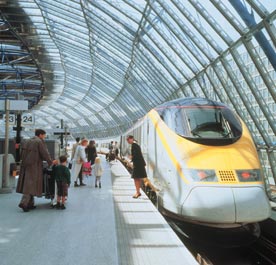 Trains are wonderful, but they usually don't stop at the origin nor at the destination of passengers' journeys. This is especially true of medium-to-long-distance itineraries. Instead, a train trip generally consists of at least three parts: getting to the station, riding the train and connecting transportation from the station at the other end. In addition, riding a train almost invariably involves (short) walks between vehicles and also at either end of any given trip.
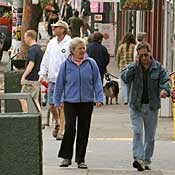 1. Walking: If you work in e.g. the financial district in SF and commute by BART, chances are you just hoof it for the last few blocks. There's no reason to assume that someone coming up from LA on a high speed train won't do exactly the same. Pedestrians average no more than 2.5 mph, less if they need to stop at traffic lights. That said, it is a little light exercise and you don't have to wait around for a bus to show up - one that might not drop you off exactly where you need to be anyhow. The converse is also true: in a number of places around the state, people are increasingly choosing to live in condos close to a subway or light rail line rather than chase after a McMansion out in the boonies, where the car is the only possible option for commuting to work, often dozens of miles away.
 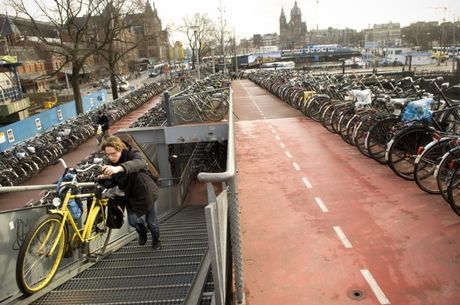 2. Cycling: In flat but crowded places like Holland and Denmark, China, Vietnam etc. bicycles are perceived first and foremost as modes of transportation. Sure, there are special bikes intended for strenuous exercise, but those are a separate category. In California, that category is almost all there is: road racers and mountain bikes. City bikes are often perceived as being strictly for kids too young to drive a car. This obsession with bikes as exercise machines may explain why pedelecs (bikes with electric assist motors) haven't really caught on yet in the Golden State, even though they let you climb hills and brave headwinds without working up much of a sweat - deal if you're about to board a train.
 There are plenty of folding designs on the market and, they're much easier to take along on any type of transit. Folding pedelecs are a new category that is only just emerging, thanks to recent advances in Li-ion battery technology, permanent magnet motors and control systems for the assist motors in these muscle-electric hybrids. China is arguably the world leader at the economy end of this emerging market.
 3. Local Transit: If you happen to live or work near a bus, light rail or subway stop with frequent and reliable service, then that may be the best option for either the first or the last leg of your trip. Unfortunately, it may not be on the other end - you may have to settle for one or more slow bus connections or else, shell out for more expensive direct service.
 Excellent connecting transit at one end a city pair only boosts HSR ridership if the same is true at the other end. In California, the volume and frequency of transit service varies greatly from county to county. The recent rapid run-up in gasoline prices prompted a renewed effort to spruce up transit services and, HSR stations provide a suitable anchor for multimodal hubs in major cities. Unfortunately, those same gasoline prices burst the housing bubble so it remains to be seen if these plans will come to fruition. Offering a single ticket valid on all transit services in a given region (e.g. the Bay Area) could boost off-peak ridership.
 4. Taxi/Limo/Sharecab Service: For those who place a premium on their time and/or their privacy, catching a cab or arranging for a limo may be the preferred option, much as it is at airports. Sharecabs (cp. airport shuttles) are not private and usually less comfortable, but they do get you to exactly where you need to be at more moderate cost. HSR stations will be excellent anchor locations for sharecab services based on vans that can transport up to 8 passengers and their luggage, supplementing fixed-route local transit or replacing it where none exists today. There is a case for subsidizing sharecab services, as they ease congestion and the related air pollution in downtown areas.
 5. Personal Car: Driving your own car to the station is often cited as the most convenient or even the only practical option. Sure, there's traffic and you need to pay for parking but you can get there fairly quickly, without having to wait for local transit, in comfort and privacy. Plus, you can take stuff along - it's especially hard to travel light with children or disabled persons in tow. Pets are another issue for anyone considering train travel. Fortunately, most railroads already operating high speed trains do permit them provided they don't bother other passengers. A leash and muzzle are often required to at least be on hand and, a half-price ticket may be required for large dogs.