Note from Robert: The below post is by Andrew Bogan, who was in attendance at last night's meeting and offered this very perceptive look at the council and its approach to the HSR project. I'm especially thankful to Andrew for posting this since all I have to go on from here in Monterey are news reports which are not always accurate or useful (I'm looking at you, Gennady Sheyner).
In Defense of NIMBYs?
The Palo Alto City Council met on March 30, 2009 for their second major discussion of High Speed Rail (HSR). The specific focus of the meeting was to approve the HSR scoping letter from City Staff to the California High Speed Rail Authority (CHSRA) for the Peninsula's Project Level EIR/EIS scoping comment period, which expires on April 6 (this date was previously extended one month by CHSRA in response to a written request from the City of Palo Alto). In addition to amending and approving the scoping letter, the City also amended and then formally approved the agreement for their participation in the Peninsula Cities Coalition, which was largely organized by Palo Alto Council Member Kishimoto. The third decision related to Palo Alto's planned letter with comments and objections to the Peninsula Corridor Joint Powers Board (PCJPB) with regard to the Caltrain and CHSRA Memorandum of Understanding that will most likely be adopted on Thursday by Caltrain's board. After the public meeting session ended, the City Attorney addressed Council in a closed session to update them on the details of the Atherton lawsuit against CHSRA that is trying to invalidate the completed Program Level EIR/EIS. The statute of limitations to become a plaintiff has expired, so the discussion was on whether the City should or should not file an amicus curiae brief in support of the plaintiffs, which includes the Town of Atherton, the City of Menlo Park (the two towns north of Palo Alto on the Caltrain corridor) along with myriad environmental groups and some "rail supporters". The Palo Alto Daily News had some of the best local media coverage of the meeting.
The Council heard brief comments from City Staff, from Lee Lipert of the Palo Alto Planning and Transportation Commission, and from the Palo Alto Historic Resources Board. Dominic Spaethling and Rod Young from the CHSRA attended the meeting, but did not speak. Mayor Drekmeier stated that CHSRA Commissioner Rod Diridon had apologized that he was in Los Angeles and could not attend and that Quentin Kopp was hospitalized with an unspecified ailment. In addition, 14 members of the community (your correspondent included) spoke during the public comment portion of the meeting. This was significantly fewer public comments than the 35 or so made at the first HSR council meeting in early March. The tone of public comments were also significantly more constructive, with the prior session's rantings largely absent. A majority of speakers specifically stated their support for HSR, although most voiced objections or concerns about how or if it should come through Palo Alto. Two speakers were expressly in favor of HSR and supported having the proposed mid-Peninsula HSR Station located in Palo Alto (including your correspondent).
The Palo Alto Planning and Transportation Commission added 26 items to the 36 existing items in Palo Alto's scoping letter, for a total of 62 points for CHSRA to address within the EIR scope. The Commission was not asked to take a stance on HSR in general or on the amicus brief and did not do so, though some members of the Commission clearly support the project. The Palo Alto Historic Resources Board provided a list of historic properties in Palo Alto near HSR's proposed route, starting with our City's ancient tree, El Palo Alto, and continuing to include the Southern Pacific Depot (aka University Ave Caltrain Station and underpass), the Green Meadow neighborhood (with its mid-century modern design and architecture), and the possibility of Southgate being a "potential historic district" (whatever that means). Green Meadow's historic homes were described to be a few hundred feet from the tracks at their closest point, so the concerns are mainly with regard to noise and vibration. A speaker from the Green Meadow community stated that "not a single household in Green Meadow supported HSR above ground". So the NIMBY concerns have moved beyond Southgate, Palo Alto's NIMBY capital.
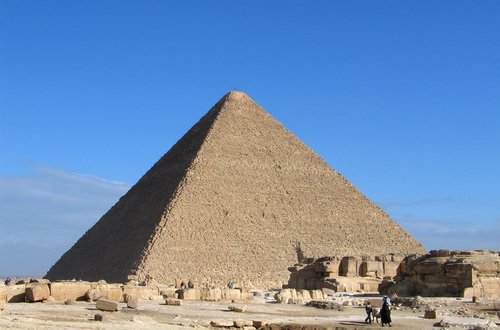
Many of the residents who spoke said the train tracks were adjacent to their property (mostly on Mariposa in Southgate or on Park Boulevard), so as Council Member Burt said, when people complain about Palo Alto NIMBYs, they need to understand the tracks are "literally in their backyard". Jim McFall's architectural rendering of an elevated structure for HSR at Churchill was shown briefly, again, though his remarks last night focused on differing views of the width of the Caltrain right of way alongside Southgate and whether or not the correct figure is 75.3 feet wide with a 6 foot rear lot line easement. Some pictures from CHSRA show Southgate's backyard fences within the defined right of way, suggesting that they might be removed without compensation through eminent domain. In his excellent rendering, McFall should space out the catenary supports correctly and add trees and vegetation to mitigate the structure's visual impact. William Cutler had the best new visual of the evening, a large cardboard pyramid, representing the size of the ones in Giza, Egypt that showed the amount of dirt needed for a mile long elevated HSR structure. His point was to emphasize that any above ground HSR solution would entail massive scale construction in and around existing homes, probably for several years. Mr. Cutler supports HSR, but is very worried about elevated structures of any significant size in Palo Alto. A petition with about 100 signatures in support of filing an amicus brief alongside Atherton was also presented, although that is a surprisingly small number of signers in a city of more than 50,000 people more than a month after they began collecting signatures. One of the NIMBY speakers stated she was "for high speed rail, but not here, not now". It was unclear what being "for high speed rail" meant to her, perhaps she likes trains to be safely on the other side of the Pacific Ocean. Another NIMBY called HSR an "airport runway in my front yard". One of the few new opinions shared last night was an older gentleman who spoke strongly in favor of HSR and reminded Council that having a HSR Station in Palo Alto would significantly slow down the speed of many of the trains passing through our city, greatly reducing the total noise produced.
The most elusive part of the meeting, and the most important, was trying to read the positions of individual Palo Alto City Council Members. With one exception, the Council held their views quite closely and were difficult to read, but one observers perspectives are below:
1. Mayor Drekmeier: He generally seems to support HSR, but requested that the 101 corridor be considered again, despite recognizing that CHSRA had already done so and would likely ignore his request. There was no mention of the impossibility of building HSR on 101 since many sections have traffic from sound wall to sound wall with a narrow concrete barrier in between that would not even be wide enough for a pillar supporting an overhead structure, let alone any kind of at grade alignment. 101 would be a good route, except it is not feasible. The mayor is a very rational person and will eventually understand this. His support is critical in Palo Alto for HSR and I hope it continues.
2. Vice Mayor Morton: Our vice mayor was the only Council Member to state his personal positions on HSR openly and it was telling that none of the others did so despite his explicit request to them. Vice Mayor Morton is of the opinion that no above ground solution is acceptable, a tunnel will never get funded, and HSR must terminate at San Jose. He believes a Palo Alto HSR Station would be a disaster and must be stopped. Vice Mayor Morton is prone to odd outbursts, like his public threat to sue the CHSRA at a Community Scoping Meeting last month and his constant inflammatory statements about Stanford University's dirty tricks and bad faith negotiations with the City. Vice Mayor Morton is dangerous, though his droning style and limited interpersonal skills probably do not pose a huge barrier to the HSR project. He does deserve credit for taking a firm stance, even if it is in favor of NIMBYism. He is a reliable opponent of nearly all development.
3. Council Member Kishimoto: She supports HSR in concept and is originally from Japan, where they built the first HSR in 1964, when she was about 10 years old. Her efforts have largely focused on educating the public about the EIR process and she has organized the Peninsula Cities Coalition, which will likely include Palo Alto, Menlo Park, Atherton, and Mountain View. Sunnyvale may also join and some other cities like Burlingame, Redwood City, and Belmont have attended some meetings, but may not join in the end. Kishimoto is trying to organize a small conference with the cities, CHSRA, urban designers, engineers, and project finance experts to try to explore all options to fund a tunnel and other HSR issues on the Peninsula. Her position is clearly pro-HSR, but she recognizes that her most vocal constituents strongly prefer a tunneling option at this point and she is prepared to advocate for it. Supporters of HSR should watch Kishimoto's lead closely, she can be a terrific ally for the project--but don't ignore the tunneling option for the mid-Peninsula, or HSR could lose a very savvy and talented supporter. She has plans to run for State Assembly.
4. Council Member Yeh: He seems broadly supportive of HSR, but very poorly informed about the details. He expressed many concerns with the Caltrain/CHSRA MOU and its description of a four track solution. He is also skeptical of Rod Diridon's ambiguous and sometimes contradictory statements to Council in the past, which is only reasonable. The YouTube videos produced by Palo Alto NIMBYs of Diridon's remarks to Council at meetings last year and last month do illustrate confusing double speak from CHSRA that has compounded the distrust of the Authority in Palo Alto and neighboring communities. Then again, how anyone thinks HSR could run on the same two tracks as Caltrain is unclear. It does not take long for a 125 mph train to catch a 79 mph train, ruining the efficiency of the entire system. As Clem would say, this is not rocket science (or biophysics for that matter).
5. Council Member Burt: Despite his usual support for HSR, his position has hardened somewhat in the past month and he expressed explicit support for the NIMBY concerns (NIMBY was his language, and it was not intended to be derogatory). The YouTube videos of Diridon saying nothing is final, then that lots of things could not be changed at this stage with regard to alignments and the number of tracks clearly angered Burt, which is understandable. He asked if anyone could imagine supporting 125 mph trains running 20 feet above existing back yards. He was very discouraged by the response he got from Caltrain regarding their MOU with CHSRA, saying that he was assured the PCJPB would represent Palo Alto's interests, but he felt they had not done so. According to Burt, Caltrain essentially told Palo Alto that it was too late to mention their concerns about 4 tracks and other specifics in the MOU. His statement about the need to build a coalition of cities and to consider "parallel strategies" sounds a lot like growing support for either filing an amicus brief or suing CHSRA in a new lawsuit. The NIMBYs have successfully turned at least one formerly pro-HSR council member into a tunnel or nothing advocate. Rod Diridon's inconsistent comments were very damaging here.
6. Council Member Klein: A skeptic all along, Klein is very concerned about the Caltrain MOU and worries that Palo Alto's concerns may not be listened to by CHSRA. He is not, however, an obstructionist or a NIMBY. Klein's concerns are practical and well thought out, like the need to determine who owns the air rights above the right of way in Palo Alto and who owns the ground underneath. Klein knows this is a long, slow process and that it is very early still. He has talked theoretically about using everything from lawsuits to state legislative action and new ballot initiatives to influence the process in the future, but he is not inclined to do anything rash. He insisted that the language in Palo Alto's letter to CHSRA say that HSR may go "along or below 3.8 miles" of Palo Alto right of way, suggesting that he supports tunneling, but almost nothing else. Overall, Klein would likely support HSR in a tunnel and he does see the value to California of the project as a whole. He will likely be a formidable opponent of anything elevated, as he knows city politics and the law very well (he is a Harvard-educated lawyer).
7. Council Member Schmid: Soft-spoken and razor sharp, Schmid has kept his views on HSR very close to his chest. He is unsure that a Peninsula Cities Coalition will actually benefit Palo Alto and generally views our City as unique, with different interests from our neighbors. He requested careful study of ground water and toxic plumes under the right of way. He also wants CHSRA to explicitly detail any potential above ground eminent domain for all the possible alignments as soon as possible, seemingly so as to understand the costs of that eminent domain to offset the costs of tunneling, at least by a tiny bit. This would probably create a firestorm of protest, but he is correct that it is better to have that now than later. He wants to explore offsetting tunneling costs with air rights and generally prefers tunneling if it is technically feasible. As one of the most logical and rational Council Members, Schmid will not likely take a public stand on HSR until well into the EIR details. My guess is that he will become a valuable supporter if CHSRA takes Palo Alto's concerns seriously and a fierce opponent if they do not. He strongly believes in cost/benefit analysis, since his PhD is in economics from Columbia.
8. Council Member Barton: Generally a supporter of HSR and an academic architect and designer himself (at Stanford), Barton has supported HSR strongly in the past and continues to do so. However, his preference is for all the rails to be underground, so that more development can be built using the right of way's air-rights. He did, however, express concerns about CEQA review and if the Caltrain MOU's mention of 4 tracks consists of a change that would require reopening the Program Level EIR. That would almost certainly be a mess and create multi-directional legal battles that could take years to resolve. It was a disappointing comment from an otherwise reliable HSR supporter. Barton, like several other council members, appeared to not understand that the MOU's mention of 4 grade-separated tracks did not rule out tunneling. This misconception is a major problem on the Council, as was pointed out in the Palo Alto Daily article.
9. Council Member Espinosa: Absent last night and always difficult to read. Espinosa, like Yeh, is quite young for a city council member and generally is pretty forward thinking. He seems to be broadly supportive of HSR on the Peninsula and actually asked staff earlier in the month to consider removing any mention of the Altamont alignment from their letter. However, he is politically astute and only did so after midnight, by which time most of the NIMBYs had gone home. It is unlikely that Espinosa would object to HSR if the alignment adequately mitigates Palo Alto's concerns, but his voice is unlikely to sway the whole Council.
In summary, the consensus view last night of the Palo Alto City Council was to continue working closely with CHSRA on the EIR for High Speed Rail, to pressure Caltrain to be more answerable to their constituent cities and three counties, and to organize a louder voice that includes neighboring cities--all constructive actions. Basically, if a tunnel is feasible then HSR will almost certainly have unanimous support on the Council. If the final alignment is an elevated structure, then a majority of Palo Alto City Council will almost certainly try to block it ever being built, which they may or may not succeed in doing since HSR has bipartisan support at the highest levels in Washington and Sacramento. However, opposing tunneling on the mid-Peninsula will be a high stakes game, since it could derail the entire project. On the other hand, a well designed tunnel would likely be supported not only by Palo Alto, but also by Menlo Park and Atherton, essentially removing the only major organized opposition to HSR in California. That might just be worth the cost of a tunnel, even if it is several billion dollars. After all, every year of delay on a $45 billion dollar infrastructure project is billions worth of construction cost inflation (which has been around 5% in recent years) and lost revenues from operation. Appeasing the Peninsula might pay for itself, if the accounting is done correctly.
Andrew A. Bogan, Ph.D.
Palo Alto, California
Tuesday, March 31, 2009
Andrew Bogan on Palo Alto City Council and HSR
Palo Alto Demands Control Over HSR Project Design And Operations; Whines When They Don't Get It
UPDATE: The council did in fact vote to file an amicus brief in the Menlo Park-Atherton suit against the CHSRA. The vote was 5-3. Kishimoto, Barton, and Drekmeier were the no votes; Espinosa was absent. The original post starts now:
Last night's Palo Alto City Council meeting showed just how absurd the city's approach to the HSR project has become. Despite the fact that most residents still support high speed rail, and that even those who want a tunnel are trying to reconcile the city's design preferences to the need for fast and environmentally friendly passenger trains, the city council seems to be demanding a level of control over the project's operations and fundamental design that is wholly inappropriate for ANY one city to have, especially a small city like Palo Alto.
According to the San Jose Mercury News report of the meeting:
The city council on Monday voted unanimously to send a letter to Caltrain's board of directors asking them to change the wording of a memorandum of understanding with the state authority, which is in charge of building a Los Angeles-to-San Francisco rail line. The letter objects to the "level of specificity" of the agreement, which would lay the groundwork for the high-speed trains to share Caltrain's land. Caltrain's board of directors will vote Thursday on whether to approve the deal.
These council members are pissed off at the four-track plan contained in the proposed Caltrain/CHSRA Memorandum of Understanding. As the article explains:
The council's specific objection was to a passage of the agreement stipulating that "ultimate configuration of the Caltrain corridor will be a four-track grade-separated high speed rail system, with mixed traffic from Caltrain commuter rail and the high speed train service capable of operation on all four tracks to enable Caltrain to achieve service levels of no less than eight trains per hour in each direction. In some places the corridor may consist of more than four tracks."
The city responded, "This level of specificity indicates that options and alternatives will be determined without meaningful public input and consultation. Palo Alto requests removal of any commitment to specific track design or operational condition without public input and required environmental review."
Translation: Palo Alto believes that a four-track design will make it difficult to build a tunnel, and therefore will almost certainly mean an above-grade structure. Palo Alto doesn't want that, and even though a four-track design is the best solution from an operational perspective Palo Alto's city council seems to believe they have the right and the power to impose inferior and inefficient solutions on the rail corridor to suit their own purposes.
Palo Alto city council members who are whining about this are implying that the four-track arrangement in the MOU is the same as saying an above-grade structure will definitely be built. It's a dishonest stance, as some people tried to explain last night:
Transit officials have said the passage actually does not commit Caltrain or the high-speed rail authority to any specific track design. A four-track, grade-separated system could be achieved through any number of design options, including a tunnel, a trench, or an above-ground structure. The authority has stated for years that its system would be fully grade-separated, which means that cross streets must pass either under or over the tracks.
The agreement does specify a minimum number of tracks, which Caltrain officials said was a safeguard to ensure the high-speed trains don't squeeze out local service. Council Member Yoriko Kishimoto passed on that message to her colleagues Monday night, but they still felt the three-county transit agency had overstepped.
Several city officials pointed out that High Speed Rail Authority Board Member Rod Diridon had told the council no decisions had been made and all options were still open. They said the agreement the authority was poised to sign with Caltrain contradicted that claim.
With each passing day the Palo Alto city council is losing credibility, and last night's meeting was a stunning example of this. They were told that no decisions had been made regarding the structure, but proceeded to dishonestly behave as if they had been.
What does the proposed MOU actually say about all this?
Ultimate configuration of the Caltrain corridor will be a four-track, grade-separated high speed rail system, with mixed traffic from Caltrain commuter rail and the high speed train service capable of operation on all four tracks to enable Caltrain to achieve service levels of no less than eight trains per hour in each direction. In some places, the corridor may consist of more than four tracks.
What the MOU lays out are the basic operational requirements of the Caltrain corridor. I don't see a damn thing that precludes a tunnel. I do not see any clear indication that Union Pacific's freight demands have been met, but that's another matter entirely. What the MOU lays out are the conditions that ANY implementation, whether above-grade or below-grade or a tunnel, will have to meet. And what some in Palo Alto are upset about is that the conditions weren't rigged to ensure a tunnel will be built.
Gennady Sheyner's recent article in Palo Alto Online is useful in shedding light on this ridiculous attitude on the part of the council:
Councilman Pat Burt, who is a member of a recently formed council subcommittee focusing on the high-speed rail, said the section of the memorandum describing the track design "stuck out like a sore thumb."
Burt said he was concerned about the contradictory statements from rail authority officials, who have long presented the four-track design as one of several that would be considered.
Is that actually what was promised? And does the proposed MOU actually violate any such promise? I am unconvinced that it does. Sheyner writes:
As recently as March 2, Rod Diridon, member of the rail authority's board of directors, told the council that the agency would consider every viable option.
"We're going to look at every alternative that was brought before us," Diridon told the council. "We'll do a thorough evaluation of every one of those alternatives."
Diridon also indicated in October -- one month before California voters approved a $9.95 billion bond measure for the project -- that Palo Alto staff would be involved in the decision-making process, which will involve a wide range of alternatives, including two-track systems and four-track systems.
"All of those will have to be examined," Diridon told the council in October. "Whether (the trains) will be in a tunnel, in a trench covered, in a trench open, whether they'd be on-grade and elevated would be studied."
"Your staff would be deeply involved in that," he added.
As I read Diridon's quote, he didn't make absolutely clear whether a two-track or four-track implementation would be among the items Palo Alto would be involved in. Nor is it clear what "involved" would include - and we do not know what meetings were held between Caltrain, the CHSRA, and city staff. Sheyner and some of those that he quotes appear to believe that "deeply involved in" a process meant that Palo Alto would get to help decide the outcomes, which would be an interpretation they chose to make and not one that is inherently truthful or accurate.
In fact, if one read the actual proposed MOU, they'd find that it does indicate that local governments like Palo Alto will continue to be involved and consulted:
III. C. High speed rail must be designed, constructed and operated in a manner fully consistent with the operational requirements of the Caltrain commuter rail rapid transit service and with consideration of the cities on the Peninsula through which the high speed rail system will be constructed and operated....
IV. A. Formulation of a plan for community outreach to the affected community, counties and governmental and regulatory agencies, and other operating entities in the corridor
That looks to me like they're planning to involve Palo Alto.
As Sheyner's article makes abundantly clear, however, to some members of the Palo Alto City Council, it's not involvement or consultation they way - but veto power over the basic conditions of the HSR system. It is neither right nor democratic to give ANY city that power, and it is extremely bad planning to fit the system around Palo Alto's own demands, instead of fitting Palo Alto's requests around the system's needs. But some in Palo Alto insist on going right down that road:
But even at that time, Councilman Greg Schmid warned that an above-ground line could hurt the community and made it clear that he was only supporting the proposition because of the possibility of running the rail underground.
"I think of high-speed rail lines going down the Peninsula and dividing the communities the way rivers used to divide communities in the Middle Ages," Councilman Greg Schmid said at the October meeting. "It's not necessarily in our interests to have this division take place in an area where the networking of ideas is the key to success."
This comment is both absurd and revealing. Absurd, because rivers were until the 19th century indispensable to civilization as they were THE primary method of transportation, offering the cheapest and fastest and most efficient movement of goods and people for most of the history of human civilization. Communities usually formed around and because of rivers, not in spite of them. I'm not sure that Londoners who had to cross the Thames in the 1590s to attend the Globe Theater would see the river as a barrier, but of course, some dude in the 21st century obviously knows better than they do about their own lived experience within their communities.
Which shows how ignorant Greg Schmid appears to be about Palo Alto's own history. In the 19th century and for some of the 20th century as well, railroads played the same role as rivers - providing the basis for communities. Palo Alto exists because of the railroad and was built around it.
The comment is also revealing because it shows that, in fact, members of the City Council were aware of the plans for the HSR line to be built above-grade before the November election, despite the claims of many residents that "omg we had NO idea!" Schmid's comment shows that those who say they didn't know about the above-grade possibility were not paying attention - and I don't see how that's the CHSRA's fault.
Other city officials made clear that they believe they should have the ability to determine the operational requirements of the system, a totally inappropriate demand:
Burt said he was concerned about the inclusion of the four-track design in the memorandum between the two agencies.
"We thought it was inappropriate," Burt said Friday. "It's a cart getting ahead of the horse."...
"I think the point we're trying to make to the HSRA (High Speed Rail Authority) is that they should not predetermine the outcome," Kishimoto said. "We expect that it will be a truly open process."
The city has also drafted a letter to Don Gage, chairman of Caltrain's board of directors, asking that the section specifying the four-track design be removed or altered.
"This level of specificity indicates that options and alternatives will be determined without meaningful public input and consultation," the letter reads.
I'm sorry folks, but Palo Alto doesn't get to determine alone what the entire state needs and deserves in terms of passenger rail capacity and service. You just don't. That's not democratic, that's bad planning, and it's just ridiculous. The CHSRA has shown it is willing to give the city the opportunity to participate in the process of deciding how the system and the service will be implemented. But folks like those quoted here are playing a different game entirely - thinking that if they want a two-track solution that they should get it, even if that is not practical or reasonable from an operational standpoint.
And when we see Palo Alto city council members making inflammatory and dishonest statements like these, from last night's meeting:
"We think that's a duplicitous message, and we intend on pointing that out," said Deputy City Manager Steve Emslie. Council Member Larry Klein added, "There are decisions being made, decisions have been made by Caltrain, and I think that taints the process."
Council Member Pat Burt said he was disappointed with Caltrain's approach. "I'm less hopeful than I was that we're going to have our voices listened to by just being persuasive and collaborative," he said.
Well, it doesn't speak very highly of the city council, which appears to have slid into outright HSR denial - just 5 months after unanimously endorsing Prop 1A, and in spite of their constituents' desire to see HSR built and integrated effectively with Caltrain. And the council even went into closed session last night to discuss filing an amicus brief in support of Menlo Park and Atherton's suit against the HSR project.
I'll leave it to Palo Alto residents to explain what exactly the hell is going on with their city council. From my perspective they seem to have taken leave of common sense, honesty, and reality. They're upset that Caltrain's board did its job by ensuring Caltrain can continue to expand its operations under the Caltrain 2025 plan by signing the MOU. They're willfully misinterpreting CHSRA statements and trying to poison the well - especially in the media and therefore in the public mind - with their deliberate distortions of the truth.
Their behavior makes it difficult for sensible and practical solutions to be delivered. There are some good people in Palo Alto pursuing tunnel solutions, and others who want to find ways to build an above-grade structure more effectively and in line with what the city needs.
Monday, March 30, 2009
To Catch A Train
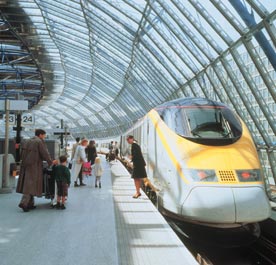
Trains are wonderful, but they usually don't stop at the origin nor at the destination of passengers' journeys. This is especially true of medium-to-long-distance itineraries. Instead, a train trip generally consists of at least three parts: getting to the station, riding the train and connecting transportation from the station at the other end. In addition, riding a train almost invariably involves (short) walks between vehicles and also at either end of any given trip.
Transportation planners like to scope these literally pedestrian issues out of their projects because there's a lot of work but relatively few construction dollars associated with them. Plus, addressing them would actually require co-ordination with other projects, a potential political minefield they prefer to avoid. However, allowing pedestrian access to fall through the cracks - e.g. between HSR stations and airport check-in counters or, between SF Transbay Terminal and Embarcadero BART/Muni - is a sure-fire strategy for failing to meet the ridership forecasts for the shiny new big-ticket services. Ideally, CHSRA should designate one member of its board to take on responsibility for adequate pedestrian facilities at transfer points. The state legislature should also insist that HSR feeder funds from prop 1A are used to optimize connections, rather than just local/regional transit capacity.
The general assumption on this blog appears to be that passengers could and would take local/regional transit to reach the nearest HSR station. Indeed, some $950 million of prop 1A are reserved for capital improvements to qualifying heavy rail "HSR feeder" services like Amtrak California, BART, LA Metro, Metrolink, Caltrain, ACE and NCTD. That's not nearly as much money as it sounds. For example, there will be little or no money left over for local/regional connecting bus services. Expect nothing at all to be available for improving pedestrian connections, e.g. between the Transbay Terminal in SF and Embarcadero, the nearest BART station.
However, like it or not, the vast majority of Californians never uses transit at all or at least, very infrequently. For the most part, that's because service tends to be infrequent and slow, except during rush hour. In addition, not everyone feels comfortable sitting or standing near strangers. Instead, decades of cheap gasoline/kerosene have enabled low-rise sprawl and got California residents used to either driving the whole way or else, driving to an airport, parking their car, flying and getting into another car at the other end. That other car might be an airport shuttle van, someone coming to pick them up or, a rental car. In short, travel within California is very oil-intensive and the hope is that HSR will make a dent in that.
However, a common objection to the California HSR project is that local transit should be put in place first, lest HSR cause massive traffic problems near downtown stations. The counter-argument is that politically, HSR serves as an anchor project big enough to prompt/accelerate the development/expansion of local/regional transit that's long been talked about but never properly funded. There is some evidence of this in that voters LA, Santa Clara, Marin and Sonoma counties all voted to increase local sales taxes to pay for improved rail transit, in addition to approving prop 1A on the statewide ballot.
Still, counting on local transit funding to ride the coattails of HSR is risky in that it forces both types of services to receive massive infusions of cash at the same time. If the political appetite for passenger rail were to dry up for any lenght of time, there's a good chance that funds intended for bread-and-butter local transit at the federal and state level would be raided to keep the politically sexier HSR project alive, with knock-on effects at the county and city levels. There is some evidence for this as well, in the shape of last-minute re-allocations of funds already within the transportation section of HR1, the stimulus bill. Indeed, the capital expenditure budgets of passenger rail and other transit services are liable to be raided at anytime by the politically entrenched highway-and-runway lobby.
These budget shenanigans will be going on all through the planning and construction phases of the California HSR project at both the federal and especially, at the state level. Urban traffic planners and station architects therefore need to anticipate a wider range of connecting transit options than just local transit. Moreover, the appropriate mix of options will be vastly different in the major HSR locations (SF, SJ, Fresno, LA, Anaheim, Sacramento, San Diego), at stations near airports (SFO, PMD, ONT, MER?) and at stations in smaller towns (Bakersfield, mid-peninsula, Gilroy, Modesto, Burbank, Riverside etc.)
Perhaps, then, we ought to take a closer look at connecting transportation from the customer's point of view. They will base their choice of vehicle on multiple parameters: door-to-door travel time, risk of delays, flexibility to reschedule, convenience, safety/security, comfort, privacy and fare cost - plus old habits that may be hard to break. No single strategy will work for every passenger, so station designers and local traffic planners have to reserve adequate room for multiple modes of connecting transportation.
1. Walking: If you work in e.g. the financial district in SF and commute by BART, chances are you just hoof it for the last few blocks. There's no reason to assume that someone coming up from LA on a high speed train won't do exactly the same. Pedestrians average no more than 2.5 mph, less if they need to stop at traffic lights. That said, it is a little light exercise and you don't have to wait around for a bus to show up - one that might not drop you off exactly where you need to be anyhow. The converse is also true: in a number of places around the state, people are increasingly choosing to live in condos close to a subway or light rail line rather than chase after a McMansion out in the boonies, where the car is the only possible option for commuting to work, often dozens of miles away. Transit villages are a welcome new phenomenon, but their long-term popularity will depend on the future price of oil.
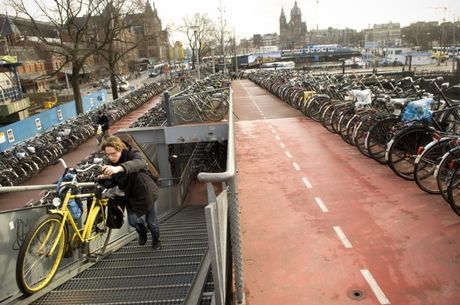
2. Cycling: In flat but crowded places like Holland and Denmark, China, Vietnam etc. bicycles are perceived first and foremost as modes of transportation. Sure, there are special bikes intended for strenuous exercise, but those are a separate category. In California, that category is almost all there is: road racers and mountain bikes. City bikes are often perceived as being strictly for kids too young to drive a car. This obsession with bikes as exercise machines may explain why pedelecs (bikes with electric assist motors) haven't really caught on yet in the Golden State, even though they let you climb hills and brave headwinds without working up much of a sweat - deal if you're about to board a train.
There are plenty of folding designs on the market and, they're much easier to take along on any type of transit. Folding pedelecs are a new category that is only just emerging, thanks to recent advances in Li-ion battery technology, permanent magnet motors and control systems for the assist motors in these muscle-electric hybrids. China is arguably the world leader at the economy end of this emerging market.
Even in Europe and Japan, many railroads still think of all bicycles as equal and are only just beginning to wake up to the potential of folding bicycles and pedelecs to increase their catchment areas without having to sacrifice space for passengers who pay full fare. Just slide your under your seat (and perhaps the adjacent one, too) - done. At first, the notion of taking a folding pedelec along on a high-speed train may seem absurd, but if you travel light it's actually a perfectly sensible option, especially if there is a courtesy outlet to let you recharge. Pedelecs are limited to 20mph by law in California and you have to be 16 to ride one. Range on a single charge is typically on the order of 15-30 miles, depending on conditions and on how hard you pedal.
The biggest drawback is that bicycles are vulnerable in traffic unless there are designated bike lanes or better yet, segregated bike paths. In California, cities are loath to close traffic lanes or entire streets to motor vehicles without a special permit - pedestrian zones are almost unheard of (except in purpose-built shopping malls). The second biggest is that biking in wet or extremely hot weather is no fun at all, so transit planners tend to discount it as an unreliable ridership source. That may be a mistake, since pedelecs are by far the most affordable personal electric vehicles and the weather in California's population centers is reliably sunny for at least four months out of the year.
3. Local Transit: If you happen to live or work near a bus, light rail or subway stop with frequent and reliable service, then that may be the best option for either the first or the last leg of your trip. Unfortunately, it may not be on the other end - you may have to settle for one or more slow bus connections or else, shell out for more expensive direct service.
Excellent connecting transit at one end a city pair only boosts HSR ridership if the same is true at the other end. In California, the volume and frequency of transit service varies greatly from county to county. The recent rapid run-up in gasoline prices prompted a renewed effort to spruce up transit services and, HSR stations provide a suitable anchor for multimodal hubs in major cities. Unfortunately, those same gasoline prices burst the housing bubble so it remains to be seen if these plans will come to fruition. Offering a single ticket valid on all transit services in a given region (e.g. the Bay Area) could boost off-peak ridership.
4. Taxi/Limo/Sharecab Service: For those who place a premium on their time and/or their privacy, catching a cab or arranging for a limo may be the preferred option, much as it is at airports. Sharecabs (cp. airport shuttles) are not private and usually less comfortable, but they do get you to exactly where you need to be at more moderate cost. HSR stations will be excellent anchor locations for sharecab services based on vans that can transport up to 8 passengers and their luggage, supplementing fixed-route local transit or replacing it where none exists today. There is a case for subsidizing sharecab services, as they ease congestion and the related air pollution in downtown areas.
5. Personal Car: Driving your own car to the station is often cited as the most convenient or even the only practical option. Sure, there's traffic and you need to pay for parking but you can get there fairly quickly, without having to wait for local transit, in comfort and privacy. Plus, you can take stuff along - it's especially hard to travel light with children or disabled persons in tow. Pets are another issue for anyone considering train travel. Fortunately, most railroads already operating high speed trains do permit them provided they don't bother other passengers. A leash and muzzle are often required to at least be on hand and, a half-price ticket may be required for large dogs.
However, the biggest downside is at the far end of the trip: either someone has to pick you up, you have to use a taxi/shuttle or, you end up renting a car. Add it all up and simply driving yourself all the way starts to look like a way more attractive option for a family of four. And therein, perhaps, lies the biggest challenge of all: persuading Californians to travel more frequently within their state but with less stuff, to make going down to Disneyland or up to San Francisco a simple weekend trip with just one night's stay rather than a major multi-day outing. For those living in the Central Valley, either destination could easily be an occasional day trip.
Conclusion: Getting the most out of HSR means adjusting the way way you work and play - it's not a drop-in replacement for the lifestyle you lead today. In particular, more frequent outings within the state will inevitably mean less frequent leisure travel to other states or overseas. The upside is that more tourism dollars stay in California, doubly so if HSR + connecting transit attract larger numbers of out-of-state tourists.
Sunday, March 29, 2009
Hooray For Victorville!?
Remember that whole Las-Vegas-to-Disneyland maglev concept that Sen. Harry Reid (D-Nev) is still pushing because it's supposedly "more Vegas"? While he's been making waves in Congress, private investors have quietly pursued an alternative based modern non-compliant multiple unit trains trains running on dedicated tracks. Diesel-electric option would run at a top speed of 125mph, whereas an electrified version could run at 150mph (top speed is currently limited by the lack of FRA rules, not the available technology). Note the faint overhead catenary in the above picture, with nary a pole in sight. Or a second track, for that matter, but perhaps that is only needed at one or more points along the route.
The big idea is to relieve congestion on I-15 and at McCarran airport in Las Vegas so folks in Southern California have an easier time getting to Las Vegas. The investors had become disillusioned with prospects for public funding for a fast a rail link. The hardest part is securing a viable ROW through Cajon Pass, which is heavily used by rail freight and includes a crossing of the San Andreas fault. Therefore, the current plan simply calls for the line to terminate at a giant new parking lot northeast of Victorville. Southern Californians would drive there, park and take the train the rest of the way.
This then is DesertXPress. FRA has announced the closing date for public comments on the draft EIR/EIS: May 22, 2009. Before then, there will be three more public hearings on the project.
- Las Vegas Area
Tuesday, April 28, 2009
5:30 – 8:00 p.m.
Hampton Inn Tropicana
4975 Dean Martin Drive
Las Vegas, NV 89118 - Barstow Area
Wednesday, April 29 2009
5:30 – 8:00 p.m.
Ramada Inn
1511 East Main Street
Barstow, CA 92311 - Victorville Area
Thursday, April 30 2009
5:30 – 8:00 p.m.
Green Tree Golf Course
14144 Green Tree Boulevard
Victorville, CA 92395
From the California point of view, there are a number of pluses and minuses here:
- PLUS: private companies are funding an HSR line (standard gauge steel wheels)
- PLUS: final nail in maglev coffin (at least on the California side)
- PLUS: congestion on I-15 should ease quite a bit
- PLUS: diesel trains require far less fuel than cars at the same occupancy rate
- NEUTRAL: SoCal-Las Vegas not part of federally designated California HSR corridor
- NEUTRAL: no stop in Barstow (limited water to support population growth)
- MINUS: project not integrated with California HSR
- MINUS: project not integrated with Pres. Obama's smart electrical grid
- MINUS: tracks (and OCS, if any) not designed for operation at 220mph
- MINUS: max. gradient 4.5% (vs. 3.5% for California system)
- MINUS: only limited relief for McCurran airport in Las Vegas
- MINUS: requires people to drive out to Victorville and park there
IMHO, there would be a lot of value in getting SoCal-Las Vegas included in the officially designated national HSR corridor for California as soon as possible. Sure, the Republicans would have a field day (for a day) but it's still the smartest thing to do.
First, it would establish that HSR out to Las Vegas shouldn't be a completely separate project, even if the tracks won't join up right away. That would give USDOT (i.e. Ray LaHood) some leverage to force integrated planning.
Second, the designation would make the tracks through the desert eligible for federal HSR dollars, which could fund the wider curves and tighter geometry tolerances required for future operation at 220mph. The DesertXPress sidesteps the thorny issue of the endangered Desert Tortoise by hewing close to I-15 east of Barstow. Nevertheless, some opposition from at least Indian gambling interests in California is likely, though siting the western terminus at Victorville makes the train less of a competitive threat.
Third, early electrification of the line would make a whole lot of sense if phase 2 of the project included a nearby HVDC power line to carry renewable electricity from the Mojave desert and Nevada to population centers in (Southern) California. But please, don't put a big solar farm and a relief airport next to one another.
Fourth, an early connection to the California network would do more to relieve McCarran airport, since 30% of its flights are to or from California cities that will be served by California HSR. At peak times, e.g. during major conventions, Las Vegas could leverage Palmdale as a relief airport, provided LAWA doesn't hobble it with a solar thermal plant right next to the runways. At 200mph cruise speed, travel time would be just over an hour. Fully leveraging California HSR and Palmdale airport would eliminate the need for a new Ivanpah Valley relief airport between Primm and Jean in Nevada, not far from the BrightSource's Ivanpah solar thermal power plant on the California side.
Sixth, project integration would permit both sides to pool both political clout in Congress and purchasing power.
The tricky part is figuring out how to integrate the projects. A spur off the SF-LA-Anaheim starter line at Mojave would make a lot of sense, but DesertXPress may not be interested in going anywhere but Victorville. A connector from there to the phase II spur between LA and San Diego is theoretically possible and would give San Bernardino an HSR station. We'll see.
Early electrification of the DesertXPress line would be excellent but it's something their web site has not previously mentioned. Note that CHSRA is currently planning its own, electrified test track in the Central Valley (part 1, part 2), which will become part of the starter line and spur to Sacramento.
View Larger Map
Saturday, March 28, 2009
Union Pacific Speaks
Never let it be said that I don't give HSR deniers credit where it is due. Morris Brown has obtained a copy of a letter from Union Pacific to the California High Speed Rail Authority laying out their stance on HSR implementation between San Francisco and Gilroy. Their overall attitude is one of "we own the corridor, either through easements or outright ownership, and you're going to implement HSR according to our guidelines."
The SF-Gilroy corridor is broken up into three pieces:
1. SF to Santa Clara, owned outright by the Peninsula Corridor Joint Powers Board (PCBJPB - set up in 1991 to run Caltrain) but where UP has an easement to run freight
2. Santa Clara to Lick, "a point approximately three miles south of Diridon Station" - UP "owns and has primary operating rights on Main Track Number 1".
3. Lick to Gilroy (and ultimately to Moorpark in Ventura County), owned wholly by the Union Pacific Railroad.
UP's stance as laid out in the letter is, in essence and going in reverse order:
3: No way in hell will HSR trains use the UP ROW between Lick and Gilroy. Their specific language is:
Union Pacific has no intention of allowing or permitting the Authority to build or operate the HSR within Union Pacific's right of way southward of Lick. The Authority should take this into account as part of the EIR/EIS for the San Francisco — San Jose segment.
2: Depending on how freight trains are mitigated, UP is fine with HSR between Santa Clara and Lick - but UP will be the final arbiter of what this means. Their specific language is:
The Authority must not undertake any action that interferes with Union Pacific's ownership and operation of Main Track No. I without prior approval from Union Pacific and the commuter agencies identified above. All adverse impacts must be mitigated to Union Pacific's satisfaction.
1: UP expects to not only maintain, but potentially increase, freight service along the Caltrain corridor, insists that its easement be respected, and that HSR be built to not adversely affect freight operations in any possible form.
Specifically, UP demands the following, which is most directly applicable to the Caltrain corridor:
(i) Slow speed freight trains and high-speed trains are incompatible on the same
tracks at any time, including cross-overs. Union Pacific requires overhead clearance of 23 feet 6 inches, which is higher than the Authority contemplates for its electrical system. The Authority must provide grade-separated cross-overs for freight trains at necessary locations. The Authority must not contemplate operation of freight trains on any HSR trackage at any time (and vice-versa). If necessary, completely separate freight trackage must be provided. HSR must comply with all applicable FRA regulations.
As far as I can tell what UP is saying is that at least one track has to be set up for freight trains, and if that requires a totally separate track, so be it - CHSRA and PCJPB are UP's bitch when it comes to making changes on the Caltrain corridor.
What does this mean for the battle over HSR implementation on the Peninsula? Brandon in San Diego lays it out like this:
any proposal to retain freight's ability with any necessary tunneling having the intent to accomodate HSR + Caltrain at the expense of an above ground alignment accomodating freight...
...will mean:
1) more costly tunneling efforts (bigger/higher, longer due to softer grade changes, and/or... ventilation) or
2) the tunneling to accomodate Caltrain + freight cannot happen at all.
If so on #2, that means Caltrain may remain above ground and possibly at-grade where they already are... and our friendly peninsula bergs are SOL.
I think that's a pretty good summation. Ultimately I think this deals a pretty significant blow to the tunnel concept as being floated by the Peninsula cities, who have floated a concept of a two-track tunnel. Unless the tunnel has four tracks and is large enough to accommodate UP freight, it's not going to meet UP's standards. Another option is to build a two-track tunnel and let UP continue operating freight trains on the surface above the tunnel, which is an absurd solution and also makes it impossible for cities to sell "air rights" to develop land above the tunnel to pay for the tunnel's costs, as some have proposed.
The only other option for Peninsula cities would be to pursue federal law that would limit UP's negotiating power. UP notes that their freight operations in this region are regulated by the federal Surface Transportation Board. Congress and the White House could, if they wanted to, pursue new laws and regulations pushing or even forcing freight railroads to accommodate HSR and other passenger rail even if they're reluctant to do so.
I am not sure we should expect that to happen. President Obama has shown hardly any desire to piss off large corporations like UP, and Congress has shown little interest in modernizing railroad law. If the federal government is serious about implementing HSR, they're going to need to attend to both, and the dispute over the Caltrain corridor may be a good place to start. But I am not confident it will actually happen.
Friday, March 27, 2009
The AP Falls for Joseph Vranich's HSR Denial
Wow, for some reason this week seems to be HSR Denier Week in the media. First we had Daniel Goldberg's moronic argument as to why California's passenger rail system is perfect just the way it is. That was a blog post on a relatively small newspaper's site, and came and went pretty quickly.
Late this week, however, a much bigger piece of HSR denial hit the national media in the form of an AP article by Deborah Hastings that was carried in the San Jose Mercury News, the Chicago Tribune, the Atlanta Journal-Constitution, among other major papers. The article, titled "Billions for high speed rail; anyone aboard?" gives considerable space to letting noted HSR denier Joseph Vranich space to attack high speed rail without rebuttal. So it's our job to provide what Deborah Hastings wouldn't - facts.
But this country has never built a high-speed "bullet" train rivaling the successful systems of Europe and Asia, where passenger railcars have blurred by at top speeds nearing 200 mph for decades.
Since the 1980s, every state effort to reproduce such service has failed. The reasons often boil down to poor planning and simple mathematics.
This is simply not true. As her own article shows, the actual reason is simple and singular: the United States has not shown the political leadership necessary to see HSR projects through to completion, largely because passenger rail has for the last 50 years been starved of funding in favor of roads and airports.
California is the only state with an active project, and its proposed cost is more than five times the stimulus amount. The $42 billion plan is far from shovel ready—it's still seeking local approvals—but it's farther down the track than any other state with an outstretched hand for a slice of Obama's high-speed pie.
This is also untrue. In addition to the already-identified list of projects the California HSR project can begin by 2011, it is believed that large chunks of the system can be ready by 2012 or 2013.
It doesn't help that Hastings steadfastly refuses to point to the role of Republican HSR opponents in killing these projects. Jeb Bush played the leading role in 2004 in killing Florida's project, and George W. Bush did the same while Texas governor in the mid-1990s. Southwest Airlines' opposition to the Texas project also played a significant role.
After misleading readers about the fate of HSR in Texas and Florida Hastings then lets Vranich spew some HSR denial:
"In virtually no way does the Acela Express perform near overseas standards," says author Joseph Vranich, a former Amtrak public affairs spokesman and president of the High Speed Rail Association. In 2004 he wrote a highly critical book titled, "End of the Line: The Failure of Amtrak Reform and the Future of America's Passenger Trains."
He's equally unimpressed with the federal stimulus money.
"Here's what's going to happen: The (Obama) administration will issue these funds in dribs and drabs—to this project and that project—and the result will be an Amtrak train from Chicago to St. Louis that takes maybe 15 minutes off the travel time."
Current Amtrak travel time between the two cities is about five hours, 30 minutes.
Nobody expects Obama's HSR stimulus to all by itself produce true high speed rail in this country. But if it is accompanied by a real national strategy - and Obama's budget plans suggest he is interested in doing that - then the HSR stimulus can help initiate that project, which is all anyone ever expected anyway.
Trying to make American trains run faster will always go off the rails, Vranich says, as long as planners keep trying to recreate overseas systems. "We're not Europe. We're not Japan. We're looking at shorter travel times, through population densities that are much higher."
Wait a minute. I thought the flaw with HSR in California and the US is that we had too little population density for the ridership to be there. Now the flaw is that we have too much?
It's hard to keep HSR denial straight these days.
Wednesday, March 25, 2009
How Important Is UPRR To California HSR?
Note: The Blogger service will be down for scheduled maintenance on Thursday 3/26 between 4:00pm and around 4:10pm. We apologize for any inconvenience.
On Tuesday, an article in the Hollister Freelance discussed the HSR project from the perspective of Gilroy and the cities that will be in the catchment area of the planned stop there. The piece is timely, since the High Speed Rail Authority will host a project-level EIR/EIS scoping meeting in Gilroy this week (cp. heads-up at the end of this post):- Thursday, March 26
- 3-7pm
- Hilton Garden Inn, Ballroom A, 6070 Monterey Road, Gilroy
- Spokeswoman Zoe Richmond said her employer gets "very skittish" about freight trains running in close proximity to high speed rail, whose equipment is very light, [very] fast and carries [lots of] passengers. A UP train derailed and spilled coal onto an [adjacent] light rail line in [Littleton, Colorado on 11 December of 2007, causing the light rail train to derail as well. None of the 30 passengers on board was injured but] Mz Richmond characterized the incident Richardson as "too close for comfort", adding that safety is her company's primary concern.
- She also raised concerns about continued access to the existing customer base and winning new business, because freight trains cannot easily and safely cross high speed rail lines at grade. It would be counterproductive if bullet trains ended up forcing freight onto the state's and the nation's roads.
- In the same vein, Joseph Thompson, a transportation lawyer in south Santa Clara county claimed that CHSRA had not yet clarified how it would cross UPRR's tracks between Santa Clara (where they run west of UPRR's Alviso line) and Pacheco Pass, well east of Gilroy. He asserted that "Union Pacific's eminent domain trumps High Speed Rail's" because it had been delegated by Congress and President Lincoln.
View Larger Map
The sections of concern are south SF-Gilroy, south Fresno-Merced, the northern approach to Tehachapi Pass, Mojave-Palmdale in the Antelope Valley and part of the Inland Empire route for the phase II spur to San Diego. The Merced-Sacramento section and the "HST/commuter overlay" that is "under consideration" would also raise concerns. All told, roughly 50% of the entire preferred HSR route requires appropriate agreements with UPRR.
Note that while the PCJPB owns the Caltrain ROW, the terms of the 1991 contract with SP - which UPRR acquired in the context of a merger a few years later - give UPRR limited but perpetual trackage rights and 30-minute windows during which it may run its trains "at commuter speeds". For more details, please see Clem Tillier's posts Freight on the Peninsual, Port Pork and Memorandum of Understanding. Legally, CHSRA only needs to deal with the PCJPB, but the latter needs to ensure UPRR's rights are upheld in the process. That could put Caltrain in the middle of a dispute between CHSRA and UPRR, so it should insist on three-way negotiations for issues related to operational safety.
Now, let's examine the concerns raised above in reverse order:
Re 3: In the 19th century, Congress declared that privately owned for-profit railroads were performing a public service by moving goods and passengers around the country. To that end, Congress delegated to them strictly limited powers of eminent domain for the purpose of expanding the public service. In practice, that referred to widening rights of ways, acquiring land for new turnoffs, sidings, yards etc. The idea was to protect railroads against speculators and other landowners who could otherwise exact extremely high prices because railroad alignments must meet certain minimum radii, maximum gradients etc.
The delegation of eminent domain was not intended to allow railroads to prevent competition or other public services from being delivered. Since Nov 4 2008, California HSR is arguably a public service in development. It is therefore not immediately clear that UPRR's powers of eminent domain would trump those of the state of California, let alone those of Congress. However, it is extremely unlikely that anyone will seek eminent domain against UPRR anyhow, even for air or ground rights needed to cross. The objective should be to negotiate in good faith.
Re 2: For now, CHSRA, Caltrain and others are drafting plans that ensure existing freight operations can continue unhindered. In practice, that may mean the monopoly dispatcher for a given corridor may need to instruct one or more bullet trains to slow down or stop to give a freight train the opportunity to cross over to the non-HSR tracks via a diamond. Alternatively, the split of HSR and regular tracks could be defined such that most freight movements are anyhow unaffected. For the remainder, one option would be grade separation between the HSR tracks and freight spurs off the main line. Another, possibly cheaper alternative would be to pay UPRR and its customer to stop using a given spur.
Re 1: UPRR has been in business for 146 years, during which time they've forgotten more about freight railroad operations than CHSRA can ever hope to learn. In particular, they are fully aware of the risk of derailments, which is very small but non-zero. Since US-style heavy freight trains can be up to a mile long, the engineer in charge of a train may not even notice the derailment of a single truck on a single car at first. Indeed, major derailments involving cars tipping or toppling over and fouling adjacent track are quite rare. Usually, a train can be brought to a full stop long before that happens.
UPRR's concern relates to the early detection of a derailment event and, to sending early warning to the operator of the service on the adjacent track - preferably via computer-to-computer messaging to avoid delays related to human-to-human interactions. Time is of the essence because a bullet train traveling at 300km/h can take 40 seconds to come to an emergency stop (less if traveling at e.g. 200km/h). During this time, it can cover well over a mile. With CHSRA planning up to 12 trains per hour each way (esp. on the network's trunk line in the Central Valley), the probability that a bullet train traveling at high speed would be within 60 seconds of the site of a freight rail derailment could be as high as 40% during peak travel periods. That's if the freight train has already derails, a very low probability event.
The upshot is that even if the bullet train's automatic/European/positive train control system were notified of a derailment on an adjacent track and applied the emergency brakes immediately, there would still be a high residual risk of a follow-on collision if the derailed freight train were to foul the bullet train tracks. If that were to happen at significant relative speed, the result could be catastrophic loss of life.
It is a fairly pathological scenario but one that is at least theoretically possible. In general, engineers define a hazard as the product of the probability of occurrence and the damage done. Indeed, Burlington North Santa Fe (BNSF) has not raised a red flag on this issue (at least not in public), perhaps because it perceives the hazard as much lower than UPRR does.
In any event, UPRR published a press release on June 4, 2008, giving notice that it had had no discussions with CHSRA on operational safety in two years and no interest in selling any of its ROW. Mehdi Morshed, the authority's senior engineer, responded with a terse press release of his own, stating that HSR would not share track with UPRR freight trains and citing the excellent safety record of HSR elsewhere in the world (cp. Union Pacific's HSR Games). Note that the circumstances of the 1998 Eschede disaster in Germany had nothing to do with freight trains and everything to do with the hubris of Deutsche Bahn's engineers - it is simply not germaine to the issues raised by UPRR.
That does not mean there is no hubris on CHSRA's part here. US freight railroads are private companies that must pay property taxes on their rights of way, while their competition - the trucking industry - gets a heavily subsidized ride on the nation's highways. Considering US freight rail operators are for-profit corporations, it is not surprising that they should try to make do without expensive active safety systems and keep maintenance overheads on their infrastructure and rolling stock as low as possible without compromising safety in the existing operational context. UPRR does not want to increase its cost of operations just to accommodate high speed rail.
In other words, if CHSRA wants to have any chance of sticking close to its preferred route, it will need to sit down with UPRR and discuss safety concerns regarding derailments in the California context. Unless and until UPRR's engineers are satisfied that these concerns are being taken seriously and adequate measures to keep the hazard acceptable are feasible, the business managers will not be willing to offer any part of the ROW. Moreover, they may raise a red flag with FRA even if no land is transacted. Considering a mile-long heavy freight train traveling at 70mph represents a vast amount of kinetic energy, the civil engineering approach ("add more concrete") may not be sufficient to prevent track fouling in the event of a freight train derailment.
Similar concerns apply to a freight train derailing and hitting a support column for HSR on an aerial structure or, fouling an open trench containing HSR tracks.
FRA has already done some work regarding the aerodynamic interactions between Amtrak Acela Express and freight trains on adjacent tracks. The largest impact was on empty, tall freight cars passed at a relative speed of 110mph. At higher speeds, the response was less pronounced in spite of the greater load pulses at the bow and stern of the passing train because those pulses also lasted less long. The aerodynamic shape of the Acela meant its interactions were less severe at 150mph than those produced by conventional Amfleet trains at 125mph. In any event, the interactions were not considered severe enough to cause a freight train to derail.
The inverse problem, i.e. the serious derailment of an HSR train - mercifully an extremely unlikely event, even in an earthquake (cp. Shake, Rattle and Roll) - could set the scene a follow-on accident with an approaching freight train. However, since there will be far fewer freight trains and they travel at lower speeds, this hazard is a secondary concern. Besides, life is risk, there is no such thing as 100% perfect safety in the transportation sector. The cost of safety measures has to be commensurate with the hazard reductions they achieve.
If CHSRA has not yet done so, it might want to consider hiring a recently retired senior US railroad operations manager with an engineering background, specifically to reach a technical understanding and mutual comfort level with UPRR. Worst case, CHSRA may find UPRR unreceptive even after good faith efforts to address safety concerns. If CHSRA can secure a brand-new ROW that is sufficiently removed from UPRR's, e.g. in the San Jose-Gilroy section, it might well still be possible to proceed without having to redo that portion of the program EIR/EIS.
Plan B?
Otherwise, the only remaining option would be to select a route that minimized or eliminated statewide interactions between UPRR and the high speed rail system, even if BNSF remains willing to share its own ROW in the Central Valley. The most significant impacts would be on the way out of the Bay Area, on the detour via Palmdale, on the spur up to Sacramento and, on the spur through the Inland Empire - four major aspects of the planned network.
Nevertheless, a solution would be possible, at least for the starter line, see the following map. Please note that the alignment implementation details (at grade vs. below grade) are only valid for the section west of Tracy.
View Larger Map
For argument's sake, I've assumed an HSR-capable link across the San Franciso Bay at Dumbarton will prove infeasible because of the Don Edwards National Wildlife Refuge. However, I have assumed an arrangement acceptable to all parties will be found for the entire Caltrain ROW but not for the section down to Gilroy where more freight trains operate. Under that specific set of assumptions, the south bay HSR station would probably have to be moved from SJ Diridon to SantaClara/SJC to secure run-through tracks to the I-880 median. The HSR tracks would cross underneath UPRR's Alviso line and skirt the vast Newhall yard VTA has reserved for BART to the east. It would make sense to reserve part of that yard for additional HSR platforms and/or a yard, especially since it would lie one level below the BART facilities.
The next problem would be crossing over to Pleasanton/Livermore. The BART extension to Fremont Warm Springs and beyond means that CHSRA's Altamont variations based on a route through Niles are no longer feasible. Instead, the most likely option would be to tunnel underneath CA-262 and all the way across to Haynes Gulch (Calaveras Road). Six miles long, it would only just be legal to construct this without a third service/escape bore. At least the Calaveras, perhaps even the Hayward fault would need to be crossed underground. Fortunately, approaching Sunol from the south means the new route could bypass both Pleasanton and Livermore by tunneling across to El Charro Rd, one of the alignments being considered for the BART extension to Livermore. The HSR alignment might need to remain underground to cross under both the UPRR Altamont Pass line and Livermore municipal airport. The lakes near El Charro Rd might have to be drained, at least during construction. I'm not sure what they are used for.
HSR would continue east in the I-580 median, deviating only once to keep the alignment sufficiently straight for high speed service. In the interest of keeping express line haul time down, the Tracy station would end up in the I-205 median, well north of downtown. Beyond it, the CA-120 median and sections across farmland would connect the new route to the BNSF alignment just south of Escalon. Modesto would be served at E. Briggsmore, Merced county at Castle Airport with a possible detour around the Merced town.
The BNSF ROW through Fresno is not straight enough for high speeds, even if adequate noise mitigation measures could be found. It might make more sense to construct a western bypass for HSR/BNSF/Amtrak (3-4 tracks) through farmland and, to run a new DMU-based light rail service on the old BNSF ROW through town. This would deliver passengers from downtown to basic "beet field" HSR stations near Gregg and Bowles that would each be served by 50% of the trains originally slated to stop in downtown Fresno.
Unfortunately, even with all these measures, switching to Altamont implies a line haul penalty of 8-10 minutes for SF-LA express trains, relative to Pacheco Pass. To compensate, the detour via Palmdale would have to be sacrificed (cp. Future's So Bright...) in favor of the technically more challenging but already studied alignment across the Grapevine, past Lake Castaic Wildlife Preserve. For LA county, this sacrifice would presumably not be acceptable unless at least Ontario airport were well served by HSR as early as possible - not an easy proposition if UPRR refuses to co-operate (cp. Quo Vadis: LA- San Diego).
Conclusion: CHSRA had better get into UPRR's good graces, or the entire project could potentially face massive changes to the route, with the fate of some portions (e.g. Stockton - Sacramento) unresolved. The relevant sections of the program EIR/EIS would then have to be re-done, setting the project back by several years. In particular, simply buying land from someone other than UPRR but very close to its ROW may not be sufficient: UPRR could still raise a red flag with FRA if it feels its concerns regarding integrated operational safety and by extension, liability for accidents and loss of revenue, are not adequately addressed.
Daniel Goldberg Reaches New Lows in HSR Denial
On Monday the Ventura County Star ran a good article on high speed rail. That prompted on Daniel Goldberg, who writes a blog for the VC Star's website, to write one of the silliest pieces of HSR denial I've ever seen. Even though it's absurd on its face, it's worth deconstructing these arguments which are likely to be with us for some time, especially as contentious debates over HSR implementation continue.
Goldberg starts with:
On Monday's front page there was an article about $8 billion in stimulus funds that might be allocated to high speed rail. My initial response was "why can't we stop wasting money?" The high speed rail debate has been going on for years, I think if it really was worth it, we would have dont it by now.
Obviously Goldberg has no clue about how major infrastructure projects are designed and permitted in this country, nor is he aware that we were supposed to vote on this in 2004 but Arnold Schwarzenegger insisted on delaying the vote for HSR bonds to 2006, and then to 2008.
Yes, building the fancy train set might create some jobs, but what about the long run.
Does he assume the train will vanish after 10 years? That it's got some sort of Mission: Impossible self-destruct system? In fact the HSR system will be a central part of California's long-term economic strategy, providing jobs and savings for decades to come. One estimate was that 450,000 jobs would be created by 2030 by the system - nothing to sneeze at.
Our state is already equipped with airports in every major city. And most minor cities also have small airports.
This is more of the usual "air travel means trains aren't necessary!" nonsense we usually see from HSR deniers, people who have probably never actually used some of these small airports. Many, like San Luis Obispo airport, are seeing declining passenger levels and carriers are abandoning the small airports in droves. Of course, peak oil means that the cost of flying will continue to rise - $49 fares from SF to LA will be a thing of the past in 2018.
Furthermore, let us not forget about our current rail system. Besides the Metrolink accident that occurred late last year, the current system works. Trains run daily all over the state and in an efficient manner. This brings me to the old saying, "If its not broken, don't fix it." Lets hope the wiseguys up in Sacramento subscribe to it.
Obviously Goldberg has never actually used a passenger train in California. They run daily, and are efficient given their enormous constraints. But they are wholly inadequate to the task of meeting California's overall transportation needs in the way they can and should. It shouldn't take 12 hours to get from SF to LA via train. It shouldn't even take an hour to get to LA from Santa Ana on a train. California's passenger trains, especially the intercity trains, have attracted a lot of riders and dedicated supporters, but I doubt any of them would say that the present situation is adequate or acceptable.
Especially given the need to boost non-oil based forms of travel, for environmental, economic, and energy reasons. But then I'm guessing Goldberg doesn't believe in global warming either.
He concludes his ill-informed rant:
Back to the $8 billion at hand. I am plenty sure it can be used for a better purpose. What about all those teachers who were just laid off or buying books for students. I imagine it would be better to invest the stimulus money into education rather than on infastructure, and especially for infastructure we DO NOT NEED.
And in the actual version, the "DO NOT NEED" is in a much bigger font than the rest of the text, as if we're too stupid to understand that's his point without being shouted at.
As to the issue of other needs, like schools - we've actually discussed that very issue before, back in May 2008, and ironically based off another ill-informed bit of HSR denial that ran in the Ventura County Star.
The points are still valid today. HSR isn't taking money from schools. The state contribution comes from general obligation bonds, paid out over 30 years at what's probably going to be an annual cost of around $600 million (and that's the higher end of the estimate). Our K-12 schools, however, face a $9 billion cut this year.
If you want to fix our schools, we need to raise taxes. There's no way around it.
But the issues go deeper. Why is California's budget in a mess? For 30 years now we have had a structural revenue shortfall - in other words, for the last 30 years we have not raised enough tax revenue to pay for our basic needs. The solution to this is NOT to turn to bonds - a structural problem needs a structural solution, and bond debt isn't such a solution.
Bonds are properly used to build long-term infrastructure. To pay for ongoing costs like education, we need more tax revenue.
Further, the economic crisis - what I believe to be a Depression, but what many are now calling the Great Recession - is sending tax revenues into the tank. That economic crisis is largely due to the effects of high oil prices on an economy based on sprawl and automobile commuting. If we want to recover from this crisis, grow the economy, generate new tax revenues, and pay for schools, then we need to get off of oil NOW. High speed rail helps get us there.
Unfortunately, HSR deniers refuse to acknowledge any of this, and that means they and their silly arguments will be with us for many years to come.
Tuesday, March 24, 2009
BruceMcF on Transbay Terminal
Note from Robert: Bruce McF has been generous enough to allow us to post this excellent discussion of the Transbay Terminal trainbox and track issues that he wrote. In addition to the link to his own site he gave below, he posted it over at the European Tribune as well, where as usual there is a good discussion on this.
From Burning the Midnight Oil for Living Energy Independence
I was able to get an interesting look into the proposed future of Intercity Travel in the Bay at the Transbay Terminal (TBT) in San Francisco.
Senate Info Hearing on High Speed Rail in California
Note that I am not trying to give "objective reporting" on this issue but rather to give vent to my reaction to watching the hearing online ... see The Troubling Discord Between Transbay and High Speed Rail Authorities for a less hot under the collar reaction..
One piece of information is that in California, when one public authority has the funding for sufficient staff and another doesn't, and it comes to a fight, it is considered fair game for the staffed up authority to toss up spin and red herrings and biased analyses, confident that the other authority does not have the capacity to answer promptly.
Late on in the piece is the technical guy from the Transbay Terminal (TBT) project putting in all sorts arguments against changing the design of the TBT "train box", without concern or regard for whether the arguments would be considered fair or impartial by a disinterested third party. He compared:
- the station stopping time at a through platform to the station stopping time at a terminal platform;
- the terminal turn-around for a regional rail service running between San Jose and San Francisco with a long distance rail service for a train that arrived from Anaheim/LA (or even, in Stage 2, San Diego); and
- the number of services on single routes in Japan and Europe with the number of services for the main northern terminal for multiple routes in California
He wasn't the only one with tricks up his sleeve ... one of the Senators asked after the terminal capacity at Anaheim. The answer, by the way, was six platform tracks for what is supposed to be the secondary Southern Terminus when the full system is complete ... two more than the TBT proposes for HSR, at what is supposed to be the primary Northern Terminus.
How many HSR services should be allowed for?
On the other hand, the California High Speed Rail Authority (CAHSRA) seems to be making claims that are difficult to support. They seem to have asked for an ability to support 12 trains per hour (tph), with 40 minute platform dwell times, claiming that they need 9 to 10 platform tracks.
First, the basic math ... 12tph with 40 minute platform dwells, inclusive of headways, is 8 platforms.
More fundamentally, though, where are 12 trains per hour coming from? That is a technical requirement for through stations, because the HSR line is designed to permit trains to pass at five minute intervals, and along the line, you cannot allow one service to block the next in line.
For the terminal station, the question is the number of services that might start or end at the station. For the California HSR system:
- LA and the Bay is the backbone transport market for the HSR system ... there could well be demand for one LA/Anaheim Express and, half an hour later, one LA/San Diego Express
- Running Express Routes drops off very useful trip pairs, so there will be demand for a Semi-Express, and the likelihood is that the hour that supports two Bay/LA Express services will support a Bay/LA/San Diego Semi-Express.
- The Central Valley will be within three hours by an all-stops HSR to both LA and the Bay ... and within two hours of one, the other, or both. So in addition, one all-stations LA/Anaheim HSR service per hour providing access to and from the CV ... bearing in mind that while this is a smaller transport market, the HSR will grab a larger share of the total market
So this is 4 trains per hour ... 1 train per hour on four distinct services ... without even considering a Fresno special, or a spur at Mojave for Las Vegas.
And when the 400 seat single level, single set trains start filling up, its better for building ridership to increase frequency than to increase capacity. 2 LA/Anaheim Expresses per hour, split the all-stops CV into Express Fresno then all-stops to LA and all-stops to Fresno and Express to LA, and a mix of Express LA/San Diego and Express to LA then all stops to San Diego, and we are already at 6tph.
Indeed, as blogger DoDo on the European Tribune notes, the service schedule that the HSR ridership modeling is based upon (pdf) implies up to 8 trains per hour at the TBT.
Twelve trains per hour may be aiming too high, but six trains per hour clearly risks aiming too low.
Given the massive cost of building more capacity after the original foundation has been laid, the capability for eight (8) HSR trains per hour seems to be a perfectly reasonable expectation for the primary northern terminus for the system.
Following the trail of red herring
Now, when someone deploys deceptive comparisons and unbalanced comparisons, I have a reflex reaction ... a pile of red herring is normally used to cover something up.
And that something seems to be is a design flaw.
The TBT "train box" includes two "tail tracks", allows trains to get off the platform, either for overnight parking or for non-passenger operations like restocking and cleaning, without using up space in the tunnel.
What this means in theory is a train can arrive at an arrival platform, unload passengers (which is a very quick operation, since trains have far fewer passengers per door than airplanes), move to the tail platform to make room for the next train, get trach unloaded, seats needing deep cleaning looked after, food and beverage restocked, and then get move to the departure platform.
And the TBT tunnel access is designed with three tracks, which eliminates all sorts of potential bottlenecks:
- Both Caltrain and HSR services arrive in the TBT on the central track
- A Caltrain service departs from the Caltrain island platform using the "inner" tunnel track, which opens up the platform for an arriving Caltrain service
- After the departing Caltrain service has left, the arriving Caltrain service switches over to the "inner" track to get to the Caltrain island platform
- HSR services run directly to the central arrival island
- Passengers depart the HSR services, the train goes to the tail track for restocking and to clear the platform for the next service, from the tail track to the departure platform, then depart using the "outer" tunnel track
This is a system that allows three different islands to be accessed with little interference, because only two islands receive incoming trains, and because each type of service has its own dedicated departure track ... so they can arrive in sync, dwell in station for different lengths of time, and leave on their own schedule.
In particular, it allows the HSR trains to be in the station for over 40 minutes, while only occupying the platforms for 30 minutes each, raising the capacity of four platforms from six trains per hour to eight trains per hour.
This also makes it easier to organize efficient movement of passengers, since passengers are either leaving or arriving at each HSR platform ... there isn't a the problem of departing passengers getting in the way of arriving passengers.
With this approach, 4 platform tracks support 8 trains per hour ... which is to say, adequate to the needs of the planned HSR system with enough spare capacity to allow for some growth.
The Design Flaw
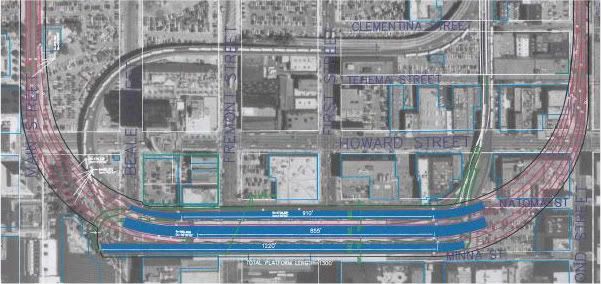
The design flaw ... for supporting 8tph, that is ... may not jump out at you, but its in the picture, taken from the 2003 "locally preferred option" design for the TBT Environmental Impact Report. The right hand side is the tunnel from the present end of the rail line. The left hand is the turn to the tail tracks.
Now, the HSR platforms have to be designed for long trains ... once the capacity is filled with 8 car, 400 seat trains, they can be extended to 16-car, 800 seat trains, and then by moving to bi-level trains, 1400 seat trains. That means a 1,320 foot long platform. That means that the bottom two islands are for the HSR and the top island is for Caltrain. The bottom two platforms need to be stretched a bit, and the middle one straightened somehow ... but the TBT technical person said that that had been fixed up.
So, stepping through the pictured design:
- Counting access tracks, three tunnel tracks split up to make six platform tracks. So far, so good.
- For Caltrain to operate as described above, a switch will have to be added so Caltrain services can get from the middle tunnel track to the "inner" tunnel track which leads to the Caltrain platform. And since the outbound train has to leave the Caltrain platform before the inbound train can arrive, that will work just fine.
- The two Caltrain platform tracks are connected directly to the Caltrain exit track, so that will work just fine.
- For the HSR trains to operate as described above, the central island is the arriving platform, connected directly to the tunnel track that brings trains in. That will work just fine.
- That leaves the bottom island as the departing platform. The two platform tracks at this island are connected directly to the HSR exit track, so that will work just fine.
- And the tail tracks ... are not connected to the bottom platform track. Instead, the bottom platform track comes to a dead end. That is not just fine. Indeed, assuming that the TBT has the staff that they likely know all of this already, that might be what the pile of red herring is supposed to cover up.
What can be done to straighten up the mess? One approach is to swap the Caltrain platform from top to bottom ... and trim a substantial piece from the front (right hand side) of the bottom platform. In fact, trim enough from the front that the switch between the two platform tracks is after the single tunnel track has rounded the corner.
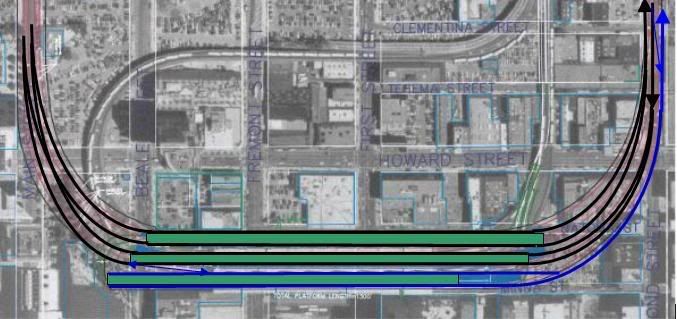
Note that this is just a rough sketch
Trimming off the front of the bottom island allows the middle island to straighten up. Straightening up the middle island allows the top island to straighten up.
The middle island can be straightened up a bit by extending the tail track directly from the middle platform, with switches connecting the top island, which gives more room before the platform track must bend to form the rail track..
This might not be enough for 1320 ft. of straight platform, but it'll be a lot closer ... and, after all, the CAHSRA is probably overstating how much straight platform they need, since the platform only needs to be straight for the passenger car portion. A little bit of bend for the driver cars at the front and rear of the train can be tolerated. If this can get 1200 ft.. of straight platform with a 60 ft. curved part on either side, that certainly seems like it ought to be OK.
So, if both sides are wrong, who is going to admit it?
The question that puzzles me the most is not the technical one ... as tight a squeeze as it may be ... but the political one. The TBT authority have made public claims that present a picture of basically being ready to go, except for the fantastical demands of the CAHSR authority. The CAHSR authority has made fallen into the trap of making an ambit claim that they will have to strain to support ... but if that costs them the political argument, the fact that the TBT train box is an inadequate design is likely to be lost in the collapse.
The only player that strikes me as having the opportunity to say, "wait a minute, here's a fix that won't cost all that much to implement" is Caltrain. But ... under the solution above, they are giving up a 900 ft. platform, connected to the tail tracks, for what could end up being a 800 ft. platform, with only one connection to the tail track, and that connection only available when the closest HSR platform track is empty.
To Be Continued ...
Anyway, that's the puzzle. But there's another possibility ... one which might be of more appeal to Caltrain ... so I am going to end this with an ellipses.
...
-Bruce
Monday, March 23, 2009
Arnold Schwarzenegger on HSR; and an Unusual Poll
So, I don't quite know what to make of this poll, but I'll pass it along anyway. The San Francisco Examiner is reporting on a poll done by BW Research Partners. The poll is about HSR, but takes what I would consider something of an odd tack - asking if Californians would support HSR even if it meant limiting air travel to do so:
Would you support limiting flights to cities in California and having passengers use a high-speed-rail system to get to destinations in Central and Southern California?
Support: 56%
Oppose: 17%
Not Sure: 26%
No answer: 1%
Would you still support limiting flights if you knew that the high-speed rail would cost about the same as air travel, but would take 2½ hours to get to Southern California?
Yes: 79%
No: 8%
Not sure: 12%
No answer: 1%
The survey by BW Research Partnership, a public-opinion research firm, asked as many as 2,000 registered voters questions about how they would envision the future of the major airports in San Francisco, Oakland and San Jose.
Umm...OK. I'm not quite sure that the issue is "limiting flights", since the experience of HSR on major corridors (Madrid-Barcelona, or London-Paris) is that the travel market shifts and flights decline as a response to changing ridership patterns and not to legislative mandates. I'm not aware of any efforts to officially limit flights in order to help build HSR, so I really don't know what generated this poll. Nor do I know who paid for it.
It is worth noting that HSR will be integrated with air travel in California - at SFO, SJC, potentially PMD (Palmdale) ONT and SAN. SFO's administrators welcome high speed trains, and we're seeing similar support emerge among San Diego airport planners.
Still, the poll does show that at least in the SF Bay Area, Californians strongly support HSR even if it were to be framed as undermining air travel.
Public support as shown in this poll (for whatever it's worth) is bolstered by support from leading American politicians, including Governor Arnold Schwarzenegger, as expressed on Meet the Press yesterday morning:
Schwarzenegger was joined on the Sunday morning show by New York City Mayor Michael Bloomberg and Pennsylvania Gov. Edward G. Rendell, who are part of a bipartisan coalition of elected officials pushing for increased infrastructure investment.
"Look, everyone gets stuck in traffic. There is no reason why we should get stuck in traffic," Schwarzenegger said on the show.
More than once during the interview, the three elected officials spoke of high-speed rail.
"This country desperately needs to build a high-speed rail passenger system," Rendell said, adding that other infrastructure projects also were of vital importance.
You can see some of Arnold's remarks on this, including his desire to use public-private partnerships to fund this (but also willing to consider a higher gas tax), here:
Of course, Arnold tends to play a governor on TV but not off screen. He is notorious for playing up his leadership when the cameras roll, but for not being willing to assert leadership within government for important projects or bills. If Arnold wants HSR to be built, he could for example ensure that the CHSRA gets the $29.1 million it needs to continue operations, or help produce a solution to the Transbay Terminal mess, or help resolve the dispute on the Peninsula. That's more valuable at this point for the HSR project than going on Meet the Press yet again to show how awesome he us.
Sunday, March 22, 2009
Sunday Open Thread: Central Valley + Sunnyvale
UPDATE: The Fresno Bee reports that CHSRA is hosting additional scoping meetings for the project-level EIR/EIS process.
Tuesday, March 24, 3-7pm: Visalia Convention Center
Wednesday, March 25, 3-7pm: Fresno Convention Center Exhibit Hall
If you're planning to attend, the following questions need answers IMHO:
a) where is CHSRA at in ROW negotiations with BNSF for south Fresno - Bakersfield?
b) where is CHSRA at in ROW negotiations with UPRR for south Fresno - Merced (- Stockton)?
c) how fast does CHSRA intend to run HSR express trains (SF-SJ-LA-Anaheim stops only) in the Central Valley, specifically in the downtown areas of Fresno, Bakersfield and smaller towns along the way?
d) is CHSRA considering noise mitigation measures to support those speeds and, how effective are those at the speeds express trains will run at in the Central Valley?
e) if UPRR is not willing to share or part with its ROW through Fresno, has any thought been given to a western bypass - through farmland - for both HSR and BNSF/Amtrak San Joaquin?
As part of any such a grand bargain, the city/county of Fresno would need to commit to operating a new DMU-based light rail service ("Fresno Flyer", cp. NCTD Sprinter and SMART) on the current BNSF alignment through downtown. This Flyer would connect to both a North Fresno station near Gregg (also serving Madera via connecting regional buses) and a South Fresno station near Bowles (also serving Hanford-Visalia-Tulare, also via buses). Any HSR train that was due to stop in Fresno anyhow would then stop instead at one of these "beet field" stations - but not the other. BNSF's Calwa yard would be used for the new Flyer service and a new one built for BNSF's freight operations at a suitable location elsewhere - not a trivial decision for BNSF.
The trade-off would be between a downtown HSR station + speed/noise issues related to express trains vs. "beet field" stations serving a larger area + a starter line for regional rail transit.
We haven't had an open thread in a while. After yesterday's discussion of HSR in Merced county, I'd be interested in how folks in Bakersfield think about this project. The HSR station will be intermodal with Amtrak San Joaquin (the links off the Amtrak California web page are broken). The Bakersfield Amtrak station is currently at S St/16th St, even if Google Maps thinks it's further west. Given the city's population of around 250k, only a subset of HSR trains is expected to stop there. That probably means four tracks plus one island or two side platforms dedicated to HSR, in addition to whatever Amtrak's FRA-compliant trains need. Pedestrians/cyclists would use one or more over- or underpasses to cross the entire ROW or access any of the platforms.
What about HSR express trains that are supposed to run through there at close to 200mph? Is that correct and acceptable to Bakersfield residents?
For details of the route and the implementation options selected for cost estimation, please zoom in on CHSRA's Google Map of preferred HSR route. A combination of at-grade and aerial sections is indicated for Bakersfield. Note that noise mitigation measures were not included in the original cost estimates, sound walls typically cost on the order of $1-$1.5 million per mile.
Bakersfield rail yards and Kern river crossing (low quality):
View this video on YouTube
Near Wasco:
View this video on YouTube
Central Valley overview (High Definition):
View this video on YouTube
Originals of videos on CHSRA web site.
HEADS UP: the San Jose Mercury News has announced a CHSRA project-level EIR/EIS scoping meeting for SUNNYVALE, intended for city officials but open to the public.
Date: Tuesday, March 24 @ 6pm
Location: City Hall conference room, 456 W Olive, Sunnyvale
If you're planning to attend, you may want to prepare by looking at the following:
- Google Map of preferred route showing the implementation options used for cost estimation, please zoom in. North Sunnyvale: embankment, south Sunnyvale: at grade
- Cost estimation basis for HSR implementation in Caltrain corridor. Dated 5 Apr 2007 and marked as preliminary and subject to change. Sunnyvale section is on page 8.
- North Sunnyvale: 3.7m (~12ft) retained fill embankment, i.e. solid walls with earth in-between, shallow underpasses for the cross-roads.
- Transition: 3% grade, probably more than UPRR freight trains can handle. After the merger with SP, Union Pacific now has an easement for the Caltrain ROW and also a say if other railroads get to operate freight and intercity passenger services on it.
- South sunnyvale: at-grade, no details yet on grade separation recommendation for Sunnyvale Ave. The other cross roads in south Sunnyvale already have over- or underpasses, double-check if they will present problems for expansion to four tracks.
- Please ask if HSR will use the inside or the outside tracks. How will that decision impact the Caltrain stations, which may need longer platforms (e.g. 1000ft) to make full use of the two platforms at the new Transbay Terminal in San Francisco? What about anticipated noise levels and mitigation measures in Sunnyvale?
- North Sunnyvale: 3.7m (~12ft) retained fill embankment, i.e. solid walls with earth in-between, shallow underpasses for the cross-roads.
- Selected cross-section drawings of the cost estimation basis.
Additional information regarding Caltrain ROW width in Sunnyvale is here, maps 37-TCCM-200-B.pdf through 41-TCCM-200-B.pdf. The minimum width for four tracks is 75 feet. At Caltrain-only stations, 95-100 feet are required to also accommodate two side or one island platform, as the case may be.
Note that full grade separation at stations implies one or more pedestrian over- or underpass(es) to cross the ROW and access the Caltrain platform(s), even if HSR trains will never stop there. The number of passages depends on platform length and expected boardings/alightings, forecast data that Caltrain would have to provide. Afaik, ramps or elevators for ADA access are required by law for new construction, this may entail the acquisition of some additional ROW width.
Btw, grooves for bicycles next to stairs are very useful features in pedestrian over-/underpasses at stations:
If you decide to attend and write up a short summary of the salient clarifications and yet-to-be-resolved issues for Sunnyvale, you may want to send a copy to Robert Cruickshank who owns this blog.
Saturday, March 21, 2009
HSR Comes to Merced
Wednesday night's HSR scoping meeting in Merced brought out numerous supporters of a project that promises to bring dramatic improvements to a city that could use sustainable transportation and the jobs it would provide:
Community members at the session were interested in seeing the project get under way. On one comment board, the suggestion scrawled in red marker was simple: "Start digging now." Another person added: "Go for it -- and hire local consultants."
Jim Sutherland, a 63-year-old retired Merced resident said he was "100 percent behind the project."
He even said he would consider working part-time if the Castle maintenance hub goes from blueprint to bricks and mortar.
Now that's the spirit.
The meeting also produced some actual news, which I'm sure Rafael will be glad to hear:
Gary Kennerly, a project manager for the authority, also said the authority considered Castle Air Force Base its first choice for a major maintenance hub.
Still, "There is nothing in stone," he said. "(Castle) will be looked at, as will the other locations."
Other maintenance sites are being considered near Chowchilla and Madera.
"We have the lines already going into Castle," Atwater Councilman Joe Rivero said. "It is centrally located. It would be a good choice for us and a good choice for the system."
Note that this won't be the only maintenance hub for the system, but would be the prime hub for the Central Valley. Merced does strike me as the best choice, but it's worth doing the due diligence on Chowchilla and Madera as well.
One thing it's NOT worth doing the due diligence for is a station at Los Banos, which was specifically forbidden in AB 3034 and therefore in Prop 1A as well. That hasn't stopped some Merced County officials from hoping against reality that such a stop can be revived:
County supervisor Jerry O'Banion said he supported the project, but hoped a stop in Los Banos might be added before the plans become final.
O'Banion noted that much of the information at the meeting was still speculation.
"It is the future. It is not going to happen overnight," he said. "But if you don't start planning sometime, it will never occur."
While that's true in a general sense, it is NOT true of a Los Banos station. It will never happen and that's as it should be. I had the chance to drive through Los Banos two weekends ago on the way to and from Fresno. It's a fairly typical San Joaquin Valley town that had the misfortune to be exurbanized in the late and least sustainable phase of the great housing bubble. On the west edge of town are a couple shopping centers still half-built, with vacant storefronts and big-box stores that are likely having a difficult time remaining profitable. Several newer housing developments in and around town are half-finished with many foreclosed and empty homes. The central part of town is still nice, but future growth in the San Joaquin Valley ought to be channeled into the existing urban centers - Modesto, Merced, Fresno, Bakersfield. Not to Los Banos.
Upcoming HSR scoping meetings:
• March 24: Visalia Convention Center, 303 E. Acequia Ave, Visalia
• March 25: Roosevelt Community Center, 901 E. Santa Clara Street, San Jose
• March 25: Fresno Convention Center, 848 M Street, Fresno
• March 26: Rabobank Theater, 1001 Truxtun Ave, Bakersfield
• March 26: Hilton Garden Inn, Monterey Road and US 101, Gilroy
(I'm going to try and attend the Gilroy meeting, but my schedule for that day is still a bit up in the air.)
Friday, March 20, 2009
La Vitrine
Note: Clem Tillier, who owns the Caltrain-HSR Compatibility Blog, kindly contributed artwork to this post. Unfortunately, I'm artistically challenged but I hope the cross-section drawings help to get the idea across.
In a follow-up to Thursday's welcome news that Palo Alto officials are waking up to the potential downsides of letting tunnel boring machines into suburbia, this post presents a possible alternative implementation for HSR in the mid-peninsula that may also be of interest elsewhere (e.g. Fullerton-Anaheim-Irvine). It seeks to minimize local environmental impacts, i.e. visual clutter, noise, vibration, re-configuration of cross-roads and changes to established road traffic patterns. This does involve some trench construction, but digging can't be avoided if above-grade solutions are deemed unacceptable: wherever grade separation is required, either the roads or the tracks will have to descend.More detailed studies will be required to decide which is preferable, but my hunch is that the 150-year railroad ROW might actually be the easier of the two options, as existing plumbing, gas, telephone and utility lines will at least be documented more accurately and may anyhow run deeper to avoid vibration damage.
Before I delve into the gory details, allow me me clarify a few things up front:
- The suggestion described below is my own, it does not come from CHSRA nor their consultants for this segment (HNTB). My objective is to discover what is and what is not acceptable to residents of the mid-peninsula towns of Redwood City, Atherton, Menlo Park, Palo Alto and Mountain View. No sleight is intended to residents of other peninsula towns, that's simply the geographic scope I selected to illustrate the concept.
- I've assumed that CHSRA will win the pending court case regarding the EIR/EIS process and, that it will secure the ROW to Gilroy needed to implement its preferred route (as in: not mine).
- Implementing this would be a good deal more expensive than the original proposal of a retained fill embankment. The funding gap would need to be quantified and appropriate financing negotiated. CHSRA is having enough difficulty scraping together the ~$33 billion it has already estimated for the starter line. That means any solution that goes well above-and-beyond would require that cities tax themselves and/or rustle up other funds not already available to CHSRA.
It's also worth looking HSR implementation (pls zoom in) in the peninsula as a whole. For example, it's not immediately obvious why CHSRA is proposing a tunnel between San Tomas Expy and San Jose Diridon station, so local officials should ask for an explanation and request an alternative if appropriate. This may involve co-operation and cor-ordination with other peninsula communities and multiple railroads, but that should not preclude an attempt at overall optimization. Even if that succeeds, there still has to be some element that will keep every town and hamlet along the route from seeking upgrades or else, cost escalations will sink the entire HSR project very quickly indeed. That's not an acceptable strategy for mid-peninsula cities to pursue. - Unfortunately, HSR construction will be a noisy, messy affair pretty much regardless of which option is chosen. It may be possible to phase construction such that there are always two tracks available for Caltrain and heavy freight trains. However, the work might proceed faster and at lower cost if the old single-track Dumbarton rail bridge were restored first so UPRR's Mission Bay Hauler trains could be diverted, perhaps permanently. This would be at their option, since they have a limited easement on the Caltrain ROW - even a say in who else gets to use it! During critical periods in the construction schedule, Caltrain could maintain some limited SF-SJ service via temporary trackage rights on UPRR's Alviso line and also offer temporary bus services via Central Expressway/Alma/El Camino Real.
Considering its western trestle and approach burnt to a crisp in a suspicious fire in 1998, restoring this 100-year-old bridge would be a marginal proposition at best (and one CHSRA has not budgeted for). After HSR construction, a restored bridge could support UPRR, a few Caltrains across to Union City, perhaps even a new ACE service up to SF - figure around half a dozen trains each way per day. Note that replacing the bridge with a new dual-track causeway with bascule sections would be preferable for seismic and fire safety alone, even if it is only ever used for a limited volume of freight and commuter rail/Amtrak. Basically, the decision hinges on how much construction near and rail traffic through the DENWR (founded in 1974) will be permitted at all.
Sadly, the idea of running dozens of HSR trains through there at grade each and every day is almost certainly a non-starter. If the Altamont HST/commuter overlay ever gets built, CHSRA's plan is to run regional high speed trains down to SJ Diridon, not across Dumbarton and up to SF. This is why - for better or worse - I'm sticking with plan A here and trying to contribute to the process of finding an acceptable solution.

In a nutshell, what I'm suggesting here for the mid-peninsula is to build an enclosure for all four tracks to minimize visual clutter from the overhead catenary system and especially, to keep bow wave and noise emissions isues to a minimum - even for trains moving at 125mph. At grade, the enclosure would be composed of two sides and a lid. The outside width of the enclosure would be 75 feet.
To conform to AAR specifications for tunnels, the sides would be 18' tall and then continue up along an arc. The definition of where the sides end and the lid begins is up to the architect. They would consist of a slender latticework of steel I-beams encased in concrete for protection against rust and fire, rather than conventional rebar.
The spaces in-between would be filled with large soundproof glass panes (possibly sandwich structures), probably triangular with rounded corners. These would be embedded in the latticework using a visco-elastic putty/dense foam interface to minimize stresses in the glass membrane in response to temperature, wind and earthquake loads. An example of how large glass panes can be supported securely yet flexibly is the mile-long terminal building at Kansai Airport near Kobe (Japan), which has withstood subsidence, typhoons and a major earthquake without damage to its glass skin.
However, the use of large glass panes would preclude the use of regular ballast, as small pebbles propelled by the aerodynamic forces of passing trains could damage them. The rails, too, can be damaged by ballast pitting. Instead, the concrete sleepers would be attached directly to a concrete foundation slab. A promising new Japanese approach based on ballast bags filled with a special non-toxic aggregate made from recycled materials could be applied to dampen rail-wheel noise beyond what the enclosure alone would achieve. Damping is most effective for medium and high frequencies, but those are the ones that the human ear is more sensitive to.
The idea is to create an airy, largely transparent structure with rounded edges along the top. This should massively reduce the claustrophic effect a tall solid embankment can have, something even an interesting surface texture cannot fully overcome. Thanks to the large glass panes, the result would be more like a giant version of what the French call a vitrine, showcasing products at a store or artifacts in a museum. Both metaphors seem apt, considering that passenger trains played such a vital part in the state's past and will do again soon. Peering through the glass, you would be able to see the trains passing but should hear no more than a quiet low rumble. That's because the lid eliminates virtually all direct transmission paths through the air, much like closing a door will greatly reduce noise coming from an adjacent room. The visco-elastic putty will permit the glass panes to move and even flex slightly in response to the bow waves of passing trains, lending the whole structure the grace of a subtle kinetic sculpture.
The lid would implement the circular arcs required by AAR for the walls of the outside tracks (used for HSR?) plus the relatively flat center section in-between. However, since the Caltrain/HSR tracks will need a couple of feet of additional vertical clearance anyhow, the wide span of the structure could perhaps be supported as a vaulted ceiling, completely eliminating the visual clutter of internal columns.
One stunning example of this concept is found at Santiago Calatrava's beautiful Satolas TGV station, located next to the regional airport in Lyon, France.
Ironically, the very success of the TGV service ended up depriving the airport of customers for domestic flights. Note that the Satolas station is much wider and taller than what I am suggesting for the mid-peninsula and, that its sides are open to the elements. Nevertheless, I hope the comparison gives you a sense of what a skilled civil engineer-cum-architect can accomplish. That said, pulling off a vaulted ceiling 75' wide would be a bit of a challenge in earthquake country.
The underside of the lid would be used to suspend the overhead catenary system or perhaps, space-saving overhead conductor rails from Switzerland that support speeds of up to 150mph, certainly good enough for Caltrain/UPRR use. There would be no need for the usual catenary poles.
In spite of the slender latticework, the rounded edges, the vaulted ceiling and the glass panes, the enclosure concept still implies a large above-ground structure, roughly 75 feet wide, ~28 feet tall in the center and literally thousands of feet long. Inevitably, it would dominate its surroundings, so it's not appropriate in all locations. As indicated above, it would also cost a pretty penny. Unfortunately, selling air rights above it to developers wouldn't be a viable option.
The Linear Park

That is why I'm suggesting that the upper side of the lid be leveraged for an elevated linear park serving the community, with the objective of boosting - rather than blighting - the values of nearby properties. Many options exist: if the edges of the enclosure are curved as suggested above, the park could be confined to the central portion of the ROW or feature cantilevered outriggers or both, to suit local requirements.
Many linear parks already exist, e.g. the new Highline in New York and the Promenade Plantée in Paris:
Both of these leverage abandoned elevated railroad rights of way, rather than the space above active tracks. However, Seattle's Freeway Park, Sam Smith Park and the Lid Park on Mercer Island (WA) are all built on top of major active transportation arteries. More recently, President Sarkozy of France has invited suggestions for yet another expensive grand makeover for that country's capital. Richard Rogers' entry would create park spaces above active railroad tracks and yards, though the scope of that is far more ambitious than what I'm proposing here.
In addition to safety railings, there might be value in installing bowers and pergolas to support climbing plants that provide shade and provide some formal structure at a human scale, cp. the Promenade Plantée video above.

Load restrictions at existing road underpasses may force architects to narrow the linear park to just a foot/bike bridge across a lightweight lid section that could be an architectural flourish or a more delicate feature spanning a (very) shallow pond or trompe-l'œil mural.


Trench Sections
In some parts of the alignment, the most appropriate solution may be to force the tracks to descend into a deep trench so they can pass under existing cross streets, to avoid vehicle access impacts to buildings along the first block to either side and/or intersections with frontage roads. Such constraints are more common where residential properties directly abut the Caltrain ROW. Note that trench walls require a certain thickness but that the lid structure would serve as a buttress. Engineers will have to work hard to fit it all into just 75 feet of width, but it ought to be possible.
The enclosure and the linear park above it would follow the elevation change of the tracks. Obviously, the latticework side walls would be replaced with solid concrete below grade level. In these trench sections, the park would actually run 2-3' above grade to support lush vegetation, e.g. using recycled water. The sides would be retained with heavy wooden beams or else sloped as a 2:1 embankment. Either way a suitable fence and/or hedge would be indicate the property line, that's a detail to be resolved at a later stage. Because edges of the lid would still curve down to the sides, there would be plenty of soil to support large shrubs and small to medium-sized trees. Bike and pedestrian paths would slope down toward cross streets unless traffic planners, civil engineers and landscapers decide that very low hump bridges would be preferable, e.g. to reduce excavation depth. Playgrounds, fitness parcours or (lightweight) outdoor sculptures might be appropriate in one location, perhaps a serene Japanese pagoda with water features and a rock garden in another. Again, plenty of scope for customization at the city or neighborhood level.
Optionally, tall graceful arches could be installed in some of these sections of the park to provide a visual frame of reference, support wire trellises and/or enhance outdoor lighting.


Ventilation
Along the entire length of the structure, there will be a need for ventilation funnels at regular intervals. These should be shaped to direct sound upward and feature a grate/net to prevent objects from falling in (or being lobbed in). If any train operator insists on running diesel locomotives through the structure, the funnels should feature quiet fans. Note that extremely strict EPA Tier 4 emissions regulations will be in force by 2015, these should be used in this enclosed structure.
Track Elevation Transitions
Here is where things get a little technical, feel free to fast forward to the next section if you're not so inclined.
The following map shows which sections of the Caltrain ROW I would recommend be left at grade (blue) and which might best be put in a deep trench (red). The green sections represent elevation changes. In cross-section, these S-ramps consist of vertical arc segments, typically connected by a straight slope segment. Note that these transitions are not identical for the Caltrain/UPRR and the HSR tracks. Freight trains are limited to slopes of 2.2%, whereas HSR trains can negotiate 3.5%. On the other hand, Swedish and German design guidelines recommend vertical curve radii of 6400m and 10000m, respectively, at 125mph. Tighter curves can be used at lower speeds.
Note that some of the existing road underpasses may have been designed for just two tracks, just like those up in San Carlos. The bridges for the additional tracks on either side may therefore have to be elevated a little to maintain vertical clearances for tall road vehicles. I've allowed up to 2' difference in elevation at these points, which should be plenty. The upshot is that the inside and outside tracks would run at different elevations in a number of locations, limiting where the extra-long turnouts for baby bullet operation at 90mph could be placed.

The minimum vertical clearances are spelled out here: 24'3" for the Caltrain/UPRR tracks and 22'6" for the HSR tracks. Note that there is no need for an additional 1'3" electrical clearance in this case as the HSR tracks are not ever supposed to be used for AAR plate H freight cars. I assumed an additional 4' would be needed for the support structures of the short (75') road bridges at rail underpasses, with the additional option of support columns if fully-loaded 18-wheelers (80,000lbs GVWR) are to be permitted.
The Google Map
I've crunched the numbers in a spreadsheet, without any spiral easements in this first cut. The whole thing has ended up resembling a very gentle rollercoaster.
View Larger Map
Churchill Avenue: Rail Underpass
Only between Embarcadero (an existing road underpass) and Churchill Ave (which should ideally remain at grade) in Palo Alto is the transition a really tight fit. Caltrain would remain limited to 79mph at that one location, which is not a problem since all of its trains stop at University Ave anyway. HSR trains could run at 125mph (Swedish rules) or have to slow down to 103mph (German rules) - the difference stems from the passenger comfort thresholds maintained by these national railroads, rather than safety considerations.
Palo Alto Avenue: Road Underpass, Chicane
The Palo Alto Ave (Alma St) grade crossing is located between San Francisquito creek and the University Avenue Caltrain Station. Since both of those needs to be negotiated at grade, a deep road underpass is unavoidable in the context of this scenario. Given the proximity to the delicate root system of the venerable El Palo Alto coastal redwood tree, moving the road crossing south a little bit might be worth considering. That might also mitigate the impact on the connection for the eastern part of Palo Alto Ave. The 100-year-old railroad bridge across the creek should be replaced for safety reasons. Its replacement should support four tracks at grade and be located further from the tree, to protect its roots during construction. Worst case, the tracks could run on a low viaduct (1-2') to avoid exerting any pressure on the root system at all. The resulting crawl space could be filled up with loose earth if desired.
A fringe benefit of moving the tracks will be that the curve radii at the north end of the Palo Alto chicane will be eased somewhat. Doing so at the south end would also be appropriate, if the land can be obtained at reasonable cost. Easing the chicane would avoid a much more intrusive rectification of the Alma/University grade separation. Leaving the chicane in place would force express trains to slow to about 85mph, adding a full minute to their SF-SJ line haul time. If CHSRA selects Palo Alto University Avenue for the mid-peninsula HSR station, at least one straight 400m (1/4 mile) platform will be required, forcing a more significant redesign of the alignment. Both Redwood City and Mountain View are viable alternatives.
Honorable Mentions
In several locations, creeks and storm drains would have to be diverted underneath the tracks. In at least the latter case, regular cleaning would be required to prevent a build-up of debris and a risk of local flooding on the upstream side.
From north to south:
- in Redwood City, the section between Woodside Rd and 5th Ave should remain at grade on account of the existing grade separations, the Dumbarton wye and the Hetch Hetchy aqueduct that provides the peninsula with drinking water.
- in virtually all of Atherton and Menlo Park, the tracks would run in a deep trench, an implementation both cities requested of CHSRA.
- in north Palo Alto, tracks would run at grade everywhere except for the rail underpass at Churchill. This may or may not avoid conflicts with a toxic plume and an emergency aquifer, I'm not sure where they are located exactly.
- in south Palo Alto, both E Meadow and Churchill would remain at grade.
- San Antonio Caltrain station would still be at grade as well, but HSR tracks there would have to run underneath the Caltrain platform(s), as both the ROW and the San Antonio overpass are too narrow to support four tracks plus two platforms. That means a pedestrian overpass will be needed to reach the platform(s) - not much of an eyesore considering it will be right next to the road overpass. Also, the enclosure could be narrower between Charleston and Rengstorff, since only two of the four track would rise back to grade level. That would leave scope for bike/pedestrian paths, trees or elongated shallow water features at grade level, with spectacular lighting effects.
- in Mountain View, Castro Street and VTA light rail tracks mean that Caltrain/UPRR and HSR will need to run in a trench. Rengstorff Ave is a poor candidate for a road underpass, so the caltrain/UPRR tracks would remain underground for a total of ~2.2 miles. HSR tracks would run in a deep trench all the way from E Meadow to just north of 237.
The anyhow needed long trench in Mountain View would open up the possibility of an underground HSR/Caltrain station there. The city has recently requested that CHSRA study the possibility. IMHO, it might actually be a lot easier to put one there than at University Ave in Palo Alto. The Arroyo del Agua creeks would make an elevated alignment preferable in Redwood City, so an HSR station there would dominate the skyline.
In Mountain View, the Caltrain ROW could be widened underneath Central Expressway, with temporary lane closures during the construction period. Platforms would be reached via not one but three pedestrian underpasses, on account of the 1/4 mile HSR platforms. These would be two levels down, connecting West Evelyn to Willowgate. In the long run, the greatly enhanced property values on the far side of Central Expressway might merit rezoning for mid-to-high-rise mixed-use developments. Bike grooves next to stairs are always highly recommended in pedestrian underpass designs.
VTA light rail would remain at grade but be upgraded to dual tracks, with the option to extend service out to Rengstorff. This would be at the expense of the linear park feature but serve the senior center and create some room for overnight parking. A new line from Mountain View to Alum Rock would be possible, as would stairs/elevators from either Caltrain or HSR directly to the VTA platform(s).
In addition, a new streetcar loop service based on ultra-low floor (ULF) rolling stock could connect the downtown area (popular lunch destination, candidate for a small pedestrian zone?) to Shoreline business park/amphitheater with a yard east of Crittenden Lane. If the VTA line is extended, tracks for the two services would cross at right angles on Castro Street.
Most buses could continue to stop at W Evelyn, though city traffic planners could leverage the pedestrian underpasses to make auxiliary stops on the far side of Central Expressway (Willowgate, Moffett) potentially viable. A southbound bus lane from Rengstorff to just past the VTA turnoff on top of the tracks could also help avoid congesting in the downtown area.
Vitrine Entrance/Exit
Given the no doubt hefty premium an enclosure/trenching and a linear park would command, it's very likely that some peninsula cities will choose an uglier but cheaper option for HSR implementation, e.g. a Japanese-style viaduct with sound walls. However, the transition from open to enclosed track sections will be much like a tunnel entrance and should therefore be sloped and beveled to minimize any impact on the lateral stability of the trains and tunnel boom. The following example illustrates the residual effect at 186mph. Please note that all of the sounds you will hear would be less pronounced at the lower top speeds (90-125mph) applicable to the peninsula.
Thursday, March 19, 2009
Palo Alto Planning Commissioners Debate HSR Options
It's good to see that despite the Palo Alto City Council's decision to do a 180 and cave to a small, unrepresentative group of NIMBYs, the city's planning commissioners are taking a more sensible approach to the question of how to build HSR through their city. I don't agree with all of their conclusions, but they seem to be offering the kind of constructive engagement that has been totally lacking from the city council:
Many in the city still support the train in concept but are grasping for ways to fit it into a narrow rail corridor that bisects quiet neighborhoods. The first paragraph of the city's draft letter asks that the study "provide a complete analysis of all linear rail corridor elevation options, including at-grade, elevated or depressed including open trench and tunneling."
It goes on, "All options, particularly the tunneling option, should be evaluated to the same level of detail as the elevated track proposal."
That doesn't mean the city considers a tunnel a miracle solution, however. Planning Commissioner Samir Tuma asked that city staff remove the clause "particularly the tunneling option," saying that it's not yet clear that would be the best alternative to raised tracks.
At this blog we've been quite willing to examine the tunnel concept, and Rafael will have more to say on that and other possible implementations of HSR in an upcoming post. But the tunnel should be evaluated on the same terms as the other options, and shouldn't be given any undue favoritism or shrift.
Most opposition to a tunnel so far has focused on the cost, which is presumed to be astronomical. But Commissioner Karen Holman agreed it may not be the answer even if the city can afford it. She said she often tells members of the public, "Don't fall in love with the below-grade scenario. There are all manner of potential impacts to that, and many are the same as above-grade."
Specifically, Holman said, construction of a tunnel or trench could disrupt the lives of those who live nearby and require the state to take people's property. Beyond that, it could pose problems related to underground water, including a toxic plume and an aquifer that serves as an emergency drinking-water supply.
Kudos to Karen Holman for this very sensible position. There are indeed lots of impacts to a tunnel, from the disruption of construction to unknown effects on hydrology to, of course, the enormous cost. The public should look at all of the options from a fully informed perspective, whereas some of the louder voices have already decided a tunnel is best without really looking at the details. This is especially ironic given that one of the main NIMBY arguments is that the CHSRA somehow did not properly inform Palo Alto residents about the project before the November vote. That charge has no validity, but it's not right for those NIMBYs to sell a tunnel as the solution to the HSR question without being able to offer the public any real information on what it would actually look like, how it would be implemented, and what the cost would be.
Given that, Commissioner Daniel Garber wondered if the city should ask for more study of keeping the tracks at ground level. That would likely require closure of several cross streets, however, a possibility other commissioners were not interested in considering.
The overriding sentiment was captured by Commissioner Arthur Keller near the end of the four-hour-long session. "There is no completely satisfactory solution to this," he said. "All of the alternatives will have drawbacks. The question is which of the drawbacks are better than others, which of the drawbacks we can live with. And the ones can we live with, the ones Caltrain can live with and the ones high-speed rail can live with might not all be the same."
Again this is a sensible point to make, even if I disagree with the framing of solutions as "drawbacks." Keller realizes that there is no magic bullet solution that will make everyone happy (and that is probably what he intended to say by using the term "drawbacks"), so the city ought to move ahead through an honest and realistic assessment of all the options without trying to prejudge the outcome.
Especially welcome is the planning commission's desire to ensure HSR gets built. That stands in clear contrast to the city council's flirtations with HSR denial. It would be ideal if the constructive attitude shown by the planning commission spreads to the city council, but it's probably going to take a push from Palo Alto residents who support HSR to ensure that happens.
PS: The BayRail Alliance is hosting a meeting tonight on the Transbay Terminal/DTX project, at the Panera Bread located just across from the 4th and King Caltrain station in San Francisco from 6 to 8:30 pm. Unfortunately I won't be able to make it up from Monterey for this meeting, but it promises to be an excellent opportunity to learn more about the project and where it stands.
Wednesday, March 18, 2009
The LAO and Sen. Alan Lowenthal Attack the HSR Project
Over the last year it's become quite clear that the California High Speed Rail Authority is not exactly the most beloved of state institutions. Arnold Schwarzenegger has tried to kill its funding streams, notably in the 2007-08 budget. Quentin Kopp and Rod Diridon are distrusted by some on the Peninsula and in the Santa Clara Valley. The CHSRA's ongoing financial problems, a creation of the state budget mess, make it more difficult for the Authority to effectively plan the system, and wind up reinforcing some of the negative perceptions of the agency.
I have consistently rejected most of the more conspiratorial criticisms of the CHSRA. I don't see the point in making bogeymen out of Quentin Kopp and Rod Diridon. Sometimes I agree with the Authority's decisions, sometimes I do not, but as a supporter of the project and someone who believes in evidence and reality, I think they're generally a good agency that tries to make the best of a troubled state government, and an overall lack of political leadership for the high speed rail project in California. Quentin Kopp in particular has a tendency to be rather forceful in his public statements, but given the general unwillingness of California politicians to speak out in defense of the project, can you blame him?
One of the CHSRA's more persistent critics has been Democratic State Senator Alan Lowenthal of Long Beach. Lowenthal, you may remember, was behind the flawed report put out by the Senate Transportation Committee last summer that proposed gutting the high speed rail project in favor of turning it into a glorified commuter rail. One hoped that the passage of Prop 1A - which got 55% in LA County - would have shown Sen. Lowenthal the need to support the vision of fast intercity trains connecting SF to LA. But no dice. Sen. Lowenthal is now targeting the CHSRA, but in ways that suggest he is still out to undermine the project itself.
Sen. Lowenthal recently requested an assessment of the CHSRA from the California Legislative Analyst's Office, which you can find as a PDF here. Under Elizabeth Hill, the former Legislative Analyst, the LAO was seen as one of the most respected, informed, and nonpartisan sources of information in the Capitol. Under the new head of the LAO, Mac Taylor, I have instead noticed a steady rightward drift in the work product of the LAO. Sen. Lowenthal appears to have found a willing partner in his effort to undermine the high speed rail project, by using an attack on problems with the CHSRA to mask an attack on the project itself.
Some of the recommendations make sense, including having Caltrans play a larger role in helping vet some of the CHSRA's funding requests and acquisition of federal HSR money. Some are not that useful or necessary, but aren't objectionable, such as the "more oversight and accountability!" portions. Worth noting for a moment that what HSR needs most isn't oversight and accountability, but political support from California leaders and a commitment to getting this thing built the right way. That is nowhere to be found in this report.
One of the more troubling aspects of the LAO report is their lack of context when criticizing the 2008 Business Plan. The LAO lists some specific things that were missing, and concludes:
The information provided by the revised plan is very general and does not provide specifics that are included in typical business plans. In particular, the plan does not provide any better sense of how the authority would accomplish the objective of developing, constructing, and operating a high-speed rail system.
But this is a case of the pot calling the kettle black, for the LAO report does not mention - anywhere, at all - that the 2008 Business Plan was delayed and undermined by the state budget delay, as Quentin Kopp explained last October. I wonder how the LAO would perform if it were asked to deliver their usual in-depth analyses of the state budget but were denied the funding to produce that study. It is quite dishonest of the LAO to criticize the business plan without mentioning the budget delay.
By far the most egregious portion of the LAO report is the reappearance of Sen. Lowenthal's effort to gut the HSR project - this time in the guise of a neutral analysis from the LAO. Here's the offending language:
Project Selection Criteria Should Encourage Immediate Mobility Benefits. The authority plans to commit the majority of the Proposition 1A bond funds early in the project. It is important that the funds be spent on projects that benefit the state's overall transportation system in case the high-speed train program is delayed or suspended. We recommend that the authority be required to adopt project selection criteria that prioritizes the use of bond funds to the delivery of projects with the greatest immediate mobility benefits.
Come on, admit it, until you read that you probably thought I was being overly dramatic. But there's no other way to read that section as anything other than an attack on the HSR project itself. Shouldn't the LAO be in the business of trying to carry out the will of the voters and ensure the project gets built? Sure, there's always a nonzero possibility the project will be delayed or suspended. But isn't the best way to prevent that to ensure that project funds actually go to the HSR project itself?
By prioritizing "projects that benefit the state's overall transportation system" the LAO is doing several things. First, they're saying that HSR is NOT part of the overall transportation system, which is nonsense. Second, they are saying that the long-term mobility needs of the state - which HSR is designed to serve - are irrelevant. Third, they are suggesting that the system planning be compromised in order to serve "immediate mobility benefits" even if doing so will undermine the ability of the project to be completed effectively, on-time, and on-budget.
Besides, virtually every part of the HSR proposal can provide "immediate mobility benefits" - from upgrading the Caltrain corridor to starting work on the Transbay Terminal to building track in the Central Valley or grade crossings along the Metrolink corridor in LA County.
Some readers might say I'm reading too much into this, that it's not necessarily an attack on the HSR project. But read this in the context of Sen. Lowenthal's nonsense HSR report from June 2008, which included this recommendation:
6. Ensure that the Authority stages its construction program so that state funds are used on regional segments of the high-speed rail corridor, before developing the long distance link between the state’s major urban centers, i.e., Los Angeles and San Francisco. It is possible that the rail bond program could be approved by voters before the Authority has an approved financial plan that includes state, federal, and private resources. In that case, it is important that the first expenditures of state money should be used for improving regional travel segments where rights-of-way may be shared with commuter operators, Amtrak, freight railroads, and eventually high-speed rail.
It's almost exactly the same language, and clearly making the same overall point. As I wrote at the time:
the State Senate Transportation Committee led by Alan Lowenthal wants to turn the HSR project into commuter rail, and gut the "killer app" aspect of HSR - providing sustainable, non-oil based travel within the state of California. It flies in the face of the stats listed in the study suggesting that the long-distance link is what will make HSR financially viable.
Unfortunately Sen. Lowenthal has gotten the LAO to join his attack on the HSR project. A shame.
I'm all for improvements to the CHSRA. I'm even open to the "Department of Railroads" concept proposed by Senator Denise Ducheny in SB 409. But not every recommendation is a good one. We must support the good ones, and fight the ones designed to gut the HSR project in the mask of "reform."
The California high speed rail system is still facing determined opposition from the usual suspects, even after the passage of Prop 1A. Passenger rail advocates need to not let up their activism at a time like this if we are to avoid becoming the third state to approve and then kill an HSR project. This project is too important to let die.
UPDATE: State Treasurer Bill Lockyer and the Pooled Money Investment Board are going to try and sell $4 billion in bonds this week - but they have not decided whether to give $29.1 million of that to the CHSRA despite Mehdi Morshed's stated concern that the CHSRA would have to shut down without it. However, things do look promising:
Tom Sheehy, who was sitting in on the investment board for Finance Director Mike Genest, said he came to the meeting prepared to support the high-speed rail loan, but decided to wait until the board meets again in two weeks. By then, he said, board members will know if next week's bond sale was successful.
Morshed said he would ask the project's engineering and environmental-review contractors to keep working, banking on the assumption that the loan will be approved in two weeks and they'll get paid.
"With the Department of Finance's strong support I think we're probably in good shape," he said.
NIMBYs versus Realists on the Peninsula
After what had been a somewhat slow news week, yesterday brought a lot of HSR news, so you all will get two posts today instead of the usual one. I know, shocking! First up is an emerging split among Peninsula cities trying to draft a "Mayors Letter" to the California High Speed Rail Authority regarding the HSR project. Whereas Palo Alto appears to be moving inexorably toward outright HSR denial alongside Atherton, Menlo Park, San Mateo and Redwood City are resisting such destructive tactics.
The letter will apparently include:
The consortium's letter asks the authority to consider whisking its bullet trains through the Peninsula via tunnels, below-grade trenches and other non-disruptive options. The letter also requests the authority to evaluate a "hybrid" option in which the high-speed rail line would end at San Jose and become a Caltrain baby bullet express line north to San Francisco.
I don't know if the "non-disruptive" term comes from the letter itself or from a biased reporter, but anyone who thinks tunnels and trenches are "non-disruptive" is nuts. Even if the tunnel is bored there will be a lot of disruption in these communities due to the construction process.
It's also unfortunate to see those drafting this letter endorsing the anti-HSR concept of terminating trains at San José. It must be repeated that this is an extremely bad idea that will bleed the system of riders. Intercity travelers are NOT going to transfer to commuter trains at San José that do not have the same amenities, including luggage storage, that the HSR trains offer. Either the people drafting this letter do not know that, which calls into question their basic familiarity with the project, or they DO know this, in which case their letter should be seen as a deliberate attack on the project as a whole.
To make my position clear - it is perfectly justifiable for these cities to advocate for a tunnel. But it is not appropriate to suggest that the system be fatally compromised just because these cities are unhappy. That turns a legitimate disagreement into a desire to kill the entire system - a distinction that some cooler heads on the Peninsula recognize:
But opponents such as San Mateo and Redwood City fear being linked with cities such as Palo Alto, Menlo Park and Atherton, whose leaders are completely opposed to the train. Menlo Park and Atherton have sued the state to stop the rail from going through the Peninsula.
"Why would high-speed rail be open to an agreement with two cities that have filed a lawsuit against their ability to do what they're supposed to do," said Redwood City Mayor Rosanne Foust.
San Mateo Deputy Mayor John Lee agreed, saying, "I'm not going to go to a group that says, 'I hate high-speed rail.' "
Exactly. John Lee nails it here by seeing right through what leaders in Palo Alto, Menlo Park, and Atherton are trying to pull - using overwrought and often baseless concerns from a vocal minority to try and undermine the entire high speed rail project. San Mateo has not been silent about its own concerns, but alongside Redwood City they represent the realist faction on the Peninsula - people who genuinely want high speed rail to work for both the state and their communities.
In contrast, Palo Alto, Menlo Park and Atherton appear to be primarily motivated by classic NIMBYism - a stance taken usually by prosperous white homeowners that says they alone have veto power over any project that they do not like, even if it is tailored to their needs. This interpretation is bolstered by the fact that those three cities seem uninterested in actually giving a voice to all cities in the region:
A third group of Peninsula cities farther from the Caltrain tracks — such as Foster City, East Palo Alto and Los Altos — have had little discussion about the project and apparently will not be asked to join the group.
East Palo Alto is a racially diverse, working class community that may be located across the freeway from Palo Alto but is in a very different economic universe. They would benefit immensely from high speed rail, especially a station at Palo Alto. HSR and an upgraded Caltrain would reduce traffic on 101, and thus reducing pollution. It would help emancipate working-class residents from dependence on the automobile and the airplane. HSR would, in short, be a huge boon to a community that really needs it.
And yet Palo Alto doesn't want to invite them to their group. Why does this not surprise me?
HSR supporters have given Palo Alto numerous opportunities to advocate for this project in good faith. Unfortunately that city's leadership, which unanimously endorsed Prop 1A last year in full knowledge of how it would affect the community, is now siding with conservatives and HSR deniers against Californians and their less fortunate neighbors, against environmental improvement and efforts to fight global warming, and against mass transit.
Kudos to San Mateo and Redwood City for their more reasonable stance, and let's hope that their vision prevails over the regressive and reckless stance of some of their more privileged neighbors.
Later today: What's the future of the California High Speed Rail Authority?
Tuesday, March 17, 2009
Future's So Bright ...
we gotta wear shades. The city of Palmdale is stuck between a rock and a hard place. On the one hand, it is home to an enormous airport that has never lived up to its 1968 billing of a destination for supersonic passenger jets. Indeed, Los Angeles World Airports (LAWA) reportedly gave up altogether on commercial operations when United recently canceled the last remaining commercial service to SFO because it had become unprofitable.
Although LA County voters seem to have narrowly rejected Measure B on March 3, it is still possible that the LA City Council may implement its conditions anyway and create a legal obligation to install 400MW of renewable electricity generation capacity in the county. LAWA is therefore proposing that a fraction of the 17,750 acres of land occupied by its Palmdale airport be used for a 100MW solar thermal power plant. For reference, LAX occupies around 3,500-4,500 acres (estimates vary by source).
On the face of it, this is excellent news for high speed rail, which is supposed to run entirely on renewable electricity. At full capacity - which won't be reached until 2030 at the very earliest - the fully built-out HSR network would require around 480MW or, approx. 1% of total installed generating capacity in California today (the vast majority based on fossil fuels).
However, the primary reason for the long detour via Palmdale and the Tehachapis was excellent access to a fully operational Palmdale airport to relieve LAX. Palmdale is the only existing airport in all of Southern California that could easily accommodate an additional long runway. Metrolink and the FlyAway bus evidently aren't fast enough to make it commercial viable, but HSR would take just 27 minutes to LA Union Station - a game changer. Ergo, HSR ought to be a huge shot in the arm for this struggling regional airport as well as maxed-out LAX.
The flip side is that HSR's short travel time also implies the risk of further population growth in the High Desert, already home to hundreds of thousands. Ever more growth would be problematic even if it were of the transit-oriented variety rather than traditional car-centric low-rise sprawl. That's because there is very little natural rainfall in the area, so any new residents would have to be supported at great expense to the state by pumping water up the San Joaquin Valley and uphill to the High Desert. The elevation data tells the story: Tracy ~400ft, downtown LA ~400ft, Palmdale ~2900ft. The High Desert is arguably the wrong place for California to grow in.
So, we now have three issues coming to a head - renewable power generation vs. high speed transportation vs. population growth - simply because LAWA happens to own a patch of temporarily unproductive land. It's not as if solar power plants could not be built anywhere else in the state. Complicating the issue is that LA took the airport land by eminent domain decades ago for the express purpose of commercial aviation, so it's not clear that the legal authority to re-purpose the land even exists at this time. Officials from the city of Palmdale complain they were not even consulted about plans to build a solar thermal power plant. From a practical point of view, the questions are if solar power generation would be temporary and/or have any impact on the resumption of commercial passenger flights a decade from now.
For that, we need to consider what a solar thermal power plant actually looks like. One indication is BrightSource's 400MW Ivanpah plant, located deep in the Mojave desert near I-15 and the Nevada border. 
Covering 5 square miles, its ~200,000 heliostat mirrors will be computer-controlled to accurately track the path of the sun during the day and year. The reflected sunlight is concentrated in a small area, heating water (or other working fluid) flowing through pipes there to 550 degC (~1000 degF). The resulting steam is converted to electricity using a regular steam turbine and generator. The water is condensed by forced air convection to achieve closed-loop operation. Another emerging technology uses water-cooled high-temperature photovoltaic semiconductor panels that convert the power of sunlight concentrated 500 times directly into electricity. Either way, concentrated solar power plants are not the the sort of installations you can easily move to an alternate location after just a decade of operations.
In terms of airport operations, the risk inherent in a permitting a nearby solar thermal power plant is blinding glare for the pilots. The mirrors are not perfect reflectors and the boiler tower not a perfect absorber of sunlight. A significant amount of light scatters and could prove a threat to aviation safety. So far, FAA has not taken a position because there has been no formal submission to review. Considering that unhindered airport operations are the very reason for running HSR past Palmdale, I would argue that CHSRA should be treated as a stakeholder in any environmental review of siting a solar thermal power plant so close to the airport.
It's possible that glare turns out to be a non-issue and that a solar power plant and unfettered airport operations could coexist quite happily. My point is that no-one has actually verified that to date, so this potential problem should be nipped in the bud before too much effort is wasted on trying to secure ROW and viable tunneling solution for the planned HSR route. If a solar power plant is built and it permanently restricts commercial aviation at Palmdale airport, there's a good case for switching the HSR route to the I-5 Grapevine, cutting 12 minutes off the SF-LA line haul time. Those time savings might be sorely needed if CHSRA's preferred route through Pacheco Pass in Northern California proves impossible to implement for any reason.
The solar plant idea for Palmdale proves that once again, co-ordinated inter-agency planning appears to be in very short supply in the state of California.
Monday, March 16, 2009
The Five Year Curve
One of the best train bloggers out there is DoDo, and over at the European Tribune he offers one of his best pieces yet - an examination of the AVE system's ridership growth and a comparison to other HSR systems around the world. He draws two key conclusions, which I'll explore in some detail below (though you need to read his full post to get the full picture), the first of which is:
What should be striking is that traffic seems to reach its full potential in at least five years. (Air/rail market share data would have been more appropriate for this purpose, but it's harder to come by, and you get the picture.)...
The lesson from this: high-speed rail (and not just high-speed) is a long-term investment. Do not insist on instant success -- but do expect a permanent change in travel patterns.
In short, if the LA-SF route is fully opened around 2018, then we will not see the "full potential" reached until 2023. However, we WILL see a permanent long-term shift in how Californians get around this state, which is of course the core goal here.
DoDo uses as his model the AVE line from Madrid to Barcelona, which was finally completed about a year ago. It replaced the "Puente Aéreo" - the "air bridge" between Madrid-Barajas and Barcelona-El Prat that was the world's busiest air route by flights. The "Puente AVE" as DoDo calls it has eaten heavily into the Puente Aéreo, to the point where the AVE trains now take about 50% of the market share of Madrid-Barcelona travelers.
But as DoDo also notes, the Madrid-Barcelona AVE, despite those impressive gains in modal share, has yet to meet ridership expectations:
RENFE missed its own expectation for the entire line by almost 250,000 -- and that for the Madrid-Barcelona relation alone by 300,000. Only the last few months of Spanish intercity traffic were affected by the economic crisis, so there is something else at play here. I criticised high ticket prices a year ago, and I find that this has indeed become a theme in the Spanish media over the past year. Even at the anniversary press conference, where new airline-style last-minute discounts were announced.
What explains this? To DoDo the answer is obvious: "all potential customers won't try out a new offer instantly - you have to wait for people to discover that the new alternative is better."
This leads to DoDo's second key conclusion - that there are certain bad decisions that typically get made by HSR builders and governments in response to the slow start (though some of these bad decisions are made in the design and construction phase):
It happens actually quite often that a major new rail project gets off to a really bad start, generating bad publicity -- and then turns into a solid mainstay of the transport system a few years later (with less media coverage). To sum up the reasons:
- an expectation that people will change travel patterns instantly;
- financing (e.g. interest rates and period of maturity) and rosy projections themselves are tailored for short-term expectations on profitability;
- after diverse construction delays, (especially high-speed) lines are often opened half-finished (missing sections, stations, local transit connections, trains, signalling), and thus can't realise their full potential instantly
- when the builders become nervous about their ridership projections (be it due to cost overruns or 'half-finished' openings as per above), they tend to bet on passengers accepting higher ticket prices -- which usually doesn't work out.
I can all too easily envision some or all of these coming true in California. And though DoDo explains how SNCF successfully handled some of these issues in the early 1980s, under the Socialist leadership of François Mitterand (bringing down ticket prices to encourage long-term ridership growth), I think that at this stage in the process we have the opportunity to avoid some of these problems.
First, we cannot expect ridership goals to be met immediately. DoDo's analysis shows they will be met but not until around five years have passed. This will produce hackles from the usual HSR deniers (who will still be with us in ten years' time) - the Wendell Coxes and Martin Engels who will say that "omg you haven't met ridership - the HSR train is a boondoggle! kill all remaining extension plans!" We must resist them patiently but firmly and let the project steadily attract riders.
Second, we need to oversee the financing process to ensure that the project's finances are not going to be imperiled by expectations of high ridership out the gate. This is a long-term project; its financing should be long-term as well. This is one reason I am skeptical of some of the more broad public-private proposals for how to fund the train. Government has the luxury of waiting for the system to mature and work properly; the private sector instead demands immediate profits at the expense of long-term planning (and we see how well THAT worked out).
Third, construction delays. I have always said that we are likely to see both delays and cost overruns, but that we can and should work to ensure the are minimal. Sometimes the two are linked - Peninsula NIMBYs are inherently arguing that it is OK to both make the HSR project more delayed and more expensive to suit their demands. We may well see similar problems on other sections of the route. We cannot let these delays compromise the overall system. The route has always been intended to be opened in stages, as was BART, but the finances, operation, and political support for the project cannot be made dependent on that staging. Further, the stages should be opened for practical reasons, and not in an effort to cut corners or costs. Again the long-term vision for the system must be kept in mind at all times.
Fourth, fares. Whether the $55 fare from SF-LA is possible even in 2018 dollars is an open question. But the system cannot raise ticket prices to try and cover financial shortfalls or cost overruns if they are to build a long-term ridership base.
It is entirely possible that ten years from now the short-sighted short-term political and economic worldview that helped create the present economic mess will have been replaced with a renewed emphasis on long-term planning and infrastructure, and that Californians will be willing to wait a few years for HSR ridership to rise to expectations.
But I wouldn't bet on it. Instead we are going to have to continue to fight to ensure that HSR is built the right way, the proper way, without compromising for people who put all sorts of petty and small concerns above the HSR project itself.
Saturday, March 14, 2009
Your Weekend Transbay Terminal Update
We've been touching on this subject in the comments section of some of the recent posts, and it's time we devoted some space on the front page of the blog itself to the recent developments in the Transbay Terminal planning. The California High Speed Rail Authority is calling for a train box capable of accommodating 12 trains per hour to be built at the outset of the project, instead of the currently planned box capable of handling four trains an hour. As reported by the San Francisco Chronicle SF politicians are skeptical of the need to do this:
"We need to see whether high-speed rail's demand of a train every five minutes is bogus, which is what I believe, or if there's actually merit to it. Then they have a money problem," said San Francisco Supervisor Chris Daly, who serves on the Transbay Joint Powers Authority board. That agency is overseeing construction of the new transportation center at First and Mission streets...
Like Daly, [Transbay project manager Emilio Cruz] questioned the assertion by representatives of the California High Speed Rail Authority that the station needs to accommodate so many trains. Only Tokyo - a city of more than 12 million people, or nearly 15 times larger than San Francisco - has a station that accommodates more high-speed rail service than the authority proposes.
The article quotes Mehdi Morshed as arguing that "We want to build something that will last 50 or 100 years" - a sentiment I agree with in principle. But as others have noted, the CHSRA has yet to detail the reasons for wanting a train box capable of handling 12 trains an hour and why it should be built up-front, instead of down the road when a burgeoning ridership could create the political will to finance an expansion. (If anyone at the CHSRA wants to share that info, I'd be happy to pass it along - my email is my last name at gmail.)
Eric at Transbay Blog can't find any clear answer for the 12 trains per hour argument:
But even in that worst-case scenario, combining the CHSRA’s ridership projections with its new alleged need for increased peak capacity, the trains would only be 12-43% full at the newly increased service levels. Note that there are still other design options that were once considered — including tail tracks and an underground track loop — which would improve the flow of trains in and out of the station.
And in the long, long, term, beyond 2030? An additional tube under the Bay has long been discussed in hushed tones, even though it is not yet being planned outright. If an additional tube contained four tracks (with two broad gauge tracks for BART, and two standard gauge tracks for intercity and high-speed rail), it would dramatically increase pinched transbay capacity. It would open up new possibilities for regional connectivity, and it would finally integrate Oakland and the East Bay directly into the state’s high-speed rail network. It would also mean that trains would run through Transbay, rather than terminating there, which would put less stress on that station.
So is this really about CHSRA's desire to keep open the option of an extension across the bay to Oakland? If so, it could explain their lack of specificity on the plan for 12 trains an hour - why give ammunition to the Peninsula NIMBYs by holding out a transbay tube and a possible East Bay route that these NIMBYs could point to as a reason to kill HSR.
That's blind speculation, of course. And we've seen worse suggested in the comments, that this is all somehow a Quentin Kopp effort to undermine the Transbay project for his own goals. I have always resisted the groundless conspiracy theories that some toss out there about Kopp, or Rod Diridon, or the CHSRA, and I continue to resist those here. But it must be said that such theories abound when there is a lack of information. The CHSRA needs to release its studies and reasoning that explains why they need a train box capable of handling 12 trains an hour so that we can give them open and honest discussion. That's to their benefit and ours as well.
Ironically, the dispute is doing something usually not thought possible in SF politics - uniting Chris Daly and Gavin Newsom:
"I find myself on the same side as Gavin Newsom,” Sup. Chris Daly, who has long supported the Transbay project as a TJPA board member and regularly battles with Newsom. “We’re going to pull together San Francisco officials around this issue."
Daly said he has had recent discussions with Newsom’s economic policy head Michael Cohen and with Newsom-aligned Sup. Sean Elsbernd, and they’re all on the same page.
Strange bedfellows indeed.
Friday, March 13, 2009
Pandora's Box

To borrow a phrase from Forrest Gump:
Tunneling is like a box of chocolates, you never know what you're going to find.
People have been constructing tunnels for thousands of years and, it's always been a royal pain in the keister. Often, the motivation was access to minerals like salt, coal and metal ores. The ancient Greeks and later, the Romans, painstakingly hollowed out mountains to create gently sloping water galleries that supported their cities. These days, the best-known tunnels are for transportation arteries, i.e. roads and rail. Think of the Seikan linking the islands of Honshu and Hokkaido in Japan, the Channel Tunnel between France and the UK and, the Saint Gotthard and Lötschberg base tunnels through the Alps in Switzerland to name just a few. There are even plans for a rail tunnel under the Straits of Gibraltar that would link Spain and Morocco. Like the Tsugaro Strait, this area is seismically active. Also, the combined weight of the overburden and the water above it would squeeze out water trapped in the rocks surrounding the tunnel. Pumps would have to operate continually just to keep it from flooding, at least during the construction period.
By comparison, each of the tunnels in the California HSR network will be a run-of-the-mill project - but only when viewed in isolation. All told, the construction of the starter line will involve dozens of track-miles of tunnel construction.
Mountain Crossings
Individual tunnel systems longer than 6 miles must feature additional emergency escape routes, but that will not be necessary in the context of the HSR project. All the major slip-strike faults along the route can be crossed at grade, which greatly simplifies not just rescue efforts but also repairs to the tracks. However, a secondary fault near Pacheco Pass will have to be crossed underground.
During a 2001 tunneling workshop (report, slides), CHSRA used Australian software called Quantm to identify optimized alignment options for each possible route choice through e.g. the transverse range, based on the best available geological information at the time. The software automatically generated and analyzed thousands of variations to cull those that did not meet constraints such as bore length, maximum gradients and the desire to cross major faults at grade.
The results overturned those of a less sophisticated 1994 study by Parsons Brinkerhoff, shaving billions off the estimated cost and sharply reducing the risk of drilling into pockets of natural gas or aquifers. For reference, 32 workers died in an explosion during the construction of railroad tunnels through the Santa Cruz mountains in the 19th century. More recently, errors in tunnel design and construction in Andalucia (Spain) led to a major environmental disaster for a once-thriving small town of Valle del Abdalajis:
View this video on YouTube
For reference, similar water columns exist in Pacheco Pass, draining them would turn prime farmland in part of the west side of the Central Valley near Los Banos into a virtual desert.
Among other findings, the Quantm study showed that an alignment along the Grapevine is affordable, though far fewer feasible variations were found there than through the Tehachapis. The only one that crosses both the Garlock and the San Andreas at grade would run close to the wildlife refuge at Lake Castaic. Considering that there is always uncertainty regarding the detailed geology inside mountain ranges, engineers recommended the latter option, even though it adds 60 miles and 12 minutes to the SF-LA line haul time. For a map of where the tunnels through the transverse range will be, plus cross-sections of the alignment at selected points, see part 1, part 2 of the Bakersfield to LA portion of the program EIR/EIS.
The decision in favor of the Tehachapis dovetailed nicely with LAWA's plans to leverage Palmdale as a relief airport for LAX, but it also risks promoting further population growth - transit-oriented or otherwise - in the arid High Desert. Moreover, it was one of the factors that prompted CHSRA to select the fastest possible route out of the Bay Area. According to CHSRA's analysis, San Jose to Fresno via Pacheco is 10 minutes faster than via Tracy. Are the time savings worth sacrificing an SF-Silicon Valley-Sacramento run-through route via SantaClara/SJC that would be time-competitive with driving on I-80 and other congested Northern California freeways/bridges? Controversially, CHSRA concluded that they are.
In a recent and bitter twist to this saga, the foreclosure fiasco recently prompted United Airlines to cancel its last remaining flights between Palmdale and SFO due to lack of demand. Without any prospects for attracting other commercial carriers anytime soon, LAWA is now mulling "temporarily" converting the airport into a giant solar farm. That would have to be relocated - at considerable expense - in the future before the airport could be re-opened, because the glare of the solar farm would blind pilots. Renewable electricity is wonderful, but without planning certainty regarding Palmdale airport, an HSR detour via the High Desert makes no sense at all.
Tunneling Techniques
Civil/mining engineers have multiple technologies at their disposal, the optimal choice depends on the geology involved. Very long tunnels involve massive logistical efforts to get personnel and materials to and from the face of the tunnel during construction, so small exploratory tunnels and/or shafts are excavated to improve knowledge of the local geology at the meter scale. For the Channel Tunnel, whose alignment follows a seam of chalk marl, construction of the third (service) tube was used for the purpose. Base tunnels in the Alps rely on vertical shafts as emergency escape routes of last resort, supplementing the horizontal route along the length of the adjacent track. For high speed trains, engineers prefer separate tubes in each direction, linked every so often by cross tunnels. Trains act more or less like pistons, pushing a column of air out ahead of them. In addition to serving as evacuation routes, the cross tunnels provide a way for the air to escape, reducing drag losses. The cross tunnels feature firewalls that are closed in the event of a fire in one tube so the other is preserved for limited service during repair works. This off-design scenario applied to the Channel Tunnel just recently.
View this video on YouTube
Extremely hard rock must be carefully blasted with dynamite, which is why the Swiss base tunnels feature a single tube for two adjacent tracks. This is suboptimal for high speed operations because the aerodynamic interactions of the train with its surroundings are asymmetrical, which can cause sway (lateral motion) and even dynamic instability. However, since those tunnels will carry mostly freight and auto trains, the lower cost of blasting just one tube won out. These days, engineers try to apply the New Austrian Tunneling Method, which relies on precise measurements of the way the overburden (rock above the tunnel) settles as the load redistributes to either side of the tunnel. The application of shotcrete (sprayed concrete grout) and especially, the installation of support rings assembled from prefabricated segments are avoided as much as possible to keep costs down.
For rocks of intermediate hardness, the cheapest and hence preferred option these days is to use a pair of giant Tunnel Boring Machines (TBMs). These leviathans feature a huge rotating cutting face supported by a support infrastructure for slurry (water + bentonite, a mineral lubricant), rock crushing and shotcrete/ring construction to stabilize the section just excavated. The ring segments are shaped such that the two faces of the completed ring end up at a slight angle to one another. This permits the implementation of tunnels with gentle lateral and/or vertical curves. Laser-based geodetic systems are used to precisely guide the direction the TBMs take, such that two such machines drilling toward one another meet up within inches of each other after miles of tunnel construction. In the Channel Tunnel project, the business ends of the TBMs were steered past each other and parked in dead ends for the rest of eternity, because it would have been more expensive to dismantle and remove them.
TBMs are also used for tunnel construction in urban areas, e.g. the Canada Line light rail project in Vancouver, BC. To get a better idea of just how complex and risky tunnel construction in built-up areas can be, I highly recommend you take 50 minutes to watch the following excellent documentary on the Kuala Lumpur Mega Tunnel (the other SMART) project in Malaysia (while it's still available). The single giant bore and dual use objective differentiates it from what would be needed for boring deep tunnels for four tracks underneath Palo Alto, an idea that CHSRA has been asked to study. In addition to the massive disruption to vehicular traffic and residents near the point(s) of surface access, the single biggest headache would be the risk of subsidence under the active rails, an existing under- or overpass, the frontage roads and high-value buildings such as hospitals and high schools. The end result may be worth having, but construction could be a nightmare.
As for the price tag of $250 million, Malaysia isn't Silicon Valley. Not even close. If the project to extend BART to Santa Clara via bored tunnels through San Jose is any indication, figure upwards of $500 million per mile in the Bay Area.
View this video on YouTube
For soft rock, such as is found in downtown San Francisco, the preferred option is to cut deep trenches from the surface and cover them later on to restore the road surface. This is noisy, messy and highly disruptive to traffic during the construction period, but you can't make an omelet without breaking any eggs. Unfortunately, trains - high speed trains in particular - cannot negotiate tight corners, so buildings above them either have to be demolished first or, old-fashioned shield construction techniques applied. These are very labor-intensive and therefore expensive. Flooding, subsidence and earthquake risks all complicate their application, so they are used as sparingly as possible.
On the plus side, the incremental environmental impact required to construct two levels of tracks stacked on top of one another isn't all that great. This may be why some are advocating the construction of a second deck of platforms under the new Transbay Terminal Center. Personally, I very much doubt claims that the capacity afforded by the present single-deck design with 6 full-length platform tracks will ever present a bottleneck for HSR or even Caltrain. Also, access to platforms on a second, deeper deck would introduce serious pedestrian flow capacity and emergency evacuation issues, in addition to substantially higher cost. While there will be no tanks full of diesel or other flammable materials to worry about, extremely rare electrical fires are possible - as are earthquakes or terrorist attacks.
Conclusion
There are ways to put trains underground, but digging always involves a lot of risk and money. All possible above-ground approaches should be evaluated and rejected before opening Pandora's Box.
Thursday, March 12, 2009
The Keys to the Magic Kingdom
One of the relatively late changes to the definition of the HSR starter line was the inclusion of the segment from LA Union Station to Anaheim ARTIC, OCTA's planned multimodal transit hub. Nothing wrong with that at all, after all Orange County is the second most populous in the state. Besides, OC needs the grade separations along BNSF's core "91" line to support future capacity growth for container freight out of the LA/LB harbors. A similar billion-dollar project is to improve grade crossings with UPRR's lines in the San Gabriel valley, dubbed Alameda Corridor East, is already underway. Grandiose plans for using fancy, unproven freight maglev technology to shuttle containers to a new Inland Port in Mira Loma appear to have bitten the dust and those for maglev to Vegas along with them.
Anaheim ARTIC on YouTube
The hoped-for quid pro quo for grade separation is that BNSF will offer CHSRA enough land to run dedicated tracks between Redondo Junction - the northern terminus of the successful Alameda Corridor - and Fullerton. To date, BNSF has been receptive to CHSRA overtures, but that was in the Central Valley. The company's ROW between Richmond harbor and Bakersfield is arguably not fully utilized, much of the alignment is single track.
The "91" line, named - this is Southern California for you - after the adjacent freeway through the Santa Ana river valley, is a whole different ball of wax. It is the only ROW out of California that BNSF actually owns outright. All its other routes out of the state depend on trackage rights on competitor UPRR's network. Up to a point, those could be restricted or canceled without falling foul of anti-trust laws. The price for the trackage rights is also subject to change.
Therefore, we should expect BNSF to take a much tougher line in negotiations regarding the sale of part of the "91" ROW. The Alameda corridor currently carries about freight 40 trains a day, but sooner or later that may double, even triple. With prescient investment in modern signaling, diligent track maintenance and professional operations, two track ought to be enough for BNSF to handle its share of that. But what if there is an accident or an earthquake. UPRR has multiple rights of way that it can use to re-route its trains. The companies may well have secured mutual emergency trackage rights on each other's lines. Still, BNSF risks putting itself at something of a competitive disadvantage if it sells part of its most precious asset in California. Once you give up a right of way, you never get it back. Not ever. BNSF may want to be a good corporate citizen and it knows that grade separation will reduce the risk of accident-related disruptions to its own service. But does that mean CHSRA will get to lay down tracks? We'll see.
Between Fullerton and the OC/SD county line near San Onofre, the right of way is owned by the Southern California Regional Railway Authority (SCRRA) which operates Metrolink. Amtrak Pacific Surfliner and some BNSF freight trains also use this alignment. BNSF owns the connector that runs north from Orange to the "91" line as well as the bit from National City to San Diego. The harbor down there is not a container terminal, it appears to be used for importing cars. All of these trains use FRA-compliant locomotives and rolling stock.
The SCRRA ROW in Orange County is quite narrow, really only wide enough for two tracks in most places. Widening it via eminent domain for the sake of laying down dedicated HSR tracks would be massively unpopular and ruinously expensive. The plan is therefore to seek FRA approval to operate mixed traffic, i.e. to add a limited number of non-compliant bullet trains to the mix via time separations guaranteed by signaling upgrades that prevent engineers from running red lights by accident. Top speed for this last stretch would be down to 79mph, but it's so short that presents no object. After last year's disaster at Chatsworth, HR 2095 mandated the installation of positive train control technology on busy rail corridor and those carrying hazardous materials by 2015.
The request for the mixed traffic exemption will be rolled into that for a "rule of special applicability" that CHSRA will anyhow need for its entire network. FRA currently has no rules at all for passenger train operations at speeds in excess of 150mph, nor any for the safe design and operation of 25kV AC overhead catenary systems. The agency had already begun to draft such rules for Florida HSR some years ago but they were shelved when Gov. Jeb Bush killed that project. They will soon be dusted off and completed, presumably many will be cribbed from the regulations Asian and European countries have already drawn up.
However, there's always a chance that one or more domestic - or at least North American - would-be HSR vendors will emerge. They might seek to gain a competitive advantage by getting FRA to draft rules that would force more established global players to modify their designs. That would be foolish from a safety/reliability/cost point of view, but protectionism-by-red-tape is one of the oldest games in town. Bureaucrats, too, love to draft special rules under the guise of "special conditions" that supposedly exist in the territory they are responsible for. In the US, some freight operators may well seek some regulatory overkill to push back against states that suddenly want to acquire part of their ROW, just so they can benefit from the federal largesse that is now being heaped - ok, spooned - onto high speed rail projects. Well-connected organizations that oppose HSR in principle, a particular project or impacts on their back yard might also try to lobby FRA, in the hope that this might kill or at least delay HSR implementations. We should be vigilant and push back against such selfish efforts.
The rules for California will set a national precedent for both true bullet trains running at well over 125mph on dedicated tracks and, for rapid rail below that speed, with freight and passenger trains each using the equipment best suited to their business model yet sharing a ROW and even tracks. Let's hope President Obama and Secr. of Transportation LaHood realize the importance of FRA's rulemaking on HSR in the years to come.
Clem Tillier over at the Caltrain-HSR compatibility blog has published the following diagram in his analysis of SF Peninsula Rail Traffic in 2030. It shows statewide train traffic on the HSR network, based on CHSRA's 2008 business plan. It does not include non-HSR trains that HSR will share track with in sections such as Fullerton-Anaheim. 
Hi-Resolution Version
For Anaheim, CHSRA is apparently forecasting 2-3 trains in each direction per hour during a six-hour peak window. Of those, 60% would head up to the SF peninsula and 40% to Sacramento. There appear to be no plans to terminate trains in Los Angeles. Today, Metrolink's Orange county line between LA and Oceanside is served by up to 3 trains per hour each way during rush hour, but far fewer during the day. Amtrak Pacific Surfliner adds one more. If there were a 100% increase in legacy train operations by 2030, we'd still only be talking about 10-11 passenger trains running on the existing dual track alignment between Fullerton and Anaheim. That's a 6-minute headway, quite busy but not extremely so, provided that all trains run pretty much on time. I don't know how many freight trains run through Anaheim station today, let alone in 2030. That's a wildcard.
In a comment on the March 10 post entitled LA - San Diego: Quo Vadis?, yeson1a suggested that CHSRA might want to keep it simple and stupid (KISS): continue on to San Diego by staying on the 91 corridor from Fullerton through Corona and switching to the I-15 median there. This option has not been studied by CHSRA and would not be considered unless securing a ROW past Ontario airport proves impossible or too expensive. Yeson1a's alternative would leverage the investment already made for LA Union Station - Fullerton in phase I. A connector from Anaheim to Atwood would permit a capacity-defined subset of HSR trains to detour from the main line to Anaheim. If desired, some of the rest could stop at a no-frills auxiliary station in Fullerton. Norwalk/Santa Fe Springs would then only be served by some of the trains that make the detour into Anaheim. The route would probably feature and intermodal with Metrolink in Corona, with the option for a regular secondary station in Lake Elsinore, though Murietta would be fairly close by.
View Larger Map
The principal downside of this idea is that neither Ontario airport not Riverside are on the route. However, a possible phase II/III spur up to Las Vegas could give the downtown areas of Riverside, San Bernardino and Victorville HSR stations. Passengers hailing from Northern California would likely prefer a shorter spur off the starter line at Mojave. Perhaps both will end up getting built someday, with tracks joining up in Barstow. Such a full build-out would, however, require quite a bit of magic dust from the money fairy.
Wednesday, March 11, 2009
Gavin Newsom Wants To Be the HSR Governor
SF Mayor and gubernatorial hopeful Gavin Newsom held a town hall in Oakland last night, and my friend sean mykael of Bear Flag Blue attended and gave a great report on the event. Becks of Living in the O was there as well, and focused on Newsom's answer to a question from AC Transit Director Joel Young. Newsom pretty much evaded Young's question on transit funding, but did use the opportunity to make a paean to high speed rail:
Joel explained that the state had defunded public transit and asked if Newsom, as governor, would restore public transit funding.
Newsom responded that public transit is so important for the environment and briefly answered, “Yes,” that he would restore the funding. But then instead of explaining why or how, he jumped into a long-winded speech about high speed rail. He started off by saying that he wanted to tell us about a project that he knew not all of us supported because it barely passed. This is a strange thing to say because 63% of Alameda County voters voted in favor of Prop 1A.
He then explained how high speed rail was going to change the state, creating jobs and changing how we thought about and used transportation. He talked about his vision for the “Grand Central Station of the West,” which is what some are calling the Transbay Terminal. Energetically, he explained how this would greatly improve the Bay Area region, making it easy to get from downtown to downtown (Oakland to SF).
And that was it. That was his answer to an AC Transit Director.
I'm sure Newsom and his staff will quickly learn that a large chunk of the SF Bay Area did support Prop 1A (or that they need to have different talking points depending on their audience!), but this is a nice statement of support for the HSR project from one of the Democratic candidates. It would also be worth noting that John Garamendi, another Democratic candidate for governor, has also been a strong backer of high speed rail.
I'm glad to hear that Newsom understands the importance of the Transbay Terminal and HSR more broadly. And I am also pleased to hear that he is not just promoting this at campaign events, but is working with Speaker Nancy Pelosi to lobby the feds for HSR funds:
San Francisco officials are teaming up with their Los Angeles counterparts to jointly push for a huge chunk of the $8 billion the stimulus plan will devote to high-speed rail. California believes the federal funds could accelerate the state's plan for a bullet train that could whisk passengers between the two cities in 2 1/2 hours.
At a closed-door meeting Tuesday, Pelosi told the San Francisco delegation the city was more likely to have success in winning the funding from federal officials if it presented a united front along with other California cities.
Board of Supervisors President David Chiu said the city was facing tough competition for the dollars from other regions, including President Obama's hometown of Chicago, which is seeking high-speed rail links to Milwaukee and St. Louis. But he said California is the only state to have passed bonds for high-speed rail and completed an initial environmental planning process.
"From a readiness perspective, we're ahead of probably any other comparable project in the country," Chiu said.
And as to the dispute over the train box? SF Supervisor Bevan Dufty says that high-level meetings between all the key agencies are happening, but Senator Dianne Feinstein is throwing a monkey wrench into the works:
Sen. Dianne Feinstein, D-Calif., a supporter of the project, said the city should be able to make a good case for the high-speed rail money, but only if state and local entities come together behind a realistic plan.
"My greatest fear is that it's not going to get done right," she said Tuesday. "Now I hear discussions that it has changed to fit a train every five minutes. Well, I know San Francisco, and there ain't going to be a train that gets in and out of there in five minutes. So I'm worried about how realistic the planning is. It used to be (one train) every 15 minutes, which is much more reasonable."
Someone needs to tell DiFi that if you want to "get it done right" then you need to build the train box to handle the desirable capacity now instead of doing a costly rebuild decades down the line. And I'm not the technical expert here, but I'm not sure the choice is between a train every 5 minutes or every 15 minutes - or that every 5 minutes isn't viable.
The worst thing that could happen is to limit the expansion capacity of the system - to prevent it from being "scalable" to borrow from web development jargon - just because a moderate Democratic Senator felt like being stingy way back in 2009.
Still, it's good to see Newsom taking a strong position publicly and privately for HSR. If he really wanted to help he could talk about the need to secure the $29.1 million (I got it right this time! yay me!) that the CHSRA needs to complete its work. And if he wanted to be bold he would go to the Peninsula and explain why they need to stop obstructing and start collaborating with the Authority and the project.
Let's hope Newsom's lead encourages the other gubernatorial candidates to demonstrate their support for high speed rail and provide some leadership that has been severely lacking these last few years.
Tuesday, March 10, 2009
LA - San Diego: Quo Vadis?
Note: commenter calwatch, a member of the Technical Working Group for the LA - San Diego segment of HSR, kindly contributed to the research for this post.
We recently discussed plans to completely remodel the overburdened Lindbergh Field airport and before that, the possibility of extending HSR to Mexico, because the SD Trolley Blue Line to the border is so busy.
Of course, both of these presumed that the planned HSR spur from LA Union Station to San Diego Santa Fe depot - or perhaps, a new multimodal transit hub at Lindbergh Field - will actually be built as intended. This requires that the starter line attract enough ridership to generate an operating profit that will permit the sale of non-state bonds to raise capital for phase II, which also includes extensions to Irvine and Sacramento. It also requires that CHSRA secure a suitable right of way, which will not be easy and needs to be done now, more than a decade before phase II construction will even begin.
Here is a map showing the principal railroad rights of way in Southern California (and their owners) plus several of the currently unused freeway medians. Despite appearances to the contrary, it does not represent a smorgasbord of options for HSR - the majority of them are already reserved for freight (expansion) and local/regional transit. At least the risky maglev project through the Inland Empire appears to have shrunk to just a gleam in a number of politicians' eyes: Sen. Harry Reid, Gov. Schwarzenegger and Gov. Gibbons. Rapid transit service between Anaheim ARTIC and Ontario airport via hwy 57 might be more easily implemented via a sexy bus styled by an F1 aerodynamicist and running at elevated speeds (90-150mph) on dedicated lanes and possibly even batteries. HSR is great, but it's not always the most appropriate option.
View Larger Map
Passenger rail service between LA and San Diego is currently provided by the popular Amtrak Pacific Surfliner that runs through Orange County and down the San Diego county coast. The trip takes about 2 hours.
HSR would cut that to 1h 15m, even though CHSRA has selected a preferred route via Riverside county that adds around 30 miles. There were three reasons for this preference:
- LAWA desperately wants to relieve California's largest airport LAX, where a project to add a third runway had to be canceled after protests from nearby communities. That is the primary reason why the HSR network includes both Palmdale and Ontario airports.
- San Bernardino, Riverside and other inland towns are currently only connected to LA via Metrolink, if at all. However, none of lines has a stop next to the airport terminals, the nearest large airport in the region.
- An HSR alignment along the coast ROW was ruled out because that is too narrow to support four tracks south of Fullerton in Orange County, because of the visual clutter an overhead catenary system would bring to San Clemente and Del Mar in particular and, because of concerns about weather-related and geological hazards that NCTD has had to deal with in the past. CHSRA recommended an upgrade to 110mph diesel-based service be considered but did not pursue the corridor any further.
The preference for a detour past Ontario airport and Riverside introduces several critical ROW issues:
- CHSRA is proposing expensive run-through tracks (zoom in on LA please) for a new upper deck at LA Union Station. We have already discussed several alternatives that would require fewer eminent domain takings on this blog. For a variety of reasons, most commenters insisted that HSR trains should stop at Union Station, not at any separate station connected by a local shuttle service - especially one anywhere near the new State Historical Park. Any run-through tracks for HSR would be separate from the ones already planned for FRA-compliant Amtrak/Metrolink equipment on the lower deck. The objective is to secure alignments that allow trains to run from SF/Sacramento to both Anaheim and San Diego without having to waste time reversing direction in LA. Note that there are no plans for direct HSR service between Anaheim and San Diego because Amtrak Pacific Surfliner already serves that market.
- Securing a ROW from LA Union Station to Riverside
- Securing a ROW from Riverside to San Diego
- Avoiding ROW conflicts with freight capacity expansion in Southern California. Fortunately, analysis to date suggests that a combination of expanding conventional rail freight and adding dedicated truck lanes on selected freeways would be a lot more more effective than an inland port served by a bleeding-edge electricity-guzzling freight maglev system in dealing with congestion and even air quality problems that are constraining growth in shipping volume.
This last point is really important, because 1 in 7 jobs in LA county depends on the ports. The majority of all manufactured goods imported from Asia into the US flows through the container terminals there and to point east via the Inland Empire. Already, rail freight up to Redondo Junction near downtown Los Angeles has been consolidated via the fully grade separated Alameda Corridor, freeing up old rights of way for projects such as the Harbor Subdivision Transit Corridor.
The success of freight consolidation has spawned a sequel dubbed Alameda Corridor East, with phase I already in progress. Its scope are improvements to 39 grade crossings the UPRR rights of way in the San Gabriel Valley between Redondo Junction and Pomona. The grade separation projects already completed did not anticipate the construction of HSR tracks, something CHSRA's consultant engineers HNTB (also selected for the SF peninsula) are aware of. Later phases will address the eastern section of the UPRR corridors out to Colton and beyond as well as the "91" corridor owned by BNSF, which CHSRA has identified as the preferred corridor between Redondo Junction to Fullerton. South to Anaheim and Irvine, the ROW is narrow and owned by Metrolink.
San Gabriel Valley
At this point, it looks increasingly unlikely that CHSRA can obtain land on the preferred UPRR Colton/Riverside and Colton ROWs for the purpose of constructing HSR tracks. The ROW choice is very much in flux, but right now leading candidates for alternatives out to Riverside appear to be, in no particular order:
- I-10 median on an elevated alignment. The section between LA Union Station and El Monte is already occupied by a single track used by the Metrolink San Bernardino line. The most likely route would therefore involve air rights over UPRR's Colton/Riverside ROW between Redondo Junction and the I-605/hwy 60 interchange, then cutting up to I-10 alongside I-605. The all-essential connecting transit to cover the ~1/2 mile to the three Ontario airport terminals would likely be implemented either via shuttle buses or an elevated people mover.
One big problem is that there is no easy way to cut across from Colton to the I-215 median, the preferred route down to San Diego. Colton, San Bernardino and Riverside all very much want a station in the area, but residents near March AFB in Moreno Valley are objecting. Note that Metrolink has plans for a new service out to Perris, Hemet and San Jacinto.
An alternative would be to cut across to the I-15 median just east of Ontario instead, perhaps even via the long-term parking lot at Ontario, S Haven Ave and a short section of UPRR's Colton/Riverside ROW (e.g. via air rights). The alignment would then continue south to Murrieta via Corona and Lake Elsinore. An intermodal station with Metrolink might be possible if the existing one for Corona were moved about a mile east. - Hwy 60 median east of the 710 interchange. It is still unused all the way out to Riverside UC and connected to the preferred route down to San Diego via the I-215 median. Reaching it from Redondo Junction would be difficult if UPRR refuses to cede at least air rights on its Colton/Riverside ROW . Moreover, there are two competing applications for the hwy 60 median: the Eastside Light Rail project and, dedicated truck lanes to haul freight out of the LA/LB ports (though other freeways are also under consideration).
For HSR, a bigger issue with this option is that hwy 60 runs a couple of miles south of Ontario airport. However, a sufficiently fast high-capacity shuttle bus service or people mover up S New Haven could link the HSR station, the East Ontario Metrolink station, the long-term parking lots and all three terminals. A suboptimal solution, but better than nothing.
Both the I-15 and the I-215 medians are more easily reached via hwy 60 than via I-10.
Note that both solutions involve obtaining some co-operation, e.g. air rights, from UPRR to proceed south-east from Redondo Junction. The same safety/liability issues that railroad raised in the context of a serious derailment with debris fouling an adjacent HSR track also applies to air rights. What if a derailment were to damage a support column or portal? How would the accident be communicated fast enough to avoid a potentially catastrophic follow-on accident involving a high speed train with hundreds of people on board?
Earthquake safety may be more manageable, though land would be needed to install the support structures. That could prevent UPRR from laying down another track and/or jeopardize the safety of its employees hanging off railroad cars. UPRR may be a crufty old-fashioned railroad compared to BNSF, but they are profitable and they have been in operation for 146 years. They've almost certainly forgotten more about day-to-day railroad operations and off-design conditions than CHSRA's board members will ever know.
HSR isn't being built in a vacuum, it is being introduced into the pre-existing US railroad ecosystem (for lack of a better term). If it has not yet done so, CHSRA would be wise to retain the services of a recently retired senior railroad operations manager, because neither civil engineers like Mehdi Morshed nor foreign HSR vendors nor foreign HSR operators will be able to bring local knowledge of (antiquated) operating practices to bear in CHSRA's negotiations with the freight rail companies and FRA. You can't reach consensus until the other side is persuaded that you fully understand the concerns they are raising. Operations guys tend to trust their own, because nothing focuses the mind on safety like an injury or death on your watch.
I-15 Managed Lanes
Unfortunately, getting past Ontario is only half the battle. SANDAG is already constructing additional managed lanes in the I-15 median that CHSRA was counting on in the 20-mile stretch between Escondido and south of Miramar. This video animation shows how this "freeway within a freeway" will be accessed via high overpasses. To date, no provision has been made to accommodate HSR. One option now under consideration would use even taller overpasses to permit tracks running on an aerial alignment.
A third option would rely on a covered trench below the center lanes, supported by columns in the middle. If this visually and mechanically more appealing variation is chosen, it would be prudent to anticipate those future trenches now rather than destroy nearly 40 lane-miles of perfectly good freeway lanes later on. One option would be to deploy prefabricated concrete slabs that could be removed during and re-installed after HSR construction. Another option would be to bite the bullet now and construct those trenches sans tracks in anticipation of HSR construction a decade hence. Worst case, HSR does not happen and they would be re-purposed for some other transportation application (zero emissions lanes? water pipes?) The question is: who would pay for digging trenches now rather than later? Note that the spaces between the on- and off-ramps would serve as emergency access points every few miles, eliminating the need for a service tunnel. The Escondido station should probably be sited north of where the managed lanes begin.
Note also that might be possible to obtain land just west of I-15 to avoid having to deal with the managed lanes complication, but 20 miles is a long stretch.
Miramar, Lindbergh Field and beyond
Further south, yet more pitfalls await our intrepid HSR planners. There is as yet no easy solution for cutting over from the I-15 median to the existing railroad coast ROW owned by the San Diego Northern Railway. The closest approach is at Miramar, a Marine Air Corps Station. County voters rejected a proposal to ask the Marines to leave so the field could be converted to a new airport far from downtown.
That ROW is wide enough for four tracks near Lindbergh Field, of which two are already in use for FRA-compliant equipment operated by Amtrak, NCTD and BNSF. The other two are used by SD Trolley, i.e. light rail. Unless FRA grants a rapid rail waiver along the same lines as the one that will be needed in Orange County, the HSR tracks will most likely have to run on an aerial, see slide 22 of this presentation. It seems highly unlikely that this would introduce any clearance problems for aircraft if wind conditions force them to take off to the east or, that wake turbulence and jet exhausts would even be noticeable to HSR trains. However, the authors appear to have include HSR at the last minute as an afterthought: there is no 400m (1/4 mile) island platform for the HSR trains nor any pedestrian overpass to reach them - three would be needed. Fixing this at a later date would require a massive change to the transit terminal's signature wave roof, so it should be elevated some 25-30' before the architectural plans are finalized.
Otherwise, CHSRA will have to stick with plan A and somehow site its station at the beautiful historic Santa Fe Depot near downtown or else further south, e.g. near Petco Park.
View Larger Map">
Finally, HSR will need a yard for overnight train storage, perhaps even maintenance. If BNSF are amenable to the idea, one possible location would be all the way down in near the salt ponds near Main St/I-5 in Castle Park. That location would double as an HSR station for communities near the border.
View Larger Map
Monday, March 9, 2009
Fresno Bee: Fund the High Speed Rail Project
The looming cash crisis facing the California High Speed Rail Authority - which, I must repeat, is not the Authority's fault but instead the product of a flawed state budget process that has caught the CHSRA within its grasp - is the subject of a great Fresno Bee editorial today that calls on state lawmakers to find a solution and prevent the new national support for HSR from passing California:
The California High Speed Rail Authority is out of money, and may have to call a halt to all the planning efforts now under way. That could put the state at risk of losing out on federal funds in both the stimulus bill and the omnibus spending bill....
California is currently ahead of the rest of the states in planning its high-speed system. We're the only state whose voters have approved spending our own money on such a project, and the environmental and engineering studies required for the massive project are already well begun.
But that lead could evaporate quickly if California's efforts are stalled by money woes. Not a day passes without news of the enthusiasm that's rising in other states and regions to build high-speed systems -- the Midwest, the Northeast corridor, Texas, Florida.
In the meantime, some of the private contractors doing the engineering and environmental reviews in California have already stopped the work because they aren't getting paid. Most of the work of planning, designing and building the high-speed system will be done by private sector companies -- but they won't work for free, nor should they.
California's budget crisis is growing worse, and the US Senate's decision to tell the states to "drop dead" by cutting the state stabilization funds is a huge part of the problem. Still, $29.1 million is not an enormous amount of money and is a smart investment in enabling billions in federal money to come California's way.
State legislators and administrators must find a way to ensure the CHSRA has the money it needs to do its work. Otherwise we're going to see an emboldened NIMBY and HSR denier movement that will destroy high speed rail in the absence of the kind of information, charts, graphics, and public meetings that the CHSRA can offer.
Getting voters to approve Prop 1A was the easy part. Changing the underlying politics that frustrated passenger rail projects for over 40 years is the hard part. We have an opportunity to do that now. We cannot afford to let it pass us by.
Sunday, March 8, 2009
The View From the Valley
I've spent two very interesting days here in Fresno organizing for another issue, but have had some time to talk to people about high speed rail (because really, what sort of HSR activist would I be if I didn't?!). I've found that the project actually has a fairly high profile here - most of the diverse group of people I've talked to actually know about it and support it. As there are at least 2.5 million people living along the HSR route between Merced and Bakersfield, their backing of the system is crucial - lest we forget, Merced, Fresno, and Kern Counties ALL voted FOR Prop 1A back in November.
What's behind the support? In my conversations there are some common reasons given:
- Desire to connect to the rest of the state. Whether they love living in the Valley or not, most people here want to be able to get to and from the bigger parts of the state quickly. They may have family or friends going to school in LA, or want to see a show in SF. Typically they're going to drive, which is usually at least 3 hours in each direction. A rapid train will help make that easy.
- Desire to cut pollution. Even though it's an early spring day, the air quality here in Fresno hasn't been so great this weekend. It reminds me of the 1980s in Southern California, where smog was commonplace. The San Joaquin Valley has some of the worst air pollution in the entire nation. Asthma and other respiratory diseases are extremely common, and given the frequent traffic on Highway 99 it's no surprise. People here WANT a method of travel that will not make their health problems worse.
- Desire to stop sprawl. To hear some people tell it Valley residents love sprawl. That's always been a debatable point; in reality it's the Valley's political leaders who have promoted it, along with the inexorable logic of having built an entire national, even global economy on sprawl. With the housing bubble collapse, which has hit the Valley harder than probably any other place on the globe, there is a clearer desire for preserving farmland, stopping sprawl, and channeling growth inward. The people I talked to get this.
- They're sick of being ignored. With at least 2.5 million people along the initial HSR route, and with over 5 million in the Valley as a whole (including Sacramento), Valley residents have watched state funds and projects go to the "cities" - SF Bay Area, Southern California, while Highway 99 has been ignored. And that enables opponents of mass transit, for example, to demagogue on the issue - "don't vote for this project, it's just going to help those Bay Area liberals who don't care about you." Which in turn emboldens those voices here that tell Valley voters "the cities will just take your tax money and give nothing in return" (if the Valley elected more Dems the 2/3 rule would no longer be an issue). San Joaquin Valley residents feel, quite reasonably in my view, that they deserve to be part of this system.
And it makes practical sense in this case to include them. The flattest route between SF and LA involves the Central Valley. The 2.5 million people who live along the San Joaquin Valley portion of the LA-SF route are an important part of the potential ridership base of a financially viable HSR system. And it will play an essential role in achieving the kind of long-term shift in land use policy in California, a shift that cannot succeed unless the Valley is included. Otherwise the Valley plays the role of a kind of China, undercutting the efforts at higher labor and environmental standards elsewhere in the state.
I know that there have been some comments suggesting that we just bypass the Highway 99 corridor when building the LA-SF route, that the inclusion of Fresno and Bakersfield was just a political ploy, that it's just not necessary to build HSR in these places. I could not disagree more strongly. California High Speed Rail will not be successful unless it includes the Valley.
Saturday, March 7, 2009
Where Should a Hanford-Visalia Station Go?
I'm spending the weekend in beautiful downtown Fresno, and as a result I've been thinking more about the San Joaquin Valley section of the HSR route. Now that the California High Speed Rail Authority has agreed to study the possibility of adding a station in the Hanford-Visalia area (and it should be emphasized that as far as I know, it's merely a possibility; no firm decision has been made whether to actually include such a station), the region must now debate where the station ought to go, as this Fresno Bee article examines. First, some background:
"In 30 years, there's going to be a million people in Tulare and Kings counties, southern Fresno County and northern Kern," said Visalia Mayor Jesus Gamboa. "I don't want the train to zoom by and we just look at it."...
This week, the Visalia City Council got a word of encouragement from Bob Schaevitz, project manager for the Fresno-Palmdale stretch of the 800-mile rail line.
"This station makes a lot of sense," Schaevitz said. "I've heard nothing negative about the station."
But the community should make its voice heard before the environmental impact report is written, he said.
There's precedent in speaking up. Two years ago, a coalition of city managers and elected officials from Visalia, Tulare, Corcoran, Kingsburg, Selma and Fowler went to the authority and asked for a station.
The group succeeded in getting the authority to change its route maps to include one potential station between Hanford and Visalia, and four more sites around Tulare and Goshen.
Now the goal is to get one of the sites changed from "potential" to "designated," Gamboa said.
The "million people" figure posited by Mayor Gamboa is open to question, which would be roughly double the current population of the area. Still, 500,000 people is nothing to sneeze at, and if there's a way to build the station without encouraging low-density sprawl, it ought to be examined.
Visalia would be a good place for a stop - it has a downtown with some actual density to it and is a larger urban center than Hanford. Unfortunately, Visalia is on the Union Pacific line, and since UP has made it clear they want no part of HSR that would seem to rule out a station east of Highway 99.
That leaves Hanford, 20 miles to the west of Visalia, as an option. Although it is not a binding indication, the CHSRA's own Merced to Bakersfield Notice of Preparation surmises that the most likely location of a Hanford HSR station would be just east of Hanford along Highway 198, somewhere near the 198/43 interchange:

The CHSRA map seems to preclude an alignment through Hanford, as the BNSF line and therefore the Amtrak California San Joaquin currently uses. That would indicate that a station would be placed on the edge of town, which could provide for some transit oriented development opportunities, but of an inferior quality to those that could be built in an existing urban center.
Update:See also this PDF map of the existing SJV rail network and Rafael's detailed look at how this might be upgraded.
I'm going to guess that unless the Hanford-Visalia region comes up with the money to build a station, it's not going to happen. And I'm OK with that. Amtrak California would still serve the San Joaquin route and could be timed to coincide with HSR trains at Fresno or Bakersfield, enabling residents of the Hanford-Visalia area to use a connecting service to get to the HSR system. It's not quite as robust a solution as an HSR station, but then, the Hanford-Visalia region has yet to make a strong case as to why they really need to have an HSR station.
That's my view. What's yours? The California High Speed Rail Authority is hosting public meetings on the Merced-Bakersfield route this month, at the following dates and locations:
• March 18: Merced Community Center, 755 W. 15th St., Merced
• March 19: Madera County Fairgrounds, 1850 W. Cleveland Ave, Madera
• March 24: Visalia Convention Center, 303 E. Acequia Ave, Visalia
• March 25: Fresno Convention Center, 848 M Street, Fresno
• March 26: Rabobank Theater, 1001 Truxtun Ave, Bakersfield
Show up and let your voice be heard.
Friday, March 6, 2009
The Acelafication of California High Speed Rail
Today marks the one-year anniversary of this blog. I'd actually been trying to build out a much bigger pro-HSR site using a dedicated URL, a Joomla! installation, and with neat bells and whistles. But it was taking months, and by March 2008, I gave up and decided to just whip something up on Blogger to fill what I felt was a big gap in the online world, a lack of a site dedicated to both the discussion and support of the California High Speed Rail project.
It's been an eventful year, to say the least. The dramatic gas price spike that showed Californians passenger rail was an essential part of our future infrastructure. The long fight over AB 3034. The constant efforts of HSR deniers such as the Reason Foundation to sow misinformation about HSR to the public. The passage of Prop 1A. And now the fight over whether there will be high speed trains on the Peninsula. We've covered all of it here, sometimes contentiously. I think we've all achieved something fantastic here, and I thank all of my readers and especially the commenters for helping keep this blog going.
Looking back on that year, two things have stood out to me that define this project:
1. The public as a whole supports high speed rail and wants it to happen.
2. However, the political conditions that produced 40 years of passenger rail stagnation, as well as California's broad 21st century crisis (an economic, environmental, and energy crisis), are still there, and the necessary political leadership to overcome those conditions and solve those crises does not yet exist.
President Barack Obama may be the game-changer here, as he is in so many other aspects of American life. His support for high speed rail is genuine, as he played the central role in putting $8 billion in HSR funds into the stimulus. His budget proposal includes $5 billion more for HSR. He could provide the leadership that has been lacking, and could help bring groups to the table to hammer out differences.
Such leadership is desperately needed right now in California and on the Peninsula in particular, where concern over above-ground structures - concerns I believe to be overblown and misplaced - have given rise to a de facto willingness to weaken the HSR project unless it is built underground. Way too much of the NIMBY commentary on the situation implies that HSR isn't necessary, and some of the old HSR denier arguments from the 2008 campaign - that HSR can't turn a profit, that the ridership numbers aren't credible, that the Peninsula doesn't really have any need for this anyway - have unsurprisingly been mobilized to attack the project.
This is but one example of some of the underlying political conditions that have produced passenger rail stagnation and economic crisis. Parochial self-interests have spent the last 30 years constructing any number of methods to veto policies they don't like, whether it's the 2/3rds rule or systematic abuse of the environmental review process to accomplish inappropriate NIMBY objections.
And some of it stems from an ongoing unwillingness to admit the need to change. The NIMBY attack on HSR is grounded in the assumption that the status quo is perfectly acceptable - a state dependent on carbon emitting, pollution spewing, fossil fuel burning methods of travel that are not physically sustainable or economically viable. That the physical landscape of Menlo Park can remain that way for all time.
Nobody here wants to destroy communities. But when some in those communities define the way things look in 2009 as a perfect status quo that must not be changed, then ANY change, no matter how sensible or beneficial, becomes viewed as a threat.
Such attitudes have led to the economic crisis we face, where an unwillingness to confront basic realities, stemming from a desire to cling as tightly as possible to a status quo that is quite clearly failing, has prevented necessary action.
Unfortunately we've been here before. In the early 1990s the Northeast Corridor High Speed Rail project was announced with much fanfare, and was promised to finally bring true high speed rail travel to the United States.
15 years later, we have the Acela. It's a workable system, a train that has over 40% of the market share on the NEC and a generally positive reputation among travelers. But it's also not what was intended. The Acela only achieves its true top speed of 150 mph in a few places; in many others it's held to 79mph.
What happened? To put it simply, stakeholders weren't willing to accept some changes in order to build the Acela properly. Some didn't want to give up land to straighten the tracks. Others were concerned about noise and speed. Some didn't want to spend money upgrading the infrastructure. The FRA wouldn't relax its inane weight rules. And in the 1990s, cheap oil lulled people into complacency, believing that passenger rail was a toy that had little practical use, that filled little practical need.
To me it is self-evident that if we're going to build a project, we should build it the right way. That if we ask voters to approve something - especially if we ask them to help pay for it - then it seems self-evident to me that we should deliver exactly what they approved. The City of Palo Alto and many others on the Peninsula appear happy to gut the HSR project by forcing it to run unacceptably slowly along the SF-SJ route, or to force an unworkable transfer to Caltrain at SJ Diridon that will significantly reduce ridership, or to bypass the state's third largest city (San Jose) just to make a small handful of residents happy.
That's just not right. We must build HSR the right way. We can build it in a way that meets the needs of everyone in California, but when NIMBYs refuse to compromise, they're implicitly saying that a flawed system or no system is preferable to one they don't like. They're happy to Acelafy our project.
We see these problems anytime efforts are made to address our multifaceted crisis. Obama wants to restore higher tax rates on the wealthy to pay for his economic recovery plan? Oh god no, can't have that! Solar energy companies want to build a solar plant in a sunny desert spot, but need to build power transmission lines through open desert to get there? Oh god no, can't have that! We need to build a high speed train along an existing rail corridor? Oh god no, can't have that!
If the underlying political problems did not exist - a state government hamstrung by the 2/3rds rule, a small but vocal group of NIMBYs who are expert at hijacking planning processes, a lack of political leadership on passenger rail - then we wouldn't have these crises at all. HSR would have been built long ago, California's budget would be in the black, and the US would not be staring economic Depression and the massive effects of global warming in the face.
The reason I am such a strong advocate of California high speed rail is because I understand that things must change if our state is to survive this crisis. HSR is just one aspect of the changes that need to be made. And that requires fixing the underlying problems that have produced the crisis and threaten to strangle the HSR project.
The big picture has been lost. If people truly believe that an above-grade trackway is more of a problem than mass unemployment and global warming, then maybe we're in a bigger crisis than even I imagined. If a small group of NIMBYs can block HSR, what's going to happen when we try and build wind turbines or tidal energy projects?
One year later, I am encouraged that Californians as a whole understand the need for passenger rail. But I am concerned that even HSR supporters have lost sight of the big picture, and aren't sufficiently willing to challenge the failed assumptions, rules, procedures, and practices that have brought us to this crisis point. Palo Alto is a warning shot across our bow. Unless we find away to remind Californians of the stakes, of why HSR is such a vital part of the solution to our multifaceted crisis, it will be turned into another Acela, rendered less effective and less viable because we did not have the courage to face down those who created this crisis, and those who believe there's no urgent need to do anything at all to solve it.
Thursday, March 5, 2009
How Is the CHSRA Supposed To Work Without Money?
One of the more common complaints on the Peninsula has been "omg nobody told us about this!!" Such claims are not credible, as there was widespread discussion especially in the news about the HSR project and that it would involve the Caltrain ROW - enough discussion to lead the city of Palo Alto to unanimously endorse Prop 1A and begin discussing how to implement it within their town.
Of course, you can never have too much engagement with the public, and during the recent fight, some artist renderings of what possible structures might look like along the Peninsula route would have been incredibly useful in helping to dispel the "Berlin Wall" lie that has been dishonestly spread around the region.
Unfortunately it has been difficult for the CHSRA to provide that level of information because the state budget crisis has left the CHSRA unable to pay its bills. The agency has been struggling with a lack of financial support from the state of California since at least 2007, when Arnold Schwarzenegger proposed an almost total elimination of CHSRA funding. Last October Quentin Kopp reported that the CHSRA's executive director, Mehdi Morshed, had not been paid for months because of the Legislature's inability to pass a budget.
The situation has now grown quite serious, as reported by the AP:
California may have to halt work on its high-speed rail project if it does not get an infusion of cash from the state's infrastructure fund.
Aides told the state's high-speed rail board today that the project is out of money and unable to pay its bills. The problem is an outgrowth of the state's larger budget crisis.
Some of the rail project's engineering and environmental review contractors have said they will not continue working without being paid.
The rail board has asked the state's Pooled Money Investment Board for a $29.1 million loan to fund its operations through the end of June. But the state's budget problems forced the board to freeze funding for infrastructure projects.
That has not changed even though the Legislature passed a two-year budget plan last month.
It must be made quite clear - because HSR deniers on the Peninsula will spread misinformation about this - that this is not the result of any wrongdoing or mismanagement on the part of the CHSRA. They are at the mercy of the state government as a whole and cannot create money out of thin air. They have asked contractors and their own employees to work without pay for months. Clearly that is an untenable situation.
The PMIB will likely restore funding for infrastructure projects, including the CHSRA, but that will take some time. And the state budget mess is far from over - if the initiatives on the May 19 special election ballot fail, California will face a $6 billion gap, on top of whatever gap the state will face as a result of the worsening economic crisis.
Again, there will be some critics who will take this to mean that the state cannot build HSR at all. That would be an extremely reckless answer to this problem, abandoning economic recovery because "gee it's too hard to fix the current crisis." California must demonstrate a commitment to high speed rail and fund the operations of the CHSRA - funding that will help provide accurate information to the residents of the state and counter the lies being spread by HSR opponents.
All of this is further evidence that California politicians must make a clearer and stronger commitment to high speed rail. It is all to easy to let this necessary project fall prey to the same failed politics that have produced the dire crisis the state finds itself in today. To borrow an overused phrase, high speed rail is too important to let fail.
Wednesday, March 4, 2009
Central Valley HSR to Open In 2015, With a Station in Visalia
UPDATE: The California High Speed Rail Authority has issued a correction to the reports on the "first" section of the HSR spine to open:
Some news reports Tuesday suggested the state's first completed high-speed train segment would connect Bakersfield and Merced. No decision has been made on which section of the backbone link between Anaheim/Los Angeles and San Francisco will be the first to become operational. Current plans anticipate that a test track may be built on a flat stretch in the Central Valley somewhere between Bakersfield and Merced.
Original post begins here:
Shifting to more productive news, the plans to build
And as the Visalia Times-Delta reports it is likely that a station will be built after all in the Visalia-Hanford area:
An earlier environmental study did not consider Visalia for a station. But input and intensive lobbying by Visalia officials led the rail authority to consider five possible stations in the Visalia-Hanford-Tulare area.
The most likely site for a station is on Highway 198 near Hanford, about 12 miles west of downtown Visalia. That location looks promising because Burlington Northern railroad company, owner of the railroad right of way, has expressed interest in partnering with the high-speed rail authority.
Four other proposed locations — all along Highway 99 — are near existing Union Pacific railroad lines.
"Union Pacific has stated it is not interested in high-speed rail," Schaevitz said.
High speed rail is an essential part of economic recovery in the San Joaquin Valley, which has some of the nation's highest unemployment rates, and has virtually no intercity travel options aside from overburdened freeways and the San Joaquins Amtrak California route, a great line but one that doesn't have high speed and that doesn't connect to Los Angeles.
This is further confirmation also that the CHSRA plans to follow the BNSF route through the Valley and not the UP route, although within Fresno there are still plans afoot to try and unite all the rail corridors in one place through the city, hopefully leveraging HSR funds to help accomplish that goal.
It's nice to see that we finally have some solid timelines on when to expect construction and first testing of trains. 2015 is only 6 years away - time will fly when we're turning dirt.
Again, I'm going to direct people who want to discuss the Peninsula to the previous thread - posts on that topic will be deleted from this particular thread.
Tuesday, March 3, 2009
Palo Alto Launches Attack on High Speed Rail Project
In Indiana Jones and the Last Crusade the hero must choose from a collection of drinking vessels to determine which is Holy Grail and which leads to certain death. When the Nazi-collaborating villainess picks the wrong cup the knight says "she chose...poorly."
Unfortunately the Palo Alto City Council has chosen poorly as well, preferring to fuel a broad-based attack on the high speed rail project to a more reasonable set of suggestions about how to effectively build HSR in Palo Alto. They adopted the anti-HSR recommendations that this blog implored them to reject, turning an understandable debate over the visual and physical impact of a structure to a more fundamental attack on the concept of high speed rail itself. Palo Alto could have limited itself to asking for a tunnel. Instead they want to buck the will of the voters - including their own residents - and insist that the HSR project be imperiled because of a small handful of whiners and HSR deniers.
As reported by the San Jose Mercury News:
The council responded by unanimously approving a formal letter to the high-speed rail authority calling for it to study the possibility of building a rail tunnel under the city. Despite Diridon's comments, the letter will also call for the rail authority to reopen the possibility of running the trains through the East Bay or along the Highway 101 or Interstate 280 corridors rather than along the Caltrain tracks. Another suggestion is to stop them in San Jose, forcing riders to transfer to Caltrain to get to San Francisco.
"That's not the end of the line," Council Member Larry Klein said of the authority's 2008 decision on how to route the trains. "Laws do get changed. That's what our legislature is for, that's what the initiative process is for, and that's what the courts are for, in some cases."
Larry Klein is basically trying to force the Pacheco Pass routing, and cut out of the HSR project entirely the city of San José, the third largest city in California and the largest city in the San Francisco Bay Area. Failing that he wants to destroy the entire system by forcing it to terminate at San José Diridon and forcing intercity passengers to transfer to a commuter rail service to finish the journey to SF - something most passengers WILL NOT DO. Klein seems willing to ignore the democratically expressed will of the people and risk the entire HSR project, which he presumably supported when Palo Alto's City Council endorsed Prop 1A last year, because of a few ignorant people.
Rod Diridon called out Klein and other members of the Palo Alto City Council for their hypocritical and reckless stance:
If Palo Alto didn't want bullet trains racing through town, it should have spoken up earlier, California High Speed Rail Authority Board Member Rod Diridon told the city council Monday. The decision to run the 125-mph trains up the Peninsula via the Caltrain corridor was made in 2008 after years of debate, and revisiting it now could cripple the $40 billion Los Angeles-to-San Francisco project.
Instead, the city ought to focus on how to make the train work now that it has been approved by the state's voters, Diridon said. The rail authority has heard the city's desire to study running the line underground, and it will study that possibility, he added. No decisions about the specifics of the tracks' design will be made until after an environmental review.
This is an eminently sensible approach - but it only works if you are working with people who want to be constructive and sensible. By endorsing these anti-HSR proposals, Larry Klein and the Palo Alto City Council have shown they do not want to be sensible, and instead prefer to try and destroy the HSR system.
Klein shows that he basically doesn't care about the HSR system at all:
Klein rejected Diridon's warning that any delay could cause project costs to skyrocket, noting that construction costs have actually declined in the past year. "If this goes forward, it is going to be in existence for 100 years, 200 years," he said. "So if it gets delayed by a year or whatever, I don't think that makes too much difference. It's much more important this gets done absolutely right."
What Klein willfully refuses to understand is that if Palo Alto is successful in fatally weakening the project, it will be difficult to fund the project. The delay will hurt our chances of getting federal and private sector funding. And Klein conveniently hasn't said where he thinks money for a tunnel will come from.
Thanks to HSR deniers like Larry Klein, here is what the city of Palo Alto is now planning to oppose:
- Reduce carbon dioxide emissions equivalent to removing 1.4 million cars from the road, and take the place of nearly 42 million annual city-to-city car trips
- Reduce CO2 emissions by up to 17.6 billion pounds/year
- Reduce California’s oil consumption by up to 22 million barrels/year
- Finally move California away from dependence on fossil fuels and freeways for intercity travel
It is a tragedy to see Palo Alto join the realm of the HSR deniers, especially as they appear to have been swayed by lies, distortions, and ignorance. They have joined Bobby Jindal and Sean Hannity in attacking action to mitigate our climate crisis and now are de facto supporting pollution and sprawl, all because a tiny group of people can't handle the fact that Palo Alto is going to have some changes and improvements to its community because of this.
The city of Palo Alto is not full of HSR deniers. Neither are Menlo Park or Atherton. But their city councils have chosen to enable those few voices in order to kill a project California voters approved. Palo Alto's city council deludes itself if they think the rest of the state will go along with their hissy fit. We're not going to reopen the Pacheco vs. Altamont argument for them. We're not going to do something so obviously stupid as entertain a routing down freeways. And we absolutely will not terminate the route at San José.
California is going to build high speed rail. Palo Alto will not be allowed to block that. We believe they can and should try to work constructively to implement HSR in their community. But if they choose HSR denial, then we can and will push back against them.
Tight Squeeze At Transbay Terminal?

The San Francisco chronicle reports that CHSRA is now publicly complaining that the train box and tail tracks planned for the new Transbay Terminal Center in San Francisco (SFTT) may run out of capacity as early as 2030. For those who have followed the development of that project and its relationship with both HSR and Caltrain, this latest issue is in fact old news. To recap:
The design of the SFTT train box calls for six underground platform tracks, of which four will be reserved for HSR and two for Caltrain. Two tail tracks plus evacuation route will run down Main St. as far as the freeway supports. The tail tracks will enable offline cleaning/provisioning of HSR trains during the day and, provide additional overnight parking capacity for four trainsets. Caltrain would perform its cleaning in San Jose/Gilroy and use its existing station at 4th & King as an overflow overnight parking lot.
CHSRA is planning ahead for the possibility of one day running as many as 12 trains per hour (tph) in each direction during peak periods. That corresponds to headways of 5 minutes, i.e. de facto maximum line throughput capacity. Whether this volume of HSR traffic will materialize on peak traffic days in 2030 is of course uncertain. Indeed, it may take far longer or, never happen at all. The point is that CHSRA does not want to build a very expensive network only to have throughput capacity limited by one of its anchor stations.
Most likely, there have been behind-the-scenes discussions on this for a while, but adding platforms would be far from trivial. However, now that TJPA intends to apply for a slice of the $8 billion reserved for HSR in the recent stimulus bill, CHSRA has decided to pull the rip cord by going public.
So, does Quentin Kopp have a valid point regarding capacity limitations at SFTT?
The math suggests that he does: 12tph each way means using two platform tracks for alighting and two for boarding. Just 9 minutes would be available for each operation, with one additional minute reserved for moving away from the platform. Cleaning/provisioning time would likewise be limited to just 9 minutes plus one minute for moving the train back out. Total turnaround time would therefore have to be limited to just 30 minutes, which is very aggressive.
A single single-level HSR trainset (8 EMU cars including 2 conductor cabins) can support around 400 seats, comparable to a Boeing 747. A bi-level trainset is more akin to an Airbus A380. Full-length trains consist of two trainsets - SNCF regularly operates 16-car TGV Duplex consists offering a total of 1090 seats on the busy Paris-Lyon-Marseille route. JR's largest shinkansen trainsets, the E4 Max, feature five seats abreast to support 817 passengers each, yielding a maximum of 1634 passengers per train - fully three Airbus A380s! Ideally, operators would like at least an hour of turnaround time for such monsters, but at full line capacity the SFTT design would require cutting that in half. Is that even remotely feasible?
Theoretically it is, but only just. Here's how:
- A train, with up to 1200 passengers on board, pulls into an empty track at SFTT. The side of the wide platform is empty. Within 9 minutes, passengers alight through two doors per car and proceed to the building's concourse level. By the time the train is empty, a separate one will emerge clean and provisioned from the tail tracks and quickly proceed to the empty departure platform.
Meanwhile, the first passengers booked on the outbound train 30 minutes later are already passing through security (if required) and sitting down in a waiting area that is sectioned by car number and row groups. Each passenger already holds an e-ticket with a mandatory seat reservation (cp. TGV in France) that specifies the departure time, train car, row number and seat identifier. - The now empty train quickly proceeds to an empty tail track, where a cleaning/provisioning crew of 4 (6 for bi-level trainsets) per car gets cracking for 9 minutes. For a full-length, bi-level train that comes to a brigade of 96 persons. Up to two trains must be cleaned in parallel and, there are two shifts per day. Accounting for 5% break time, staff out sick/on vacation/absent, this adds up to roughly 225 workers per shift or 450 personnel on the payroll. A few specialists would always be held in reserve to deal with unusual issues such as severely soiled seats or mechanical problems in the cafe car.
Such a large operation will require a staff-only section at the east end of the SFTT concourse level. A walkway would get them to the north end of the tail tracks, where they would descend to a narrow, full-length island platform. A separate walkway at the south end of the tail tracks would serve as a secondary exit. Drivers of arriving trains would use it to reach grade level, where they would walk back the 1/4 mile to SFTT (or use a folding bike or shuttle service of some type). Walking the length of the narrow platform would be possible as well. Fresh drivers would board trains via the north access to the tail tracks.
Meanwhile, departing passengers are permitted to descend to the boarding platform. One side of that is empty, as an earlier train has just completed its boarding process and proceeded into the DTX tunnel. After approximate sorting upstairs (cp. Southwest Airlines), passengers are now expected to queue up at their exact row number as marked on the floor and signposted. Note that staff would only enforce this procedure whenever HSR actually does operate at 12tph and, that 10 minutes are available to execute it. - When the clean, empty trains pulls up, passengers rapidly board through their designated doors. For bi-level cars, a maximum of 80 passengers would have to file through each door within 9 minutes. Because of all the queuing discipline, there should be minimal traffic jams inside the car - ideally, all passengers on the entire train would arrive at their reserved seat at almost the same time. As a matter of etiquette, passengers would be asked to avoid blocking the aisle. Large suitcases, folding bicycles etc. need to be stowed, but small items such as carry-on bags etc. can wait until everyone is on board.
Note that this schedule contains absolutely no slack. If any part of the turnaround procedure takes extra time for any reason or, if trains fail to arrive on time, there are knock-on effects on at least several - perhaps many - subsequent trains. Such "brittle logistics" are highly undesirable, cp. the constrained pedestrian flow capacity at BART stations in downtown SF during rush hour.
Also note that doubling the number of tail tracks gives the cleaning/provisioning staff twice as much time per train. However, unless their numbers were also doubled to 900, each brigade would consist of half as many workers scrubbing just a s furiously as before - not much would be gained. Besides, decades of experience in assembly-line work have shown that workers quickly figure out how to get their tasks done as efficiently as possible.
On the other hand, additional tail tracks would increase the number of trainsets that could be parked right at the SFTT overnight. The question is if the additional expense for tunneling is worthwhile, compared to the overheads of an at-grade overflow yard for both Caltrain and HSR in Brisbane, the site of an old SP rail yard. This might double as a high speed cargo transshipment center, conveniently located for piggy-backing on single trainset non-express passenger trains during off-peak hours.
At SFTT, a far more serious bottleneck might be the very short interval available for boarding, mostly because orderly queuing is not nearly as common in American culture as it is in Japan or the UK. However, when things get crowded, it's human nature submit to sensible flow management procedures if they are properly explained on the ticket, supported by signs and helpful staff. Infrequent travelers, children traveling alone, the disabled and tourists (except tour groups) may need additional help, possibly even in foreign languages.
However, it's not all doom and gloom: CHSRA's scenario of 12tph is really quite extreme. First, as general ridership goes up, there will come a point at which it makes more sense operationally to switch to full-length and then to full-length bi-level trains to keep tph count from escalating. As discussed earlier, a full-length bi-level train with 16 cars and 4 seats abreast can offer ~1100 seats today. With distributed traction, the next generation AGV Duplex should support ~1200 passengers as well as top speeds of ~220mph. Alstom and SNCF are reportedly already collaborating on the design.
Taking that as a basis, consider the numbers: 2 x 12 x 1,200 = 28,800 passengers either boarding or alighting in a single hour. If the pace were maintained for a single 16-hour day of operations, there would be ultimate capacity for 460,800 passenger trips (assuming each seat is only occupied by one passenger for part or all of the route). Considering California's projected population of 50 million by 2030, that still a stupendously large number for intercity travel - even on Thanksgiving.
Side note: SNCF achieves 75% average seat capacity utilization on its TGV network and, tries to avoid letting any one line reach more than 85% to avoid customer satisfaction problems. Of course, individual trains are often sold out on peak travel dates.
Also, keep in mind that SF is not Paris and trains are not short-hop flights. Not every passenger will board at SFTT, there are other stations along the route to LA (at least San Jose Diridon). Therefore, the number of passengers alighting and boarding any given train at SFTT will generally be significantly less than the full complement of seats. Alternatively, it might make a lot of sense to terminate some northbound trains in San Jose on predictable peak traffic days. That would keep tph count at SFTT manageable, giving staff there more time to turn trains around. Some trains departing from SF would then run non-stop to the Central Valley and SoCal.
That means CHSRA's 12tph scenario and the strict turnaround procedure outlined above may not be all that realistic to begin with, even for peak traffic days in 2030. There's really no need to over-engineer the SFTT.
Nevertheless, CHSRA was right to express concerns now, rather than punt the problem to a future generation of planners and engineers. It's also worth pointing out that 12tph for HSR plus Caltrain traffic all day long would severely tax both the DTX tunnel capacity and the patience of peninsula residents whose property abuts the Caltrain right of way. Even if some cities did decide to retain some hardened grade crossings for now, they would have to close or grade separate them at a later date. If ridership on the two railroads really does reach such high levels, any above-ground solution would have to feature very effective sound and vibration damping to avoid real estate blight.
On the other hand, spending additional billions on a tunnel alignment through at least Atherton, Menlo Park and north Palo Alto up front - regardless of who pays for it - would be overkill if ridership grows much more slowly than CHSRA is projecting. Food for thought but again, there's a risk of very expensive over-engineering.
On the other hand: if the state's population really does keep growing as predicted and, HSR really does prove so wildly popular that SFTT introduces brittle logistics, there will be knock-on effects for transportation within the SF-Oakland region (and elsewhere). In particular, capacity and earthquake resilience considerations alone combined may prompt the construction of a second transbay tube after the HSR starter line is becomes operational in the 2018-2020 time frame (assuming no construction delays). CHSRA has already explored the option of running tracks up to Oakland, terminating in an intermodal station with West Oakland BART, to prepare for that possibility.
Unfortunately, like it or not, West Oakland isn't a significant draw for passengers and BART already occupies the available rights of way in downtown Oakland. However, a much more interesting option is emerging: the US Navy has turned over the former Alameda NAS to the city of Alameda, which has re-named it Point Alameda. Granted, the clean-up of this superfund site is ongoing. Meanwhile, most of the area has been designated a wildlife refuge for a little-known but endangered species of grey bird (the Least Tern) that has taken a shine to the old runways, because they help to hide nesting sites from predators.
For argument's sake, let's suppose the superfund cleanup can be completed in the next decade and the Least Tern colony recovers sufficiently to permit relocation to a permanent, perhaps smaller, refuge elsewhere in the Bay Area. I'm no ornithologist, but perhaps the uninhabited island just south of Richmond Harbor might be suitable. The issue would definitely require close scrutiny.
With these provisos, the city of Alameda could then consider careful, strictly transit-oriented development of the old Navy base, which is the largest patch of contiguous land available in the region. Readers may want to compare the suggestion below to what the existing community near Point Alameda is already working towards. Again, what type - if any - development happens at the point is up to the city (h/t to commenter Alameda?).
What I have in mind is primarily a large urban park / open space preserve, in addition to the already planned golf course across from Oakland harbor. Historic buildings worth preserving would be re-purposed, new construction would be limited to the southern and eastern edges of the area occupied by the old runways, plus the area just north of Seaplane Lagoon. Since virtually all of that is landfill (cp. Marina district in SF and Treasure Island), the focus would be on few high-rises separated by low-rise with green roofs. The model for the development in downtown Vancouver (BC) and its beautiful Stanley Park. On Point Alameda, trees and meadows (plus the golf course) would be irrigated with recycled water from the city of Alameda.
The catalyst for this effort could be a successful bid to host the 2028 Summer Olympics in the Bay Area.
Perhaps most importantly, motor vehicle access to the entire area occupied by the former Naval base would be restricted to permit holders. Alameda is famously averse to traffic, especially through the Webster and Posey street tubes across to Oakland. Therefore, the primary ways of getting to this new regional park and the new districts would be public transit. Local streetcars, buses, rental bikes (cp. Velib' in Paris), personal folding bicycles and bicycle rikshas (plus plain old walking) would all supplement heavy rail service.
Specifically, BART would be extended from downtown Oakland via a tube and run mostly underground out to the Point. The much longer second transbay tube would extend the SFTT tail tracks to new Caltrain/HSR stations on the Point, with an at-grade terminus/yard at Atlantic Ave. If desired, a parking lot there could be restricted to Alameda residents.
Here's a map of what the end result might look like:
View Larger Map
This concept of extending both broad and standard gauge systems into Point Alameda would give millions on both sides of the bay convenient access to a beautiful new urban park, open space preserve and golf course as well as new housing, office and commercial/nightlife facilities, including a large urban beach. Conveniently, it would also reduce the capacity constraints at SFTT, which would become a through station. Many passengers hailing from or destined for the East Bay would transfer to BART there rather than to buses or BART in SF. This would free up bus terminal capacity at SFTT for beefing up service to Marin county, connecting to SMART trains bound for Santa Rosa in San Rafael.
An optional feature would be an underground gauge change station for BART rolling stock retrofitted with variable gauge trucks. A regular standard-gauge locomotive operated by Caltrain would tow the BART train - possibly without any BART staff on board - across to SFTT and if desired, out to Millbrae/SFO on Caltrain tracks. It may sound a little funky, but variable gauge technology has been in commercial service in Europe for 40 years. FRA would have to approve the arrangement.
Monday, March 2, 2009
Grade Separations Done Right
One of the core claims of the HSR deniers that are trying to kill the system on the Peninsula is that an above-grade set of rails will look like a freeway - like some sort of "Berlin Wall". Here's what one group of deniers claims will result in Menlo Park from above-grade HSR:
The only thing missing from this image is barbed wire, gun towers, and a GDR flag.
But how are grade separations for HSR trains in urban areas accomplished in Europe? A quick glance shows that the "omg Berlin Wall!" claims are nonsense and that elegant above-grade solutions that enhance the character of cities are possible.
Here's a train from Monterosso, Italy:
Notice the elegant use of archways to break up the elevated structure and to integrate with the surrounding landscape. This also offers many more opportunities to cross the ROW than even exist with the current at-grade Caltrain tracks.
Here's an image from Berlin. Notice the shops that have been integrated into the elevated structure:
And another image of ICE trains in Berlin:
To Britain now, with a Eurostar train at Lambeth Road in London:
This is obviously a much older elevated structure but it too uses the multiple archway concept to both provide separate tracks but also opens up the structure to light, pedestrians, and other methods of keeping a community together.
Too bad there's no examples on the Peninsula of how arches help make structures look better and more open. Oh, wait, what's this?
(Stanford University, for those of you who aren't aware.)
It is my sincere hope that the cities along the Caltrain/HSR route will consider suggesting these kinds of solutions to grade separating the tracks in their communities, and refuse to follow a small but loud group of anti-HSR forces in opposing one of the most important projects California has considered in decades.
Palo Alto, Menlo Park, Atherton and other cities should use European HSR systems as models for how to successfully implement improved passenger rail in their cities. It's not a choice between a "Berlin Wall" or a tunnel or nothing.
Sunday, March 1, 2009
Help Palo Alto Make the Right Choice
On Monday night the Palo Alto City Council will meet to consider the comments it wishes to submit to the California High Speed Rail Authority on the Peninsula portion of the HSR line. Although this seems like a small point, Palo Alto has become a major flashpoint in the attempt by a small but vocal group of HSR deniers to kill the high speed rail project outright. Unfortunately, a recommendation by Palo Alto city staff appears to bolster these NIMBYs. It is therefore extremely important that all HSR supporters around California mobilize to ensure that Palo Alto does not suddenly decide to undermine the project in order to satisfy a few ignorant claims.
If Palo Alto succumbs to the NIMBY HSR denier crowd it will be a severe blow to not just high speed rail, but to mass transit, action to mitigate and reverse global warming, smart growth, energy independence and economic recovery. It would deal a blow to President Barack Obama's plans and give a boost to conservative Republicans like Bobby Jindal and Sean Hannity who claim that high speed rail is bad for America.
The basic issue is this: a few people in Palo Alto, who are almost totally uninformed as to the details of the project (whether this is deliberate or not isn't clear and depends on the individual), have become convinced that high speed rail is going to "destroy their community." They are spreading numerous lies and falsehoods about what HSR will do for Palo Alto. And although the Palo Alto City Council unanimously endorsed Proposition 1A last year, they are coming under intense pressure to join the frivolous lawsuit filed by Menlo Park, Atherton, Stuart Flashman, and other opponents of high speed rail.
One of the core arguments is that somehow an above-grade set of HSR tracks will ruin the community - harm property values, bring "blight". Some are even taking to calling the HSR tracks a "Berlin Wall" - an offensive claim that cheapens the lives of those Germans who died trying to cross the Berlin Wall to freedom.
In fact, along most of the Peninsula there is already sufficient ROW to add two tracks to the existing Caltrain tracks. This is true for much of Palo Alto, despite claims to the contrary.
More importantly, the HSR grade separation project would vastly improve the quality of life in Palo Alto. Electrified tracks mean no more polluting and smelly diesel fumes. Grade separations mean no more loud train whistles. They also mean no more accidents, making it safer for families to cross the corridor. Far from "dividing" communities it actually unites them.
Still, the huge levels of support in Palo Alto for Prop 1A and HSR would normally suggest to me that these ignorant claims from NIMBYs wouldn't be worth worrying about. Unfortunately, the City of Palo Alto staff are making a series of recommendations that could fundamentally undermine the HSR project if the City Council approved them. It is imperative that we let the Palo Alto City Council know that some of these recommendations are not only inappropriate, but deeply flawed and ought to be rejected. Instead the council should support HSR, and submit comments to the CHSRA indicating a desire to produce a sensible solution that will implement the HSR system as approved by California voters in November.
The objectionable recommendations include:
• Reopen the Altamont vs. Pacheco debate
• Explore routing HSR down Highway 101 or Interstate 280
• Consider terminating the HSR route at San José Diridon and forcing intercity travelers to transfer to Caltrain to complete their journey to San Francisco
Each of these are problematic, but it is the last point that is especially heinous. Let me explain.
First, Altamont is dead. That option isn't coming back. Californians voted for Prop 1A knowing that Pacheco Pass was the choice. That ship has sailed. An Altamont alignment means cutting out San José from the system, one of the state's largest cities.
It also means dumping the problem in the laps of Fremont and Pleasanton. Who are Palo Alto residents to say "we're too good to accept some small improvements in a rail line - some other town has to deal with it?"
The recommendation to build HSR along 101 or 280 is also deeply flawed. That would be a very bad move that violates almost every rule regarding sound transportation planning principles. HSR along the Caltrain route means stations in city centers, instead of along freeways. It would reduce ridership and seriously retard efforts to make California less car-dependent. In fact, the Palo Alto staff report notes that according the the CHSRA:
Station locations must have the potential to promote higher density, mixed use, pedestrian accessible development
By moving the line to 101 or 280 - which will never happen but I'm humoring the staff here - it ensures that these goals are impossible to meet. Further, it would embolden Palo Alto resistance to items necessary to improve Caltrain service - including electrification and grade separation.
Palo Alto staff are implying that it may well oppose efforts to improve Caltrain service as well. The city's draft scoping comments include asking to eliminate overhead catenaries in Caltrain electrification and preventing "visual impacts" that above-grade crossings would present. How many people are killed along Caltrain tracks? How many accidents have there been at grade crossings? If the goal is to eliminate any grade separations short of a tunnel - as this report appears to imply - then what city staff are proposing is an attack on any and all efforts to move more Bay Area residents to trains, all because they feel it would make their community look less pleasant.
The staff report suggestion of terminating HSR at San José and forcing riders to transfer to Caltrain is perhaps the most damning and foolhardy proposal of them all. This would severely undermine the HSR system as it would cause ridership numbers to plummet below the levels needed for the system to be financially viable. Caltrain is a commuter rail system and is not designed to handle intercity travelers. It does not have luggage facilities. It does not have spacious seats or a cafe car. Transfers reduce ridership, and cutting off the line at San José therefore constitutes a mortal threat to the entire system.
The staff recommendation is an implicit attack on California's strategy to finally build a 21st century model of transportation, and a de facto embrace of inaction on the multiple crises we face - a desire to maintain a failed status quo that is harming the environment, increasing dependence on fossil fuels, and blocking the development of sensible and sustainable alternatives.
Palo Alto's city council voted to endorse Prop 1A and the construction of HSR. They should reject this staff recommendation as both unrealistic and inappropriate, ask staff to strip those elements that constitute an attack on passenger rail and sustainable transportation, and instead submit more constructive comments, that would reflect the following realities:
• Very little if any eminent domain will be needed as much of the necessary ROW already is in Caltrain's hands
• Grade separations improve the community by making crossing the corridor far safer
• Most of the breathless "Berlin Wall!" comments are deliberate lies that ignore the landscaping and other design elements that will ensure an above-grade line will not look unappealing.
It must also be noted that the CHSRA has been a very good partner with the Peninsula on discussing this project, extending the comment period by a month (to April 6) in order to allow cities to have more time to produce their comments and feedback.
Palo Alto has previously shown support for both HSR and passenger rail. It is time for the cooler heads in that city to prevail. Palo Alto residents who both support HSR and who want to build this the right way need to speak up in support of a more constructive approach and against this staff report. Otherwise their city may wind up with nothing but a significant backlash that will cost the city more than it gains.
The 20th century is over. Palo Alto, which was built around an existing rail line, cannot reasonably expect that the conditions of the 1980s or 1990s will continue indefinitely. The HSR project calls for modest changes to the rail corridor and will leave most of Palo Alto untouched and leave the rest improved. Palo Alto should not join Bobby Jindal, John Boehner, and Sean Hannity in attacking the kind of mass transit solutions that we all need to meet the crisis of the 21st century and come through that crisis with better, more prosperous, and more sustainable communities.
And this is where you come in.
I have started an online petition that asks the Palo Alto City Council to endorse HSR and reject the inappropriate and anti-HSR staff recommendations. Please sign it, and make sure your friends sign it too. I am going to post this petition on major websites like Calitics and Daily Kos to help increase the number of signers, and to show Palo Alto that HSR has widespread public support that they should not ignore in order to keep a few fools happy.
As I said right after our election victory, the passage of Proposition 1A was just a first step. It is time to mobilize the network of HSR supporters to win another battle - a battle for mass transit, economic recovery, and environmental action, a battle against those who would sustain a failed status quo because of their selfish and ignorant beliefs.
This is not the equivalent of the Century Freeway, and Quentin Kopp is not Robert Moses. Palo Alto must do its part in helping California and America escape the failed policies of the 20th century. They can do so by endorsing HSR and rejecting the inappropriate staff recommendations that are designed to attack the project itself.
Help Palo Alto make the right choice. Sign the petition. And let's show Palo Alto that we want to work together, in a spirit of cooperation, to ensure HSR works for their community - and that none of us, Palo Alto residents or otherwise, will allow a small group of people to destroy our future.