by Robert Cruickshank
In a meeting with bloggers yesterday at the California Democratic Convention here in Sacramento, Gavin Newsom answered questions on a wide range of topics, including one from Becks who writes at Living in the O on restoring transit funding.
(I'm the one sitting next to Gavin)
Newsom's answer was that California is a wealthy state, and that we should be able to find the means to support transit. He pointed out the absurdity of the federal stimulus supporting spending on infrastructure and rolling stock but not on operating expenses - "we can buy buses but can't pay people to drive them." Newsom specifically mentioned high speed rail in his answer - that when he was younger he took a trip to Europe and rode their high speed trains, but when he came back "all we had was Caltrain." Newsom was a strong supporter of last fall's Proposition 1A, and has been one of the leading forces behind getting the Transbay Terminal done. Newsom wants to build HSR as governor of California - if he won two terms he might be able to preside over the opening of the LA-SF route in 2018.
Of course, his leading rival for the Democratic nomination for governor, Jerry Brown, is also a longtime supporter of HSR, having created the state's first HSR project back in the early 1980s when he was governor. Both men, if they became governor, would presumably be strong supporters of HSR.
I'm headed back to Monterey on the Capitol Corridor this afternoon - use this as an open thread.
Sunday, April 26, 2009
Gavin Newsom on HSR


Monday, March 30, 2009
To Catch A Train
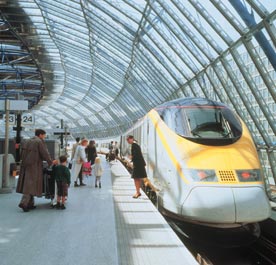 Trains are wonderful, but they usually don't stop at the origin nor at the destination of passengers' journeys. This is especially true of medium-to-long-distance itineraries. Instead, a train trip generally consists of at least three parts: getting to the station, riding the train and connecting transportation from the station at the other end. In addition, riding a train almost invariably involves (short) walks between vehicles and also at either end of any given trip.
Transportation planners like to scope these literally pedestrian issues out of their projects because there's a lot of work but relatively few construction dollars associated with them. Plus, addressing them would actually require co-ordination with other projects, a potential political minefield they prefer to avoid. However, allowing pedestrian access to fall through the cracks - e.g. between HSR stations and airport check-in counters or, between SF Transbay Terminal and Embarcadero BART/Muni - is a sure-fire strategy for failing to meet the ridership forecasts for the shiny new big-ticket services. Ideally, CHSRA should designate one member of its board to take on responsibility for adequate pedestrian facilities at transfer points. The state legislature should also insist that HSR feeder funds from prop 1A are used to optimize connections, rather than just local/regional transit capacity.
The general assumption on this blog appears to be that passengers could and would take local/regional transit to reach the nearest HSR station. Indeed, some $950 million of prop 1A are reserved for capital improvements to qualifying heavy rail "HSR feeder" services like Amtrak California, BART, LA Metro, Metrolink, Caltrain, ACE and NCTD. That's not nearly as much money as it sounds. For example, there will be little or no money left over for local/regional connecting bus services. Expect nothing at all to be available for improving pedestrian connections, e.g. between the Transbay Terminal in SF and Embarcadero, the nearest BART station.
However, like it or not, the vast majority of Californians never uses transit at all or at least, very infrequently. For the most part, that's because service tends to be infrequent and slow, except during rush hour. In addition, not everyone feels comfortable sitting or standing near strangers. Instead, decades of cheap gasoline/kerosene have enabled low-rise sprawl and got California residents used to either driving the whole way or else, driving to an airport, parking their car, flying and getting into another car at the other end. That other car might be an airport shuttle van, someone coming to pick them up or, a rental car. In short, travel within California is very oil-intensive and the hope is that HSR will make a dent in that.
However, a common objection to the California HSR project is that local transit should be put in place first, lest HSR cause massive traffic problems near downtown stations. The counter-argument is that politically, HSR serves as an anchor project big enough to prompt/accelerate the development/expansion of local/regional transit that's long been talked about but never properly funded. There is some evidence of this in that voters LA, Santa Clara, Marin and Sonoma counties all voted to increase local sales taxes to pay for improved rail transit, in addition to approving prop 1A on the statewide ballot.
Still, counting on local transit funding to ride the coattails of HSR is risky in that it forces both types of services to receive massive infusions of cash at the same time. If the political appetite for passenger rail were to dry up for any lenght of time, there's a good chance that funds intended for bread-and-butter local transit at the federal and state level would be raided to keep the politically sexier HSR project alive, with knock-on effects at the county and city levels. There is some evidence for this as well, in the shape of last-minute re-allocations of funds already within the transportation section of HR1, the stimulus bill. Indeed, the capital expenditure budgets of passenger rail and other transit services are liable to be raided at anytime by the politically entrenched highway-and-runway lobby.
These budget shenanigans will be going on all through the planning and construction phases of the California HSR project at both the federal and especially, at the state level. Urban traffic planners and station architects therefore need to anticipate a wider range of connecting transit options than just local transit. Moreover, the appropriate mix of options will be vastly different in the major HSR locations (SF, SJ, Fresno, LA, Anaheim, Sacramento, San Diego), at stations near airports (SFO, PMD, ONT, MER?) and at stations in smaller towns (Bakersfield, mid-peninsula, Gilroy, Modesto, Burbank, Riverside etc.)
Perhaps, then, we ought to take a closer look at connecting transportation from the customer's point of view. They will base their choice of vehicle on multiple parameters: door-to-door travel time, risk of delays, flexibility to reschedule, convenience, safety/security, comfort, privacy and fare cost - plus old habits that may be hard to break. No single strategy will work for every passenger, so station designers and local traffic planners have to reserve adequate room for multiple modes of connecting transportation.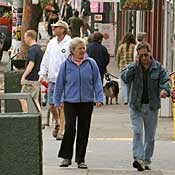 1. Walking: If you work in e.g. the financial district in SF and commute by BART, chances are you just hoof it for the last few blocks. There's no reason to assume that someone coming up from LA on a high speed train won't do exactly the same. Pedestrians average no more than 2.5 mph, less if they need to stop at traffic lights. That said, it is a little light exercise and you don't have to wait around for a bus to show up - one that might not drop you off exactly where you need to be anyhow. The converse is also true: in a number of places around the state, people are increasingly choosing to live in condos close to a subway or light rail line rather than chase after a McMansion out in the boonies, where the car is the only possible option for commuting to work, often dozens of miles away. Transit villages are a welcome new phenomenon, but their long-term popularity will depend on the future price of oil.
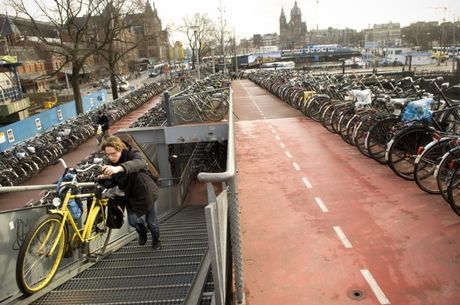 2. Cycling: In flat but crowded places like Holland and Denmark, China, Vietnam etc. bicycles are perceived first and foremost as modes of transportation. Sure, there are special bikes intended for strenuous exercise, but those are a separate category. In California, that category is almost all there is: road racers and mountain bikes. City bikes are often perceived as being strictly for kids too young to drive a car. This obsession with bikes as exercise machines may explain why pedelecs (bikes with electric assist motors) haven't really caught on yet in the Golden State, even though they let you climb hills and brave headwinds without working up much of a sweat - deal if you're about to board a train.
 There are plenty of folding designs on the market and, they're much easier to take along on any type of transit. Folding pedelecs are a new category that is only just emerging, thanks to recent advances in Li-ion battery technology, permanent magnet motors and control systems for the assist motors in these muscle-electric hybrids. China is arguably the world leader at the economy end of this emerging market.
Even in Europe and Japan, many railroads still think of all bicycles as equal and are only just beginning to wake up to the potential of folding bicycles and pedelecs to increase their catchment areas without having to sacrifice space for passengers who pay full fare. Just slide your under your seat (and perhaps the adjacent one, too) - done. At first, the notion of taking a folding pedelec along on a high-speed train may seem absurd, but if you travel light it's actually a perfectly sensible option, especially if there is a courtesy outlet to let you recharge. Pedelecs are limited to 20mph by law in California and you have to be 16 to ride one. Range on a single charge is typically on the order of 15-30 miles, depending on conditions and on how hard you pedal.
The biggest drawback is that bicycles are vulnerable in traffic unless there are designated bike lanes or better yet, segregated bike paths. In California, cities are loath to close traffic lanes or entire streets to motor vehicles without a special permit - pedestrian zones are almost unheard of (except in purpose-built shopping malls). The second biggest is that biking in wet or extremely hot weather is no fun at all, so transit planners tend to discount it as an unreliable ridership source. That may be a mistake, since pedelecs are by far the most affordable personal electric vehicles and the weather in California's population centers is reliably sunny for at least four months out of the year. 3. Local Transit: If you happen to live or work near a bus, light rail or subway stop with frequent and reliable service, then that may be the best option for either the first or the last leg of your trip. Unfortunately, it may not be on the other end - you may have to settle for one or more slow bus connections or else, shell out for more expensive direct service.
 Excellent connecting transit at one end a city pair only boosts HSR ridership if the same is true at the other end. In California, the volume and frequency of transit service varies greatly from county to county. The recent rapid run-up in gasoline prices prompted a renewed effort to spruce up transit services and, HSR stations provide a suitable anchor for multimodal hubs in major cities. Unfortunately, those same gasoline prices burst the housing bubble so it remains to be seen if these plans will come to fruition. Offering a single ticket valid on all transit services in a given region (e.g. the Bay Area) could boost off-peak ridership.
 4. Taxi/Limo/Sharecab Service: For those who place a premium on their time and/or their privacy, catching a cab or arranging for a limo may be the preferred option, much as it is at airports. Sharecabs (cp. airport shuttles) are not private and usually less comfortable, but they do get you to exactly where you need to be at more moderate cost. HSR stations will be excellent anchor locations for sharecab services based on vans that can transport up to 8 passengers and their luggage, supplementing fixed-route local transit or replacing it where none exists today. There is a case for subsidizing sharecab services, as they ease congestion and the related air pollution in downtown areas.
 5. Personal Car: Driving your own car to the station is often cited as the most convenient or even the only practical option. Sure, there's traffic and you need to pay for parking but you can get there fairly quickly, without having to wait for local transit, in comfort and privacy. Plus, you can take stuff along - it's especially hard to travel light with children or disabled persons in tow. Pets are another issue for anyone considering train travel. Fortunately, most railroads already operating high speed trains do permit them provided they don't bother other passengers. A leash and muzzle are often required to at least be on hand and, a half-price ticket may be required for large dogs.
However, the biggest downside is at the far end of the trip: either someone has to pick you up, you have to use a taxi/shuttle or, you end up renting a car. Add it all up and simply driving yourself all the way starts to look like a way more attractive option for a family of four. And therein, perhaps, lies the biggest challenge of all: persuading Californians to travel more frequently within their state but with less stuff, to make going down to Disneyland or up to San Francisco a simple weekend trip with just one night's stay rather than a major multi-day outing. For those living in the Central Valley, either destination could easily be an occasional day trip.
Conclusion: Getting the most out of HSR means adjusting the way way you work and play - it's not a drop-in replacement for the lifestyle you lead today. In particular, more frequent outings within the state will inevitably mean less frequent leisure travel to other states or overseas. The upside is that more tourism dollars stay in California, doubly so if HSR + connecting transit attract larger numbers of out-of-state tourists.
Monday, February 23, 2009
LaHood: Expect More HSR Funds; MTC Funding Debate
UPDATE: As reported by the Transbay Blog the MTC is planning to apply for the Transbay Terminal train box funding to come out of the $8 billion HSR stimulus and not from the general transit stimulus funds. Debate continues over funding the BART to OAK - in addition to the Transbay Blog article (which opposes funding BART to OAK out of stimulus money) see more at Living in the O, TransForm, and the Calitics version of this post. The original post begins here:
Some great news out of the US Department of Transportation:
Transportation Secretary Ray LaHood today emphasized the administration's long-term commitment to expanding high-speed rail service in "five or six regions" of the country, not just with the $8 billion provided in the economic stimulus package President Obama signed into law last week, but also "in subsequent years a very substantial effort." Meeting with reporters earlier today, LaHood said that for Obama building high-speed rail networks is, "if not his No. 1 priority, certainly at the top of his list. What the president is saying with the $8 billion is this is the start to help begin high-speed rail projects." He added that the administration "is committed to finding the dollars to not only get them started but to finishing them in at least five parts of the country," although he declined to elaborate on where these projects might ultimately be built.
One of my lingering concerns about the Obama Administration has been that they might be tempted to claim victory with the $8 billion in HSR funding added to the stimulus and not follow up on that money, which as we know merely pays for some initial costs. But what Ray LaHood is saying is that in fact, the $8 billion in HSR stimulus really is intended as a signal to America that Obama is truly serious about building HSR.
This couldn't be better news for us in California, where we have long known that at least $15 billion in federal aid, spread out over 10 years, will be needed to build the SF-LA line. Unfortunately the news is tempered by the fact that the Obama Administration's support for HSR did not extend to mass transit as a whole. Here in California the state has decided to zero out the State Transit Assistance account, costing local agencies over $500 million in funding. The federal stimulus isn't nearly enough to make up the difference. And as the San Jose Mercury News reports, that's setting up a situation where HSR may be pit against local transit agencies:
The MTC meeting Wednesday in Oakland could turn contentious, as the current plan calls for allocating $75 million to help build the Transbay Terminal in San Francisco, which would serve as the final stopping point for a high-speed rail line and Caltrain, [NOTE: in fact the MTC now plans to get the train box money from the $8 billion HSR stimulus - see update at top of the post] and $70 million to build a BART spur to Oakland International Airport. Those two projects alone would take 43 percent of the $340 million headed to the area in stimulus funds for local transit.
Some want money for those new two projects scrapped or reduced — and redirected to cover the cost of paying for day-to-day transit needs.
But MTC officials counter that building the Transbay Terminal now will save millions of dollars in later costs, and combined with the $8 billion in stimulus funds set aside for high-speed rail could accelerate that program. California is a leading candidate to capture much of that money because voters in the fall approved a $10 billion bond measure to begin work on the line, which will someday extend from San Diego to San Francisco and Sacramento.
"Given that California is the only state to pass a bond to build a new high-speed line, we think we might be able to do some double-dipping there," said MTC executive director Steve Heminger. "We are going to spend the stimulus money fast. I can guarantee that."
I support using that money for the Transbay Terminal, although I'm less certain about whether BART to OAK is all that necessary; the AirBART buses work pretty well (I used them on numerous occasions when I was an undergrad at UC Berkeley, although that was 10 years ago).
But I really hate it when HSR pitted against other forms of transit. I have said it before and I will say it again - HSR and other mass transit need each other to be successful. It should not and must not be an either/or choice. I don't blame the MTC for being stuck in this position - that blame lies in Sacramento and Washington DC. But we transit advocates need to not fall out along modal lines.
I'd like to propose a solution, one that I don't even know is possible under state law but makes a ton of sense to me. The nine-county SF Bay Area region should implement its own gas tax, which will solely be used to fund public transit. I haven't penciled out the numbers so I don't know exactly what the tax amount should be, but it should be indexed to the price of gas, and not a fixed cent number.
This money would initially be used to backfill the loss of STA funds, and allow the federal stimulus money to go to new transit infrastructure such as Transbay Terminal or BART to OAK. Ultimately the STA funds must be restored by a statewide gas tax increase, but it is much more politically possible to implement a gas tax in the Bay Area first than to try and get the Central Valley and the Southern California exurbs to buy into this (they can be brought on board later, once the 2/3 rule is eliminated).
It's very difficult for folks living in the nine counties to evade the tax, with the possible exception of Gilroy residents who might drive to Hollister to fill up. Most folks will simply pay the increase rather than drive far out of their way to get a cheaper gallon of gas.
I'm not sure if this option has been explored by the MTC and the member counties, but it ought to be. It's a sensible solution that would not only help spare transit agencies from "Armageddon" but would itself be a long overdue policy shift that would give a real boost to transit efforts in the SF Bay Area.
Thursday, February 12, 2009
$8 billion for HSR While Public Transit Starves
The latest news on the state and federal fronts is decidedly mixed. HSR is poised to make out like a bandit from the federal stimulus:
The most important news is the massive amount of money proposed for high-speed rail - $8 billion - and the large increase in Amtrak funding, up to $1.3 billion from $800 and $850 million in the respective House and Senate bills. This represents the largest single expenditure on rail in United States history and promises a new day for train travel. The U.S. Department of Transportation will lead the distribution of these funds; most of the money is likely to go to existing programs such as California High-Speed Rail, Midwest High-Speed Rail, and Southeast High-Speed Rail. States will get no supplementary money for rail programs, which implies that the bill’s writers want states to focus on implementing high-speed rail over standard-speed intercity rail.
I'm not going to argue with $8 billion for HSR - that's much more than the $2 billion I hoped would come from the stimulus. Still, I'm not quite comfortable with focusing on HSR at the expense of other intercity rail systems. The fact is that America needs more passenger rail period and needs a comprehensive program to implement them that includes high speed and non-high speed trains. Still, as The Transport Politic pointed out in the above quote, this is still the biggest amount the US has ever spent on passenger rail and should be considered a victory.
Less encouraging, however, is the doom about to face local public transit agencies, particularly those here in California. The final federal stimulus bill contains some transit grant funds, but zeroed out the proposed $2.5 billion for new starts. But the real catastrophe comes from Sacramento, where the proposed budget deal will eliminate state funding for local transit agencies in its entirety, a cut of $536 million that comes on top of nearly $3 billion in cuts that have been made since summer 2007. This is especially ironic given that the budget deal includes a 12 cent increase in the gas tax - but none of that will go to transit.
Many sustainable transportation advocates argue for a higher gas tax - but believe it should fund increased mass transit options. While schools and health care need more funding, that should come from other sources. Using the gas tax to do that is just not good policy.
Sure, this is an HSR blog, and perhaps we could be satisfied with the $8 billion coming to a high speed rail project near you. But as I have repeatedly insisted, HSR is just part of a bigger strategy to reshape American transportation. The big picture goal is to reduce our dependence on oil and sprawl. HSR is a good solution for the LA-SF corridor, but it won't help bring folks from Hollywood to Union Station, or from the Sunset District to the Transbay Terminal. HSR needs local transit to attain its highest ridership goals and to be the kind of success we know it can be.
The state budget deal is far from final, and Republicans may walk away from it once their wingnut base gets word of the tax increases. But the use of gas taxes for non-transit related funds, particularly when local transit is getting left in the desert with a canteen and a compass, is especially egregious.
Monday, February 9, 2009
The Stimulus Bill Saga: Senate Edition
UPDATE: MSNBC reports that the cloture vote on Nelson (D-NE) / Collins (R-ME) amendment just passed 61-36 in the Senate. This development suggests that both Sen. Collins and Sen. Snowe (both R-ME) and Sen. Specter (R-PA) have voted in favor and, makes is very likely that the version discussed below will reach cloture and pass on Tuesday. Note that there are multiple numbers describing the dollar volume of the bill, perhaps because of varying estimates of costs related to tax cuts and assistance for the unemployed.
UPDATE 2: As expected, the Senate has passed its version of the stimulus bill with the help of yes votes from Sen. Collins (R-ME), Sen. Snowe (R-ME) and Sen. Specter (R-PA). CNN previews the compromises both houses will have now have to make in conference.
 The Huffington Post has published a summary of the compromise on the stimulus bill as hammered out by centrist Republicans and Democrats to secure a filibuster-proof majority in the crucial vote expected on Tuesday, Feb 10. With amendments introduced and voted on in record speed, it has been difficult for Senators - never mind the general public - to ascertain the precise status of the bill over the past few days.
For the purposes of this blog, the most relevant section is the one on transportation. All line items are limited to capital projects, the numbers in parentheses refer to the amount in the amended House version as received by the Senate.
- $27.06b for highways (was $30b)
- $8.4b for transit (was $7.5b)
- $5.5b for general-purpose grants (was $2.5b)
- $1.3b for commercial aviation (was $3b)
- $2.0b for high speed rail (was $2b for fixed guideways)
- $250m to states for intercity rail (was $300m)
- $850m for Amtrak (was $800m)
- $160m for small shipyards + ferry services (was $0)
- $830m for roads on public lands (was $750m, but as part of $30b highway grant)
Total: $47.34b or 6% of the entire $780b Senate version (was $46.1b or 5.6% of the entire $819b House version)
Readers of this blog will be pleased to see that the Senate version targets $2b specifically at high speed rail in the corridors designated by DOT, especially since the California project is currently the only one with a completed program EIR/EIS. However, as currently defined by DOT, "high speed" translates to a minimum top speed of just 90mph. Note that the House version permits applications for arbitrary corridors and lower-speed technologies (e.g. commuter rail, subways, light rail, streetcars, guided buses, unmanned people movers, monorail systems, even urban gondolas).
Unfortunately, it's not entirely clear in either version into which funding category e.g. Amtrak California, a joint venture between Amtrak and Caltrans, would fall. California HSR is arguably also intercity rail, but I don't think that's what Senators had in mind. Similarly unclear is the distance at which local transit ends and intercity rail begins or, how it relates to the size of the state(s) requesting funding. In California, consider e.g. the cases of BART, Caltrain, Metrolink, NCTD and SMART. Comparable systems might well be interstate services in parts of New England! A paragraph clarifying these demarcations, if only by reference to existing DOT definitions, would be helpful.
All told, the Senate version actually increases transportation spending by around 3% relative to the House version, in spite of cutting the total bill volume by almost 5%. In particular, some funding has been shifted away from oil-intensive highways and aviation and toward fuel-efficient transit.
Also greatly increased is the level of general-purpose grants that DOT, i.e. the Obama administration, may award to any mode of transportation in an as-yet ill-defined competitive bidding process. The general policy direction of the administration appears to be in favor of weaning the nation off oil, but that may be superseded by a need to spend money as quickly as possible and/or to reward the Republican Senators that are breaking ranks. Both Maine and Pennsylvania have plenty of existing infrastructure, e.g. road bridges, in urgent need of repair. Once the stimulus bill is out of the way, the President may well seek to secure ongoing support from these centrist Republicans by negotiating a formal European-style coalition agreement with them - plus Sen. Reid and Speaker Pelosi - through end of year 2010.
If the Senate passes this latest version of the stimulus bill as-is, it will still have to be reconciled with the engrossed House version in conference. IMHO, given the razor-thin majority in the Senate, it is likely that House Democrats - after some huffing and puffing - will swallow their pride and make do with relatively minor last-minute adjustments so the President can sign the bill into law as soon as possible.
As a whole, it is arguably very much imperfect, especially in its emphasis on tax cuts over emergency assistance to states whose tax base has collapsed. Unfortunately, politics is the art of the possible. By including generous tax cuts from the outset, the President denied the GOP the opportunity to be seen exercising what little power it has left. It doesn't matter that those cuts were a key campaign promise, since the President had been careful not to specify when it would be kept. Thus, the GOP could have claimed to have forced him to concede them earlier than he might have wanted to and, pretended that this morsel of fake red meat constituted the basis of true bipartisanship. "No drama Obama" simply forgot that for opposition Senators, grandstanding is the point. They need their 15 minutes of C-SPAN fame.
Meanwhile, most state constitutions - including California's - require balanced budgets. This effectively forces Governors to act as Mini-Hoovers, furloughing or letting go state employees, thus reducing their ability to prop up an economy in desperate need of consumer demand. It would be prudent to restore the $40 billion in aid to states that was cut, but with strings attached - especially for the state of California, whose deficit dwarfs that of the other 49. For example, there could be a requirement that balanced state budgets be passed with simple majorities going forward, subject only to a gubernatorial veto. If compliance requires a change to the state constitution, so be it.
Alternatively, the stimulus bill could be amended to authorize the Federal Reserve to buy a certain dollar volume of long-term state bonds at reasonable rates, e.g. those prevailing prior to the collapse of Lehman Brothers (i.e. based on a credit rating of A+ rather than A for California). At a recipient state's request, the authorization would waive repayments in 2009 and 2010, with interest accruing in the interim. With regard to capital investments, only the difference between the interest offered by the Federal Reserve and that available on the market would represent a federal contribution.
Fortunately, the above comparison suggests the House will probably not seek to reduce spending on transportation projects, which enjoys broad support from the electorate. Indeed, it is theoretically possible that an amendment co-sponsored by Sen. Dianne Feinstein (D-CA) to add another $25 billion for highway, water and transit infrastructure could be incorporated into the bill in conference, especially if attempts to reverse cuts in general aid to states should fail. The amendment had received 58 votes in the Senate, just two shy of the number needed to overcome a Senate filibuster on the issue.
