Showing posts with label sustainability. Show all posts

Tuesday, November 17, 2009

A Reality Check Must Be Grounded In Reality

NOTE: We've moved! Visit us at the California High Speed Rail Blog.

It's a bold headline from my alma mater: "A Reality Check on High Speed Rail" is how UC Berkeley bills a recent HSR symposium. Already Morris Brown is peddling this as yet another reason why HSR is terrible and doomed to fail. Morris wants us to not dismiss the symposium lightly. OK, I'll dismiss it heavily:

Even if high-speed rail attracted everyone who drove and flew between the Los Angeles basin and the San Francisco Bay Area during the year 2007, it would amount to only eight million passengers per year, nowhere near the numbers projected by the California High Speed Rail Authority, explained CEE professor Mark Hansen. But even that estimate is optimistic. HSR would be extremely unlikely to capture most current air travelers due to lack of transportation connectivity in most California cities and regions.

“In Europe and Japan, where HSR has been especially successful, it is a very simple thing to take a subway to the HSR station, go upstairs and get on the bullet train,” explained Madanat. For example, access to Eurostar—the HSR system that passes under the English Channel to link Britain with mainland Europe—is easy and car-less; a typical business passenger traveling from London arrives in downtown Paris in two-and-a-half hours and can walk or take the Métro from the same station to his or her meeting. This connectivity, or short access and egress time, is essential to the success of high-speed rail, and California has very little of it.

Oh really? This would be an accurate statement if HSR stations were going to be built on the edges of city centers. But they're not. The two key endpoints will be directly in the center of the existing mass transit networks in the state: SF Transbay Terminal and LA Union Station. Both are already served by an impressive amount of mass transit, and if Antonio Villaraigosa gets his way, LAUS in particular could be reachable from West LA and much of the San Gabriel Valley by passenger rail by the time HSR opens to SF. As anyone who is even remotely familiar with both SF and LA knows, Transbay Terminal and Union Station are both far more accessible, in a shorter period of time, than slogging through traffic on the freeways to LAX or even Burbank.

We can look to the Acela as an example. The Acela is a successful HSR route. It generates operating surpluses and has no trouble attracting riders. Sure, it helps that NYC has an excellent mass transit system. Washington D.C.'s system is pretty good, built in a very similar way to BART. Stations are located in the centers of both cities, even though DC has an easily accessible airport just across the river from downtown. Suburban DC is very car-centric, as is much of NYC outside the five boroughs, and that hasn't hurt the Acela either.

The presenters at the UCB symposium are not being realistic when they dismiss CA has having "very little" connectivity. Even in cities where the network still has some work to do, like San José (a stop they do not mention), the HSR station will be located very near to the airport (and is actually closer to downtown than the airport), putting both on an equal footing. And unlike SJC, Diridon Station has a stop on the VTA light rail line.

Of course, as Joey pointed out in the comments to yesterday's post, the UCB symposium seems to have neglected the fact that HSR isn't just serving SF and LA, and includes places like San José, Fresno, and Bakersfield, where HSR would still be a compelling choice even without mass transit connectivity.

In short, their theory that HSR ridership depends on mass transit options CA lacks doesn't seem to hold water.

Travelers heading to Los Angeles from San Francisco, for example, will consider the time it takes to go to and from airports at each end of the trip, versus the time spent getting to a high-speed rail station. Time spent on the line-haul portion of the trip (actual flying or riding time) is more productive than the access and egress portions. But if access and egress times from HSR stations are as long and onerous as those for air, passengers will save time by driving to an airport instead.

“High-speed rail trades unproductive access and egress time for productive line-haul time,” explained Madanat. That is advantageous to travelers, and they are willing to spend an extra hour or more in line-haul time if egress and access time are diminished. Air travel between some cities in Japan has become nonexistent, thanks to the ease of traveling by high-speed rail.

I'm sorry, but Madanat is just plain wrong here. The unproductive access and egress time belongs entirely to airplanes, at least in California. He does not appear to have included the ridiculous security theater involved in air travel that adds up to a half hour to travel times. TSA recommends people arrive two hours before a domestic flight. Add in the travel to LA-area airports, none of which have good mass transit connections (whereas LAUS is the hub of the entire Southern California mass transit network), and it is not conceivable to me that HSR is at a disadvantage in terms of travel times. If anything it is likely to have an advantage, or would be comparable, which is all it really needs to be.

Again, we can look at reality to demonstrate the point: if HSR was such a bad deal, why does the Acela have half the market share on the Northeast Corridor? Madanat apparently didn't speak to actual Acela users:

Barry Ginsberg of Deer Park, N.Y., boarded an Acela train after a meeting in Washington.

"It's a lot less hassle and more comfortable," Ginsberg says. "When you figure how much in advance you have to get to the airport, it's a lot more convenient."

So there's another strike against the "reality check."

The other piece of the symposium report deals with emissions, and claims that HSR won't actually be the cleantech wonder we expect:

Proponents of California high-speed rail tout its energy-saving, greenhouse gas–eliminating characteristics. But panelist Arpad Hovath, also a CEE professor, reported on research showing that, unless ridership is very high, rail cannot perform better than air travel. To compare the carbon footprint of rail with air or driving, he explained, far more than just tailpipe emissions must be taken into account.

Horvath’s life-cycle analysis of the three modes suggests that high-speed rail will produce some 10 million metric tons of CO2 per year during construction. Furthermore, electricity to run the trains must be generated from coal-fired plants, leading to additional greenhouse gas emissions once HSR is operational.

Except that Horvath didn't mention the reality that the CHSRA has mandated that its trains will be powered by alternative, renewable sources to the maximum extent possible, with the goal being generation from 100% renewables. CHSRA's very existence helps bring online that capacity, by providing a guaranteed buyer of solar and wind power.

Horvath's assumptions also assume that ridership will be low. It will take about five years to reach the projected ridership levels (which is why many of CHSRA's projections are for 2030, not 2020), but once you're there, HSR will produce the reduced carbon footprint we expect.

He also charges that the construction alone will generate 10 million metric tons of CO2 per year. Maybe it will. But the cost of doing nothing is not zero. Even those tons of CO2 are a worthwhile investment for long-term significant reductions in CO2, since without HSR CO2 emissions are either going to continue rising and drown us in rising seas, or they'll crash totally without any alternative method of transportation when the oil gives out. And no, this symposium report does not mention "peak oil" at all. If it was discussed, UCB didn't see fit to mention it.

Oh, and the symposium report got in one last shot that Morris Brown, Stuart Flashman, and the PCL will just love:

Changes in alignment could help build ridership early, Madanat said. By switching the Northern California route from Pacheco Pass to Altamont, many more potential riders from fast-growing areas of Contra Costa and Alameda counties could be lured away from air travel.

Or Madanat could have mentioned the Altamont HSR corridor that the CHSRA is planning, which will bring the very kind of "connectivity" he claimed those potential riders needed in the form of a much faster ACE train.

Now it's possible that the problem here is with the staff producing the UC College of Engineering newsletter in which this article appeared. They didn't have to frame it as "reality check" and there may have been a more balanced discussion than what the article presented.

Still, it's a pretty lame "reality check," especially since it doesn't actually consider the realities I described above.

UPDATE: In fact, that's what seems to have happened. Alon Levy in the comments points to a post by Andy Nash about the symposium, which was apparently far more balanced, insightful, and useful than the UCB newsletter made it appear:

Professor Carlos Daganzo gave the first presentation. He showed convincingly how high speed rail can bring down the total cost of travel given the expected increase in travel demand combined with the HSR's decreasing cost per passenger model. This means that there is a very strong case for subsidizing high speed rail in the early stages of development, since it will improve the overall transport system....

Professor Mark Hansen spoke next. Hansen looked at the relationship of HSR to air travel. He believes that with HSR the air travel market will become less competitive and that the reduction in flights will be most evident in secondary airports (only a small share of SFO, LAX and SAN flights are intra-state ... although they use more than their share of capacity since they are generally smaller planes)....

Professor Robert Cervero proposed four lessons for California: (1) station siting is critical, building stations in freeway medians or surrounded by free parking will lead to more sprawl development and greater driving; (2) feeder systems are important for solving the "last mile" problem, extended TOD corridors are a good solution; (3) TOD as a necklace of pearls (e.g. like Copenhagen's approach) would be excellent, but California's current planning regime does not support this approach; (4) joint development must be high quality and pedestrian-oriented, studies of joint development in Hong Kong show that these types of joint development can be much more effective than the alternative basic systems.

So now the question is, why the biased report by the UCB "Innovations" newsletter?!

Sunday, September 27, 2009

Spain's Transport Minister Makes Progressive Case for HSR

NOTE: We've moved! Visit us at the California High Speed Rail Blog.

Although most Americans who know anything about high speed rail associate the trains primarily with France and Japan, it is Spain that has had some of the most dramatic success with high speed rail this decade. The AVE (Alta Velocidad Española) trains have attracted significant numbers of riders in a nation whose geography and population densities are quite similar to California, and operating profits from the existing lines have been plowed back into expansions of the system.

But there are bigger picture reasons to embrace HSR, as Spain's Minister of Transportation José Blanco López explains:

Someone could think that we, the political representatives in charge of looking after the public interests by assessing the opportunity costs of each choice, would be tempted to follow the easy path on those crucial crossroads. But this is not the case.

Maybe Spain, with the socialist party at the head of successive governments, is the best example of how a mindful combination of courageous decisions on difficult times, the power of a cabinet lead by egalitarian principles and the supportive effort of the taxpayers, can lead a country to new heights of economical and social progress.

Our high speed rail network reaches now several edges of the Iberian Peninsula, and connects some of the most important cities of Spain with the most sustainable transport mode and in a fast, safe and clean way: Barcelona, Madrid, Malaga, Seville and Valencia at the end of 2010. Its next objectives will be Galicia, the north coast, Portugal and France.

The effort under way is so big that, by 2012, Spain’s HS network will be the longest one in service in Europe. And only eight years later, by 2020, another historic landmark will be achieved when more than 90% of the country’s total population will have a HS train station at less than 31 miles away.

Sure, López is selling the PSOE as a good steward of a tough economy, but he raises the key points in how we consider high speed rail. HSR opponents have not offered any explanation of how they will grow the economy and provide economic recovery to the people of California. Whereas we who support HSR have history on our side. We built the Golden Gate and SF-Oakland Bay bridges during the Depression. We built Boulder and Shasta Dams. We built the Central Valley Project and countless other key pieces of infrastructure during the worst economic downturn in history. That spending, far from hurting the economy or making the Depression worse, provided job growth in the short-term and provides jobs and savings to this very day.

López explains that in Spain they too have had to battle conservative Hooverites who opposed AVE expansion:

Spanish conservatives even raised doubts and sowed distrust about a high speed system which finally yielded priceless benefits to the whole society.

’Boondoggle‘, ’Loss-making whim‘, ‘Monument to bad territorial planning’… Shielded behind overly simple, short sighted cost-benefit analysis, critics complained with those arguments against high speed projects over years, until the success of each one of the new corridors proved them wrong and showed that in troubled economic times, the best investments for a society are the ones which improve equality. Today, like we did over the last 20 years, we have to express our conviction in a brilliant future for high speed rail in Spain, with the extension of the network to each edge of the country, building a multi-node web in which each city is a centre. A network which draws territories together and grants equal opportunities to each citizen, no matter where he lives. A network which ties us strongly to Europe.

Now more than ever, we have to look towards the future and we shouldn’t slow down our pace, because each new high speed line carried out will be at the same time a retaining wall against the economic crisis and a lever to get the society ready for the incoming recovery.

López's article is produced in conjunction with this week's Labour Party conference in Britain, where the current British governing party is hoping to use high speed rail as part of its strategy to stave off electoral catastrophe in the spring 2010 election. Julian Glover, writing in the Guardian, makes the case:

High-speed rail can be justified as green if we sort out non-fossil fuel electric power, but the case is really as much social and economic. The unspoken aim of British politics is to make all of Britain middle class, and the middle classes travel – and will do so more and more. It's best if they go by train. Faster journeys are a bonus; the gains are as much about reliability and capacity – good links between Birmingham, Manchester and Leeds, as well as to London.

Transport routes north from the capital are full, or soon will be. England's great cities cannot enrich themselves in isolation and the harder it is to get between them, the poorer they will be. Rail investment is a progressive cause, if we don't want to see London as a sort of Singapore, a first world island isolated from – and perhaps one day refusing to fund – an impoverished hinterland.

We can say the same for California. High speed rail is essential to providing economic growth and prosperity to California in the 21st century. Driving and flying aren't going to be affordable for much longer, as the great gas price spike of 2008 showed. Since most jobs are going to be created in the urban centers, those who don't have the ability to live there, and other regions of the state, will be locked out of prosperity.

Those who oppose HSR are those who believe that the economic system of the latter half of the 20th century will persist forever, with a transportation system that hasn't evolved past 1985. They offer no arguments for how we will solve the gridlock on the freeways and the airports that would come with population growth, except presumably to spend twice as much money expanding those instead of building HSR. They offer no arguments for how we will wean California off of carbon emissions, to which transportation is a key contributor. They offer no real arguments at all about how California will generate jobs and economic opportunity - they just assume it will materialize out of thin air.

For the rest of us who have to live in the real world, we cannot put blind faith into a magical economic recovery based on a 20th century model whose failure has produced the present crisis. There is no reason for us to sit on our hands and refuse to follow the proven, successful model laid out by nations such as France and Spain, which have used high speed trains to provide sustainable economic growth and to try and battle a global recession.

And of course, Californians have already decided to reject the "lower your horizons and suffer" model being offered by HSR deniers. Californians knew what they were doing when they voted to build a high speed rail system in their state, and knew what they were doing when they voted to put Barack Obama in the White House, a president who understands the value of HSR and plans to fund it.

Still, we need to constantly remind ourselves and our fellow Californians of why we did that in November 2008, especially as the HSR deniers and those who would put small, parochial concerns over the needs of the state as a whole try and block HSR from getting built.

Sunday, July 26, 2009

The Multi-Pronged Attack on California HSR

NOTE: We've moved! Visit us at the California High Speed Rail Blog.

Last year this blog led the fight against the staggering amounts of misinformation put out by opponents of mass transit in their effort to defeat Proposition 1A. Even though these opponents were frequently given room to spout their misleading claims in TV and print reports around the state, whereas pro-HSR forces rarely ever got that opportunity, we won the battle. Californians rejected the arguments of the HSR deniers, the people who tried to argue against the evidence that high speed rail would be a financial disaster or that it wouldn't work in California or that people would never ride the trains. The voters showed that they understood the value and need for sustainable transportation, for economic recovery, for giving Californians an alternative to soaring oil prices.

That was the easy part.

2009 has seen a different and much more challenging battle taking shape. The Reason Foundation is still out their with their talking points, but few are listening. Instead most HSR deniers, like Morris Brown, have shifted tactics. Instead of arguing against passenger rail - a losing argument in California - they are trying to play on the environmental concerns of Bay Area residents. In order to undermine high speed rail, which will be one of the most environmentally beneficial projects this state has ever seen, they have joined with misguided environmentalists to try and block the progress of California high speed rail by claiming the project as planned will harm the environment.

Environmentalists have made a deal with the devil (so to speak) and allied with people who are fundamentally opposed to high speed rail. The environmentalists in question - particularly those from the Planning and Conservation League - apparently believe that they can use the HSR deniers for their own purposes without enabling the deniers' broader attack on the HSR project. In this the environmentalists are very, very wrong. They are jeopardizing the viability of the project as a whole, are placing a parochial and small concern above the concept, and are enabling anti-environment, anti-rail arguments in order to achieve their goals.

Californians rightly want to protect their environment. They rightly want big infrastructure projects to be built affordably and properly. And even though the environmental/NIMBY alliance ultimately seeks none of that - in fact, they are pursuing methods that jeopardize those values - they are increasingly effective at spreading their misleading claims among both the public and the state legislature.

As longtime blog readers know, these criticisms of mine are not new. What is new is that the Planning and Conservation League and the BayRail Alliance, two normally progressive organizations that support environmental and mass transit projects, have allied with the vehemently anti-HSR TRANSDEF, the "Cal Rail Foundation" (and its three members), and the cities of Menlo Park and Atherton to launch a deeply misleading attack on the high speed rail project.

The centerpiece of the attack is a new website: HSR: Let's Do It Right. The site is chock full of misleading statements, and embraces messaging that will ultimately and fundamentally undermine the HSR project they claim to support.

Before taking an in-depth look at the flaws of this site, let's lay out the landscape of HSR opposition in California:

Peninsula NIMBYs. Concentrated in the Menlo Park/Atherton/Palo Alto area, these are a quite small but vocal group of well-off homeowners who are adamantly opposed to building a grade-separated railroad for Caltrain and HSR, despite the numerous safety and environmental benefits of doing so. They've been convinced that a tunnel is a better solution, but have not identified any funding source for such a ridiculously expensive solution. They have no organization, but have instead brought on board the cities of Menlo Park, Atherton, and Palo Alto to their cause.

HSR deniers. Contrary to those who criticize the use of the term, this refers to a very distinct group of people who deny the proven benefits of high speed rail and want to kill the project outright. They are called "deniers" as an analogue to global warming deniers, based on the HSR deniers' repeated use of claims about HSR's supposed lack of financial viability, its supposed inability to meet projected ridership, and/or its supposed lack of environmental benefit. They tend to be ideologically opposed to government spending and to passenger rail projects. Not all HSR opponents are HSR deniers. But HSR deniers have had a lot of success in allying with more mainstream and respectable groups to advance their cause - specifically, the NIMBYs. HSR deniers have achieved significant gains by convincing some Peninsula residents that above-grade tracks will be a horrible city-killing disaster and that a tunnel is a better alternative - despite the fact that a tunnel is too expensive to ever become reality. HSR deniers hope that NIMBYs will provide the political power they themselves lack, and kill the project when it becomes clear that there is no viable alternative to grade-separating the Caltrain corridor.

Parochial environmentalists. The state's main environmental organizations, like the Sierra Club, strongly embraced high speed rail AND worked to ensure Prop 1A was as environmentally strong as possible (particularly by writing a ban on a Los Banos station into Prop 1A). They recognized that HSR will be a revolutionary shift in California infrastructure in favor of truly sustainable transportation that helps fight global warming, reduces pollution, and grows mass transit while shrinking the ranks of automobile commuters. But a small group of environmentalists have chosen to reject these broad benefits in a fit of pique about the choice of the Pacheco Pass alignment. The Planning and Conservation League is the biggest offender here, apparently convinced that the Pacheco alignment is so horrible that it is worth risking the entire HSR project to block it. To do so they are now allying with the NIMBYs and HSR deniers.

Parochial state legislators. California's Legislature is a broken institution totally incapable of governing this state in a time of crisis. One reason for this is term limits, which encourage legislators to ignore long-term planning and focus on their own careers. This incentivizes a focus on their own districts at the expense of the state's needs. As it relates to HSR, it enables ideological opponents of HSR like Senator Roy Ashburn, a genuine HSR denier, to try and tie down the project through burdensome and unnecessary oversight rules. It also enables people who don't care about the project's stated purpose of providing sustainable intercity transit to try and use the Prop 1A money to fund pet projects in their own backyards, like Senator Alan Lowenthal. NIMBYs, HSR deniers and environmentalists are allying with both Ashburn and Lowenthal to try and kill the HSR project by running it aground on the shoals of the legislature.

All four of these groups are represented on the HSR: Let's Do It Right site. The website is an incoherent jumble of anti-HSR claims that are sometimes mutually contradictory, but together represent a formidable threat to high speed rail.

Let's have a look at some examples.

Lying About Altamont/Pacheco

The main intent of the site is to rally the public to oppose the Pacheco alignment and force its abandonment in favor of Altamont - despite the fact that the decision for Pacheco was made through a legitimate process a year ago, and despite the fact that it was ratified by voters at the November 2008 election. Their Why Altamont? page consists of this extremely dishonest graphic:


This is pretty ridiculous stuff. The notion of "fewer impacts on communities" is only true if you don't consider Fremont, Pleasanton, Livermore and Tracy as communities. As I'll explain in a moment the site is full of "concern" for the "livable communities" on the Peninsula that would be harmed by HSR, but no such concern is offered here for the East Bay cities along the proposed Altamont route. There are about the same impacts on communities in the Altamont alignment - but those communities do not count, are not relevant, to the PCL and the other backers of this website.

It is true that expanding passenger rail along the Altamont corridor would help ease congestion. Which is why Prop 1A created a high speed corridor along the Altamont Pass and directs the CHSRA to spend money upgrading it for the purpose of easing congestion. But you wouldn't know that from the site or this graphic.

Sure, a shift from the Pacheco to the Altamont alignment might serve more East Bay residents. But it would come at the expense of about the same number of people in Santa Clara County and the Monterey Bay Area. Given that San José is the state's third largest city and one of the state's key economic centers, you'd think that it would have a pretty strong argument for being included on the HSR line. But you won't hear that argument on the website.

The claim of "$2 billion saved" is not sourced or proved. Given the support for Peninsula NIMBYs, the site's authors are in no position to make claims about saving money.

As to the wilderness area, this is is complete bullshit. The graphic is designed to mislead people into thinking the whole wilderness as shown on the map is under threat from HSR. It isn't. The tracks will run close to the existing Highway 152 corridor, and will go underneath Pacheco Pass State Park in a tunnel - which is conveniently not mentioned anywhere in this graphic or on the site.

Another lie is the "no sprawl effect" claim made. The graphic labels "land speculation" as possible in the Los Banos area, not informing readers that a station at Los Banos was specifically outlawed when Prop 1A passed. No station is planned on the western side of the Pacheco Pass. There IS a station planned at Gilroy, but that alone doesn't induce sprawl - unless the site's supporters think Caltrain service to Gilroy does that already. South County has its sprawl issues, but those already exist without HSR, and residents of Gilroy have already shown their willingness to oppose sprawl (fighting a planned Wal-Mart supercenter, for example).

Embracing NIMBYism

Environmentalists who actually care about doing something to stop global warming should be extremely wary before getting into bed with NIMBYs. NIMBYs around the country have fought wind turbines, solar power generators, and the transmission lines needed to bring clean, sustainable, renewable power to cities that need them. Solutions designed to protect our environment and arrest the pace of global warming will necessarily impact communities in ways some won't like. We have to weigh their objections against the dire and pressing need to act to reduce pollution and reduce carbon emissions.

The environmentalists who put the website together have thrown all such caution to the win. Desperate to stop the Altamont alignment, they are busy fueling misleading NIMBY claims that WILL get used elsewhere in the state to attack the HSR project, presumably in places where the PCL (among others) claims to support HSR - like Pleasanton.

The site includes a paged titled Visualize What Disaster Looks Like. It's the old misleading "Berlin Wall" images from Menlo Park that we debunked back in March.

But that's not the most insane and crazy element of the unholy alliance between the PCL and the NIMBYs. On the contact page, which includes the list of organizations sponsoring the site, in bright red capital letters is written the statement "REMEMBER: THE CITY YOU SAVE MAY BE YOUR OWN!"

Umm...wow. Is that a message people who supposedly support the HSR project, as the PCL and the BayRail Alliance claim, want to spread? By claiming that HSR will destroy cities, they're inviting open season on the HSR project from other cities, including those along the Altamont alignment. Does the PCL want Fresno to sue? Do they want Fullerton to sue? This is madness.

Allying With Legislative Enemies

The final lunatic aspect of the site I want to examine is their alliance with a broken legislature and in particular with legislators whose opposition to high speed rail has frequently been demonstrated. The site encourages the broken legislature to exert "oversight despite the fact that the legislature is incapable of effectively doing so until that institution is repaired and restored to functionality. There is no better way to undermine the HSR project than to make it dependent on a legislature that can no longer effectively govern the state.

Especially when the site specifically calls out for praise known HSR opponents. One of these is Senator Roy Ashburn, who tried to postpone the Prop 1A vote beyond 2008. Here's what the site has to say about Ashburn, listing the members of the Senate Appropriations Committee (emphasis mine):

Below is a list of Senators on the Senate Appropriations Committee. Note that Senators Simitian, Yee, Cedillo, Corbett, and Oropeza, along with Senator Ashburn, are on both Committees. Senator Ashburn has been very sympathetic:

Perhaps the site would like to explain WHY Ashburn has been sympathetic? That he has worked hard in the last year or so to throw as many roadblocks and obstacles in the path of HSR as he can?

Although Alan Lowenthal is not singled out for praise (yet) on the site, he is one of the leading figures in the legislature trying to use "oversight" to destroy the project. This blog has frequently demonstrated Lowenthal's desire to chop the statewide project into disconnected pieces, to create a glorified commuter rail benefiting Southern California and presumably the Bay Area (although the alliance with Peninsula NIMBYs jeopardizes that).

There are more flaws with the website in question, but I've gone on long enough as is. The above should be enough to make it clear that the folks behind that site are not interested in telling Californians the truth about the high speed rail project, and certainly aren't interested in ensuring that HSR actually gets built.

In fact, as I will demonstrate tomorrow, the Planning and Conservation League has taken a leading role in trying to undermine California's application for federal HSR stimulus funds, thus jeopardizing the financial viability of the entire project. There's much, much more to come.

Wednesday, July 15, 2009

Private Sector Still Interested in HSR

NOTE: We've moved! Visit us at the California High Speed Rail Blog.

by Robert Cruickshank

Although some still seem to believe that the recession and state budget problems make HSR undesirable, that view isn't held by some of the most important figures - Secretary of Transportation Ray LaHood (who at least in his public statements has turned out to be WAY better than I ever imagined) and the companies that would build and operate high speed rail in the US. The recession is bad, is likely to persist for some time, and runs a very real risk of taking another downward lurch. But as this Reuters article makes clear, there is still demand and capacity out there to build HSR:

Transportation Secretary Ray LaHood, speaking to policy experts and reporters, said rail would be a strong opportunity for outside participation with the Obama administration taking early steps financially and politically to advance new train corridors to compete with short-haul air and highway travel.

"Companies involved in (overseas) high speed rail are in the U.S. right now," LaHood said, noting that several states are vying for a piece of an $8 billion downpayment in federal rail funding from February's economic stimulus package.

"I think you'll see private investment in high speed rail -- from Europe and Asia, not just the U.S.," he said.

LaHood also said broadband expansion would be a good bet for private interests but was less optimistic about attracting near-term investment from outside government in U.S. road projects due to recession.

This is quite significant - not only because it suggests that HSR demand is robust, but that there is more interest in funding it than in funding roads. The fact that Ray LaHood is picking up on this suggests that the Obama Administration is aware of this and might be willing to plan its transportation priorities accordingly (although first they'll need to resolve the battle over the Transportation Bill, subject of tomorrow's post).

LaHood is joined by industry leaders such as Alstom and SNCF in this assessment:

Hitachi and Kawasaki Heavy Industries are leading train manufacturers.

Leading global players also include Canada's Bombardier, Germany's Siemens and France's Alstom....

Alstom's U.S. president, Pierre Gauthier, told Reuters in an interview the company concentrates on providing trains and signal systems but would not preclude other forms of investment in U.S. rail if a market develops.

"When you have this and good service, I think Europe has shown that people use this a lot," Gauthier said.

One of the key questions being asked right now as we look at the wreckage of the global economy is what will drive growth that can get us out of this crisis? Mass transit, including high speed rail, is obviously part of the answer. Neither California nor the US can afford to fall behind yet again. We wasted the prosperity of the 1980s and 1990s on more freeways and kicked high speed rail down the road. Now that we are in an economic crisis brought on partly by that failure to embrace sustainable transportation, we would be fools to miss a chance to use HSR to both rebuild our economy and put it on a much more sustainable and prosperous long-term footing.

Monday, July 6, 2009

NIMBYism and the Environment Don't Mix

NOTE: We've moved! Visit us at the California High Speed Rail Blog.

by Robert Cruickshank

The East Bay Express, a weekly newspaper serving the Berkeley-Oakland market, had a great feature article last week titled "You're Not An Environmentalist If You're Also A NIMBY". Its focus is the debate over urban density in Berkeley and Oakland, where folks who claim to be environmentalists are also opposing greater urban density, despite the fact that such opposition fuels sprawl, which contributes significantly more pollution and carbon emissions to the atmosphere than urban density:

Global warming is changing far more than just the climate. It's altering the way environmentalists view development. For years, city dwellers who consider themselves to be eco-conscious have used environmental laws and arcane zoning rules to block new home construction, especially apartments and condominiums. In the inner East Bay, liberals have justified their actions by railing against gentrification and portraying developers as profiteers. But the lack of urban growth in Berkeley and in parts of Oakland during the past few decades also has contributed to suburban sprawl and long commutes. And all those freeways choked with cars are now the single biggest cause of greenhouse gas emissions in the region.

The debate on the Peninsula regarding high speed rail has a different focus, and yet the basic details remain similar as this AP article on Peninsula "concern" over HSR explains - one of a number of similar articles that have been written about Peninsula NIMBYism in the wake of the release of the draft scoping report on the SF-SJ segment of the HSR route. As in Berkeley, folks in Palo Alto and Menlo Park are primarily driven by a desire to maintain their communities exactly as they look right now, with little regard for the environmental consequences of maintaining an urban landscape suited to the auto-oriented 1950s.

There is a crucial difference between the urban density debate in the East Bay and the HSR debate on the Peninsula. NIMBYs on the Peninsula have been able to have it both ways, claiming that they aren't opposed to HSR, that they either want it built underground (without explaining how to pay for it, meaning they're not offering a credible proposal) or built somewhere else (without explaining why, if HSR is so awful for communities, it's OK for Pleasanton and Hayward to be stuck with it).

In all this time I've never been unsympathetic to legitimate concerns from community members about making sure that HSR can work in their town. Nobody, myself included, wants to just drop the train in the middle of town. Of course, neither does the CHSRA, despite the frequent hyperbole you hear from some on the Peninsula.

But what you never seem to hear is an honest assessment of the HSR project's place in our broader agenda of environmental and global warming action. Too often HSR is cast as some random project being foisted upon the Peninsula, when in fact it's designed to help them get around their county, their region, and their state more easily and sustainably.

Thursday, June 11, 2009

Thursday Open Thread

NOTE: We've moved! Visit us at the California High Speed Rail Blog.

So I'm off to Portugal for 2 weeks, and you will be in the capable hands of Rafael and Matt Melzer, who will be doing some guest posts. There will be some open threads every other day, although if any of the guest posters want to move one of those to another day in order to post something, particularly if it is timely, they're welcome to do so.

Today's topic: rising gas prices. Breaking the magic $3 mark across the state. It was when gas prices stayed above $3/gal for an extended period in mid-2006 that the housing bubble burst. Sure, the bubble was going to burst eventually, but it burst at a specific time and due to specific causes, which we can't overlook. Further, the gas price spike of 2008 surely helped play a big role in sending the economy into a tailspin in the latter half of that year.

As a number of economists are coming to realize, any economic recovery could be strangled by rising gas prices. The underlying factors are still there - peak oil, exacerbated now by slackening investment in production. Any hint of recovery is going to send gas prices soaring.

So tell me again why we would NOT want to be investing in a form of transportation that is not dependent on the fluctuating price of oil? That could promote economic growth instead of throwing a drowning economy an anvil?

Tuesday, May 26, 2009

Will the California Farm Bureau Join the 21st Century?

NOTE: We've moved! Visit us at the California High Speed Rail Blog.

So this is an odd article (from the California Farm Bureau):

As the state's High-Speed Rail Authority plans an 800-mile high-speed rail system that will help alleviate congestion on roadways and transport passengers from San Francisco to Los Angeles in a little over two and a half hours, California's agricultural landscape is likely to change dramatically.

An estimated 300 miles of the project is expected to go through the Central Valley—one of the most productive farming regions in the world.

"There has been a real concern by agriculture about the route that the California high-speed rail project ends up taking and how it is going to impact those properties, as well as properties adjacent to the proposed project corridor," said Andrea Fox, California Farm Bureau Federation governmental affairs legislative coordinator. "While the routes of the project are being planned, we cannot lose sight of the many benefits of California agriculture, not only to support the state and nation economically, but to feed people locally and around the world."

This doesn't really make sense. The ROW they're looking at is very narrow, and follows an existing rail corridor. Sure, some farmland will be lost, but the amount we're looking at is a tiny percentage of the overall acreage in the San Joaquin Valley. It's not like this thing is a 12-lane freeway.

Further, it's totally unclear how HSR would itself have a negative impact on farmland or farmers. It would free up valuable freight rail space, and make it less necessary to have to widen either Highway 99 or Interstate 5, projects that could also wind up taking farmland.

What really seems to be going on here is a concern about sprawl, as well as a desire to use bond money for ag interests:

Merced County Farm Bureau Executive Director Diana Westmoreland Pedrozo foresees this project as creating real problems for the future of agriculture in the Central Valley.

"Unless the state has some real land-use rules to be attached to this project, it will be a nightmare for agriculture," Pedrozo said. "So far, my local, regional and state governments have not given me any confidence in their ability to actually protect and preserve our ability to feed our future generations and ourselves. You are talking about the only place on earth that can do what we do."...

"CFBF supports the concept of mass transit, but we must insist on protecting agricultural land and preventing urban sprawl. Because our success depends on a healthy environment, we are committed to solutions that work," Fox said. "Considering California's projected $21.3 billion budget deficit and the existing $100 billion bond indebtedness, coupled with the need for new water projects and improvements to existing transportation and other infrastructure, we are concerned about cost-effectiveness of this project."

The irony is that we who support HSR are some of the strongest supporters of preserving agricultural land and preventing sprawl. As we've explained numerous times on this blog, HSR is a much better way to limit sprawl, as it encourages in-fill transit-oriented development as opposed to sprawl. I have also repeatedly expressed my belief that the state should push through land use rules strictly limiting sprawl in critical agricultural areas like the San Joaquin Valley, the Sacramento Valley, the Salinas Valley, the Imperial Valley, Ventura County, and other places.

The rest of Andrea Fox's comment there shows that like many other local Farm Bureaus in the state, the California Farm Bureau is hopelessly locked into a 20th century model of how state infrastructure should look. They seem to want more freeways and roads, yet don't understand how that brings more sprawl than HSR would. Whereas HSR would channel population growth to existing cities, freeways would channel it to exurbs. Instead of making Fresno more dense, the Farm Bureau seems to support letting Los Banos sprawl all over the place. It makes no sense from the stance of preserving agricultural land.

California does have a water problem. But that problem is driven partly by global warming, which is causing less rain to fall in the state. Shouldn't the Farm Bureau, whose members are by far the largest consumers of water in the state, be supportive of methods to cut down on carbon emissions and slow the rate of global warming so as to slow the decline in average annual rainfall?

Further, the San Joaquin Valley has some of the nation's worst air quality. Surely the Farm Bureau supports clean air for its workers, its crops, and its neighbors?

The California Farm Bureau is picking a fight with the wrong people. HSR and its supporters are allies of California agriculture, not its enemies. It's time the California Farm Bureau embraced sustainable and carbon-neutral transportation. In return we will be more than happy to embrace their effort to stop sprawl. They have nothing to lose and everything to gain.

Wednesday, May 20, 2009

Keeping Perspective on HSR and State Budget

NOTE: We've moved! Visit us at the California High Speed Rail Blog.

The failure of the budget propositions yesterday have led some to wonder how this will impact high speed rail. It's been discussed in the comments, and is mentioned in a George Will column. George Will has been on a kind of jihad against sustainable policy lately, with his silly attack on Portland and his dishonest misuse of data to undermine action on global warming. So it should be in that vein that we read this:

California’s voters are complicit in their state’s collapse.

They elect and re-elect the legislators off whom public employees unions batten. Also, voters have promiscuously used their state’s plebiscitary devices to control and fatten the budget. Last November, as the dark fiscal clouds lowered, they authorized $9.95 billion more in debt as a down payment on a perhaps $75 billion high-speed rail project linking San Francisco and Los Angeles — a delight California cannot afford.

As you can tell, facts and evidence no longer mean anything to Will - there is no basis for the claim that HSR will cost $75 billion. If "perhaps" is the only justification to toss out numbers, then I think HSR will "perhaps" cost $1.50. I mean, really. WTF.

Of course, Will's argument is deeper. He claims that HSR is unnecessary (a "delight") that we "can't afford" and its mere presence on the book as a partly-funded proposal is to him further sign of how California got into the crisis.

So, here we go again, with arguments that to me were decisively won by our side in 2008. I won't completely repeat myself - go read The Cost of Doing Nothing is Not Zero and Prop 1A and State Bond Debt for starters.

But, it is worth reminding ourselves of the key points:

  • If we don't build HSR, that does NOT represent savings to the budget. HSR is itself savings. The cost of expanding airports and freeways to meet the expected future demand has been estimated to be anywhere from $80 to $160 billion. HSR can meet much of that demand for much less of the cost. Further, it does so by providing sustainable transportation, saving money to workers and businesses by liberating them from the vagaries of oil prices.


  • HSR is absolutely necessary to economic recovery. Our budget mess isn't the product of overspending but of the worst economic crisis in 60 years. If it were up to folks like Will we'd still be in the Depression - massive public works projects like HSR provide short-term stimulus and long-term economic growth. The 100,000+ jobs the construction will create will pour money into the state's economy and into the state's treasury. On the converse, NOT doing public works like this will help create a downward spiral that will leave California in perpetual crisis.


  • HSR does NOT come at the expense of any other budget line item. It's not a matter of firing teachers to build trains. This is because the money for HSR is going to come out of bonds and federal funds. Some might say that's disingenuous since we have to pay for the bonds somehow. But the point I would make is that HSR's costs are amortized over 30-40 years. Teachers need to be hired and paid now. Cutting HSR won't save other services (especially when the current amount of spending on HSR is barely $100 million, whereas the budget deficit is $25,100 million). The problems with the ongoing budget deficit have to be resolved through a mixture of new taxes and economic stimulus. Cutting stuff will actually make the problem worse.


It's not that we support HSR because we are train junkies. We support it because it is an essential part of our economic recovery and vital to providing long-term prosperity in the 21st century. We should not be surprised when the usual suspects and, yes, HSR deniers like George Will use the budget mess to try and push through their usual attack on government and on passenger rail. But we can and should push back against their nonsense.

Monday, April 20, 2009

How The AVE Is Changing Spain

NOTE: We've moved! Visit us at the California High Speed Rail Blog.

Today's Wall Street Journal offers a fascinating look at how Spain's AVE high speed trains are changing that country in some interesting and generally positive ways. As you know from our previous posts on the topic, not only do I have a personal affinity for the AVE, but their dramatic success in a nation whose pre-AVE travel habits, population densities and natural geography are very similar to those of California is a strong indicator of how HSR will be successful here in California.

To sell his vision of a high-speed train network to the American public, President Barack Obama this week cited Spain, a country most people don't associate with futuristic bullet trains.

Yet the country is on track to bypass France and Japan to have the world's biggest network of ultrafast trains by the end of next year, figures from the International Union of Railways and the Spanish government show.

Although the AVE was initiated by a Socialist government in the early 1990s, both the PSOE and the right-wing Partido Popular are strong backers of the AVE trains, and now Spain will have a large network of fast electric trains connecting its major cities. Already Sevilla, Málaga, and Barcelona are linked to Madrid - Valencia, Bilbao, and some of the northwestern cities are next in line. But they don't plan to stop there:

But the AVE-which means "bird" in Spanish- proved to be a popular and political success. Politicians now fight to secure stations in their districts. Political parties compete to offer ever-more ambitious expansion plans. Under the latest blueprint, nine out of ten Spaniards will live within 31 miles of a high speed rail station by 2020.

That's some amazing penetration of the HSR network that is planned for the next ten years. And it's even more fascinating considering that until the first AVE line opened in 1992, Spain's travel habits closely resembled those of California:


And although those numbers stem from the Madrid-Sevilla AVE line, they've been repeated in particular on the Madrid-Barcelona line, which has taken nearly 40% of the market on what was one of the world's busiest air routes.

The WSJ article suggests that the AVE has not only reshaped travel habits, but social and economic habits as well, maybe even cultural habits:

"We Spaniards didn't used to move around much," says José María Menéndez, who heads the civil engineering department at the University of Castilla-La Mancha. "Now I can't make my students sit still for one second. The AVE has radically changed this generation's attitude to travel."...

The AVE was originally designed to compete with the airplane for commutes between major cities around 300 miles apart. But the biggest, and least expected, effect of the AVE has been on the smaller places in between.

Perhaps the most striking example is Ciudad Real, a scrappy town 120 miles south of Madrid in Castilla-La Mancha which, Mr. Ureña says, "had completely vanished from the map." In medieval times, the town was a key stopover point on the route between the two of most important cities of the time, Córdoba and Toledo. But the railway and the highway south later bypassed the town, and Ciudad Real began to wither.

Now it has an AVE station that puts it just 50 minutes away from Madrid, and Ciudad Real has come alive. The city has attracted a breed of daily commuters that call themselves "Avelinos." The AVE helped attract a host of industries to Ciudad Real, and the train is full in both directions.

Ciudad Real is a town somewhat analogous to Merced, and one can imagine that the California HSR trains will make UC Merced a more attractive option to students in the Bay Area and in Southern California. You can be sure that Central Valley cities are looking to the experience of places like Ciudad Real as a possible model of how their towns can provide more stable and lasting economic growth built around the high speed train.

Of course, the article does mention some criticism of the high speed trains:

Not everyone is pleased. ETA, the militant Basque separatist group, has said it would target anyone involved in the construction of a high-speed train line that will connect the restive northern region with Madrid and France. In December, ETA killed the owner of a company working as a contractor on the project, and in February detonated a bomb at the headquarters of Ferrovial SA, another contractor working on the project.

This issue is not so relevant to California, for obvious reasons, and it's worth noting that ETA's concern is that the AVE will be so successful that it will erode the Basque Country's autonomy by linking it more closely with the rest of Spain. The other main criticism voiced is that Spain's HSR focus is leaving other transportation infrastructure less funded:

Other, nonviolent critics say the country's massive investment in high speed rail has come at the expense of other, less-glamorous forms of transportation. Starved of funds, Spain's antiquated freight-train network has fallen into disuse, forcing businesses to move their goods around by road. That means the Spanish economy is unusually sensitive to changes in the price of crude oil.

And yet that's not really an argument against the successful HSR project - instead it's an argument for the investment in freight rail. It doesn't have to be an either/or proposition.

Critics say the AVE will never stop losing money. Even its backers say high-speed rail can only be economical if the state bears much of the construction costs. But they say the train's benefits-lower greenhouse-gas emissions, less road congestion and, in Spain's case, greater social cohesion and economic mobility-make it an investment worth making.

Of course, Spain's roads were built with state money as well. Here in California our airports and freeways were built with state and federal money. Freeways are not expected to turn a profit. The whole notion that our transportation infrastructure should turn a profit is absurd, even if most HSR systems break even or generate surpluses, more than covering their operating expenses. And that's a sensible approach - the state makes the investment in the infrastructure, and the ongoing operations are self-sustaining.

Spain is like California in another way - it's getting extremely hard hit by the global recession. Like California, Spain experienced a significant property bubble and is now paying the price with high unemployment. I don't know how this will impact the ambitious AVE construction plans. But at least Spain spent the last 20 years investing in sustainable transportation - whereas California frittered away its economic boom on sprawl, roads, and tax cuts. Spain is in a better position to weather the economic storm and recover from it thanks to its investment in the AVE.

It's not too late for California, of course. With Prop 1A and President Obama's support we can start down the trail Spain blazed nearly 20 years ago. HSR will change California in interesting ways, and although we're already a far more mobile population than Spain apparently is, HSR will still provide economic and environmental benefits that so far we can only imagine.

Friday, March 6, 2009

The Acelafication of California High Speed Rail

NOTE: We've moved! Visit us at the California High Speed Rail Blog.

Today marks the one-year anniversary of this blog. I'd actually been trying to build out a much bigger pro-HSR site using a dedicated URL, a Joomla! installation, and with neat bells and whistles. But it was taking months, and by March 2008, I gave up and decided to just whip something up on Blogger to fill what I felt was a big gap in the online world, a lack of a site dedicated to both the discussion and support of the California High Speed Rail project.

It's been an eventful year, to say the least. The dramatic gas price spike that showed Californians passenger rail was an essential part of our future infrastructure. The long fight over AB 3034. The constant efforts of HSR deniers such as the Reason Foundation to sow misinformation about HSR to the public. The passage of Prop 1A. And now the fight over whether there will be high speed trains on the Peninsula. We've covered all of it here, sometimes contentiously. I think we've all achieved something fantastic here, and I thank all of my readers and especially the commenters for helping keep this blog going.

Looking back on that year, two things have stood out to me that define this project:

1. The public as a whole supports high speed rail and wants it to happen.

2. However, the political conditions that produced 40 years of passenger rail stagnation, as well as California's broad 21st century crisis (an economic, environmental, and energy crisis), are still there, and the necessary political leadership to overcome those conditions and solve those crises does not yet exist.


President Barack Obama may be the game-changer here, as he is in so many other aspects of American life. His support for high speed rail is genuine, as he played the central role in putting $8 billion in HSR funds into the stimulus. His budget proposal includes $5 billion more for HSR. He could provide the leadership that has been lacking, and could help bring groups to the table to hammer out differences.

Such leadership is desperately needed right now in California and on the Peninsula in particular, where concern over above-ground structures - concerns I believe to be overblown and misplaced - have given rise to a de facto willingness to weaken the HSR project unless it is built underground. Way too much of the NIMBY commentary on the situation implies that HSR isn't necessary, and some of the old HSR denier arguments from the 2008 campaign - that HSR can't turn a profit, that the ridership numbers aren't credible, that the Peninsula doesn't really have any need for this anyway - have unsurprisingly been mobilized to attack the project.

This is but one example of some of the underlying political conditions that have produced passenger rail stagnation and economic crisis. Parochial self-interests have spent the last 30 years constructing any number of methods to veto policies they don't like, whether it's the 2/3rds rule or systematic abuse of the environmental review process to accomplish inappropriate NIMBY objections.

And some of it stems from an ongoing unwillingness to admit the need to change. The NIMBY attack on HSR is grounded in the assumption that the status quo is perfectly acceptable - a state dependent on carbon emitting, pollution spewing, fossil fuel burning methods of travel that are not physically sustainable or economically viable. That the physical landscape of Menlo Park can remain that way for all time.

Nobody here wants to destroy communities. But when some in those communities define the way things look in 2009 as a perfect status quo that must not be changed, then ANY change, no matter how sensible or beneficial, becomes viewed as a threat.

Such attitudes have led to the economic crisis we face, where an unwillingness to confront basic realities, stemming from a desire to cling as tightly as possible to a status quo that is quite clearly failing, has prevented necessary action.

Unfortunately we've been here before. In the early 1990s the Northeast Corridor High Speed Rail project was announced with much fanfare, and was promised to finally bring true high speed rail travel to the United States.

15 years later, we have the Acela. It's a workable system, a train that has over 40% of the market share on the NEC and a generally positive reputation among travelers. But it's also not what was intended. The Acela only achieves its true top speed of 150 mph in a few places; in many others it's held to 79mph.

What happened? To put it simply, stakeholders weren't willing to accept some changes in order to build the Acela properly. Some didn't want to give up land to straighten the tracks. Others were concerned about noise and speed. Some didn't want to spend money upgrading the infrastructure. The FRA wouldn't relax its inane weight rules. And in the 1990s, cheap oil lulled people into complacency, believing that passenger rail was a toy that had little practical use, that filled little practical need.

To me it is self-evident that if we're going to build a project, we should build it the right way. That if we ask voters to approve something - especially if we ask them to help pay for it - then it seems self-evident to me that we should deliver exactly what they approved. The City of Palo Alto and many others on the Peninsula appear happy to gut the HSR project by forcing it to run unacceptably slowly along the SF-SJ route, or to force an unworkable transfer to Caltrain at SJ Diridon that will significantly reduce ridership, or to bypass the state's third largest city (San Jose) just to make a small handful of residents happy.

That's just not right. We must build HSR the right way. We can build it in a way that meets the needs of everyone in California, but when NIMBYs refuse to compromise, they're implicitly saying that a flawed system or no system is preferable to one they don't like. They're happy to Acelafy our project.

We see these problems anytime efforts are made to address our multifaceted crisis. Obama wants to restore higher tax rates on the wealthy to pay for his economic recovery plan? Oh god no, can't have that! Solar energy companies want to build a solar plant in a sunny desert spot, but need to build power transmission lines through open desert to get there? Oh god no, can't have that! We need to build a high speed train along an existing rail corridor? Oh god no, can't have that!

If the underlying political problems did not exist - a state government hamstrung by the 2/3rds rule, a small but vocal group of NIMBYs who are expert at hijacking planning processes, a lack of political leadership on passenger rail - then we wouldn't have these crises at all. HSR would have been built long ago, California's budget would be in the black, and the US would not be staring economic Depression and the massive effects of global warming in the face.

The reason I am such a strong advocate of California high speed rail is because I understand that things must change if our state is to survive this crisis. HSR is just one aspect of the changes that need to be made. And that requires fixing the underlying problems that have produced the crisis and threaten to strangle the HSR project.

The big picture has been lost. If people truly believe that an above-grade trackway is more of a problem than mass unemployment and global warming, then maybe we're in a bigger crisis than even I imagined. If a small group of NIMBYs can block HSR, what's going to happen when we try and build wind turbines or tidal energy projects?

One year later, I am encouraged that Californians as a whole understand the need for passenger rail. But I am concerned that even HSR supporters have lost sight of the big picture, and aren't sufficiently willing to challenge the failed assumptions, rules, procedures, and practices that have brought us to this crisis point. Palo Alto is a warning shot across our bow. Unless we find away to remind Californians of the stakes, of why HSR is such a vital part of the solution to our multifaceted crisis, it will be turned into another Acela, rendered less effective and less viable because we did not have the courage to face down those who created this crisis, and those who believe there's no urgent need to do anything at all to solve it.

Sunday, March 1, 2009

Help Palo Alto Make the Right Choice

NOTE: We've moved! Visit us at the California High Speed Rail Blog.

On Monday night the Palo Alto City Council will meet to consider the comments it wishes to submit to the California High Speed Rail Authority on the Peninsula portion of the HSR line. Although this seems like a small point, Palo Alto has become a major flashpoint in the attempt by a small but vocal group of HSR deniers to kill the high speed rail project outright. Unfortunately, a recommendation by Palo Alto city staff appears to bolster these NIMBYs. It is therefore extremely important that all HSR supporters around California mobilize to ensure that Palo Alto does not suddenly decide to undermine the project in order to satisfy a few ignorant claims.

If Palo Alto succumbs to the NIMBY HSR denier crowd it will be a severe blow to not just high speed rail, but to mass transit, action to mitigate and reverse global warming, smart growth, energy independence and economic recovery. It would deal a blow to President Barack Obama's plans and give a boost to conservative Republicans like Bobby Jindal and Sean Hannity who claim that high speed rail is bad for America.

The basic issue is this: a few people in Palo Alto, who are almost totally uninformed as to the details of the project (whether this is deliberate or not isn't clear and depends on the individual), have become convinced that high speed rail is going to "destroy their community." They are spreading numerous lies and falsehoods about what HSR will do for Palo Alto. And although the Palo Alto City Council unanimously endorsed Proposition 1A last year, they are coming under intense pressure to join the frivolous lawsuit filed by Menlo Park, Atherton, Stuart Flashman, and other opponents of high speed rail.

One of the core arguments is that somehow an above-grade set of HSR tracks will ruin the community - harm property values, bring "blight". Some are even taking to calling the HSR tracks a "Berlin Wall" - an offensive claim that cheapens the lives of those Germans who died trying to cross the Berlin Wall to freedom.

In fact, along most of the Peninsula there is already sufficient ROW to add two tracks to the existing Caltrain tracks. This is true for much of Palo Alto, despite claims to the contrary.

More importantly, the HSR grade separation project would vastly improve the quality of life in Palo Alto. Electrified tracks mean no more polluting and smelly diesel fumes. Grade separations mean no more loud train whistles. They also mean no more accidents, making it safer for families to cross the corridor. Far from "dividing" communities it actually unites them.

Still, the huge levels of support in Palo Alto for Prop 1A and HSR would normally suggest to me that these ignorant claims from NIMBYs wouldn't be worth worrying about. Unfortunately, the City of Palo Alto staff are making a series of recommendations that could fundamentally undermine the HSR project if the City Council approved them. It is imperative that we let the Palo Alto City Council know that some of these recommendations are not only inappropriate, but deeply flawed and ought to be rejected. Instead the council should support HSR, and submit comments to the CHSRA indicating a desire to produce a sensible solution that will implement the HSR system as approved by California voters in November.

The objectionable recommendations include:

• Reopen the Altamont vs. Pacheco debate
• Explore routing HSR down Highway 101 or Interstate 280
• Consider terminating the HSR route at San José Diridon and forcing intercity travelers to transfer to Caltrain to complete their journey to San Francisco

Each of these are problematic, but it is the last point that is especially heinous. Let me explain.

First, Altamont is dead. That option isn't coming back. Californians voted for Prop 1A knowing that Pacheco Pass was the choice. That ship has sailed. An Altamont alignment means cutting out San José from the system, one of the state's largest cities.

It also means dumping the problem in the laps of Fremont and Pleasanton. Who are Palo Alto residents to say "we're too good to accept some small improvements in a rail line - some other town has to deal with it?"

The recommendation to build HSR along 101 or 280 is also deeply flawed. That would be a very bad move that violates almost every rule regarding sound transportation planning principles. HSR along the Caltrain route means stations in city centers, instead of along freeways. It would reduce ridership and seriously retard efforts to make California less car-dependent. In fact, the Palo Alto staff report notes that according the the CHSRA:

Station locations must have the potential to promote higher density, mixed use, pedestrian accessible development

By moving the line to 101 or 280 - which will never happen but I'm humoring the staff here - it ensures that these goals are impossible to meet. Further, it would embolden Palo Alto resistance to items necessary to improve Caltrain service - including electrification and grade separation.

Palo Alto staff are implying that it may well oppose efforts to improve Caltrain service as well. The city's draft scoping comments include asking to eliminate overhead catenaries in Caltrain electrification and preventing "visual impacts" that above-grade crossings would present. How many people are killed along Caltrain tracks? How many accidents have there been at grade crossings? If the goal is to eliminate any grade separations short of a tunnel - as this report appears to imply - then what city staff are proposing is an attack on any and all efforts to move more Bay Area residents to trains, all because they feel it would make their community look less pleasant.

The staff report suggestion of terminating HSR at San José and forcing riders to transfer to Caltrain is perhaps the most damning and foolhardy proposal of them all. This would severely undermine the HSR system as it would cause ridership numbers to plummet below the levels needed for the system to be financially viable. Caltrain is a commuter rail system and is not designed to handle intercity travelers. It does not have luggage facilities. It does not have spacious seats or a cafe car. Transfers reduce ridership, and cutting off the line at San José therefore constitutes a mortal threat to the entire system.

The staff recommendation is an implicit attack on California's strategy to finally build a 21st century model of transportation, and a de facto embrace of inaction on the multiple crises we face - a desire to maintain a failed status quo that is harming the environment, increasing dependence on fossil fuels, and blocking the development of sensible and sustainable alternatives.

Palo Alto's city council voted to endorse Prop 1A and the construction of HSR. They should reject this staff recommendation as both unrealistic and inappropriate, ask staff to strip those elements that constitute an attack on passenger rail and sustainable transportation, and instead submit more constructive comments, that would reflect the following realities:

• Very little if any eminent domain will be needed as much of the necessary ROW already is in Caltrain's hands

• Grade separations improve the community by making crossing the corridor far safer

• Most of the breathless "Berlin Wall!" comments are deliberate lies that ignore the landscaping and other design elements that will ensure an above-grade line will not look unappealing.

It must also be noted that the CHSRA has been a very good partner with the Peninsula on discussing this project, extending the comment period by a month (to April 6) in order to allow cities to have more time to produce their comments and feedback.

Palo Alto has previously shown support for both HSR and passenger rail. It is time for the cooler heads in that city to prevail. Palo Alto residents who both support HSR and who want to build this the right way need to speak up in support of a more constructive approach and against this staff report. Otherwise their city may wind up with nothing but a significant backlash that will cost the city more than it gains.

The 20th century is over. Palo Alto, which was built around an existing rail line, cannot reasonably expect that the conditions of the 1980s or 1990s will continue indefinitely. The HSR project calls for modest changes to the rail corridor and will leave most of Palo Alto untouched and leave the rest improved. Palo Alto should not join Bobby Jindal, John Boehner, and Sean Hannity in attacking the kind of mass transit solutions that we all need to meet the crisis of the 21st century and come through that crisis with better, more prosperous, and more sustainable communities.

And this is where you come in.

I have started an online petition that asks the Palo Alto City Council to endorse HSR and reject the inappropriate and anti-HSR staff recommendations. Please sign it, and make sure your friends sign it too. I am going to post this petition on major websites like Calitics and Daily Kos to help increase the number of signers, and to show Palo Alto that HSR has widespread public support that they should not ignore in order to keep a few fools happy.

As I said right after our election victory, the passage of Proposition 1A was just a first step. It is time to mobilize the network of HSR supporters to win another battle - a battle for mass transit, economic recovery, and environmental action, a battle against those who would sustain a failed status quo because of their selfish and ignorant beliefs.

This is not the equivalent of the Century Freeway, and Quentin Kopp is not Robert Moses. Palo Alto must do its part in helping California and America escape the failed policies of the 20th century. They can do so by endorsing HSR and rejecting the inappropriate staff recommendations that are designed to attack the project itself.

Help Palo Alto make the right choice. Sign the petition. And let's show Palo Alto that we want to work together, in a spirit of cooperation, to ensure HSR works for their community - and that none of us, Palo Alto residents or otherwise, will allow a small group of people to destroy our future.

Wednesday, February 18, 2009

Don't Look Now...

NOTE: We've moved! Visit us at the California High Speed Rail Blog.

...but gas prices are creeping back up again. At the corner station nearest me in Monterey we've seen an increase of about 30 cents over the last couple of weeks. Sure, $2.40 is a far cry from the $4.60 peak we saw last July, but it's a reminder that as this site has consistently argued, the long-term trend is up, up, up. HSR remains a key part of the essential project of moving California and ultimately the nation toward energy independence.

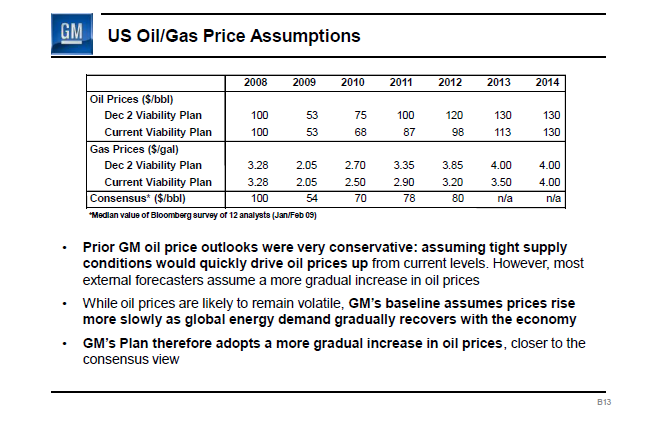
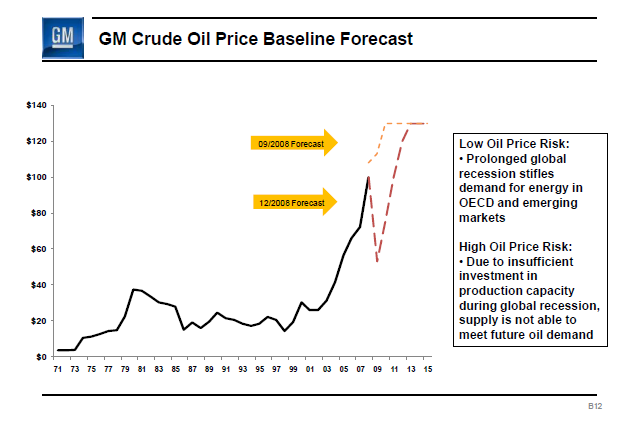
The underlying causes have much to do with peak oil. Long-term forecasts still call for price increases as demand inexorably begins to exhaust the cheaply available supply. It's worth noting those forecasts don't just come from peak oil activists - unless you consider General Motors to be a "peak oil activist":


If this doesn't show the need for greater and immediate investment in mass transit and passenger rail I don't know what does.

It seems clear to me that the long-term increase in oil prices, which climaxed in the great spike of 2008, have fundamentally changed American attitudes toward passenger rail in particular. If the price spike had been sudden and confined to 2008, perhaps nothing would have changed. But since gas prices had been steadily rising since 2005 (and some could argue since 1999) that laid the seeds for a new way of thinking about transportation, and a new appreciation for linking mass transit and energy independence.

Times like these I'm glad it's Obama in the White House.

Thursday, February 12, 2009

$8 billion for HSR While Public Transit Starves

NOTE: We've moved! Visit us at the California High Speed Rail Blog.

The latest news on the state and federal fronts is decidedly mixed. HSR is poised to make out like a bandit from the federal stimulus:

The most important news is the massive amount of money proposed for high-speed rail - $8 billion - and the large increase in Amtrak funding, up to $1.3 billion from $800 and $850 million in the respective House and Senate bills. This represents the largest single expenditure on rail in United States history and promises a new day for train travel. The U.S. Department of Transportation will lead the distribution of these funds; most of the money is likely to go to existing programs such as California High-Speed Rail, Midwest High-Speed Rail, and Southeast High-Speed Rail. States will get no supplementary money for rail programs, which implies that the bill’s writers want states to focus on implementing high-speed rail over standard-speed intercity rail.

I'm not going to argue with $8 billion for HSR - that's much more than the $2 billion I hoped would come from the stimulus. Still, I'm not quite comfortable with focusing on HSR at the expense of other intercity rail systems. The fact is that America needs more passenger rail period and needs a comprehensive program to implement them that includes high speed and non-high speed trains. Still, as The Transport Politic pointed out in the above quote, this is still the biggest amount the US has ever spent on passenger rail and should be considered a victory.

Less encouraging, however, is the doom about to face local public transit agencies, particularly those here in California. The final federal stimulus bill contains some transit grant funds, but zeroed out the proposed $2.5 billion for new starts. But the real catastrophe comes from Sacramento, where the proposed budget deal will eliminate state funding for local transit agencies in its entirety, a cut of $536 million that comes on top of nearly $3 billion in cuts that have been made since summer 2007. This is especially ironic given that the budget deal includes a 12 cent increase in the gas tax - but none of that will go to transit.

Many sustainable transportation advocates argue for a higher gas tax - but believe it should fund increased mass transit options. While schools and health care need more funding, that should come from other sources. Using the gas tax to do that is just not good policy.

Sure, this is an HSR blog, and perhaps we could be satisfied with the $8 billion coming to a high speed rail project near you. But as I have repeatedly insisted, HSR is just part of a bigger strategy to reshape American transportation. The big picture goal is to reduce our dependence on oil and sprawl. HSR is a good solution for the LA-SF corridor, but it won't help bring folks from Hollywood to Union Station, or from the Sunset District to the Transbay Terminal. HSR needs local transit to attain its highest ridership goals and to be the kind of success we know it can be.

The state budget deal is far from final, and Republicans may walk away from it once their wingnut base gets word of the tax increases. But the use of gas taxes for non-transit related funds, particularly when local transit is getting left in the desert with a canteen and a compass, is especially egregious.

Thursday, February 5, 2009

What, Palo Alto Worry?

NOTE: We've moved! Visit us at the California High Speed Rail Blog.

A few days ago the San Jose Mercury News ran a story suggesting Palo Alto residents were full of worry about the high speed rail project's impact on their town. I don't know how accurate a reflection of public opinion the report is, but the media has long demonstrated their own power to shape public opinion, so it's worth thinking about this for a moment:

Until recently, the notion of a bullet train from Los Angeles to San Francisco seemed far off to Tom D'Arezzo, a high-tech product manager who lives in Palo Alto's Southgate neighborhood. He knew it was on the November statewide ballot, but wasn't sure of the specifics.

Now that the $10 billion bond measure has passed, however, the project's full impact is beginning to hit home — almost literally. Like his neighbors on Mariposa Street, D'Arezzo has a yard that backs up to a portion of the Caltrain tracks that might have to be widened to accommodate the high-speed electric trains.

D'Arezzo now fears he could lose up to 10 feet of his property to eminent domain. But he's been frustrated in his attempts to find out for sure. Rail officials will neither confirm nor rule out the possibility, repeating a mantra that is beginning to irritate some Peninsula residents even though it's meant to soothe them: "It's early in the process."

Groundbreaking on the planned $40 million line is years away. The California High Speed Rail Authority is in the first stages of public outreach, holding "scoping meetings" in the Bay Area to get residents' thoughts on what should be studied in the environmental reports.

But D'Arezzo, and a handful of leaders in mid-Peninsula cities, worry that by the time they get the detailed information they would need to participate in the decision-making process, the big decisions will have already been made.

The fact is that, yes, it IS "early in the process." Some key questions have yet to be resolved, such as the configuration of tracks (F-S-S-F or S-S-F-F or some other combination), the design of grade crossings, and of course, where the mid-Peninsula station will go. All of that then impacts how much ROW is needed, what can or will be done to separate the tracks from its surroundings, whether it's a home or Palo Alto High School, etc. That's why these meetings are being held - to start the public conversation, to get these residents thinking about how they'd like to integrate HSR into their community.

There's no reason why Palo Alto or any other city has to treat the CHSRA like an invading army of space aliens that plans to cut a huge gash in their community with their lasers. In fact, Palo Alto actually has an opportunity to help determine how best HSR can exist in their town. If they decide they want to pay for a tunnel, there's nobody stopping them. If they decide that they would prefer this much ROW to be used here and that much ROW to be used there, they can organize and give that feedback to the CHSRA which can then use it to help make some engineering decisions.

Obviously Palo Alto can't design the entire thing themselves, but this notion that they're consigned to wander in the dark is really just not credible. They're not at the Authority's mercy. Palo Alto should instead treat this as an opportunity to help build a sustainable community oriented around passenger rail, and model to the rest of the state (and especially to their neighbors on the Peninsula) how to integrate HSR into their urban landscape.

The best cure for worry is to take action. Hold some community workshops, hire some consultants, talk to planners, send someone to visit some European cities, and take the knowledge and come up with a plan. That would be the best thing Palo Alto can do not just for HSR, not just for the state, but for themselves.

(I'm sure some or all of this is already happening, but let's make sure it gets the emphasis it deserves.)

Thursday, January 29, 2009

Slow Orders

NOTE: We've moved! Visit us at the California High Speed Rail Blog.

Should California cater to a small number of Peninsula NIMBYs and truncate the HSR line from LA to SF at San José? That's a question that has popped up during some of the Peninsula scoping sessions, as some residents think "well let's just drop everyone off at Diridon Station and put them on the Caltrain Baby Bullets! Isn't that good enough?"

As Clem points out at the Caltrain HSR Compatibility Blog, however, not all "bullet" trains are alike:

Baby Bullets look sleek, and they impress when they blast by, horn blaring. However, they are nowhere near as fast on average as the proposed high speed trains. Timings from San Jose to San Francisco:

* Caltrain local: 96 minutes - max speed 79 mph - average speed 29 mph
* Caltrain Baby Bullet: 57 minutes - max speed 79 mph - average speed 49 mph
* HSR: 30 minutes - max speed 125 mph (a.k.a "half speed") - average speed 94 mph

HSR at "half speed" is still nearly twice as fast as the Baby Bullet.

Clem also points out that it's impractical to have "half speed HSR" trains run on just the two existing tracks - you can't mix speeds quite like that, especially given the heavy usage already on those tracks. The overall impact on a trip from LA to SF - the entire point of HSR, let's remember - would be significant:

Accounting for transfer time in San Jose, the effective speed of the Baby Bullet ride would approach three times slower than a single-seat HSR peninsula ride. The overall trip from LA to SF would increase from 2:38 to 3:15, an increase of about one quarter. If we compromise that much on the peninsula, why even bother with 220 mph in the central valley? Indeed why bother with high speed rail at all?

Which is is of course the entire point of the NIMBY objections from the usual suspects on the Peninsula. Folks like Martin Engel never accepted the public verdict - or even that of their own communities - which voted strongly for Proposition 1A, knowing full well that it involved sending HSR trains along new tracks up the Peninsula. Others on the Peninsula are grasping at straws by suggesting that HSR be held up just for their own personal interests - basically trying to impose a slow order on the entire system.

In an email, Alon Levy wonders if there's a strategic way to deal with this objection:

Anthony Perl's book New Departures (http://books.google.com/books?id=-B5NgROwk9wC - look for page 26) writes that the TGV had many detractors in the French government who thought it was an "unaffordable boondoggle." In response, the SNCF met them halfway: it only built the first LGV two thirds of the way from Paris to Lyon, and routed the line on the traditional line at lower speed for the remaining third. On the one hand initial costs were kept down, but on the other travelers could see for themselves the difference between full high-speed operation and rapid rail. As the SNCF had predicted, this created political pressure to finish the full LGV to Lyon, and then to extend it to other cities.

I wonder whether this solution is applicable to California, if cost concerns and pressure from Peninsula NIMBYs is too much. The high-speed track would initially run only from LA to SJ, with the trains sharing tracks with Caltrain to SF. It would reduce speed remarkably and make HSR less competitive initially, but not critically; it would at the same time showcase the difference between baby bullets and real bullets. It would require FRA waivers, but as far as I can tell so will the ultimate goal of running HSR in the same ROW as Caltrain.

Do you think it'd be an acceptable compromise if political or financial realities started to sour?

In this case Levy is suggesting calling the NIMBY bluff, using the slower speeds on the Peninsula segment as leverage public outrage at the situation to mobilize the political will to push through HSR all the way to San Francisco at a later date, especially if cost issues necessitate some sort of less-than-complete solution.

It's an interesting concept but I am not convinced it can work. California's record at filling in gaps in the transportation network is not promising. Although I oppose this project, the 710 freeway gap in Southern California has been a missing link in the system for nearly 40 years. NIMBYs in South Pasadena have had a great deal of success blocking its completion (they also helped influence the design of the Metro Gold Line in a less than ideal way, slowing the trains through that city's portion of the route). The cost of the Peninsula route isn't likely to drop anytime soon, and once NIMBY attitudes spread, they have a tendency to get entrenched - the same homeowners stay in their same locations, dominating local politics on the issues. Nobody wants to piss off such a united bloc, so the infrastructure project gets a lower priority.

Another concern is that a non-HSR solution along the Peninsula could sap public confidence in the system itself. It's already too easy for folks to blithely dismiss any government project as inherently doomed to failure, and to cast trains as terminally slow and inefficient. If, after having promised the public a true high speed train from LA to SF - not from LA to SJ - and we can't deliver it, then that may cause a loss of political support, not an increase.

It seems to me the best move is to build on the momentum of November 2008 and rally the public against the small-minded NIMBY interests on the Peninsula who want to block the high speed rail project. HSR, even on the Peninsula, provides jobs, sustainable transportation, a cleaner environment, and less carbon emissions. Californians are not going to allow a small group of people to block that effort. Certainly those who live near the tracks need to be treated fairly, but they do not and should not have the power to compromise this project.

Wednesday, January 21, 2009

Why the Transit Stimulus Fight Matters

NOTE: We've moved! Visit us at the California High Speed Rail Blog.

Over at Grist Ryan Avent looks at the politics of the stimulus and makes some interesting conclusions about what this could mean for projects like high speed rail:

Think all news is bad news during this epic recession of ours? Think again -- over the past three months, real wages have increased 23 percent, an enormous gain. At a crucial period for many working families, paychecks are going a lot farther than they did back in the summer.

The explanation is simple: wages are flat, prices are down. The labor market operates on a bit of a lag, so while the recession affected oil demand and prices very quickly, layoffs and falling wages are emerging more slowly. Eventually, the weak economy will catch up to workers (those who still have jobs), and spending power will decline.

But this is important to remember given the trends of the past decade. When economies are growing, oil prices rise. This means that even while wages are growing, it's difficult for consumer spending power to keep up, unless we reduce the intensity of oil in our economy.

It's a point I've repeatedly made - oil prices have declined only because of the weakening economy. When the economy grows again, oil prices will rise again and eat into wages, jeopardizing the recovery. To break that cycle we must move away from oil. High speed rail is a key part of that overall strategy, which is why it and other forms of mass transit must be included in the stimulus.

Avent goes further to talk about the politics of the stimulus:

The lack of transit spending is unquestionably political, and not logistical, in nature.

The possibility remains that the Congressional leadership and the Obama administration are waiting for the 2009 transportation bill overhaul to adjust spending priorities, and indeed, that vote will be hugely important for the future of the nation's infrastructure. There may also be scope for funding in Obama's energy bill. But there is reason for concern here.

The security of our economy and our environment depend upon a sea change in transportation planning. That transit and rail were so easily sacrificed in stimulus negotiations should send us a message -- now is no time for transit supporters to ease up on their legislators. We'll need to fight until the money is in the pipeline.

Emphasis mine. The story is that transit funding WAS in the stimulus until someone either in Nancy Pelosi, Harry Reid, or Barack Obama's office took it out. All three have at one point or another expressed commitment to support HSR and mass transit, so this goes to prove Avent's point - that we have not yet won a victory for sustainable transportation in Washington DC, and that we must continue the fight to ensure that we do win. Otherwise transit and HSR funding might get thrown overboard again in the name of political expediency. We must show our leaders that it is actually costly for them to do so.

UPDATE: Elana Schor at Talking Points Memo explains that mass transit and passenger rail got the shaft in order to make room for more tax cuts, quoting Oberstar:

The reason for the reduction in overall funding -- we took money out of Amtrak and out of aviation; we took money out of the Corps of Engineers, reduced the water infrastructure program, the drinking water and the wastewater treatment facilities and sewer lines, reduced that from $14 billion to roughly $9 billion -- was the tax cut initiative that had to be paid for in some way by keeping the entire package in the range of $850 billion.

Stupid. Just stupid. Tax cuts do not grow the economy; in this environment they will be put in the bank either as savings or as debt service. If they felt that strongly about cutting down infrastructure projects to pay for tax cuts (which is already poor policymaking) then roads and not rail should have been the target.

What this shows is that the new leadership in DC - in both the Congress and the White House - are not committed to mass transit and passenger rail when the going gets tough. Just because it's easy to say on the campaign trail shouldn't mean it's easy to abandon once in power.