A study that is getting a fair amount of coverage online today is that from the Pew Economic Policy Group, which shows Amtrak "lost $32 per passenger in 2008". The full report breaks it down route by route, showing that only a few routes generated surpluses in 2008, including the only high speed rail route in the Amtrak system, the Acela.
One might see that as a positive sign for high speed rail, proving that it won't experience the same kind of operating losses the other Amtrak lines tend to produce. Already some are arguing the report should produce further support for HSR at the expense of other Amtrak routes.
Unfortunately, the report these analyses are based on is deeply misleading and should not be used by anyone to set passenger rail policy or transportation policy.
The number one flaw of the Pew report, by far, is it does not compare 2008 numbers to previous years. The report merely examines Amtrak route performance in 2008 alone. As you all remember, 2008 was a rather interesting year for American transportation. Most passenger trains - from Amtrak to the local subways and streetcars - experienced significant spikes in ridership as a result of the spike in gas prices.
Any study of 2008 passenger rail that does not take into account these effects is not credible. At all. And a study that doesn't even compare to past years is a joke.
Let's look at a California Amtrak route that DOES publish such credible studies - the Capitol Corridor. Below are excerpts from their 2008 Annual Performance Report, available at the link in the previous sentence.
These charts show a steady increase in both ridership and revenue on the Capitol Corridor, even before the 2008 spike. When presented in context, you see a successful service. Compare that to the Pew report, which took a snapshot of a single year, out of context, pointed out "loss per passenger" that makes Amtrak look like a failure.
This chart is even more impressive and significant. It shows that state subsidy levels (Capitol Corridor is funded by the state of California) have remained pretty much static for the last eight years, yet the Capitol Corridor has had dramatic success at growing ridership and bringing its costs under control.
Eugene Skoropowski, managing director of the Capitol Corridor Joint Powers Authority, presented these charts to the NARP/RailPAC meeting in San Carlos last Saturday. He noted that the 2009 numbers to date show about a 10% decline in ridership from the 2008 highs, but that they're still above FY 2006-07 in terms of revenue and riders.
These numbers paint a very different picture than the flawed and ridiculous Pew study. Amtrak routes have experienced steadily growing ridership since about 2002, and have witnessed improving farebox recovery rates. Further, since we know that the price of oil is merely in a temporary respite and will rise again once economic recovery returns, we can expect Amtrak to continue on a positive upward trend of increasing ridership and increasing financial returns on investment.
And yet that doesn't get at the other enormous problem with the Pew study, which is conceptual. Has Pew done a study of the loss per driver of US freeways?
As anyone who has driven in the Bay Area recently will attest, traffic is much lighter on freeways as a result of the recession. This phenomenon can be found nationwide. So how much money have American freeways lost per driver in 2008? In 2009? What is the trendline?
The Pew study is reinforcing a deeply biased and illogical concept, that passenger rail has to be held to standards of "profitability" that we simply do not demand of our freeway network. As Skoropowski noted at the Saturday meeting, federal highway funds were given to states with a requirement that states pay the ongoing maintenance costs. That money is supposedly paid out of gas taxes, but neither the state nor the federal gas tax has been increased in nearly 20 years. As we expand freeways and as Californians in particular conserve fuel through driving less and buying more efficient cars, the gas tax is less effective in paying these costs, requiring, yes, government subsidies. And of course, nobody has ever once proposed paying back the $425 billion (in 2006 dollars) it cost to build the system.
In short, Pew's study is intended to make Amtrak and passenger rail in general look like a bad investment, when in fact it is anything but that. Sure, the numbers from the Acela prove that HSR will generate revenue, but that's not why we support high speed rail. HSR advocates should condemn this flawed study and resist the temptation to use it to bolster our already strong case for HSR.
Tuesday, October 27, 2009
How Much Per Driver Did US Freeways Lose?


Thursday, June 11, 2009
Thursday Open Thread
So I'm off to Portugal for 2 weeks, and you will be in the capable hands of Rafael and Matt Melzer, who will be doing some guest posts. There will be some open threads every other day, although if any of the guest posters want to move one of those to another day in order to post something, particularly if it is timely, they're welcome to do so.
Today's topic: rising gas prices. Breaking the magic $3 mark across the state. It was when gas prices stayed above $3/gal for an extended period in mid-2006 that the housing bubble burst. Sure, the bubble was going to burst eventually, but it burst at a specific time and due to specific causes, which we can't overlook. Further, the gas price spike of 2008 surely helped play a big role in sending the economy into a tailspin in the latter half of that year.
As a number of economists are coming to realize, any economic recovery could be strangled by rising gas prices. The underlying factors are still there - peak oil, exacerbated now by slackening investment in production. Any hint of recovery is going to send gas prices soaring.
So tell me again why we would NOT want to be investing in a form of transportation that is not dependent on the fluctuating price of oil? That could promote economic growth instead of throwing a drowning economy an anvil?
Wednesday, February 18, 2009
Don't Look Now...
...but gas prices are creeping back up again. At the corner station nearest me in Monterey we've seen an increase of about 30 cents over the last couple of weeks. Sure, $2.40 is a far cry from the $4.60 peak we saw last July, but it's a reminder that as this site has consistently argued, the long-term trend is up, up, up. HSR remains a key part of the essential project of moving California and ultimately the nation toward energy independence.
The underlying causes have much to do with peak oil. Long-term forecasts still call for price increases as demand inexorably begins to exhaust the cheaply available supply. It's worth noting those forecasts don't just come from peak oil activists - unless you consider General Motors to be a "peak oil activist":
If this doesn't show the need for greater and immediate investment in mass transit and passenger rail I don't know what does.
It seems clear to me that the long-term increase in oil prices, which climaxed in the great spike of 2008, have fundamentally changed American attitudes toward passenger rail in particular. If the price spike had been sudden and confined to 2008, perhaps nothing would have changed. But since gas prices had been steadily rising since 2005 (and some could argue since 1999) that laid the seeds for a new way of thinking about transportation, and a new appreciation for linking mass transit and energy independence.
Times like these I'm glad it's Obama in the White House.


Sunday, November 23, 2008
False Dichotomies
In the dustup over the ridiculous Ben Adler article and the even more inane TAPPED post about Adler's article, a couple of very good points have been made about how we talk about transportation and the need to avoid reinforcing false dichotomies that undermine our goals.
One of the primary things this blog was founded to accomplish is to provide the accurate information about high speed rail that is so sorely lacking in this state. I've had the benefit of attracting some brilliant commenters like Rafael who know the technical aspects of this inside and out. The quality of the discussions here helps all of us promote and support HSR. It's the kind of info that The Overhead Wire explains is fundamental to successful transit advocacy. Especially from the news media, we get buried under an avalanche of misinformation and opinions based on incorrect facts.
We scored a major victory over those tactics by getting Prop 1A passed. There really is a huge reservoir of support in California for mass transit and passenger rail in particular. The idiotic 2/3 rule aside, 67% of voters in LA County, Santa Clara County, and the North Bay - three of the most populated parts of the state - voted for local rail service. If we are to sustain that energy and turn it into steel in the ground, into actual passenger trains, we need to continue working on pushing out the right information so that Californians and their leaders will implement the solutions we voted for on November 4.
We also need to make sure we don't fall into traps. Ben Adler did that by setting mass transit up against itself. Bruce McF offered an excellent comment on this subject:
It is not unreasonable to ask the question of spending priority, but it is always unreasonable to ask the questions in terms of setting priorities between different transport modes that happen to use the same technology.
That is, the following system makes no sense at all:
1. $X set aside for rail. Allocate between light rail, mass transit, regional passenger rail, and freight rail.
2. $Y set aside for roads. Allocate between city streets, industrial parks, state highways, federal highways, freeways.
And in perpetuating that process of proposing to establish a priority rankings within pools based on technology instead of based on transport task, that is precisely what Ben Adler is supporting.
When divided up by transport task, the money required for the HSR line is substantially less than the money required for the available alternatives ... road and air.
HSR's rivals aren't BART, Caltrain, Metro Rail, or local buses. Those services are our allies and for HSR to be successful, they must be successful. No, the real problem is a political system that continues to favor sprawl and cars even though long-term oil price increases remain likely.
HSR is a solution to failed priorities and a failed developmental model. HSR is a cost-effective solution to the problem of how to move millions of Californians around the state. Let's make sure that message, and the other reasons for HSR, get a wider airing over the coming months.
Tuesday, November 11, 2008
2008 A Record Setting Year for Ridership
At least here in California, according to Caltrans and Amtrak, who partner to operate the Amtrak California intercity routes:
Californians are leaving their cars, SUVs, vans, and trucks at home and riding trains instead in unprecedented numbers. Today, Caltrans and Amtrak reported a record-setting 5.5 million passengers rode California's state-supported intercity passenger trains in federal fiscal year 2008....
In 2007-08, the Pacific Surliner carried more than 2.89 million passengers, a seven percent increase from the preceding year.
In Northern California, Capitol Corridor (Auburn to San Jose) trains carried 1.69 million riders, an impressive 16.8 percent jump from the previous 12 months. Meanwhile nearly one million passengers (949,611) rode the San Joaquins service (Bakersfield to Sacramento/Oakland). This past July, ridership shot up a whopping 32 percent over July 2007, rising above 100,000 for the first time. The Capitol Corridor and the San Joaquins ranked as the nation's third busiest and sixth busiest lines, respectively.
Amtrak ridership in federal fiscal year 2008 increased to 28,716,407, marking the sixth straight year of gains and setting a record for the most passengers using Amtrak trains since the National Railroad Passenger Corporation started operations in 1971.
Some might cluck that this is just the product of the dramatic spike in gas prices that took place earlier this year and won't last. While that did fuel some of this ridership growth, ridership on Amtrak California routes has been steadily growing since 2002. Amtrak itself has set ridership records every year since 2002. There is every reason to believe ridership will continue to rise.
That growing ridership reflects a growing awareness among Californians of the value of passenger rail, and that was reflected in last week's election where most passenger rail proposals were approved by voters (Measure B in Santa Clara County, the BART funding plan, is still too close to call). In the article Eugene Skoropowski, managing director of the Capitol Corridor, noted that Prop 1B (passed in 2006) also intended money to be spent on rail expansion. Arnold Schwarzenegger's Department of Finance delayed this, using a flawed audit to claim new cars weren't necessary, but that has been reversed and new cars have been ordered.
We need to accelerate Prop 1A and Prop 1B rail funding. While we wait on federal matching funds for HSR - which we will press for in 2009 - California needs to wait for nobody to release the bond money for the other passenger rail projects that are awaiting funds. California legislators should make it a priority to spend that money as an infrastructure stimulus, as well as part of a long-term plan to grow rail in this state.
Record ridership is an opportunity to take passenger rail to the next level. Let's make sure our legislators follow through on it.
Sunday, October 26, 2008
Sustainability
Earlier this summer the price of a barrel of crude oil hit a record $147. Since then the price has declined dramatically to about $64. Gas prices here in Monterey have fallen from a high of about $4.60 to just under $3. Some might be tempted to argue this makes alternatives to oil less necessary, but that would miss the point - the current decline in oil prices is strictly a product of demand destruction.
What that means is we're in between a rock and a hard place. Our economy has been built on growth made possible by cheap oil. More cars need to be sold, more suburban sprawl needs to be built, more goods need to be hauled by truck in order for the 20th century economic model to continue. If you can't do any of that without risking a crippling oil price increase like that which burst the housing bubble, you are stuck in an economic trough that has no visible way out.
Unless, of course, you start building an alternative to oil.
Besides, the phenomenon of peak oil is going to rather quickly necessitate such alternatives, if OPEC doesn't do so first. If this current respite in oil prices is to be anything other than the eye of a hurricane, we must build our way out of oil dependence.
Just as the oil crisis has not gone away, neither has the climate crisis. Arctic sea ice nearly reached a new record minimum. Global warming continues unabated, as the carbon-burning industry merely takes a short breather.
2008 is therefore an opportunity to start transitioning away from a failed economic model, one that became so dependent on burning fossil fuels that the economy nearly collapsed and severe ecological crisis has taken place. If we are to turn the 21st century into a sustainable century - with sustainable prosperity, built on renewable resources and a better, more sensible ecology, we need to start NOW on producing alternatives to oil.
California High Speed Rail is one of those alternatives. It will:
-Reduce carbon dioxide emissions equivalent to removing 1.4 million cars from the road, and take the place of nearly 42 million annual city-to-city car trips (Final EIR)
-Reduce CO2 emissions by up to 17.6 billion pounds/year (HSR fact sheet)
-Reduce California’s oil consumption by up to 12 million barrels/year (same as above)
According to the Final EIR 63% of intercity trips over 150 miles in California are taken by car (scroll to page 12). This is a major factor in causing most of California to be out of compliance with state clean air goals. Given that HSR would be much faster than driving between California's major metro regions, and will likely be less costly as well by 2018, HSR would make a significant dent in those car trips and therefore in the pollution they spew.
And HSR provides a VAST carbon emissions savings over other forms of transportation:
(Image from Alberta High Speed Rail)
HSR can be powered entirely by renewable energy sources, a goal the California High Speed Rail Authority recently adopted. HSR will provide a guaranteed buyer for renewable energy projects, making their construction more likely and more economical.
Sustainability is also a smart economic strategy. We have talked repeatedly about the economic stimulus it will provide. It will also provide a Green Dividend to Californians in the amount of several billion dollars at least.
Sustainable transportation is both economical and necessary for California's 21st century future. Sure, we have a temporary respite from the worst of the oil price hikes. But does anyone here really want to gamble that such price increases will never return? That we can continue the 20th century sprawl model indefinitely?
If you don't want to make that sucker bet, then vote Yes on Prop 1A.
Wednesday, October 22, 2008
HSR: Safe and Fuel Efficient
Dennis Lytton, who has authored a post for this blog back in June and is a member of the Board of Directors for the National Association of Railroad Passengers, has now published an op-ed in today's Daily Breeze, a newspaper in SoCal's South Bay region, explaining the benefits of Prop 1A and high speed rail. I won't reproduce the entire op-ed here but will include some of the salient points.
The op-ed opens by retelling a tragic story of a UC Berkeley student from Pasadena who was killed on her way back to campus while driving near Gilroy - one of the numerous automobile fatalities that can be prevented by fast, efficient, plentiful intercity rail:
Improvements in auto safety have helped reduce the rate of automobile fatalities. However, that gain is largely negated by increases in the number of miles Americans typically drive. This is a reflection of bad public policy that favors sprawl and freeways over modern rail systems and transit-oriented development. It causes our traffic nightmares, fouls our air, takes far too many lives and makes us dependent on triple-digit prices for crude oil.
California High Speed Rail would initially stretch from Anaheim to San Francisco, with future branches to Sacramento and San Diego. The system would be completely separated from automobile traffic and freight trains. The tracks would be fenced in and monitored by earthquake sensors and cameras. Safety would even exceed that of airplanes, since high-speed trains don't carry volatile fuels that can be touched off by explosives in a shampoo bottle or shoe.
But the most important safety feature is that millions of people annually will take the train instead of driving. Europe and Japan have far fewer transportation-related fatalities than the United States - due mostly to their lower dependence on the automobile for local and intercity transit. California could potentially save thousands of lives lost per year in auto accidents if it built a state-of-the art intercity rail system.
Dennis' points are excellent and have not been made often enough. The safety features that HSR offers are not available to drivers or those taking planes. The system's safety will save lives over driving and will make the trains a more attractive option to travelers within California.
Dennis also reminds us of the fuel efficiency of HSR:
High-speed rail is the greenest way to move people ever invented. Trains consume only one-third of the energy used by an airplane and one-fifth the energy of an automobile trip. Nearly all of the electricity of HSR's trains could be produced from renewable energy sources. High-speed rail would reduce carbon dioxide emissions by up to 17.6 billion pounds per year. It would reduce California's oil consumption by up to 22 million barrels per year (1,100 million gallons per year). At a price of $125 a barrel, savings in oil costs alone would approach $2.75billion annually. Oil costs will rise in the long run, as oil geologists agree that we are entering an age of declining oil reserves that will be ever harder to extract.
Which gives me the opportunity to repost one of my favorite images:

(Image from Alberta High Speed Rail)
Now I'm sure the usual HSR deniers are clucking, "but oil prices have fallen!" That's true - for now. When Dennis originally wrote this op-ed the price of a barrel of oil was at $125. They're now at $66. Of course, it is common for oil prices to decline in the autumn and winter months, only to rise again in the spring and summer. But here's the thing - that does NOT mean we can rely on oil to serve our travel needs.
The only reason oil prices have declined is demand destruction. Meaning that fewer people are using gas to travel. If lower gas prices spur an increase in gas consumption, the price will rise again, as many economists have recognized. The only way to produce affordable, sustainable, long-term growth independent of the vagaries of oil price fluctuation is to build rail projects such as high speed rail.
As we've seen here, HSR is a successful method of travel around the world. It operates without subsidies, attracts millions of new train riders, and provides badly needed jobs and economic growth. Thanks to Dennis Lytton we are also reminded that it provides safer and more fuel efficient travel. The case for Prop 1A could not be clearer.
Monday, October 13, 2008
The Truth About Prop 1A and the State Budget
All the way back in March I opined that the biggest threat to the passage of the high speed rail bonds was the state budget. If the budget was still in deficit, folks might vote against HSR bonds even though the two are unrelated.
That may well be happening. We haven't seen new polls on Prop 1A in some time, but when we do I expect it to show a very close race.
The problem is that this thinking is deeply flawed. The state budget's problems do not - at all - mean that Prop 1A is a bad idea. Prop 1A is not the reason why the state is in deficit. It will not worsen that deficit. Instead Prop 1A is absolutely necessary to getting us OUT of deficit. Anyone telling you otherwise is simply demonstrating their ignorance of economics.
Let's look at this more closely. First, the state budget deficit. Deficits are NOT a product of natural forces but instead of bad decisions. California's current deficit stems from two major sources:
1. $12 billion in tax giveaways since 1993. This includes a $6 billion hole Arnold blew in the budget when he unilaterally cut the vehicle license fee upon coming to office in 2003. That is an annual cost of $6 billion, by the way, since Arnold has since been backfilling the revenues. Restoring that $6 billion would alone close the projected deficit. Prop 1A will create 160,000 infrastructure jobs that will pump income and sales tax revenue into the state's general fund. We badly need that revenue. We cannot afford to leave that money on the table.
(Note: California has also cut nearly $10 billion in spending since early 2007. Those who claim that this is a spending problem clearly have no knowledge of the details of the state budget.)
2. The weakening economy. As I have been arguing almost every day this month, that is an argument FOR Prop 1A. Infrastructure projects are a tried and true part of stabilizing and growing the economy during rough times. The Golden Gate Bridge, Shasta Dam, and the California Aqueduct were all built with voter-approved bonds during a recession, the first two during the deepest part of the Great Depression. Prop 1A will do the same today. We need jobs. Now. California would be crazy to turn down 160,000 jobs right now.
Further, as a recent PBS documentary explained, it was high gas prices that burst the housing bubble. Yes, gas prices have been falling - but that is only because of demand destruction. In other words, people drive less, so the price falls. The ONLY way that can be sustained over the long-term is by building alternatives to oil. If we don't, demand WILL rise - and so will gas prices.
Finally, numerous economists have argued strongly for infrastructure spending right now as both economic stimulus and a way to ease the financial crisis - which after all is happening because of underlying insolvency here in the United States. These economists include Lawrence Summers, Nouriel Roubini, Duncan Black, Dean Baker and Brad DeLong, and Nobel Laureate Paul Krugman.
Those who claim otherwise - that the state budget deficit means we must reject Prop 1A - are lying to you. They're trying to prevent a revival of the New Deal. These groups, like the oil company funded, far-right Reason Foundation, or the anti-government Howard Jarvis Association, are primarily interested in drowning government in a bathtub. Their opposition to HSR is part of a broader ideological agenda designed to prevent California from addressing its economic crisis by providing sustainable, non-oil based transportation that we badly need.
If you want to help ease our budget deficit and grow the economy, vote for Prop 1A. If you want to prolong the pain and do nothing to resolve the deficit, vote against Prop 1A. A no vote on Prop 1A is like punching the wall to cure starvation. It's only going to leave you in more pain and do nothing to solve the immediate problem.
UPDATE: Matt Yglesias calls them The New Hoovers:
This is ludicrous. You need to respond to a downturn with expansionary policies of some kind. In recent decades, we’ve preferred relying on expansionary monetary policy (Fed interest rate cuts) rather than Keynesian deficit spending. But at the moment, there’s no real room left for the Fed to cut rates. That means you need deficit spending. Among other things, the nature of state and local budgets means that a contraction in the economy will naturally lead to a contraction in state and local spending. That will lead to further contraction in the economy. If the federal government did what Scherer’s suggesting and added its own cutbacks to state government cutbacks, local government cutbacks, and private sector cutbacks that would only deepen the recession.
Again, consider the source of most HSR denier propaganda: the Reason Foundation and the Howard Jarvis Association. These people think Herbert Hoover was a good president with the right ideas.
Tuesday, September 30, 2008
Arnold Reiterates Support for Prop 1A
In remarks at the Commonwealth Club in San Francisco last Friday Arnold Schwarzenegger again explained his support for Prop 1A, the $10 billion high speed and passenger rail bond. His speech focused on anti-global warming actions and the economic value of reducing carbon emissions - and why we must continue to do do this even during, especially during, a credit crisis.
There is far more economic opportunity in fighting global warming than economic risk....We shouldn't let the budget crisis hold back good things for the future. 20 years from now you can't look back and say "well they had a budget crisis so we didn't do it." Just because we had a problem with the budget does not mean that people should vote "no" on high speed rail. Our rail system in America is so old, we're driving the same speed as 100 years ago, the same system as 100 years ago. We should modernize, we should do what other countries do...We should start in this state, we should show leadership.
I'm not exactly his biggest fan, but this is the "good" Arnold Schwarzenegger - the one who gets the need to build for the future, who understands that the green economy is going to be at the center of California's future. He spoke strongly against drilling, and noted that oil prices only came down through demand destruction - using more public transportation is the only way to bring down gas prices. (Of course Arnold, does that mean you will stop cutting public transit budgets?!) He even spoke favorably, though cautiously, of Sen. Darrell Steinberg's SB 375 - "I'll look at it carefully" - and its smart growth goals.
You can see the video yourself here - scroll to 26:50 for the Prop 1A discussion. (Couldn't get the embed to work for some odd reason.)
Let's hope Arnold takes this message around the state and help get Prop 1A passed.
The Commonwealth Club is also hosting a Prop 1A debate this Friday between Quentin Kopp , chairman of the board of the California High Speed Rail Authority, and Jon Coupal, head of the Howard Jarvis Taxpayers Association. Former US Secretary of Transportation Norman Mineta will moderate.
Sunday, September 28, 2008
Prop 1A Misinformation in Long Beach
Today's Long Beach Press-Telegram editorializes against Prop 1A. As is becoming depressingly common with newspaper editorials, the Press-Telegram's anti-HSR screed contains a number of out-and-out lies that need to be called out here. The editorial staff does its readers a disservice by misleading them on some of the most fundamental aspects of Prop 1A and our state's high speed rail plan. Some examples:
That's the measure that would borrow $10 billion and spend it on promoting, not building, a high-speed train system. This is a colossal ripoff with no promises of any results except that the money would get spent.
AB 3034 changed the proposition to ensure that no more than 50% of bond funds could be used to build the system to ensure that we must have matching funds to proceed. The editorial somehow turns that into a negative, which is absurd. Their claim that the bond money wouldn't go to construction is a lie, plain and simple.
Worse, it would get spent with no oversight, and participation on the campaign's "finance committee" by nobody other than politicians and bureaucrats. Supporters brag that the $10 billion would not require a tax increase, but what they don't say is the obvious, which is that the money, $20 billion including interest, would come straight from the state's deficit-ridden general fund.
Another lie - AB 3034 created an oversight committee that Republican Roy Ashburn fought hard to include. The editorial misleads readers about the cost - $20 billion would not be spent all at once. The bond has a 40 year life, meaning the cost would be closer to a manageable $500 million per year.
If the project ever actually got built, supporters say the cost would be $40 billion, but skeptics say it would be more like $100 billion. The expectation (which seems more like a fantasy) is that the rest of the money would come from the federal government and the private sector, neither of which is standing in line with checkbook in hand.
There is NO evidence for the skeptics' $100 billion claim. None whatsoever. But there is a LOT of evidence to suggest Congress actually has the checkbook ready - John Kerry and Johnny Isakson are proposing a multibillion HSR funding bill and if he wins, Barack Obama has shown a desire to build HSR as well. As to the private sector, nearly a dozen companies responded with interest in helping fund HSR.
High-speed trains are wonderful assets in Europe and Asia, where they whisk travelers to their destinations at speeds of 180 miles an hour or faster without the misery of airport security lines. It's a concept that works well between Washington and New York, or between Paris and the chateau country. But those aren't 400-mile trips. The ideal travel distance for a high-speed train is a couple of hundred miles or less, or, as in Tokyo, less than 50 miles or so from an airport to an urban center. Trying to connect San Diego, Orange County, Los Angeles, Fresno, San Jose, Sacramento and San Francisco is a far more daunting task, and not likely to put any airlines out of business.
The Madrid-Barcelona AVE train is a similar distance to SF-LA, and is pressuring airlines there. Passenger rail already connects the cities the editorial claims can't be linked - HSR merely provides a much, much faster service.
Additionally, the editorial makes the common media mistake of not explaining the cost of doing nothing. Nowhere are rising oil prices mentioned. Nor are higher airfares, nor are flight cutbacks, nor the environmental savings of reducing carbon and cutting oil consumption, nor the $80 billion price tag of expanding freeways and airports to meet the demand HSR will serve, nor the cost to the economy and the state budget of not creating 160,000 jobs. Instead the editorial board relied on misinformation and lies to give readers a deeply biased picture of Prop 1A.
The editorial board should know better than to write an editorial that has not been fully researched and vetted. Journalistic ethics do not end at the opinion page. The Long Beach Press-Telegram owes its readers a correction and an apology for this flawed editorial.
Tuesday, September 23, 2008
Prop 1A as Economic Stimulus
One of my most consistent arguments for high speed rail has been that it will provide a significant economic stimulus to our state at a time when we badly need it. Yesterday's Los Angeles Times put some flesh on that argument by examining the impact of the 2006 infrastructure bonds, which are just beginning to turn into actual projects on the ground:
Without this money, "the construction industry would be out of business," said Rich Gates, president and general partner of Silva Gates Construction in Dublin, Calif. "This is kind of the drip of the IV to keep us going."
The governor's decision to turn on the bond money tap allowed Silva Gates to bid successfully for three freeway projects in the Sacramento and San Francisco Bay areas.
Every $1 billion in public works spending creates approximately 18,000 jobs, according to a formula developed by the Commerce Department.
By that formula Prop 1A alone would create around 180,000 jobs. The California High Speed Rail Authority has been more conservative in its estimates, giving a figure of 160,000 construction jobs.
Schwarzenegger's spending plans, though substantial, won't do more than soften the blow to construction that's left thousands of houses half-built in abandoned tracts up and down the state, said Stephen Levy, director and senior economist at the Center for the Continuing Study of the California Economy in Palo Alto.
"This is one of the few things that state and local government can do to help in the short run" and to invest in improvements that will be in place once the economy turns around, he said. But, "if you're down by a dollar, and this helps by a penny or two, you don't want to overstate its magnitude."
I don't disagree with that, and I don't want to overstate the matter. Prop 1A isn't going to lift the state out of recession single-handedly. But it WILL help matters and create jobs at a time when we need as many jobs as we can get - a state with a 7.7% unemployment rate isn't in a position to turn down 160,000 jobs.
Those jobs have a catalyzing effect on the economy, by the way:
Getting money quickly through the transportation planning and approval process helps the construction industry, business in general and the state as a whole because of California's need for more roads and less traffic congestion, said Dan Dunmoyer, the governor's cabinet secretary and a key liaison to industry. "It's very useful now, but we would be doing this even if our economy was roaring," he said.
"Construction jobs are what you'd call high-powered jobs," said Jack Kyser, chief economist at the Los Angeles County Development Corp. Highway projects not only pay good wages to carpenters, ironworkers and operating engineers but also create a ripple effect for a slew of people working for companies that supply building materials, heavy equipment and related goods and services, he said.
These are jobs that cannot be easily outsourced. HSR's long construction schedule is a plus for these companies, from haulers to contractor wholesalers, as well as for their employees. They all get a stable source of money that will keep them in business for many years. That in turn makes them more likely to spend on other services, from a restaurant to home furniture to a weekend vacation here in our Golden State.
Up in Washington State the rule of thumb was that one Boeing job created three jobs in the community, from waitresses to mechanics to hairstylists. Whatever the actual number here in CA, these jobs sustain small businesses and help keep money within the community and the state, which then generates more tax income - something California can't exactly afford to turn down either.
HSR has many other benefits alongside economic stimulus - providing an alternative form of travel that's environmentally friendly, reduces carbon emissions, isn't dependent on ever-rising oil prices, easing congestion on roads and airports. But the economic stimulus IS a significant part of the picture, something that Californians should find quite compelling.
Monday, September 22, 2008
Oil Prices Soar
Up by $31 in the last couple days according to the New York Times, currently at $122/bbl. Sure, crude prices have been coming down since their July peak, but as I explained last month the long-term trend remains upward for fundamental reasons, including peak oil and the global surge in oil demand.
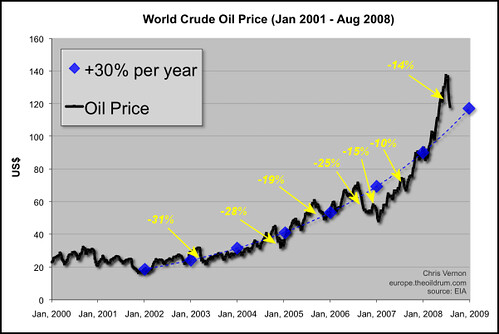
Even if oil prices were to level off around $100/bbl high speed rail would be a good deal for Californians. But what this recently rally reminds us is that upward pressure is still there and the days of $100/bbl are probably over. We've seen 30% year over year increases in the price of oil since 2002. As we know, this has a dramatic ripple effect throughout our transportation system. The airline crisis is one of them, as higher fuel costs lead airlines to cut routes, flights, and raise fares.
The only way out of this is to build sustainable mass transit that is fast, reliable, and not dependent on oil. High speed rail meets all those needs. We've already waited long enough - time to get started by passing Prop 1A.
Saturday, September 20, 2008
"That's A Lot of Supertrains"
So says Atrios, commenting on the stunning $700 billion bailout plan proposed by the Bush Administration for the financial markets. That would pay for around 17 and a half California High Speed Rails, at the current cost estimate of around $40 billion.
While something needs to be done about the credit markets, several leading economists are saying this is a bad deal. This isn't an economics blog, but you don't need an econ degree to understand common sense about our financial priorities. The US government can find $700 billion to bailout a bunch of bankers who made predictably bad loans, but we're to believe there's just no money for a relatively cheap high speed train? One that would create a significant near-term economic stimulus for California, through the creation of at least 160,000 jobs, and an even larger long-term economic boost through job creation, gas savings, lesser carbon emissions, and the green dividend.
The problem is not that HSR costs money we don't have. It never was the problem. Both California and the USA have more than enough money to build and operate HSR. No, the real issue is one of priorities. Since the 1960s this country has believed that passenger rail is not worth saving, that we would do just fine to build an economy based on freeways and ever-complex deregulated financial instruments. 2008 ought to suggest how well that worked out.
Those who criticize HSR do so because they do not believe passenger rail is a priority. They're the same people who look at a $3 billion cut to California public transportation and clap their hands. The considerable fiscal benefits don't sway them, giving Californians a real and true choice doesn't sway them, and as we saw even good old truth won't sway them.
Nobody expects to really see $700 billion spent on "supertrains" (although if it's between that and a blank check bailout, I'm for the trains). But it does suggest that if the US government can seriously consider such a move, surely it should not be difficult to find the money to build high speed rail. This nation is going to have desperate need of economic stimulus, sustainable transportation, and reliable and safe infrastructure. California high speed rail offers all of that. Rather than mortgage our nation's future to prop up the bad choices of the past, it makes so much more sense to spend some money we have now to prepare ourselves for the future.
Thursday, September 18, 2008
Nearly A Good Laugh
It was only a matter of time, really. Libertarian and far-right anti-tax groups in California have been unhappy about our high speed rail project for a while now, and sooner or later they were going to run into noted passenger rail hater Wendell Cox. Cox believes light rail, heavy rail, high speed rail are all inherently flawed concepts, perhaps because he takes no small amount of money from bus and highway lobbyist groups. Cox has also been associated with the conservative Reason Foundation for many years, a group that is funded by oil companies and their affiliated foundations. When Cox, the Reason Foundation, and the rabidly anti-HSR Howard Jarvis Association got together, the outcome was predictable.
That outcome was a anti-HSR report (full 190-page version here) that the Howard Jarvis Association included in their 2008 "Piglet Book". It's their attempt to put some "evidence" to their usual anti-train claims. In reality it's full of so many contradictions, half-truths, and outright nonsense that it would take more time than I have to fully refute the whole thing.
The Howard Jarvis Association in particular is coordinating a full-fledged media rollout of the study, with an op-ed in the LA Daily News that suddenly introduces a $54 billion price tag for HSR out of nowhere, to an appearance on KQED forum (Rod Diridon was there on behalf of HSR). That, alongside the media's love for stories on "government waste" should ensure this gets some traction in the press, albeit fleeting.
Reaction to the study has been swift from those who know a thing or two about rail. From our friends at The Overhead Wire:
And yes...they play the fear card.Terrorism against rail targets is a concern considering the extent of attacks that continue to occur on rail systems around the world.
Typical of current culture warrior thinking. When you can't win with the facts, try to scare people.
The study makes some rather outlandish claims. They charge that because HSR's projected cost has risen to around $40 billion, that by the time it opens we might have to spend as much as $80 billion. It's not enough to simply look at a trend and assume it will continue on forever - you have to explain the underlying logic, as we have with gas prices. They don't. Nowhere is global inflation of construction materials or the declining value of the dollar mentioned. A gallon of gas costs 200% more in 2008 than it did in 2000, but somehow I doubt that Reason and the Howard Jarvis people would suggest we abandon cars and freeways as a result.
Their $80 billion cost estimate is pulled out of thin air - and if we use their same logic, a gallon of gas will cost between $8 and $10 by 2018 ensuring that HSR is a financial bargain.
Numerous other examples abound. They claim California isn't as favorable for HSR as Europe or Japan, even though Spain's conditions are similar to our own. They claim Acela isn't a success, but it has at least 40% of the market share on the Northeast Corridor, a stunning number for a system that isn't true HSR. Their claims about ridership aren't backed up by a close study of the assumptions that went into the CHSRA's studies - instead they say "well this doesn't compare well to Europe so it can't possibly be right?!" They say non-HSR alternatives will be cheap, that freeways can be expanded for $900 million - but it'll cost $6 billion to widen Highway 99 alone!
It goes on and on like that for 190 pages. But the details of the study aren't important to the authors and promoters, who don't expect anyone to actually read it and see the nonsense for themselves. Instead they just want to muddy the waters in the public mind by saying "boondoggle! pork! massive cost overruns!" often enough in hopes that the media will listen and repeat it for them.
We remain confident that Californians will see the value of high speed rail. While Cox and the Howard Jarvis Association quibble over numbers Californians are screaming for solutions to the airline crisis, to high fuel costs, and to the nasty economic downturn that we're sliding into head-first. They know better than to have oil company and highway lobby shills convince them to abandon California's future.
Monday, September 15, 2008
HSR Radio Ads Hit the Airwaves
Thanks to Michael Kiesling for bringing this to my attention. The California Alliance for Jobs - RebuildCA.org - has begun airing pro-HSR radio ads starring Will Durst. Kiesling said he heard it on KFOG 104.5 in the Bay Area this morning, which is one of the leading radio stations in the market. It's a good ad, playing on Californians' annoyance with airports, frustration with fuel prices, and desire for environmentally-friendly options to show the value of high speed trains.
The CA Alliance for Jobs are the same people who actively promoted the 2006 infrastructure bonds, and is an organization backed by many of the state's largest construction unions. Glad to see them getting involved in the campaign to pass Prop 1A!
Friday, September 12, 2008
Prop 1A Would Save the Environment - and Save Billions
The media narrative on Prop 1A is beginning to solidify - neat idea but omg the cost! This report from KCBS radio in San Francisco is a good example:
Proposition 1A represents a $10 billion state investment in a high-speed rail system and the timing couldn't be better.
Frustration with air travel, the high cost of gasoline and global warming have attracted environmental and transit advocates, municipalities and local business groups....
Despite the numerous green benefits, some local governments and the California Chamber of Commerce argue that funding such an expensive project would be irresponsible given the current budget situation.
“Having California in the very precarious budgetary situation we find ourselves… now is clearly not the time to be taking on this inordinate amount of debt,” said Jon Coupal, a spokesman for the Howard Jarvis Taxpayers Association.
KCBS is actually better than some other media reports we've seen over the last few months about conveying to listeners the major environmental benefits of high speed rail, as well as the impact on fuel costs and the superior comfort of train travel. But they give Jon Coupal, head of the far-right Howard Jarvis Association, air time to make his false claims that Prop 1A would exacerbate our state's budget crisis. That's to be expected given the media's abandonment of objectivity for "he said, she said" stenography. So we're going to have to counter his claims often between now and November.
First, California can afford Prop 1A. It will NOT make our budget deficit worse - the nonpartisan Legislative Analyst's Office reported that the budget can handle the impact of the bonds. Also consider that the bond money won't be spent all at once, but will ramp up as construction gets going, and will likely reach a peak after 2012, when the state's annual bond payments drop significantly.
Second, the state budget is separate from Prop 1A. The deficit is NOT a product of natural causes but of a failed budgeting process. Next year, and particularly in 2010, there will be a series of moves to finally fix that budget, including an effort to eliminate the 2/3 rule and a total reassessment of how the state raises money. However the state chooses to solve the budget deficit doesn't change the fact that Prop 1A will not break the bank, not by any means.
Finally the "omg this will cost billions!" argument ignores the fact that HSR is actually a savings over all the alternatives. The cost of doing nothing is NOT zero - it'll cost between $80 and $150 billion to expand freeways and airports, and that doesn't include the impact to consumers, the economy, and yes the state budget of higher fuel prices. Nor does it include the amount of money left on the table by rejecting the green dividend.
High speed rail will save California billions of dollars. It'd be nice if the media would start reporting that as well.
Thursday, September 11, 2008
Ghettoizing Rail
The Progressive Policy Institute released a study earlier this week calling for a major national investment in high speed rail. Their study reads like a greatest hits of the arguments we've cited repeatedly on this blog - the airline crisis, economic stimulus, environmental benefits, and transportation needs.
The study calls for massive investment in five national HSR corridors, including LA-SF. To pay for this the study proposes a dedicated source of funding - a Rail Trust Fund that would provide for HSR as well as other rail service. Its sources would include:
- A ticket tax on all passenger rail systems, from $5 for Amtrak to $1 for commuter rails
- Charging freight companies fees to haul along new rails
- Encouraging state matching funds along the highway model (80 fed/20 state)
- Proceeds from auction of cap-and-trade (I have also proposed using an outright carbon tax or congestion charge as well)
I would personally just close the Highway Trust Fund, which is obsolete, and turn THAT into the Rail Trust Fund. But the above proposals are a good starting point.
The Progressive Policy Institute, alongside numerous other think tanks, understands the importance of providing passenger rail service at fast speeds to both improve existing rail routes and provide new service where none currently exists. California's high speed rail project will accomplish both goals.
But to hear the HSR deniers tell it, we somehow don't need HSR. That's their new line of attack - HSR is unnecessary and we should not spend $10 billion on it when we could spend the money on BART to Livermore, for example. Seriously, someone proposed that as an alternative to HSR in an email to me, despite the fact that there's about a 100 to 1 difference in the number of riders the two would serve. I'd love BART to Livermore, but come on, it pales in comparison to the service benefits of HSR.
I'll be first in line to agree that we need to improve existing passenger rail service. And hey, guess what? HSR accomplishes precisely that. Those who live along the Caltrain corridor will see major service improvements to Caltrain. Eliminating grade crossings means faster service and shorter trips even on local trains. Passengers could also transfer at Palo Alto or Redwood City (whichever is chosen) to make their journey to SF or San José that much quicker.
The anti-HSR forces are dominated by Northern Californians, which is significant. Southern Californians understand the benefits of HSR, partly because their region is much larger. Anaheim, Burbank, Riverside and Palmdale are already connected to downtown LA via Metrolink and the Pacific Surfliner in some cases, but HSR would make those trips much faster. The Surfliners already connect LA to SD, but HSR will cut that travel time in half if not better - faster than driving. And instead of seeing HSR and other passenger rail as somehow opposed, SoCal rail advocates embrace both systems.
We can look abroad to see evidence of this. In France the TGVs aren't the only form of rail travel. They are well integrated with, for example, the Paris Metro and the RER regional trains. All work together to boost each other's ridership and provide different levels of service that meet most possible travel needs.
What the HSR deniers are trying to do with this "oh we don't need HSR" argument is ghettoize passenger rail and ensure that Californians are never given the chance to use it more widely and frequently than they already do. High speed rail will bring new riders to the rails, rescuing them from a collapsing airline industry and from ever-rising gas prices. The big gap in California's passenger rail network is LA-SF, one of the most heavily traveled corridors of any kind anywhere in the state. HSR would open that corridor to rail, providing a rising tide that lifts all boats and building support around the state for increased investment in rail.
The HSR deniers should be more honest about their motives. It's not that they think HSR is the wrong kind of rail - but that they don't want new rail service period. They believe, against all evidence, that California is just fine relying on planes and cars. They want passenger rail to serve a small niche and not the masses. We reject that narrow, outdated thinking. It's time for California to join the 21st century and build a real high speed train system that can get this state moving again.
Wednesday, September 10, 2008
Menlo Park Wants To Decide For California Whether We Have HSR
Menlo Park and Atherton, two of the most affluent cities in the entire state, apparently believe it is their right to make decisions for the other 36 million people in California. At a study session last night in Menlo Park city officials and residents spouted off reasons why HSR was a bad idea for California as justification for their lawsuit and resolution against the project. While one might understand the city's desire to mitigate the impact of HSR on their landscape, the tone of the debate made it clear that HSR's impact on Menlo Park wasn't the issue. Instead the forum was a chance for HSR's few opponents in this state to push their anti-HSR arguments to the media in hopes that they could use Menlo Park residents for their own purposes.
The San Mateo County Times article on the session noted that Menlo Park and Atherton are the ONLY two cities along the proposed route that oppose the project. All others support it. Further, as Rod Diridon noted, the cities along the Altamont route oppose HSR as well - yet Menlo Park wants to saddle them with a line they don't want. Cities like Fremont and Livermore are more middle- and working-class, but the wealthy residents of Menlo Park and Atherton are quite happy to override their objections to keep the trains out of their own backyard.
Menlo Park in particular also seems interested in ignoring the fundamental reality that they are, and have always been, a railroad city. The tracks that currently carry Caltrain cars have been there since before the city was founded. Caltrain runs nearly 100 trains through Menlo Park and Atherton every day. But city staff and elected officials behave as if that doesn't exist:
The staff's consistent point has been that the train should not run through the heart of a residential city, splitting east from west and forcing the removal of old-growth trees and perhaps even city and private property.
That was the argument of Elizabeth Blois, who spoke for members of the Felton Gables Homeowners Association on Tuesday in pleading for the rail association to consider the impact on their homes.
Someone should inform city staff of Caltrain's existence. The other part of this argument should be turned around on Menlo Park - if preserving a residential city is their concern, why do they support dangerous at-grade crossings? Why do they support pollution-spewing diesel trains? The loss of a small part of city and private property seems a small price to pay for safety and clean air.
Blois and others who made similar comments revealed their true motives - classic, dictionary-definition NIMBYism. Not in their backyard - but it's apparently OK to force it onto someone else, someone poorer.
Menlo Park and Atherton also are taking a stand for global warming and against carbon reduction. They are telling Californians that the property and aesthetic values of a small group of people is more important than solving our climate and energy crises. The 160,000 construction jobs and 450,000 long-term jobs that HSR would create don't faze a community that enjoys a unique level of economic security, towns that can afford to reject a green dividend.
Some of the other comments at the meeting were of the usual, uninformed HSR denier sort:
Other arguments from the public were more far-reaching. Jerry Carlson, vice mayor of Atherton, said the high-speed rail project as a whole is a waste of transit resources.
"I think a much better approach would have been to put that money into regional plans," he said.
Now, perhaps I'm missing something, but a train that whisks passengers from SF to SJ in 20 minutes sounds like a regional plan. A train that gets commuters from Anaheim to LA in 30 minutes is a regional plan.
Atherton resident Jack Ringham said the project would probably run far over budget, take years longer than predicted and attract far fewer riders annually than the 117 million the rail authority's consultants predict.
We dealt with Ringham's nonsensical claims back in June - anyone who thinks ridership on HSR will not be high is just demonstrating their lack of knowledge about passenger rail.
Vice Mayor Heyward Robinson conceded the city may not be able to stop the project altogether. If that's the case, he said, it should work with the rail authority to get key concessions. For instance, he suggested the high-speed portion of the line could stop at San Jose, and those continuing to San Francisco could simply take Caltrain.
In other words, Robinson wants to break the entire project and force people to have slow commutes just because he wants to pretend his community is not the railroad town that it has always been.
Some HSR supporters showed up to fight the good fight:
Roxanne Rorhpaugh said "the time has passed'' for debates about the Pacheco vs. Altamont alignments. She said she's certain the train can come through Menlo Park without serious damage to nearby property, but even if there were damage, "It's 12 houses versus 117 million" riders. "Do the math."
Amen to that. Menlo Park is trying to dictate terms to the rest of the state, claiming that the interests of 12 million-dollar homes are more important than fighting high gas prices, global warming, and the energy crisis. Menlo Park's neighbors Palo Alto and Redwood City aren't opposed to the train yet they too have wealthy homeowners who live near the tracks, and Redwood City in particular has a downtown that will be rather directly affected by the trains.
They understand the need to build a sustainable 21st century future that allows all Californians to share in our prosperity, allows all Californians to travel around their state. It's a shame that Menlo Park and Atherton prefer to make the state bend to the will of a few wealthy individuals. If that's not aristocracy I don't know what is.
Tuesday, September 9, 2008
CA Chamber of Commerce Out to Lunch on Congestion Mitigation
The California Chamber of Commerce, a reliably right-wing organization, has announced its opposition to Proposition 1A, the high speed rail bond on the November ballot. Their reasoning is as follows:
“California will need to invest at least $50 billion to complete a statewide high speed rail system. There are other projects that mitigate congestion that should be a higher priority,” said [CEO Allan] Zaremberg.
First, Zaremberg's math is off. CA will invest $10 billion and the rest comes from feds and private enterprise (which will get something in return - isn't that what the Cal Chamber is all about?). Nobody is talking seriously about $50 billion, at least nobody outside the usual HSR denier groups.
But I want to instead focus on the notion that "other projects" are the solution. Such as?
Seriously. What "other projects" would these be? Shouldn't they be specifying what they would do with the money instead of just saying "nope, sorry, not gonna do it"?
We can get a sense of what the Cal Chamber probably supports from Lee Harrington, chairman of the Southern California Leadership Council, a group of businessmen. Harrington was on KQED Forum back in May with Quentin Kopp and also said we should use the bond money for other priorities. Here was my take on Harrington:
His arguments against HSR were incredibly weak and boiled down to his preference, as executive director of the Southern California Leadership Council, that the state's bond capacity be preserved for something like port capacity expansion, freeway widening, airport expansion, that sort of thing. He had no concept of why HSR is needed to keep California moving, and even parroted the discredited "Southwest Airlines offers cheap travel" nonsense. Kopp was especially effective in smacking down that claim, pointing out that the Texas high speed rail project so memorably killed by Southwest and others in the 1990s has been revived, with support from other major airlines. Harrington gave the impression of a man hopelessly stuck in the 20th century, unable to grasp that the basic economy of transportation has undergone a sea change in the last 5 years.
Harrington does not speak for the Cal Chamber but it seems reasonable to assume that his reasoning is similar to that used by the Cal Chamber to oppose Prop 1A. The Cal Chamber prefers to see freeway widening, more airport gates, and more port capacity. The latter is all well and good but won't help move passengers around the state. And as we have repeatedly explained here, expanding freeways and airports will cost between $80 and $150 billion, double to quadruple the cost of HSR.
And those projects are not likely to successfully mitigate congestion. Few airports in the state have room to expand, and the same holds true for the freeways. The phenomenon of induced demand suggests that to try and build your way out of congestion is to chase a mirage. HSR provides certainty on congestion management by getting people out of cars and plans and into a new, fast, convenient alternative.
As many California businesses are aware, high fuel costs are eating into their profitability and causing them to lay off workers. High speed rail helps provide stable passenger transportation costs, saving them money. It also provides greatly expanded commuter rail capacity, especially on the most heavily traveled routes in the Bay Area and Southern California.
The Cal Chamber is turning its back on jobs, profits, and economic growth by opposing Prop 1A. High speed rail will create 160,000 immediate jobs and in the long-term create at least 450,000 more. It will help produce a green dividend that will grow the economy by freeing up money not spent on gas to be spent elsewhere, including in businesses that are members of the Cal Chamber.
As a rather ideologically conservative organization the Cal Chamber's opposition should not be that surprising, and although it's nonsense it will also not likely affect Prop 1A's fate. The far more interesting endorsement discussion is instead happening within the Sierra Club. We'll have more on that one tomorrow.
Monday, September 8, 2008
The Green Dividend
In contrast to the usual arguments that high speed rail will cost this state billions and provide nothing in return, this blog has consistently argued that high speed rail is a smart investment that will save Californians money over the more costly alternatives, and will provide us with new economic opportunities and savings.
Thanks to a link at The Overhead Wire we now have some evidence to suggest the economic benefits of sustainable transportation. It's being called the Green Dividend and is based on the successful example of Portland, Oregon, where sustainable and green transportation policies have saved residents $2.6 billion. The ripple effect throughout the local economy has made Portland one of America's leading cities, and provides a model that California would do well to emulate.
From the short paper by Joe Cortright:
Portland, OR, has acquired a reputation as the nation’s greenest city. For many, this green streak is viewed as a sort of environmental hair-shirt. Portlanders deprive themselves of prosperity in the name of saving the environment. Skeptics view biking, transit, density and urban growth boundaries as a kind of virtuous self-denial, well meaning, but silly and uneconomic. Critics see the seeds of economic ruin. They claim planning, policies and regulations that restrict use or access to resources impede growth and lower household income.
Similar claims are frequently made about high speed rail - that we'll be pouring some $40 billion down a hole and get nothing in return for it, a "train to nowhere" in the minds of some. But that thinking is as flawed for CA HSR as it is for Portland.
Cortright's argument is that since Portlanders have a shorter commute than the US average - 4 miles less - that translates into actual money saved, money that isn't spent on commuting and that can be respent throughout the economy:
Four miles per day may not seem like much, but do the math. The Portland metro area has roughly 2 million residents. If Portlanders traveled as much as the typical U.S. metro resident, that would produce 8 million more vehicle miles per day or about 2.9 billion more miles per year. A conservative estimate of the cost ofAll told, the out-of-pocket savings work out to $1.1 billion dollars per year. This works out to about 1.5 percent of all personal income earned in the region in 2005.
This is a good minimum estimate of the aggregate economic benefits—the green dividend—that Portland area residents enjoy as a result of land use planning and related environmental policies. But the benefits don’t stop there. Since Portlanders don’t spend that money on transportation, they have more money to spend on other things. Because so much of what is spent on transportation immediately leaves the state — Oregon makes neither cars nor gasoline — money not spent on transportation gets spent on sectors of the economy that have a much larger local multiplier effect. (Think locally-brewed beer.) According to IRS data, about 73 percent of the retail price of gas (back when it was under $2 a gallon, by the way) and 86 percent of the retail price of cars is the “cost of goods sold,” which immediately leaves the local economy. The $1.1 billion Portlanders don’t spend on car travel translates into $800 million that is not leaving the local region. Because this money gets re-spent in other sectors of the economy, it stimulates local businesses rather than rewarding Exxon or Toyota.
The economic value of the time saved is $1.5 billion, which is where Cortright gets his $2.6 billion figure. Portland is not a physically large place - about 2 million people live in the metro area - so one would figure that the economic benefit to Californians of similar miles driven savings would be much larger.
This is one of the core arguments for high speed rail - it will save Californians money. As fuel prices increase the cost of airfare and driving increases a well. Without a high speed rail alternative all that money gets taken out of the California economy - we only have one auto manufacturing plant, in Fremont, and even though Chevron is headquartered in San Ramon their massive profits are spread around global investors. If high oil prices were a boon to the California economy we'd certainly be seeing the effects right now. That we're instead sliding into recession should suggest the true costs of oil dependence.
"Green Dividend" could be put another way - "economic stimulus." Unlike a one-off check from the US Treasury, or offshore drilling that will produce no savings and no income (and even no gas) for Californians, high speed rail will help stimulate our economy by freeing up billions of dollars that are currently being wasted on commuting for other things - to sustain small businesses, afford housing or health care, start a new business, innovate something new.
Those who oppose Prop 1A have NO answer to this argument. They're going to leave billions of dollars in annual savings and economic stimulus on the table. And for what? To continue the failed and economically ruinous policies of the 20th century? Some argue that we're better off relying on alternatively fueled cars. But to sustain that demand we'd need at least $80 billion in freeway and roads improvements, the R&D costs and price to the consumer of those vehicles will not be cheap, and who knows how long it will take to develop these promising technologies.
Whereas HSR is off-the-shelf technology - it is ready to go right now. We don't need a long and unpredictable R&D schedule. We don't need to spend $80 billion on new freeway lanes - we can spend (as a state) an eighth of that on Prop 1A.
High speed rail's green dividend is substantial, and represents an opportunity to secure California's economic future that cannot be missed.