Showing posts with label Department of Transportation. Show all posts

Friday, November 20, 2009

How Will the FRA Decide?

NOTE: We've moved! Visit us at the California High Speed Rail Blog.

As we await the Federal Railroad Administration's decision on awarding the $8 billion in HSR stimulus funds, some observers are wondering how exactly the projects will be selected - and what the role of merit and politics will be. Over at Railway Age, editor William Vantuono suggests the FRA will be caught between those two considerations:

Let’s assume two things. First, Administrator Szabo has every intention of sticking to the letter of the law, and to the intent of the program, by awarding project grants based on merit. Second, any program involving government dollars is going to involve politics. That’s just the way it is. Anyone who doesn’t believe this needs a serious reality check.

In the case of HSR—actually, “HrSR” (“higher speed” rail, incremental improvements to existing freight rail corridors to enable 90-125 mph passenger trains)—the political game-playing will mostly come from the states. Case in point: A project in one Midwest state, we’re told, does not meet all the FRA’s criteria, in terms of project management, environmental and ridership studies, financial plan, technical score, etc. The state agency in charge of submitting the grant application asked the FRA for guidance. The FRA basically said, “You don’t meet the criteria; don’t submit the application.” We’re told, however, that this state’s Republican governor ordered the agency to submit the application anyway. Why? Because if it’s rejected, the governor can go to his constituents and claim that the Democrats running Washington won’t give his state the funds for a project that will create jobs.

Partisan politics as usual? Of course. Did you expect anything different?

There's much less doubt about whether California's HSR project meets the criteria - it clearly does, AND it has widespread political support from the Transportation Secretary Ray LaHood, Vice-President Joe Biden, and the California Congressional delegation which, after all, includes the Speaker of the House. It is certain that California will get a big chunk of the stimulus money.

But how big? That's where these issues of the merit and politics of other HSR proposals will affect us in California. We submitted a $4.5 billion request, but can really only expect to get $3-$4 billion. Where we fall in that range will depend on how the FRA and the White House decide to allocate the rest of the money. If they feel the need to keep Ohio, Indiana, Missouri, and Florida happy (states that were key to Obama's 2008 victory and will be key to his 2012 reelection bid) then we may have to make do with $3 billion and not $4 billion. It's highly unlikely, of course, that they'll give it all to California.

As sources have described the FRA decision-making process to me, the FRA will determine which CA HSR projects get stimulus funding. It won't be a case of them giving us a set amount of money for us to use as we see fit. They may choose to fund the Central Valley test line (Merced-Fresno and Fresno-Bakersfield) and LA-Anaheim and not fund SF-San Jose. Which is actually what I expect will happen.

What I hope we avoid is a situation where CA gets less than $3 billion because Obama feels the need to shore up his position in some of those states I mentioned. Given the amount of stimulus money applied for - around $50 billion from 24 states - there will be the temptation to squeeze California. Especially since it's easy for those other 23 states to whine about California hogging all the money.

Friday, October 23, 2009

California Members of Congress Lobbying Hard for HSR Money

NOTE: We've moved! Visit us at the California High Speed Rail Blog.

As the decision point for awarding $8 billion in federal HSR stimulus nears, and with some $50 billion in applications submitted, California's federal representatives are making a strong push to ensure California gets a significant portion of those funds:

Employing every tool of persuasion from gift books and phone calls to hallway chats and high-level letters, including several to be sent as early as Friday to the White House, the state's lawmakers are making their case for $4.7 billion. But with 23 other states likewise seeking funds, and merit supposedly mattering more than politics, success could be elusive.

"We think because California is further along in this effort, we're well placed to receive federal funding," Rep. Jim Costa, D-Fresno, insisted Thursday....

"We're doing a number of things," Costa said, when asked how California is promoting its high-speed rail bid.

Still, the longtime rail advocate acknowledged that California will "probably" not receive its entire request. Speaking at a U.S. High Speed Rail Association conference Thursday morning, Costa shared the stage with congressional colleagues who have their own plans.

Which isn't unexpected. I would be surprised if we got less than $3 billion, and would be pleasantly surprised if we got $4 billion or higher. There will be pressure on USDOT to distribute the funds widely, but there is also a recognition that if you spread the money too thinly, it won't do much good at all.

Jim Costa has been a longtime champion of HSR, having authored the 1996 legislation that created the CHSRA and got this project off the ground. But our Senators are getting in on the action as well:

"I'm very hopeful we'll get a large portion of what we're asking for," Democratic Sen. Barbara Boxer said Thursday. "We're ready for it."

As part of the lobbying effort, Boxer said she, Democratic Sen. Dianne Feinstein and Republican Gov. Arnold Schwarzenegger will be sending President Barack Obama another letter as early as Friday. It will likely remind Obama that California is providing $9 billion from a bond measure, and it will be accompanied by letters from the Sierra Club and the Chamber of Commerce to show support spanning the political spectrum.

Trying for the personal touch, Costa sent Obama and White House Chief of Staff Rahm Emanuel copies of historian Stephen Ambrose's book about the building of the transcontinental railroad, "Nothing Like it in the World." And this week, California High-Speed Rail Authority leaders roamed Capitol Hill and huddled with Transportation Secretary Ray LaHood.

Since January, records also show, lobbyist Mark Kadesh -- formerly Feinstein's chief of staff -- has been paid $120,000 to advocate for California high-speed rail.

I don't know that a Stephen Ambrose book is going to make the difference - perhaps sending Rahm to Spain to ride a special AVE train with the destinations changed from Spanish cities to California cities ("next stop: Los Angeles Union Station" instead of "proxima estacion: Barcelona-Sants") would have more of an impact - but it does show that CA is making an all-out effort.

Of just as much importance is the fact that Obama Administration officials have repeatedly stated that California is likely to get a significant piece of the HSR stimulus. I am confident they'll keep to that pledge.

Rod Diridon colorfully explained to the New York Times:

"We've likened it to California and the high-speed rail program being the ugliest girl in town, or the ugly duckling, and she was growing up and nobody wanted to be associated with her," Diridon said. "Her uncle gives her $9 billion, and everyone wants to take her to the prom. Well, everyone wants to take us to the prom now."

I'm not quite sure that's accurate. It's more like the attractive boy or girl in your class who you had a huge crush on, but you weren't sure if they were available or not; their parents are kind of strict and tightfisted and might not approve of he or she dating. But now you've heard from the parents that they do approve of the date, and what's more, they're willing to give you some money to buy him or her dinner. Now you know what to do - bust a move.

Friday, October 2, 2009

CA Submits Second Federal HSR Stimulus Application - Up to $10 Billion Could Be Headed Our Way

NOTE: We've moved! Visit us at the California High Speed Rail Blog.

Across California the California High Speed Rail Authority is hosting rallies in support of the state's application for federal rail stimulus funds. You can follow along at the Authority's official Twitter feed, @cahsra.

The official application was unveiled today in a press conference with Governor Arnold Schwarzenegger, Speaker Karen Bass, and a whole host of other dignitaries, including most of the CHSRA board. The total amount of the application is $4.7 billion, which closely tracks the $4.5 billion the board approved on September 23. When combined with state and local matching funds, including funds from Prop 1A that would be eligible to be spent with the 50% match required under AB 3034, the total funding this could generate for the HSR project is $10 billion, more than enough to get actual construction work underway.

Some of the statements from the LA event:

At a news conference at Union Station, Gov. Arnold Schwarzenegger said he is a high-speed rail "fanatic" and asserted the project would provide a $10 billion economic boost to the state.

"I think it is disgraceful for America to be so far behind when it comes to infrastructure," Schwarzenegger said. "In Europe and Asian countries, they're traveling now up to 300 miles (per hour on bullet trains) while we're traveling on our trains at the same speed as 100 years ago. That is inexcusable. America must catch up."

Schwarzenegger said California deserved to get more than half of the $8 billion in federal stimulus money set aside for high-speed rail development because it is further along in planning than other states and is ready to break ground in 2011, a year before the federal deadline for getting the money.

Also, Schwarzenegger said "those stimulus dollars will go further in California than in any other state because California has pledged to match -- dollar for dollar -- all money received" from the federal government....

In a statement, Los Angeles Mayor Antonio Villaraigosa touted the project's environmental benefits.

"A high-speed rail system that runs faster on one-third the energy of air travel, and one-fifth the energy of car travel, will dramatically reduce CO2 emissions and the time people spend stuck in traffic on our state's freeways," he said.


Among the backers of the application is Senator Barbara Boxer, who put out this statement:

Senator Boxer said, “I am pleased to support the request that the California High-Speed Rail Authority is making today. California voters have already committed nearly $10 billion in state bonds for this effort. This investment of federal high-speed rail funds could help us create more than 130,000 jobs in California, reduce air pollution and congestion on our roads, and accelerate our push for a cleaner and more efficient transportation system.”


Of course, CHSRA's approved application wasn't the final version. The applications for federal stimulus come from the governor's office. And that is where things are starting to get interesting. No small amount of money was shifted around between the September 23 proposal and today's proposal. From the September 23 application:

$1.28 billion for San Jose to San Francisco, including station improvements, grade-separations, electrification and safety state-of-the-art "positive train control" in an upgraded, shared alignment with Caltrain.

$466 million for Fresno to Merced, including right-of-way acquisition, grade-separations, utility relocation, environmental mitigation, earthwork, guideway structures and track.

$819.5 million for Bakersfield to Fresno, including right-of-way acquisition, grade-separations,
utility relocation, environmental mitigation, earthwork, guideway structures, track relocation and new track.

$2 billion for Los Angeles to Anaheim, including high-speed train facilities at Los Angeles Union Station (LAUS), Norwalk Station, and the Anaheim Regional Transportation Intermodal Center (ARTIC); right-of-way acquisition, grade-separations, utility relocation, environmental mitigation, earthwork, guideway structures, tunneling, and track work.


And from the October 2 application:

$2.18 billion for Los Angeles to Anaheim, including high-speed train facilities at Los Angeles Union Station, Norwalk Station and the Anaheim Regional Transportation Intermodal Center; right-of-way acquisition, grade-separations, utility relocation, environmental mitigation, earthwork, guideway structures, tunneling, and track work. Total jobs created: 53,700.

$980 million for San Francisco to San Jose, including station improvements, grade separations, electrification and safety state-of-the-art "positive train control" in an upgraded, shared alignment with Caltrain. Total jobs created: 34,200.

$466 million for Merced to Fresno, including right-of-way acquisition, grade-separations, utility relocation, environmental mitigation, earthwork, guideway structures and track. Total jobs created: 10,500.

$819.5 million for Fresno to Bakersfield, including right-of-way acquisition, grade-separations, utility relocation, environmental mitigation, earthwork, guideway structures, track relocation and new track. Total jobs created: 16,500.

$276.5 million for preliminary engineering and environmental work in all system segments including Los Angeles to San Diego via the Inland Empire, Los Angeles to Palmdale and Bakersfield, Sacramento to Merced and the Altamont Rail Corridor. Total jobs created: 12,000.


The differences appear to be:

-$300 million on the Peninsula

+$180 million for LA-Anaheim

We still don't know yet what the details of the shift have been, as the detailed application information has yet to be provided to the public.

Apparently the funding request for the Transbay Terminal train box is still in the plan, but due to a lack of political lobbying leadership on the Peninsula, other voices on behalf of other parts of the state were more successful in retaining funding.

There are also rumors flying around about money for Caltrans' Division of Rail, which operates the popular and important Amtrak California routes. Some reports I've heard claim that $300 million was moved out of HSR and into Caltrans rail projects. Richard Tolmach, a die-hard HSR denier, put out a press release quoted in the comments to yesterday's post, where he claims that CHSRA staff "successfully convinced the Governor's office on the afternoon of Thursday October 1 to block about $3 billion of conventional rail proposals under development by Caltrans."

The problem here is that under Track 2 of ARRA, most of the money is intended to serve high speed rail projects. It is likely that Amtrak California has gotten some funding, as they should. But the notion that $3 billion would ever have been dedicated by the state to funding non-HSR intercity rail is ridiculous, and it is simply not credible to believe that the USDOT would have ever been willing to fund $3 billion in non-HSR intercity rail even if the state of California asked it to do so. Tolmach is spinning - and that's being generous - when he says, without producing any evidence, that the CHSRA tried to undermine other passenger rail. We have no reason to believe any such thing occurred, in no small part because we have no reason to believe any other passenger rail was likely to get a whole lot of money.

And despite Tolmach's claims, the most persistent stories I've heard on this all day is that Caltrans rail programs actually got MORE money than they were expecting.

While we try to sort out what, if anything, was left on the cutting room floor, we should not forget the movie itself. California High Speed Rail is poised to get around $4 billion in federal funding, which will enable the project to spend potentially $9 or $10 billion by 2012 to get underway.

That is a tremendous accomplishment. Now it's up to the US Department of Transportation to deliver the goods. And based on what the White House has said, California can expect to receive most or even all of the money requested in this application.

Despite what the deniers, NIMBYs, and naysayers may argue, this train is leaving the station. California high speed rail is going to happen.

Tuesday, September 8, 2009

Clear Winners

NOTE: We've moved! Visit us at the California High Speed Rail Blog.

Two things jumped out at me in this Wall Street Journal article about federal high speed rail funds. The first is about efforts by corporations to position themselves to benefit from HSR and other passenger rail projects:

Siemens USA, a subsidiary of Germany-based Siemens AG, has spent $76 million to expand a factory in Sacramento, Calif., where it builds rail cars. The company has already provided passenger vehicles for light-rail systems in San Diego, Denver and Salt Lake City, and it plans to hire more than 100 workers in the year or so ahead as it competes for stimulus-funded contracts.

I hadn't known of that Siemens plant, but it's definitely well-positioned to take on HSR work should the Authority choose to go with them to provide the rolling stock for the California system. That isn't stopping other companies, including the French and the French-Canadians, from showing interest:

The fastest trains currently running in the U.S. -- operated by Amtrak as the Acela service between Washington and Boston -- were built by the Canadian firm Bombardier Inc. and France-based Alstom SA. Both companies continue to be major players in the U.S. market.

Both will likely play some role in pursuing HSR contracts here in California. For its part, GE plans to stick to the "higher speed rail," projects aiming at speeds of 110 and 124 mph.

The other and more significant thing that stood out in the WSJ article were comments from FRA administrator Joseph Szabo about what would happen with the HSR grants:

As soon as this week, Joseph Szabo, administrator of the Federal Railroad Administration, Transportation Secretary Ray LaHood and other senior White House officials will start deciding how to award the grants. A Transportation Department spokesman said the officials won't meet with any lobbyists or state transportation officials.

In an recent interview, Mr. Szabo indicated that clear winners will emerge from the process.

"We have to come away with very tangible success," Mr. Szabo said. "One of the worst things we can do is spread the money around so thin" that no major impact is seen."

There's really no other way to read this except that California HSR is going to get a significant chunk of change. All indications coming out of USDOT are that California is going to get money, and that our HSR project is seen as a signature project for this administration. Can't wait to see the final results of the DOT's process.

Tuesday, August 25, 2009

California Applies for $1.1 Billion in HSR Stimulus Funds

NOTE: We've moved! Visit us at the California High Speed Rail Blog.

Applications for Phase I of federal HSR stimulus funds were due yesterday, and California's request totaled $1.1 billion, focused on the Transbay Terminal train box:

$400 million of the application sent Monday would go toward a “box” to be built 100 feet below the redeveloped Transbay Terminal that would contain a future station for high-speed rail and Caltrain service connecting San Jose and San Francisco. Proposals for spending the remaining $700 million are scattered around the state for various intercity rail projects, Diridon said.


Note that this is just for one specific, narrowly-focused pot of HSR stimulus - applications for another pot of money with more flexibility what qualifies for funds are due in October. Diridon still believes CHSRA, through the state of California and Caltrans in particular, should apply for $4 to $6 billion in that Phase II round of requests.

It is highly likely that CA will get its $1.1 billion request, and we are still in a very good position to get some of the larger request that will be made in October and decided in early 2010.

UPDATE: The Business Insider says "give all the money to California" (h/t to Streetsblog LA):

One of the biggest problem with building a high speed rail system in the United States, is all the unknowns. That's why we get highly questionable, back of the envelop guess work done by Harvard's Ed Glaeser.

If we built the train system proposed for California, we would get real, measurable, results. If the train is a flop, at least we'll know for sure. If it's a raging success, then we can choose the next part of the country in which to build a better train system....

California is ready to go. It has a plan in place for high speed rail system. California voters approved a $9.95 billion bond sale to fund the rail line. Add in $13 billion from the federal government, and the project is more than half way funded....

We can get a big shiny play thing out of our stimulus. It's the type of project--whether it's successful, or a boondoggle--that we can say came about because of the Great Recession....

Spread the wealth around, and it's just going to look like more of the same.

Were it not for the Congressional politics of funding anything - where people want to ensure their states and districts get a little something - I'd call this not only a very good idea, but a politically sensible approach. Congress and the Obama Administration ought to split the difference and help seed other HSR projects, even if they're not true bullet trains - but ensure that our flagship project here in CA gets the money it needs to be built and built the right way.

Atrios makes this point as well.

Wednesday, July 15, 2009

Private Sector Still Interested in HSR

NOTE: We've moved! Visit us at the California High Speed Rail Blog.

by Robert Cruickshank

Although some still seem to believe that the recession and state budget problems make HSR undesirable, that view isn't held by some of the most important figures - Secretary of Transportation Ray LaHood (who at least in his public statements has turned out to be WAY better than I ever imagined) and the companies that would build and operate high speed rail in the US. The recession is bad, is likely to persist for some time, and runs a very real risk of taking another downward lurch. But as this Reuters article makes clear, there is still demand and capacity out there to build HSR:

Transportation Secretary Ray LaHood, speaking to policy experts and reporters, said rail would be a strong opportunity for outside participation with the Obama administration taking early steps financially and politically to advance new train corridors to compete with short-haul air and highway travel.

"Companies involved in (overseas) high speed rail are in the U.S. right now," LaHood said, noting that several states are vying for a piece of an $8 billion downpayment in federal rail funding from February's economic stimulus package.

"I think you'll see private investment in high speed rail -- from Europe and Asia, not just the U.S.," he said.

LaHood also said broadband expansion would be a good bet for private interests but was less optimistic about attracting near-term investment from outside government in U.S. road projects due to recession.

This is quite significant - not only because it suggests that HSR demand is robust, but that there is more interest in funding it than in funding roads. The fact that Ray LaHood is picking up on this suggests that the Obama Administration is aware of this and might be willing to plan its transportation priorities accordingly (although first they'll need to resolve the battle over the Transportation Bill, subject of tomorrow's post).

LaHood is joined by industry leaders such as Alstom and SNCF in this assessment:

Hitachi and Kawasaki Heavy Industries are leading train manufacturers.

Leading global players also include Canada's Bombardier, Germany's Siemens and France's Alstom....

Alstom's U.S. president, Pierre Gauthier, told Reuters in an interview the company concentrates on providing trains and signal systems but would not preclude other forms of investment in U.S. rail if a market develops.

"When you have this and good service, I think Europe has shown that people use this a lot," Gauthier said.

One of the key questions being asked right now as we look at the wreckage of the global economy is what will drive growth that can get us out of this crisis? Mass transit, including high speed rail, is obviously part of the answer. Neither California nor the US can afford to fall behind yet again. We wasted the prosperity of the 1980s and 1990s on more freeways and kicked high speed rail down the road. Now that we are in an economic crisis brought on partly by that failure to embrace sustainable transportation, we would be fools to miss a chance to use HSR to both rebuild our economy and put it on a much more sustainable and prosperous long-term footing.

Tuesday, July 14, 2009

USDOT Announces HSR "Pre-Applications"

NOTE: We've moved! Visit us at the California High Speed Rail Blog.

by Robert Cruickshank

California has some competition - 39 competitors, if you're counting by state. Secretary of Transportation Ray LaHood made that statement at a press conference in Las Vegas yesterday:

On Monday Transportation Secretary Ray LaHood announced that 40 states had submitted 270 high-speed rail pre-applications seeking to qualify for stimulus money.


A total of $93 billion has been preliminarily requested. The Transport Politic offers a great overview of the state applications. California represents $22.3 billion of that total:

Caltrans met the Friday deadline to submit preliminary applications for $22.3 billion in passenger and high-speed rail projects in three main corridors: San Francisco-San Jose (which includes improvements to San Francisco's Transbay Terminal), Los Angeles-Anaheim and the Central Valley.

Many of these applications were for "regional" multi-state projects, such as the New England and the Midwest.

Nevada also submitted a multi-billion request, entirely for the maglev project:

Neil Cummings, president of the American Magline Group, the private consortium of firms that would develop the maglev line, said the commission proposed building the first, 40-mile segment between Las Vegas and Primm. The cost would be $1.6 billion.

The group also submitted a second application to the Transportation Department for planning money to continue developing the line to Anaheim.

DesertXpress, for its part, didn't put in an application for HSR stimulus funds, but intends to make use of the planned national infrastructure bank program to finance up to 70% of the estimated $5 billion cost, according to the Las Vegas Sun.

I confess I would be surprised if maglev got much money out of this. Ray LaHood has previously said that California and Florida are in the lead for HSR funds, and although that doesn't guarantee a thing, we've always anticipated CA could get as much as $3-$4 billion of the HSR stimulus funds.

As far as I can tell that should remain the case. The Midwestern application has its issues, including what Ray LaHood has described as a lack of leadership. New England's application is interesting but as they already have the Acela, one might expect USDOT to spread the money around a bit.

We'll find out later this fall what the USDOT's final decision is.

PS: Apologies for the spotty posting of late. I came down with the flu while in LA last weekend, and I'm only just now coming out of the worst of it.

Thursday, July 2, 2009

SoCal to Vegas to Become Official Federal HSR Corridor Today

NOTE: We've moved! Visit us at the California High Speed Rail Blog.

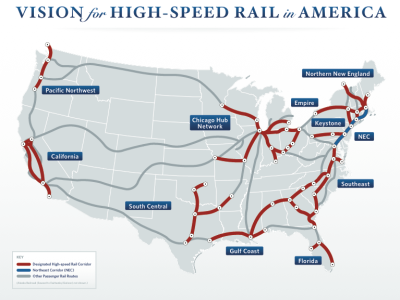
This image is about to get a makeover:


That's the map of the USDOT HSR corridors. One corridor that's not there is Los Angeles to Las Vegas. That is changing today:

The U.S. Transportation secretary will announce today the designation of a federal high-speed-rail corridor between Las Vegas and Southern California, a major assist that enables the long-imagined train route to compete for $8 billion in economic recovery funding and other federal support, the Las Vegas Sun has learned.

The announcement comes as two proposed fast trains are vying to connect Las Vegas and Southern California, a race that has intensified since President Barack Obama unleashed an unprecedented investment in high-speed rail as part of the stimulus bill approved by Congress.

It is unclear whether today’s announcement will favor one of the competing projects over the other. However, the federal designation improves the chances that a train will be developed between the two regions by opening the door to federal aid. Analysts think only one train system will be built.

DesertXpress has not as of yet planned to seek federal aid. I suspect that will have to change. Vegas is in the middle of a severe downturn, which means there's going to be much less private money available to fund it. The maglev is still alive, although with Sen. Harry Reid having switched his support to DesertXpress, I don't see the maglev plan lasting a whole lot longer. Some of its remaining backers include Bellagio CEO Bruce Aguilera, but the Bellagio and the other Vegas resorts are going to have their hands full riding out the recession.

I expect DesertXpress to be the "last project standing" along the Vegas HSR corridor. Whether it gets built, of course, is another matter entirely.

Tuesday, June 2, 2009

Ray LaHood's European Vacation

NOTE: We've moved! Visit us at the California High Speed Rail Blog.

US Transportation Secretary Ray LaHood has been touring European HSR systems in recent days and is coming away impressed:

Spain's bullet train system is a model to follow as America plans how to spend the money the government is injecting to stimulate the economy, the U.S. transportation secretary said Saturday....

The Spanish network is likely to interest the U.S. government because its specially designed, electrified tracks — first devised for the French TGV system — are not as expensive to lay and run as some German or Japanese alternatives.

And Spanish state-of-the-art tunneling technology has proved successful in boring efficiently through mountain ranges to reach the cities of Valladolid and Malaga.

LaHood met with Spain's Prime Minister Jose Luis Rodriguez Zapatero to discuss how investing in such a train system could stimulate job creation in the U.S.

"Yesterday I traveled on a train at close to 350 kilometers (215 miles) per hour, the fastest I've ever ridden on a high-speed train," LaHood said. He said he had enjoyed a conversation and beverage aboard and found the experience very civilized.

"Our leaders have made the decision that America will have high speed rail," LaHood said.

As a longtime aficionado of the AVE system I am pleased, but not surprised, to see LaHood taking to the Spanish system. Because the Iberian Peninsula had its own rail gauge, Spain had to build all-new tracks using standard gauge for the AVE - meaning they have dedicated HSR tracks just as California will. Of particular interest is the tunneling technology Spain has employed, as The Transport Politic points out:

What is clear is that the distinctively Spanish obsession with using tunnel boring machines (TBM) seems to be a model for the Transportation Secretary; these semi-automated devices save on both time and cost in building underground rail corridors. For example, the 3.5 mile tunnel under downtown Barcelona, which is part of a larger project that will allow high-speed trains from central Spain to reach France, will only cost 180 million Euros to build. That’s far cheaper per mile than any similar U.S. tunneling project, and part of the explanation is the efficient use of those TBMs.

TBMs will be a godsend here in California where significant tunneling in the Pacheco Pass and Tehachapi Mountain areas will be needed to complete the system. Of course, I am sure that the Peninsula NIMBYs will seize on this as well as an argument that their tunnel is financially viable - which it probably isn't, and besides, they need to defend the position that their tunnel is more important than the all-important Pacheco and Tehachapi tunnels which are sorta necessary for the whole project to work as intended.

It's also possible that the tour is going to reconfirm for Ray LaHood the importance of adopting European safety standards for HSR trainsets. The FRA's weight rules need to be modernized - the current rules are an embarrassment and an impediment to proper HSR development in America. As the head of the Department that includes the FRA, LaHood is in a strong position to insist that the FRA enter the 21st century.

Perhaps the most important aspect of LaHood's visit is intangible - a renewed commitment to building European-style HSR here in America. Currently the only project that meets that standard is California's. I have every reason to believe this trip to France and Spain will bolster LaHood's demonstrated conviction that California's HSR project is deserving of robust federal support.

Friday, May 8, 2009

Ray LaHood: California and Florida Most Likely To Receive HSR Funds

NOTE: We've moved! Visit us at the California High Speed Rail Blog.

So reports the Wall Street Journal:

Transportation Secretary Ray LaHood singled out California and Florida as leading candidates to secure federal funding for high-speed passenger-rail service.

"California and Florida are way ahead of the curve," Mr. LaHood said Friday at a breakfast gathering in Washington. He stressed that no final decisions have been made....

Mr. LaHood said "no one corridor is going to get all of this money" and that the DOT is "looking to create opportunities in every corridor that wants to make progress." Mr. LaHood has been meeting with many state and local officials to hear their arguments for securing passenger rail funding, including a meeting on Thursday with San Francisco mayor and California gubernatorial candidate Gavin Newsom....

California is "way, way, way ahead," he said. As for the Midwest, where many officials are hoping to place Chicago at the center of a high-speed rail network stretching to St. Louis, Minneapolis, Cleveland and Detroit, Mr. LaHood said, "They're not in that position yet."

That's certainly more welcome news than I was expecting. I'm sure that the Midwest states, which are extremely important politically to President Obama, will have something to say about this - but even if they are able to wrangle more money out of the USDOT process, it's not going to be a whole lot of money. LaHood is clearly signaling that California is positioned well to get a big chunk of that federal HSR money.

LaHood's statement comes on the heels of yesterday's CHSRA board meeting, which approved a list of "shovel-ready projects" to submit for the federal HSR stimulus:

California high-speed train officials Thursday approved a list of shovel-ready construction projects likely to qualify for $8 billion in federal stimulus funding for high-speed trains....

The project elements selected by the Board on Thursday are spread throughout California's planned 800-mile system. They include:

1. The entire Los Angeles-to-Anaheim and San Francisco-to-San Jose corridors, where the Authority is expected to have completed the project level environmental document, and qualified and selected design build teams to begin construction of the sections by the 2012 deadline.

2. Identification, selection and negotiation of right-of-way acquisition in the Merced- to-Bakersfield section, including the system’s planned maintenance facility.

Authority staff also will work before the deadline to identify other “shovel ready” projects outside the three corridors identified above that advance the Authority’s high-speed rail plan and that meet the federal criteria, according to CHSRA Executive Director Mehdi Morshed.

Unfortunately it's not clear what the specific projects will be - the CHSRA press office didn't have that information. So to all you who think I never criticize the CHSRA, here you go - they really need to get that list of proposed projects out to the public. That will help make the project tangible and show exactly what the stimulus money can bring. It can help rally the public to support HSR and those specific projects.

Still, in the overall picture this is a welcome development and a sign that the federal government is quite serious about giving the California HSR project a major financial boost.

Thursday, April 16, 2009

Obama Announces HSR Funding Plan

NOTE: We've moved! Visit us at the California High Speed Rail Blog.

Today President Barack Obama, Vice President Joe Biden and Secretary of Transportation Ray LaHood announced the DOT's high speed rail strategic plan. You can find the full details of the plan at the USDOT website.


It's an important announcement and contains some long-awaited policy changes that will help make HSR a reality across the nation. It's not yet clear how this will impact the California HSR project, but the way the funding allocation categories are set up appears to be quite favorable to us here in California.

First, I want to quote from both President Obama and VP Biden - these guys get it when it comes to HSR. It is a sea change from the last 25 years of refusal to speak openly and honestly about our nation's transportation needs.

“My high-speed rail proposal will lead to innovations that change the way we travel in America. We must start developing clean, energy-efficient transportation that will define our regions for centuries to come,” said President Obama. “A major new high-speed rail line will generate many thousands of construction jobs over several years, as well as permanent jobs for rail employees and increased economic activity in the destinations these trains serve. High-speed rail is long-overdue, and this plan lets American travelers know that they are not doomed to a future of long lines at the airports or jammed cars on the highways.”

He nailed it. This quote has it all - energy independence, job creation and long-term economic growth, and relieving congested airports and freeways. Joe Biden's quote is equally as good:

“Today, we see clearly how Recovery Act funds and the Department of Transportation are building the platform for a brighter economic future - they’re creating jobs and making life better for communities everywhere,” said Vice President Biden. “Everyone knows railways are the best way to connect communities to each other, and as a daily rail commuter for over 35 years, this announcement is near and dear to my heart. Investing in a high-speed rail system will lower our dependence on foreign oil and the bill for a tank of gas; loosen the congestion suffocating our highways and skyways; and significantly reduce the damage we do to our planet.”


I don't know who was writing their speeches, but they clearly understand the case for HSR.

That case is made strongly and powerfully in the HSR strategic plan document (PDF, 3MB). It is one of the best arguments for HSR that I've ever seen. This administration is serious about HSR. The plan includes a good overview of the history of rail funding in America, explaining that we have spent over $1 trillion on roads and airports in the last 50 years but have starved rail - even though, as the report makes clear, high speed rail is one of the best methods to move people over distances from 100 to 600 miles:


The report also recognizes the need to update the FRA's regulations to make HSR more of a possibility in this country (this should be music to Rafael's ears):

While most high-speed systems overseas have a good safety record, usually on dedicated track, U.S. railroad safety standards are designed to keep passengers and crew safe in a mixed operating environment with conventional freight equipment, which is much heavier than comparable
foreign equipment. The advent of Positive Train Control (PTC), crash energy management, and other advances provides the United States with an opportunity to revise its safety approach in a manner that accelerates the development of high-speed rail while preserving and improving upon a strong safety regime. This will be a challenge for the Federal Railroad Administration (FRA) as it seeks to administer its critical safety responsibility and facilitate high-speed rail development. The systems approach required to ensure safety of new HSR corridors will necessitate consideration of additional changes in several regulations, including equipment, system safety, and collision and derailment prevention.

The heart of the document is a three-pronged approach to funding HSR projects. I'll include the full text of the "tracks" below for folks to peruse:

1. Projects. Grants to complete individual projects eligible under Sections 301 (IPR projects) and Sections 302 (congestion projects) described above, for the benefit of existing services. Eligible projects include infrastructure, facilities and equipment. In order to qualify, these projects must: (a) be "ready to go" (i.e., environmental work required by law (National Environmental Policy Act, or NEPA) and preliminary engineering (PE) are complete), and (b) demonstrate "independent utility." For projects that meet the independent utility test but have not yet completed NEPA and PE, funding is available to conduct NEPA and PE work to make projects ready to go and, therefore, eligible under a subsequent grant solicitation. For rolling stock proposals, DOT will encourage acquisition of new, standardized, interoperable equipment
that incorporates modern safety features. Under this track, funds would be obligated for successful applications under standard grant agreement terms and conditions, including ARRA oversight and reporting procedures.

2. Corridor programs. Cooperative agreements to develop entire segments or phases of corridor programs eligible under Section 501 (HSR) and Section 301 (IPR), benefiting existing or new services. In order to qualify, these corridor programs must: (a) be based on a corridor plan that establishes service objectives and includes a prioritized list of projects to achieve those objectives; and (b) have completed sufficient corridor/ section/phase programmatic or project environmental (NEPA) documentation and sufficient planning to provide reasonable project cost and benefit estimates. For corridor programs that do not qualify under (a) and (b) above, funding is available to complete this work and make corridor programs eligible for subsequent solicitations. Under this track, funds for selected applications of a corridor program phase and/ or geographic section would be set aside at the outset, and provided at pre-specified milestone approval points. This approach would involve a higher level of Federal oversight and support than under even the
heightened scrutiny inherent in standard ARRA grant agreements.

3. Planning. Cooperative agreements for planning activities (including development of corridor plans and State Rail Plans) eligible for funding under Section 301 of PRIIA, using non-ARRA funds. This third track provides States an opportunity to prepare themselves for any funding remaining in subsequent rounds of ARRA, and/or future year appropriations. It is intended to help create the pipeline for future corridor development needed to build out a national HSR/IPR network.

As I read this, California's project is eligible for all three tracks. Of course, so would many other states. The plan also recognizes distinctions between what they call "HSR express" which is a California-style system that can achieve 150 mph or above; "HSR regional" which can achieve speeds of 110-150 mph; "Emerging HSR" where new corridors of around 90-110 mph are to be built, and "Conventional Rail" which is basically Amtrak outside the NEC. I hope that as the only true HSR express project on the drawing board (the NEC is in a somewhat different category as it already exists) that will give us a big boost, as other states fight over the rest.

So overall I think this is a huge boost for HSR, even though it does leave some things unclear as to how exactly our own project will fare. The DOT will be making the first project funding announcements later this year, for tracks 1 and 3 - track 2 will be announced toward the end of 2009 or in early 2010.

This announcement has gotten a lot of reaction around the blogosphere, but I want to single out for criticism Matthew Yglesias's take on the announcement:

My take on this is that the most promising projects on the merits, from a federal point of view, are probably those that upgrade the existing Northeast Corridor (where we know demand exists) and those that connect to the Northeast Corridor since the existing passenger rail corridor extends the utility of the new link. The Chicago Hub Network and the California Corridor concepts strikes me as very important for the long-term future of their regions, but for it to be useful will take a lot of time and money. I assume that the relevant state-level politicians for the Gulf Coast and South Central Corridors aren’t going to be interested in ponying up the sort of state funds that would make these projects competitively viable, and that may be for the best since I think those corridors may be a bit ill-conceived. It seems strange to build so much track in Texas and not manage to link Houston with Dallas.

This is a pretty flawed way to look at things. What Yglesias proposes is in fact the model Clinton eventually adopted. In 1993 he proposed a broad national HSR plan, but by the late '90s he decided to just focus on upgrading the NEC and rail was left to wither around the country.

Yglesias is wrong to say that we should prioritize the NEC and connections to the NEC. Significant improvements in speed and carrying capacity can be made in the Midwest with a few billion dollars, and the California project need federal cash infusion now to ensure completion by 2018. All of those will revolutionize rail transportation in America to a much bigger scale than upgrades to the NEC. Too much focus on the NEC is one of the primary reasons for the lack of passenger rail upgrades and improvements around the country. It's time we took HSR national.

And with President Obama's plan, that is exactly what will happen. Now, to make sure this all gets funded...

UPDATE: Rafael's comments:

Nothing particularly new here, except that USDOT will be sticking with the 11 already designated corridors (incl. the NEC). Disneyland to Las Vegas, the Texas T-bone and other hopefuls are not mentioned. So far, the President is talking about the $8 billion in the stimulus bill plus a measly $1 billion for each of the next five years. That's enough to get started, but not nearly enough to leave a legacy.

On the plus side, he mentions the need for long-term commitments from states. Presumably, that translates to a preference for those willing to put some serious skin in the game, e.g. California.

California's much more ambitious bullet train network would presumably fall into the second "track" but it's unclear if there will be anything left in the kitty at that point. Still, given the increasing amount of political capital the President is investing in HSR, it seems likely that future bills will increase the total amount available once USDOT has put in place a suitably technocratic process for evaluating grant applications on their merits. Washington being what it is, the notion that political considerations such as swing state status won't matter is probably more pious hope than realistic expectation.

In particular, additional federal funding for planning and development of additional HSR corridors will be sought in the context of the regular surface transportation bills. In plain English, that means rail proponents will have to duke it out with the highway lobby. Fortunately, the principle that transit projects will be eligible for up to 80% federal funding, putting them on par with highways, has already been established. Note that those regular bills would also be the appropriate place to make adjustments to the map of eligible corridors. The current one dates back to 2002.

In addition, FRA will need some additional funding for drawing up rules enabling mixed traffic on rapid rail routes as well as bullet train operations at speeds exceeding 150mph. The various HSR allocations do allow USDOT to retain a small fraction of the total grant volume for its own operations in support of HSR implementation.