Showing posts with label air travel. Show all posts

Monday, November 2, 2009

More Passengers Choose Trains Over Planes In Spain

NOTE: We've moved! Visit us at the California High Speed Rail Blog.

For several decades, the world's busiest air route was the "Puente Aereo" (air bridge) between Madrid and Barcelona. At a distance of about 400 miles on the ground, it's also a perfect distance for high speed rail. Ever since the AVE line was completed to Barcelona's Sants station early last year, high speed rail has been winning a greater and greater share of the Spanish travel market - despite Spain being hit extremely hard by the global recession, with unemployment of around 20%.

Now the AVE line has surpassed the Puente Aereo in terms of travelers. More people are taking the train rather than the plane between the two largest cities of Spain:

Spain’s bullet train is beating the plane in the race to win passengers. For the first time, more passengers have chosen to travel on the high-speed AVE rail link between Madrid and Barcelona than have opted to fly — a switch that could influence British ambitions for a high-speed rail network and add impetus to the creation of a second high-speed line in the UK.

Between July and September, 651,498 passengers made the 314-mile journey between Spain’s biggest cities (slightly farther than London to Newcastle), a rise of 21 per cent compared with the same period last year.

In comparison, 643,512 travellers made the journey by aircraft during the same period, a fall of 7.5 per cent compared with the third quarter of last year.

Madrid-Barcelona is the fifth busiest air route in the world, with four airlines offering 116 flights a day, according to the Official Airline Guide in July. Since the rail link opened last year, Renfe, the Spanish state rail operator, and the airlines, led by Iberia, the national flag carrier, have fought a fierce battle to win passengers. The high-speed train, which takes 2hr 40min to travel between Madrid and Barcelona, at 236.3 kilometres per hour (146.8mph), has won over commuters with competitive fares, greater comfort and the absence of elaborate airport security. It also offers promotions to attract tourists, as well as business travellers.

Once again, it is worth reminding readers that Spain offers a very good comparison to California in terms of not just high speed rail - but population density and geography. SF Transbay to LA Union Station is 432 miles, and our trains are projected to have a higher operating speed.

Ultimately, the Spanish experience suggests the SNCF report and the Brookings Institution are both correct in suggesting the LA-SF route, the nation's second busiest, will support a high HSR ridership. As our airports already burst at the seams during flush economic times and with rising oil prices, it's clear that we need the HSR option in California. Spain's success story will soon be replicated here.

Sort of fitting given Spain's role in California history...

Wednesday, September 9, 2009

Comparing Fares for Planes, Trains and Automobiles

NOTE: We've moved! Visit us at the California High Speed Rail Blog.

Over at The Transport Politic Yonah Freemark has offered two insightful posts this week on the question of HSR fares as compared to those for air and automobile travel (including buses). The first, Getting the Price Right: How Much Should High-Speed Fares Cost? argued that Amtrak has set fares on the Acela too high, though faster speeds and higher-capacity trainsets would enable the operating costs and thus the fares to drop. Freemark compared the Acela to European and Asian HSR systems and found that those systems not only offer better fares than the Acela - they also offer better fares than airline flights on the same route. However, Freemark's analysis suggests that California HSR is poised to replicate the European experience, and not that of Amtrak and the Acela (at least in terms of fares):

The California High-Speed Rail Authority, which is planning the nation’s most ambitious new rail project, has considered the effect of pricing on ridership. It predicts strikingly varying ridership outcomes depending on the cost of its future services; in 2030, with the full system operating, the agency estimates 93.1 million yearly trips if fares are set at 50% of air travel levels and 74 million if fares are set at 77% of air travel levels. Though final fares have not yet been established, one thing is for certain: California will not copy Amtrak and charge customers exorbitant rates to ride the train....

If American high-speed services offered similar prices for time traveled as Amtrak does today — at $45 per hour of running time for standard fares and $15 at reduced prices — on faster trains, U.S. commuters would switch to rail in droves. The San Francisco-Los Angeles route being planned by the State of California, with a travel time of 2h40, would cost $40 for reduced-price tickets and $120 for standard fares; those costs seem perfectly acceptable for just about everyone. A renewed Northeast Corridor, offering travel between New York and Washington in 1h40 (at an average of 220 km/h), would cost $25 for customers buying reduced-price fares. People currently driving their own cars or riding buses between the cities would take a second look at those prices.

Previous statements from the CHSRA have indicated that the fares would be around $55. I have repeatedly said we should not get attached to that number, and Freemark's conclusion that the fares will range from $40 to $120 is much more sensible.

Of course, anytime we have this discussion, you get people arguing that airfares are already cheap, nobody would pick a train over a $49 fare on Southwest or JetBlue. So some remedial discussion of this matter is valuable before plowing ahead.

Those fares are advance purchase and are almost never available on the eve of travel. And Freemark's suggestion is that CA HSR fares will work pretty much the same way. $40 or so for advance purchase, higher once you get closer to the travel date or for a "regular fare." In exchange you get a smoother boarding and deboarding experience, no TSA to deal with, a comfortable ride, and most crucially of all, city center to city center travel. The proposed HSR stations are all in much more centralized locations than the airports in the metro areas they'll serve.

More crucially, the ability of airlines to continue to offer those low fares is very much in jeopardy. Airlines received massive bailouts in 2001, but just a few years later began implementing fees for baggage and other previously standard, complimentary services. That's the mark of an industry in trouble, of an airline crisis that threatens the future not of air travel but of cheap air travel.

Southwest Airlines, which is frequently pointed to as evidence that we don't need HSR (including by someone at the Menlo Park Town Hall), has avoided this fate only through the use of complex fuel hedges. They locked in their price at $51/bbl several years ago. We're at $72/bbl, and virtually every observer expects that price to rise, if not soar, once global economic recovery finally happens. Southwest's fuel hedges expire between 2010 and 2013. There's no way they'll be able to lock in those rates again. And either LUV is going to have to raise fares or cut services.

Freemark's second post on the topic, Reframing the Fare Debate, focuses on what he sees as a more pressing topic: "attracting people away from cars and buses."

There are two ways to encourage people currently relying on road-based transportation to travel by trains: one, lower ticket prices; two, increase speeds. Both actions would provide a substantial motivation for highway users to reconsider their options. The first would put train travel back into the sphere of the economical. Plenty of bus companies market service at less than $20 between New York and Washington. At $2/gallon, a 26 mpg car could be driven between the cities for less than $20 in gas. That number doesn’t account for maintenance and ownership costs, but drivers rarely consider those factors when making decisions about how to get from one place to the next.

By increasing speeds, train travel’s time benefit multiplies significantly. While buses get into traffic, they can still make the trip from the capital to Gotham in five hours — versus the three hours required by rail. This is an advantage for train users, but increasing speeds to allow for a 1h40 trip would make it nearly impossible to justify riding the bus or driving, even at a lower cost.

Freemark's analysis is based on the Acela, but it applies even more strongly to California. Whereas buses play an important role on the Northeast Corridor, they play hardly any role in the SF-LA corridor, especially since Megabus dropped its experiment to provide their cheap service on that route last year. (Intercity buses do play a bigger role on other corridors in California, particularly Central Valley-SoCal-Mexico.)

So we're looking primarily at driving. And a lot of Californians drive from the Bay Area to LA, or from either of those regions to the Central Valley. This is especially true at the holiday season, as I discovered on one 10-hour trip back to Berkeley on I-5 around New Year's 2001.

Let's assume a trip from SF Transbay Terminal to LA Union Station in a relatively fuel efficient non-hybrid car: my 2007 Honda Fit. By car that's a 381 mile trip. I usually get about 300 miles to the tank on the open road, or about 36-39 mpg depending on conditions. That means two fillups - one at the trip's outset, another somewhere along I-5. The first fillup is going to be at least $3/gal, likely around $24 if I'm nearly empty (usually 8 gallons). The second will be about the same. So that's $42 for a one-way trip, and another fillup somewhere on the way back, depending on how much driving I do in SoCal, is going to bring the total in gas to at least $66.

True, that's for the car. I can add several passengers at essentially no extra cost, whereas they'd have to pay their own tickets on an HSR train. Even when you add in wear and tear, which on a newish Honda vehicle isn't all that much, driving is likely going to be cheaper, at least until oil prices rise dramatically again.

But when you add in time, the train becomes a compelling alternative. Google Maps gives a driving time of 5 hours, 51 minutes from SF Transbay to LAUS. If you hit no traffic at all and have lead foot you could do 5:30, maybe even 5:15. But for most people it's at least a 6-hour drive.

Whereas the train is going to take 2 hours 40 minutes. That's about half the time of driving. A lot of Californians will pay a bit extra to take the train in order to get the time savings - that's what "competitive" means. For people looking at a weekend trip, that 6 hours saved is a huge deal - the difference between a Friday evening and a Saturday midday arrival, extra time at the grandparents' or at the beach or at the ballgame.

For others it may not be enough of a compelling alternative. They may want the flexibility the car offers them, or they may have lots of stuff to carry that can't be easily checked onto a train, or they may have other reasons to prefer to take a specific trip in the car. That's fine. HSR isn't about forcing people out of cars.

It's about providing options and choices. Expanding transportation capacity in a sustainable, environmentally and climate-friendly method, giving our freeways and airports a chance to breathe. Giving people a fast way to get between cities without the higher fares or inconveniences of air travel, without the long travel times and other uncomfortable aspects of sitting in a car on I-5.

HSR isn't meant to put the airlines out of business or to eliminate vehicle traffic on I-5. It's intended to give Californians the choice of traveling at a fast speed for a reasonable price, thus fueling economic growth in the 21st century in a way that fossil-fuel based methods of travel are already proving incapable of providing. Californians instinctively understand this - it's why Prop 1A passed last fall.

I'll close this post by letting Freemark explain the reasons why this matters:

There are significant advantages to lowering ticket prices to the lowest level possible while keeping operational finances in the black. California predicts a higher revenue stream for its rail system if it charges customers fares that are at 77% of airline levels: $4.3 billion annually versus $3.6 billion with tickets at 50%, even though the latter would attract 25% more riders. But opening services to a greater percentage of the population has a number of benefits beyond those affecting the bottom line, and American policy should be to encourage low-cost rail travel. It reduces carbon emissions as people choose to drive fewer cars. It encourages the sense that trains are an engine for universal mobility, rather than a limousine on tracks for the rich. It will, most importantly, smash the conception that Americans won’t take advantage of rail services, and encourage the creation of a train-riding society.

And that's why California's HSR matters - as well as why it will be a financial success.

Friday, August 21, 2009

The New York Times' Second Punch on HSR

NOTE: We've moved! Visit us at the California High Speed Rail Blog.

Yesterday we looked at Edward Glaeser's silly attack on HSR in the New York Times' Economix Blog. Today we have another attack on HSR in the New York Times - this time from Eric Morris at the Freakonomics Blog. Ryan Avent summed it up well via Twitter:

Eric Morris closes HSR series by referring readers to Randal O'Toole. You know, in case you thought he and Glaeser were aiming for an honest critique.

Sure enough:

Certainly neither Glaeser nor I pretend to have the last word on this topic. We are looking to start some debate, not finish it. So if you want to learn more on the pros of true HSR, check out the California High-Speed Rail Authority’s site, or this report for the views of an articulate critic, the Cato Institute’s Randall O’Toole.

Either Morris is joking or is even more in the tank against HSR than we ever thought. Randall O'Toole as a credible source on passenger trains?!?! This is the same guy who thinks riding a train is more harmful than driving an SUV and whose difficulties with facts and evidence has been well documented.

But it's not just the company Morris keeps that damns his blog post. Morris has a rather interesting justification for his work on HSR planning:

I have extensive experience planning, designing, constructing, financing, and operating HSR networks; these have spanned the nation and have been terrifically elegant, with state-of-the-art locomotive technology and thousands of miles of flat, straight track to keep speeds high.

However, those HSR systems were built from electricity, not steel. And while the HSR currently being proposed will cost tens of billions, the cost of my HSR network was comparatively modest: perhaps $30 in fixed costs for the purchase of the computer game Sid Meier’s Railroad Tycoon, plus negligible variable costs for the power to run my computer and depreciation on my mouse button. The sum total of the utility I experienced from this kind of HSR paid for those costs many times over.

That's like saying I can run a street gang because I played Grand Theft Auto: San Andreas. How ridiculous do economics bloggers for the NYT not named Paul Krugman have to get before we stop taking them seriously?

The primary problem that afflicts Morris's attack on HSR is the exact same problem that afflicted Edward Glaeser's articles as well: they persistently refuse to examine HSR costs in context:

Costs in the real world are quite different. HSR is an exciting idea, and if we could make it appear by magic wand it’d be a terrific addition to our transportation network. But everything has a price, and the way things currently stand, the projected costs look like they outweigh the benefits. If the thought of some ominous budget numbers lurking on a piece of paper in far-off Washington doesn’t move you, consider the opportunity costs of this spending, in terms of health care, education, the economy, defense, or a (more effective) method of slowing global warming. Or if you want to keep the money in the realm of transportation, it could go to address what I consider to be the more serious problem we are facing: moving people around within our cities, not between them.

There are innumerable flaws with this analysis, which is actually the heart of Morris's post. Morris claims to speak of opportunity cost, but where is the estimate of how much it will take to expand roads and airports in California to handle the passenger loads that HSR will handle? Estimates for that range from $80 billion to $160 billion. But nobody aside from Morris Brown thinks California HSR will approach even the lower range of that estimate.

Morris appears to think that air travel will continue to remain cheap, plentiful and affordable. A kind of perpetual 2007. Last year we talked quite a bit about the airline crisis - how rising oil prices have jeopardized the easy air travel that we have come to expect here in the US. Airports in smaller cities have begun bribing airlines to maintain service, and cities like Fresno and Bakersfield have struggled to maintain the airline service they still have.

For Morris to basically ignore the problems of the airlines he has to ignore the all-important question of whether oil prices will remain at the same price they're at now. There is ample reason to believe they will not. Even during a severe recession gas costs at least $3/gal across most of California, the threshold that once crossed in 2006 helped burst the housing bubble. Once growth resumes, whenever that might be, oil prices are widely expected to rise again, especially considering the steady increase in global demand.

HSR is not the same as ongoing expenditures for health care or education. Like the Golden Gate Bridge or the Shasta Dam, it is a piece of infrastructure that enables economic activity to continue and grow well into the future. It enables health care and education spending to continue, rather than become strangled by gridlock.

And yes, Eric Morris, HSR will help intracity transportation just as it will provide intercity transportation. In California HSR will be used by commuters within regions just as it will be used by commuters between regions. The HSR route will serve as a transit spine for the state, with its key nodes (SF Transbay, SJ Diridon, LA Union Station) becoming the centerpieces of local rail. HSR is a rising tide that lifts all transportation boats.

Unfortunately, Morris is so in thrall to Randall O'Toole's anti-rail jihad that he won't stop to consider these aspects. Instead he uses the same arbitrarily limited and therefore insufficient scope to mislead readers about the true costs of projects. The Golden Gate Bridge might not have penciled out in the first 5 years from its opening in 1937, but hardly anyone today would argue the Bay Area is better off without it. 30 years from now, when Californians travel around their state on high speed trains, they too will wonder why anyone thought building it was anything but a sensible and farsighted idea.

Tuesday, February 10, 2009

Lindbergh Field HSR Station Plans Emerge

NOTE: We've moved! Visit us at the California High Speed Rail Blog.

So reports the San Diego Union-Tribune:

After nearly a year of meetings, the Ad Hoc Airport Regional Policy Committee is putting the final touches on a proposal to shift most passenger operations to the north side of the airport, along Pacific Highway.

The $5 billion to $12 billion overhaul would include a new passenger terminal, parking lots and a transit hub linked to Interstate 5 and a planned bullet train....

Steve Peace called the transit hub the centerpiece of the group recommendation. He said tying together mass transit will make the region more economically competitive.


See also the map of the proposed terminal.

This strikes me as a pretty damn good idea. It unites transportation methods in a single place - the passenger terminal - which would include Amtrak/HSR, SD Trolley, and of course passenger autos. The airport terminal would be located very close to downtown and in the center of the San Diego urban area, which is one of the goals of HSR station siting anyway.

Obviously there are lingering questions about how to pay for this, and for the extension to San Diego, and what the routing will be between Escondido and San Diego. But having an endpoint in mind certainly helps, by creating an incentive to solve those questions and connect California HSR to downtown San Diego.

Saturday, January 31, 2009

Destination Lindbergh

NOTE: We've moved! Visit us at the California High Speed Rail Blog.

While the Peninsula debates how to best implement the detailed plans for the high speed rail line that will serve their communities, San Diego is dealing with a somewhat different question altogether - a big picture "how do we bring people to and from our town?" issue that is now centered on Lindbergh Field. And HSR plays a potentially major role in determining San Diego transportation policy for decades to come.

The North County Times has a long article on the debate over Lindbergh Field's future, a debate made necessary by the apparent failure of long-discussed plans to build a new airport at Miramar. The basic problem, as anyone who has ever been to downtown San Diego knows, is that Lindbergh Field cannot be expanded beyond the one-runway configuration it already has. Hemmed in by San Diego Bay, the highrises of downtown, Interstate 5, and a residential neighborhood, it is impossible to expand capacity at Lindbergh Field. So San Diego officials are considering a $4 billion improvement project - and looking at a Lindbergh HSR station as a way to connect the airport to not just the city but the rest of the state, thereby creating new capacity at Lindbergh:

San Diego County Regional Airport Authority board members say they have no choice but to settle for Lindbergh's limited capacity. After a decadeslong search that cost tens of millions of dollars, voters overwhelmingly rejected the idea of building a new airport at Miramar Marine Corps Air Station in 2006....

It's not as if increased capacity is totally out of the picture, said committee member Steve Peace, the former state lawmaker who wrote legislation to create the airport authority. He said the train station ultimately would be served by California's planned 800-mile statewide high-speed rail system and indirectly increase the capacity.

That's because 11 percent of Lindbergh's planes fly short hops to Los Angeles, carrying passengers bound for Los Angeles International Airport to catch overseas flights. With high-speed rail, people could take a bullet train instead, Peace said.

Of course, the HSR trains are not going to serve LAX, and even with a Green Line extension to LAX a traveler from SAN to LAX would still have to take two rail lines (Blue and Green) from Union Station to LAX, on top of the HSR trip up from SD. It's not clear that HSR would really work as a connection for those passengers.

A point that Wendell Cox, perhaps the chief HSR and passenger rail denier in the nation, uses to try and call into question the entire "HSR as airport relief" concept:

Cox, the transportation expert who has studied California's bullet train, countered there is "not a chance" that that part of the plan would fly.

For starters, Cox said the huge Los Angeles airport is not on the high-speed rail system, as proposed. And he said that with funding uncertain for the chosen route, it is unlikely the state would find money for a spur to LAX.

If it did, he said, the route would be so circuitous and lengthy ---- passing through Temecula, Riverside, Ontario and downtown Los Angeles before reaching L.A.'s west side ---- that it would fail to persuade many San Diego County residents to take a train instead of a plane.

But let's move this beyond Steve Peace's claim about overseas travel. It *would* make much more sense for folks trying to get to or from San Diego to other destinations around the continental U.S. to use HSR as a connecting system - to Ontario Airport, not LAX. Ontario, unlike Lindbergh Field or LAX, has room to grow, and is already slated to receive an HSR stop on the LA-SD spur. The estimated travel time from Ontario to downtown SD is 57 minutes - a reasonable method of connection for travelers headed to or from SD.

It's also worth considering San Diego's continued importance as a destination for travelers going to or from other destinations in California. Whether it's an Angeleno looking for a weekend getaway, or a family from Fresno looking to visit relatives on the other side of the border, Californians make up a big part of San Diego's travelers. HSR would play an extremely significant role in handling that traffic, easing the burden on not only Lindbergh Field but on Interstates 5 and 15 as well.

What HSR means to Lindbergh Field isn't a different option for folks headed to Tokyo or Sydney to catch their flight at LAX, but a new and expandable method of bringing people to and from San Diego, period. With HSR San Diego isn't forced to shoehorn a huge number of passengers into Lindbergh Field, but now has a completely new and high-capacity option for moving people around. It's no longer "Lindbergh or Miramar or Bust" but a more balanced set of transportation options.

Which makes Wendell Cox's closing line so absurd:

"It's time San Diego woke up to the fact that it is a world-class city, and probably the only world-class city without a world-class airport ---- certainly the only one in the United States," Cox said.

"I continue to be completely amazed that the leaders of San Diego settle for being a suburb of Los Angeles when they should take a back seat to no one. It shows a lack of vision that is astounding."

If "world-class" is to be defined as "on a par with other major first-world cities" then it should seem obvious to everyone except Cox himself that "world-class" cities in the 21st century are defined not by the number of runways at their airport, but by the number of high speed rail lines serving them. San Diego is larger than Málaga and can be compared to Marseille in several respects (both are the third-largest metro areas in their state or country, both are important maritime centers, both serve as a sunny beach destination, both act as a crucial link to the developing world to the south), and both of those cities are important destinations on their respective HSR networks.

Ultimately San Diego should be asking itself how it can use HSR to dramatically improve its connections to the rest of North America, instead of relegating HSR to a role supporting Lindbergh Field. HSR isn't a junior partner to a transportation strategy focused on interstate freeways and airports, but should be seen as a fully equal - and equally important - solution to San Diego's mobility needs for the rest of the 21st century.

Tuesday, January 13, 2009

"A Revolution In Travel Habits"

NOTE: We've moved! Visit us at the California High Speed Rail Blog.

That's how the Guardian describes the dramatic success of Spanish high speed trains (h/t to lydik in the comments to the last post):

Spain's sleek new high-speed trains have stolen hundreds of thousands of passengers from airlines over the last year, slashing carbon emissions and marking a radical change in the way Spaniards travel.

Passenger numbers on fuel-guzzling domestic flights fell 20% in the year to November as commuters and tourists swapped cramped airline seats for the space and convenience of the train, according to figures released yesterday.

High-speed rail travel - boosted by the opening of a line that slashed the journey time from Madrid to Barcelona to 2 hours 35 minutes in February - grew 28% over the same period. About 400,000 travellers shunned airports and opted for the 220mph AVE trains.

Last year's drop in air travel, which was also helped by new high-speed lines from Madrid to Valladolid, Segovia and Malaga, marks the beginning of what experts say is a revolution in Spanish travel habits.

lydik is right, I have a huge soft spot for the AVE trains, which were my first HSR experience - and also because I love Iberia (my wife and I are going to Portugal later this spring). It's also because while many Americans have a stereotype that Europeans are all a bunch of train-riding sophisticates, in fact air and auto travel in Europe is still a major form of transportation.

That was particularly true of Spain - but no longer:

In a country where big cities are often more than 500km (300 miles) apart, air travel has ruled supreme for more than 10 years. A year ago aircraft carried 72% of the 4.8 million long-distance passengers who travelled by air or rail. The figure is now down to 60%.

"The numbers will be equal within two years," said Josep Valls, a professor at the ESADE business school in Barcelona.

This is worth noting since Spain and California are very comparable in terms of travel habits and population densities. As with Spain, California's big cities are often more than 300 miles apart (379 miles from downtown SF to downtown LA). Like California, Spain experienced a property-fueled economic boom during this decade. But unlike California, Spain has devoted a significant portion of the tax proceeds from that boom to building sustainable high speed rail, particularly under the PSOE government of José Luis Rodriguez Zapatero. Lines to Barcelona and Málaga have opened within the last year, along with a Madrid bypass enabling faster travel from Barcelona to destinations in Andalusia. Connections from Madrid to Valencia, Galicia, and the Basque Y are also under construction.

Spain has also had success at lowering carbon emissions via HSR:

The high-speed train network is also helping Spain control carbon emissions.Straight tracks and few stops mean AVE trains use 19% less energy than conventional trains. Alberto García, of the Spanish Railways Foundation, has calculated that a passenger on the Madrid-Barcelona line accounts for one-sixth of the carbon emissions of an aeroplane passenger.

All of this is something we can look forward to here in California - and further reason to ensure that the state gets its act together, passes a budget, and gets back to economic stimulus via infrastructure projects like HSR.

PS: On that note, the Obama Transition Team has a "Citizens Briefing Book" where users rate up projects and ideas they feel are most important. "Bullet Trains and Light Rail" are currently the #1 most popular idea. Login and be sure to vote for this to further communicate to the Obama Administration our conviction that HSR is a vital part of this nation's future.

Saturday, November 8, 2008

2008 Business Plan Published

NOTE: We've moved! Visit us at the California High Speed Rail Blog.

As promised the California High Speed Rail Authority has published the 2008 Business Plan. Remember, this would have been ready in time for the election had Republicans like Roy Ashburn not blocked passage of the state budget for three months.

The plan itself is primarily an update of construction costs and ridership estimates. The overall cost of SF-Anaheim is pegged at $33 billion, of which $12 billion to $16 billion will come from the federal government. It's worth noting not all of that is going to be in the form of cash, but much will be in the form of low interest bonds that the feds will float - Obama has for example proposed a National Infrastructure Reinvestment Bank that could help provide construction cost support to high speed rail here.

The plan also anticipates that the ridership and operating surpluses are at their best when HSR fares are 50% of airfares on the LA-SF route. Some HSR deniers might scoff at the likelihood of that happening given possible cost increases - but consider that airfares will be rising over the next ten years, likely at a much faster rate than HSR fares will climb due to inflation. The airline crisis hasn't gone away.

The updated business plan also notes that if there are problems in getting funding to build the entire system, the urban segments can likely pay for themselves. Of course I have often railed against the possibility of turning HSR into a glorified commuter rail, and strongly believe that the first items that ought to be constructed are the tracks through the mountains - Pacheco Pass and the Tehachapis - which are the current choke points for intrastate passenger rail. In any event this is one of the issues we will need to monitor very closely over the coming months and years.

Of course, the HSR deniers are still out in force, getting their misleading quotes into the newspapers. Today's SF Chronicle article on the business plan is a good example, giving leading HSR denier Jon Coupal, of the Howard Jarvis Association, the chance to spew his truthiness:

Critics said they were disappointed by the plan released Friday, saying it lacked the necessary detail.

"We waited three months for this?" said Jon Coupal, spokesman for the Howard Jarvis Taxpayers Association, which opposed Prop. 1A. "I will say it's very pretty and has nice photographs. But as a business plan to present to venture capitalists to convince them to invest, it falls far short."

This from the guy whose organization's business plan involves bankrupting our state? I find it amazing that anyone in the media sees him as a credible source when it comes to government spending and balancing out the numbers.

Let's also be clear - the HSR deniers will claim that everything "lacks the necessary detail" up to the day the first passengers board the trains. If Coupal wants to see informed discussion about the details instead of misinformation intended to kill the project he would do well to click on our comments, where the details are given very intense discussion.

The business plan update provides the necessary information for our state to move forward on the project voters endorsed on Tuesday. At this point HSR deniers are trying to undermine the project - if they want to be useful, then join us in the comments and show how we can improve it. We all want the best possible HSR system for our state. It's time for Californians to come together and make it happen.

Wednesday, October 22, 2008

HSR: Safe and Fuel Efficient

NOTE: We've moved! Visit us at the California High Speed Rail Blog.

Dennis Lytton, who has authored a post for this blog back in June and is a member of the Board of Directors for the National Association of Railroad Passengers, has now published an op-ed in today's Daily Breeze, a newspaper in SoCal's South Bay region, explaining the benefits of Prop 1A and high speed rail. I won't reproduce the entire op-ed here but will include some of the salient points.

The op-ed opens by retelling a tragic story of a UC Berkeley student from Pasadena who was killed on her way back to campus while driving near Gilroy - one of the numerous automobile fatalities that can be prevented by fast, efficient, plentiful intercity rail:

Improvements in auto safety have helped reduce the rate of automobile fatalities. However, that gain is largely negated by increases in the number of miles Americans typically drive. This is a reflection of bad public policy that favors sprawl and freeways over modern rail systems and transit-oriented development. It causes our traffic nightmares, fouls our air, takes far too many lives and makes us dependent on triple-digit prices for crude oil.

California High Speed Rail would initially stretch from Anaheim to San Francisco, with future branches to Sacramento and San Diego. The system would be completely separated from automobile traffic and freight trains. The tracks would be fenced in and monitored by earthquake sensors and cameras. Safety would even exceed that of airplanes, since high-speed trains don't carry volatile fuels that can be touched off by explosives in a shampoo bottle or shoe.

But the most important safety feature is that millions of people annually will take the train instead of driving. Europe and Japan have far fewer transportation-related fatalities than the United States - due mostly to their lower dependence on the automobile for local and intercity transit. California could potentially save thousands of lives lost per year in auto accidents if it built a state-of-the art intercity rail system.

Dennis' points are excellent and have not been made often enough. The safety features that HSR offers are not available to drivers or those taking planes. The system's safety will save lives over driving and will make the trains a more attractive option to travelers within California.

Dennis also reminds us of the fuel efficiency of HSR:

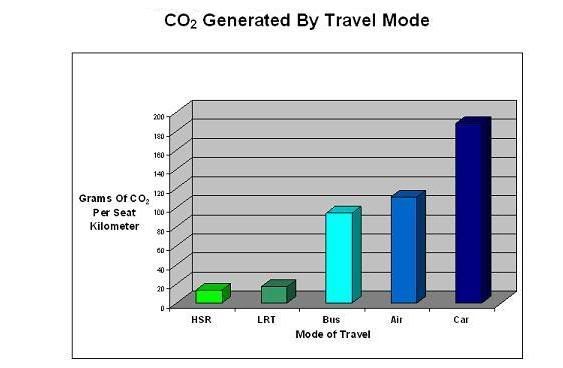
High-speed rail is the greenest way to move people ever invented. Trains consume only one-third of the energy used by an airplane and one-fifth the energy of an automobile trip. Nearly all of the electricity of HSR's trains could be produced from renewable energy sources. High-speed rail would reduce carbon dioxide emissions by up to 17.6 billion pounds per year. It would reduce California's oil consumption by up to 22 million barrels per year (1,100 million gallons per year). At a price of $125 a barrel, savings in oil costs alone would approach $2.75billion annually. Oil costs will rise in the long run, as oil geologists agree that we are entering an age of declining oil reserves that will be ever harder to extract.

Which gives me the opportunity to repost one of my favorite images:


(Image from Alberta High Speed Rail)

Now I'm sure the usual HSR deniers are clucking, "but oil prices have fallen!" That's true - for now. When Dennis originally wrote this op-ed the price of a barrel of oil was at $125. They're now at $66. Of course, it is common for oil prices to decline in the autumn and winter months, only to rise again in the spring and summer. But here's the thing - that does NOT mean we can rely on oil to serve our travel needs.

The only reason oil prices have declined is demand destruction. Meaning that fewer people are using gas to travel. If lower gas prices spur an increase in gas consumption, the price will rise again, as many economists have recognized. The only way to produce affordable, sustainable, long-term growth independent of the vagaries of oil price fluctuation is to build rail projects such as high speed rail.

As we've seen here, HSR is a successful method of travel around the world. It operates without subsidies, attracts millions of new train riders, and provides badly needed jobs and economic growth. Thanks to Dennis Lytton we are also reminded that it provides safer and more fuel efficient travel. The case for Prop 1A could not be clearer.

Tuesday, October 7, 2008

SF Chronicle Endorses Prop 1A

NOTE: We've moved! Visit us at the California High Speed Rail Blog.

This one isn't really a surprise, since they've been supporters of high speed rail for many years now, but today the San Francisco Chronicle endorsed a Yes vote on Prop 1A:

The passage of Prop. 1A would generate an estimated 160,000 construction-related jobs at a time when the state could use an economic stimulus. But its even greater long-term value to the state will be the economic and environmental benefits of connecting urban centers with growing inland cities that don't have major airports - and providing an alternative to the cattle-call flights between the Bay Area and Southern California.

They're absolutely right - and even understating the case. The long-term value isn't just in providing alternatives to cattle-call flights, nice though that will be. The long-term value comes in providing an alternative to oil, period. Our state's dependence on oil is causing financial and economic havoc. Those who make baseless criticisms of Prop 1A's financing are ignoring the far more risky and damaging impacts of "staying the course" and doing nothing in the face of a climate and energy crisis that is strangling our economy.

The editors had a good response to those fiscal critics:

Opponents have seized on the understandable anxiety about a venture of this magnitude and have questioned everything from its cost projections to ridership estimates to its environmental benefits. In a meeting with our editorial board this week, they suggested the money would be better spent on relieving gridlock on regional roadways.

However, the fiscal safeguards on Prop. 1A were toughened substantially with the Legislature's recent passage of AB3034. It limited the amount of money that could be spent on administration or other items unrelated to construction. Also, construction could not begin on any segment of the project until it was certified that the funding for it had been secured. State funding would account for about half of the project; the balance would come from the federal government and private sources.

HSR deniers want Californians to believe that if this passes that we're going to be DOOMED, doomed I tell ya, especially in our state budget. But the Chronicle points out this is nonsense. If the feds and private enterprise come through as they have consistently indicated they will then we build it and everyone's happy. If they don't come through, we don't build it, no money spent, no harm done.

They close well:

Prop. 1A presents an ambitious vision that is well tailored to the state's transportation and environmental needs. We recommend its passage.

We strongly agree.

Of course, to give the "other side" a chance to get their message across, the Chronicle published an op-ed by longtime HSR denier Richard Tolmach. That deserves its own takedown which will be provided tomorrow morning Wednesday evening (sorry guys, busy day).

Tuesday, September 30, 2008

British Conservatives Embrace an HSR Future

NOTE: We've moved! Visit us at the California High Speed Rail Blog.

Britain's Conservative Party used to be rather strongly anti-rail. Margaret Thatcher never traveled on a train while Prime Minister. John Major helped privatize British Rail, which had devastatingly negative consequences. While European nations were busy building a high speed infrastructure, Britain lagged. Its only HSR route connects London to the Chunnel, and even that line was only completed last year.

But in what some are calling a "stunning turn of events" the Tories are now embracing high speed rail - specifically as a replacement to a third runway at Heathrow. The plan is to run trains at 180 mph from London to Birmingham, Manchester and Leeds. David Cameron, who looks set to be the next Prime Minister, claims it will cut 66,000 flights from Heathrow.

Labour has opened itself up to this move by stupidly rejecting HSR. Now Cameron and the Tories are poised to burnish their green credentials even further by embracing a form of transportation that has been quite successful on the Continent.

Credit shouldn't go to the Tories alone. HSR advocates blasted Labour earlier this year, and Greengauge 21 has been persistent in putting the subject before British voters, emphasizing many of the same economic, environmental, energy and transportation benefits as we have here in California.

It's worth noting that Britain too is facing the same financial and economic problems as the US - but they also recognize the need for long-term infrastructure planning, that green infrastructure is the best tonic for an economic downturn. If British conservatives can get past their old hostility to rail, let's hope California conservatives can do the same.

Monday, September 29, 2008

California Cannot Afford to Reject Prop 1A

NOTE: We've moved! Visit us at the California High Speed Rail Blog.

Ever since this blog launched back in March I've felt that the most potent threat to Prop 1A's passage is the budget and economic crisis. Too many Californians, especially in the media, are stuck in obsolete late 20th century thinking that a recession is a time to cut back on government spending, that now would not be a good time to authorize bonds and construction of high speed rail.

Nothing could be further from the truth. If we followed that argument - being advanced in newspapers such as the Pasadena Star-News and the Long Beach Press-Telegram this weekend - in the 1930s then we'd never have built Hoover Dam or the bay bridges. If we followed that advice in the late 1950s when California had a budget deficit we'd never have built the California Aqueduct.

When a state is stuck in a recession the #1 priority is to get the economy moving again. Deficit spending to create jobs is a good way to do that. Borrowing to build infrastructure that provides many decades of value and itself spurs further economic growth is an even better way to do that.

HSR is estimated to create around 160,000 jobs in the short and medium term. A recent study suggested San Diego alone would see 45,000 jobs. Long-term job creation estimates have been around 450,000 for the entire state. California's unemployment rate stands at 7.7%. These newspapers are irresponsible to suggest California should wait to create these jobs - we need them now.

Another argument against Prop 1A is that with a state budget crisis now isn't the right time. The Pasadena Star-News makes this explicit:

Right now, though, when we need to find ways to simply balance our budget in order to pay teachers, keep health clinics open and operate other essential services, we're going to have to wait to get aboard this train.

How exactly is California going to balance the budget if we don't have jobs? If jobs are lost and tax revenues shrink because people are paying too much money for oil-based transportation?

But even worse is the notion that our choice is between teachers and high speed trains. It's not. The nonpartisan Legislative Analyst Office reported that California can afford Prop 1A - it will not significantly increase our bond debt beyond what we can afford. The total cost of Prop 1A with interest is likely to be around $19 billion. That will be repaid, however, over 40 years. $10 billion is NOT going to be authorized all at once. It will be spent over the course of ten years as the construction schedule necessitates. Meanwhile new jobs and new tax revenues will help boost the state economy and state budget. California's budget needs structural reforms, but we can and must pursue them while also building for the future.

More importantly, neither editorial assess the cost of NOT building HSR. They make the same mistake countless others have made in assuming that if we reject Prop 1A, we spend no new money. That is absurd. The cost of expanding freeways and airports has been estimated at around $80 billion. HSR meets the same need at an eighth of the cost (to the state budget). Airlines are cutting flights and raising fares which means additional costs for the state. As our foreign competitors are turning to HSR, it will be more difficult for California to attract new business investment if we lack an alternative to oil-based transportation.

The cost to the environment is also considerable - HSR will cut 12 billion pounds of carbon emissions and save over 12 million barrels of oil per year. Given the eventuality of a carbon tax or cap-and-trade fees that translates into actual money California will have to spend because we rejected Prop 1A. Those costs themselves will be considerable, and will have a negative ripple effect throughout the economy.

Some suggest we wait and build HSR later. When is "later"? When oil prices have shot through $200/bbl? When construction inflation costs have pushed the project's cost over $50 billion? If we had approved HSR in 1998, it would be ready to go now, ready to provide economic growth and financial savings. The longer we wait, the higher the cost will be.

California's economic and financial crisis stems from having relied on oil for our economy. When oil prices soared, our economy suffered and in turn our banks became insolvent. If we want long-term recovery, we MUST move beyond oil. It is an absolute requirement for further economic growth. Those who oppose Prop 1A out of a sense of fiscal responsibility are instead consigning California to chronic instability in our economy and in our budget.

California cannot afford to reject Prop 1A. The time to start building a prosperous 21st century California is now.

Sunday, September 28, 2008

Prop 1A Misinformation in Long Beach

NOTE: We've moved! Visit us at the California High Speed Rail Blog.

Today's Long Beach Press-Telegram editorializes against Prop 1A. As is becoming depressingly common with newspaper editorials, the Press-Telegram's anti-HSR screed contains a number of out-and-out lies that need to be called out here. The editorial staff does its readers a disservice by misleading them on some of the most fundamental aspects of Prop 1A and our state's high speed rail plan. Some examples:

That's the measure that would borrow $10 billion and spend it on promoting, not building, a high-speed train system. This is a colossal ripoff with no promises of any results except that the money would get spent.

AB 3034 changed the proposition to ensure that no more than 50% of bond funds could be used to build the system to ensure that we must have matching funds to proceed. The editorial somehow turns that into a negative, which is absurd. Their claim that the bond money wouldn't go to construction is a lie, plain and simple.

Worse, it would get spent with no oversight, and participation on the campaign's "finance committee" by nobody other than politicians and bureaucrats. Supporters brag that the $10 billion would not require a tax increase, but what they don't say is the obvious, which is that the money, $20 billion including interest, would come straight from the state's deficit-ridden general fund.

Another lie - AB 3034 created an oversight committee that Republican Roy Ashburn fought hard to include. The editorial misleads readers about the cost - $20 billion would not be spent all at once. The bond has a 40 year life, meaning the cost would be closer to a manageable $500 million per year.

If the project ever actually got built, supporters say the cost would be $40 billion, but skeptics say it would be more like $100 billion. The expectation (which seems more like a fantasy) is that the rest of the money would come from the federal government and the private sector, neither of which is standing in line with checkbook in hand.

There is NO evidence for the skeptics' $100 billion claim. None whatsoever. But there is a LOT of evidence to suggest Congress actually has the checkbook ready - John Kerry and Johnny Isakson are proposing a multibillion HSR funding bill and if he wins, Barack Obama has shown a desire to build HSR as well. As to the private sector, nearly a dozen companies responded with interest in helping fund HSR.

High-speed trains are wonderful assets in Europe and Asia, where they whisk travelers to their destinations at speeds of 180 miles an hour or faster without the misery of airport security lines. It's a concept that works well between Washington and New York, or between Paris and the chateau country. But those aren't 400-mile trips. The ideal travel distance for a high-speed train is a couple of hundred miles or less, or, as in Tokyo, less than 50 miles or so from an airport to an urban center. Trying to connect San Diego, Orange County, Los Angeles, Fresno, San Jose, Sacramento and San Francisco is a far more daunting task, and not likely to put any airlines out of business.

The Madrid-Barcelona AVE train is a similar distance to SF-LA, and is pressuring airlines there. Passenger rail already connects the cities the editorial claims can't be linked - HSR merely provides a much, much faster service.

Additionally, the editorial makes the common media mistake of not explaining the cost of doing nothing. Nowhere are rising oil prices mentioned. Nor are higher airfares, nor are flight cutbacks, nor the environmental savings of reducing carbon and cutting oil consumption, nor the $80 billion price tag of expanding freeways and airports to meet the demand HSR will serve, nor the cost to the economy and the state budget of not creating 160,000 jobs. Instead the editorial board relied on misinformation and lies to give readers a deeply biased picture of Prop 1A.

The editorial board should know better than to write an editorial that has not been fully researched and vetted. Journalistic ethics do not end at the opinion page. The Long Beach Press-Telegram owes its readers a correction and an apology for this flawed editorial.

Thursday, September 18, 2008

Nearly A Good Laugh

NOTE: We've moved! Visit us at the California High Speed Rail Blog.

It was only a matter of time, really. Libertarian and far-right anti-tax groups in California have been unhappy about our high speed rail project for a while now, and sooner or later they were going to run into noted passenger rail hater Wendell Cox. Cox believes light rail, heavy rail, high speed rail are all inherently flawed concepts, perhaps because he takes no small amount of money from bus and highway lobbyist groups. Cox has also been associated with the conservative Reason Foundation for many years, a group that is funded by oil companies and their affiliated foundations. When Cox, the Reason Foundation, and the rabidly anti-HSR Howard Jarvis Association got together, the outcome was predictable.

That outcome was a anti-HSR report (full 190-page version here) that the Howard Jarvis Association included in their 2008 "Piglet Book". It's their attempt to put some "evidence" to their usual anti-train claims. In reality it's full of so many contradictions, half-truths, and outright nonsense that it would take more time than I have to fully refute the whole thing.

The Howard Jarvis Association in particular is coordinating a full-fledged media rollout of the study, with an op-ed in the LA Daily News that suddenly introduces a $54 billion price tag for HSR out of nowhere, to an appearance on KQED forum (Rod Diridon was there on behalf of HSR). That, alongside the media's love for stories on "government waste" should ensure this gets some traction in the press, albeit fleeting.

Reaction to the study has been swift from those who know a thing or two about rail. From our friends at The Overhead Wire:

And yes...they play the fear card.

Terrorism against rail targets is a concern considering the extent of attacks that continue to occur on rail systems around the world.


Typical of current culture warrior thinking. When you can't win with the facts, try to scare people.


The study makes some rather outlandish claims. They charge that because HSR's projected cost has risen to around $40 billion, that by the time it opens we might have to spend as much as $80 billion. It's not enough to simply look at a trend and assume it will continue on forever - you have to explain the underlying logic, as we have with gas prices. They don't. Nowhere is global inflation of construction materials or the declining value of the dollar mentioned. A gallon of gas costs 200% more in 2008 than it did in 2000, but somehow I doubt that Reason and the Howard Jarvis people would suggest we abandon cars and freeways as a result.

Their $80 billion cost estimate is pulled out of thin air - and if we use their same logic, a gallon of gas will cost between $8 and $10 by 2018 ensuring that HSR is a financial bargain.

Numerous other examples abound. They claim California isn't as favorable for HSR as Europe or Japan, even though Spain's conditions are similar to our own. They claim Acela isn't a success, but it has at least 40% of the market share on the Northeast Corridor, a stunning number for a system that isn't true HSR. Their claims about ridership aren't backed up by a close study of the assumptions that went into the CHSRA's studies - instead they say "well this doesn't compare well to Europe so it can't possibly be right?!" They say non-HSR alternatives will be cheap, that freeways can be expanded for $900 million - but it'll cost $6 billion to widen Highway 99 alone!

It goes on and on like that for 190 pages. But the details of the study aren't important to the authors and promoters, who don't expect anyone to actually read it and see the nonsense for themselves. Instead they just want to muddy the waters in the public mind by saying "boondoggle! pork! massive cost overruns!" often enough in hopes that the media will listen and repeat it for them.

We remain confident that Californians will see the value of high speed rail. While Cox and the Howard Jarvis Association quibble over numbers Californians are screaming for solutions to the airline crisis, to high fuel costs, and to the nasty economic downturn that we're sliding into head-first. They know better than to have oil company and highway lobby shills convince them to abandon California's future.

Thursday, September 11, 2008

Ghettoizing Rail

NOTE: We've moved! Visit us at the California High Speed Rail Blog.

The Progressive Policy Institute released a study earlier this week calling for a major national investment in high speed rail. Their study reads like a greatest hits of the arguments we've cited repeatedly on this blog - the airline crisis, economic stimulus, environmental benefits, and transportation needs.

The study calls for massive investment in five national HSR corridors, including LA-SF. To pay for this the study proposes a dedicated source of funding - a Rail Trust Fund that would provide for HSR as well as other rail service. Its sources would include:

  • A ticket tax on all passenger rail systems, from $5 for Amtrak to $1 for commuter rails

  • Charging freight companies fees to haul along new rails

  • Encouraging state matching funds along the highway model (80 fed/20 state)

  • Proceeds from auction of cap-and-trade (I have also proposed using an outright carbon tax or congestion charge as well)


I would personally just close the Highway Trust Fund, which is obsolete, and turn THAT into the Rail Trust Fund. But the above proposals are a good starting point.

The Progressive Policy Institute, alongside numerous other think tanks, understands the importance of providing passenger rail service at fast speeds to both improve existing rail routes and provide new service where none currently exists. California's high speed rail project will accomplish both goals.

But to hear the HSR deniers tell it, we somehow don't need HSR. That's their new line of attack - HSR is unnecessary and we should not spend $10 billion on it when we could spend the money on BART to Livermore, for example. Seriously, someone proposed that as an alternative to HSR in an email to me, despite the fact that there's about a 100 to 1 difference in the number of riders the two would serve. I'd love BART to Livermore, but come on, it pales in comparison to the service benefits of HSR.

I'll be first in line to agree that we need to improve existing passenger rail service. And hey, guess what? HSR accomplishes precisely that. Those who live along the Caltrain corridor will see major service improvements to Caltrain. Eliminating grade crossings means faster service and shorter trips even on local trains. Passengers could also transfer at Palo Alto or Redwood City (whichever is chosen) to make their journey to SF or San José that much quicker.

The anti-HSR forces are dominated by Northern Californians, which is significant. Southern Californians understand the benefits of HSR, partly because their region is much larger. Anaheim, Burbank, Riverside and Palmdale are already connected to downtown LA via Metrolink and the Pacific Surfliner in some cases, but HSR would make those trips much faster. The Surfliners already connect LA to SD, but HSR will cut that travel time in half if not better - faster than driving. And instead of seeing HSR and other passenger rail as somehow opposed, SoCal rail advocates embrace both systems.

We can look abroad to see evidence of this. In France the TGVs aren't the only form of rail travel. They are well integrated with, for example, the Paris Metro and the RER regional trains. All work together to boost each other's ridership and provide different levels of service that meet most possible travel needs.

What the HSR deniers are trying to do with this "oh we don't need HSR" argument is ghettoize passenger rail and ensure that Californians are never given the chance to use it more widely and frequently than they already do. High speed rail will bring new riders to the rails, rescuing them from a collapsing airline industry and from ever-rising gas prices. The big gap in California's passenger rail network is LA-SF, one of the most heavily traveled corridors of any kind anywhere in the state. HSR would open that corridor to rail, providing a rising tide that lifts all boats and building support around the state for increased investment in rail.

The HSR deniers should be more honest about their motives. It's not that they think HSR is the wrong kind of rail - but that they don't want new rail service period. They believe, against all evidence, that California is just fine relying on planes and cars. They want passenger rail to serve a small niche and not the masses. We reject that narrow, outdated thinking. It's time for California to join the 21st century and build a real high speed train system that can get this state moving again.

Sunday, September 7, 2008

High Speed Nonsense in Tracy

NOTE: We've moved! Visit us at the California High Speed Rail Blog.

One of the most bizarre and nonsensical anti-HSR op-eds appeared in the Tracy Press on Friday. Written by Craig Saalwaechter, the article makes high speed rail out to be some kind of "hurricane" that will destroy the state. Instead the author winds up defending a failed status quo, suggesting that California stand idly by in the face of looming environmental, energy, and economic crisis. If Saalwaechter wants to analogize HSR to a hurricane, his approach is that of someone who sets up a lawn chair as the storm approaches without putting plywood over the windows and getting the hell out of town.

Think of it as a big Y placed smack dab in the middle of California.

No, think of it as a big WHY?

Proponents tout its ability to eliminate commuter congestion, reduce air pollution and provide an alternate mode of transportation.

At last week’s transit forum sponsored by the city, I didn’t meet any Tracy-to-LA commuters, just Tracy-toward-the-bay commuters.

High-speed rail won’t help reduce their congestion along the Interstate 580-205-120 corridor.

Earth to Craig: Tracy is not California. It's one thing to point out that Tracy isn't going to immediately benefit from HSR. But quite another to assume that since Tracy isn't going to get an HSR station, nobody else will, and nobody anywhere will benefit. Commuters in the Bay Area and Southern California will see a significant benefit from high speed rail, whether you live in San Jose and commute to work in downtown SF, or live in Orange County and commute to LA, or any number of other combinations.

Of course, HSR riders won't just be commuters. They will also be travelers - tourists, business travelers, families going to see grandma and grandpa for the winter holidays. Lots of residents in Tracy have family in SoCal. Lots of residents in SoCal have family in the Bay Area. Given the ever-rising cost of gas and airfares and the cutbacks in flights, this is an important consideration for all Californians.

Saalwaechter's article mentions none of this. It's basically a bunch of non-sequiturs strung together to reach the 800 word requirement.

Supporters of the bond reluctantly claim that the total cost of the high-speed rail system could reach $40 billion. They expect $10 billion from the feds and the rest from “private investments.” Bet you can’t wait to see the shenanigans and shady deals that are put together by our bureaucrats in Sacramento.

This HSR supporter - me - has never been reluctant to explain the total cost of the HSR system. Of course it's $40 billion. Of course we expect $10 billion or more from the feds, and yes, we expect private investors. But there's no reason to imply "shenanigans" unless your worldview is so cynical that you probably have a hard time getting out of bed in the morning. The Authority has already been in discussions with private investors about what their needs are to invest. This is a discussion that will unfold over the coming years and involve the legislature's oversight in a public process. If Saalwaechter can't be bothered to be a good citizen and get involved in the process and actually read the documents, he shouldn't be making baseless claims.

And have you noticed that as projects grow from city to county to state, they get worse? Just look in our own backyard at the multi-county San Joaquin Delta College disaster. Gee, what a shocker that the big city of Stockton gets all the goodies and the neighboring towns get shafted.

This non sequitur is actually rather telling. To folks like Saalwaechter, ALL government projects are inherently flawed. There's not a good one in the bunch. Whether it's a school or a train or a bridge or who knows what else, anything government touches turns to dung in his mind. His objection is really to government, not to HSR. Otherwise he'd have more knowledge of the transit projects that came in on-time and on-budget, like the Metro Gold Line extension.

But back to Prop. 1A and its cost estimates. It’s a huge underestimate comparison, but let’s use recent and planned BART extensions as a template. The almost $2 billion Millbrae-to-SFO connection and the now estimated $7 billion Milpitas-to-Santa Clara line will be a total of less than 40 miles of 1960s technology. Total cost: $9 billion. Does that number sound familiar? Can you imagine the higher cost of a state-of-the-art bullet train?

BART's construction costs are unusually high owing to its unique technology. It's a distinction few in the public understand, since they see all passenger rail as basically being the same. It's an unfortunate legacy of decades of underinvestment in rail. But that doesn't mean that HSR will face the same cost overruns as BART - the technology is standardized, the construction methods are standardized. Any cost overruns will come due to inflation and the declining value of the dollar.

So picture this: You drive over to San Francisco, and after waiting through long Homeland Security lines, you start your Southern California trip from the marble-laden San Francisco station, with your hair figuratively whipped by 200 mph winds. You race down the peninsula watching blue “Your Tax Dollars at Work” signs whiz by. You roar into the polished granite San Jose station and literally fly off toward Gilroy.

Oh, no, the train is slowing, and you see a “Track Closed” barrier ahead. As the train grinds to a halt, you notice there is no Gilroy station, just a retired garlic worker wearing a conductor’s hat sitting in the sun at a card table! Off in the distance, you faintly hear, “Sorry folks, we ran out of HSR money.”

This is where his column, already shaky to begin with, goes off the rails completely. From the 200mph speeds in a "marble-laden station" to a train that stops in the dead of nowhere his fantasy makes little sense. Obviously the underlying concern is the Authority will run out of money before the system is completed. That's a real issue, but Prop 1A - as amended by AB 3034 - has some pretty strong safeguards preventing such a situation. The bond money can't be spent on more than 50% of station and track costs, essentially requiring a federal commitment before construction can begin.

Recently it was written (Our Voice, Aug. 30) that this 800-pound gorilla of a proposition may generate $11 million for the Altamont corridor. It could improve the ACE tracks or lead to building a separate rail line. With the costs of land acquisition, planning, designing and environmental impact studies, that money would be burned up before the first spike is driven.

Even with some nebulous matching-fund scheme, the current cost of rail track construction would net Tracy about 3 miles of track. Well, if Alaska can have a bridge to nowhere, we can a track to nowhere.

But nowhere does he define "the current cost of rail track construction." If he wants to call Tracy "nowhere" he's free to do so, but here I thought he opened his column by arguing Tracy needs a commuter connection to jobs in the Bay Area. If he's making speculation about costs that aren't based on any evidence, and if he's contradicting himself within a single op-ed, can we really take what he says that seriously?

Prop. 1A would do absolutely nothing to improve our commuter problems. So why would we saddle our residents with this massive state bond debt?

Furthermore, Gov. Arnold Schwarzenegger is floating a 1-cent increase in sales tax to close the current $15 billion deficit. If BART costs are any indication, expect the true cost to put in the stations and 800 miles of track to easily exceed $100 billion. So expect repeated massive income and sales tax increases in the future. Do we really need this debacle?

As I noted above, BART is not HSR. I'd love for him to show me an HSR construction project anywhere in the world that saw 250% cost overruns. If he can't he's not credible.

More importantly, Saalwaechter is making the same mistake as dozens of other HSR deniers - assuming that the cost of not building HSR is zero. It's not. The cost of not building HSR is north of $100 billion, when you include the cost of expanding freeways (which Saalwaechter supports), the cost to travelers in higher fuel prices, the cost to businesses and workers of those fuel costs, the costs of climate change, and the lost economic opportunity for jobs and growth that HSR provides.

Ultimately the problem with this op-ed is that it assumes the status quo works just fine. That we can stop big bad government in its tracks and save ourselves from disaster. For that argument to work you have to ignore a LOT of evidence that demonstrates disaster is coming and that our current transportation system is not tenable.

California is going to have to pay to extricate itself from this crisis. There is no way around it. The question before us is whether we spend $10 billion on this bond or north of $100 billion to try and manage without HSR. When you look at the complete picture, as the HSR deniers never do, HSR clearly is the cost-effective, fiscally smart solution.

Friday, September 5, 2008

Taiwan's Airlines Reeling From HSR Success

NOTE: We've moved! Visit us at the California High Speed Rail Blog.

In the year and a half that Taiwan High Speed Rail has been in operation it has captured a significant chunk of the island's domestic travel market. It has already achieved profitability and now the island's airlines are reeling:

Since the high-speed railway service began, half of the air routes between Taipei City and the country's western cities have been discontinued, with those from the capital to Taichung and Chiayi closed last year and the one to Tainan ended in August. While flights between Taipei and the southern cities of Kaohsiung, Pingtung and Hengchun--home to Kenting National Park--are still in service, operators recently stated that their future is uncertain, with reductions or cancellations being considered.

Mandarin Airlines, a subsidiary of Taiwan's China Airlines, is the only company still running flights between Taipei and Kaohsiung--once the nation's most lucrative domestic route that was also operated by three other local airlines, Uni Air, TransAsia Airways and Far Eastern Air Transport (FAT). Despite reducing its Taipei-Kaohsiung service to one flight per day Aug. 16, Mandarin Airlines also applied to the Civil Aeronautics Administration under the Ministry of Transportation and Communications to pull out from the route as of Sept. 1.

"Summer is supposed to be the peak season of air travel, but our passenger occupancy rate is barely over 50 percent," said Irving Hsu, spokesman for Mandarin Airlines. "Airlines cannot survive with occupancy rates lower than 60 percent. It is increasingly difficult to maintain operations as more travelers now choose to take THSR's trains," Hsu explained.

Soaring ridership is the global rule and should finally put to bed any lingering argument that California high speed rail will have any problem meeting ridership projections.

The Taiwan Journal article I linked above used the headline "Romance of rail jeopardizes domestic air routes." But I'm not sure it's romance that's at work here. Instead it's likely simple efficiency and common sense. High speed rail is a fast, reliable way to travel. It's easier to do work on a train - you can make calls, perhaps get WiFi, and not be as crowded in as you are on a coach airline seat (with my 6'2" frame it's nearly impossible for me to even open my laptop fully). HSR trains usually serve city centers, whereas airports are typically located on the urban fringe by necessity.

Taiwan's experience, alongside that of Spain, France, and Japan (to name but a few) proves that if given a choice between flying and taking a high speed train, many if not most travelers will choose the train.

What of the economic impact on the airlines? They are already in crisis, and already cutting flights between LA and SF. US carriers are shifting their business model to emphasize medium and long-haul flights, and smaller cities like Fresno are in jeopardy of losing air service entirely. In this context HSR helps fill a vacuum for Californians and helps get the airlines make a shift they're already looking to make. The fact that no airline is spending a dime to fight Prop 1A should suggest how they really feel about it.

Additionally, the carriers that serve intra-California routes are not dependent on those routes. The days of PSA and AirCal are long gone, and even Southwest can survive without the LA-SF corridor.

High speed rail is essential to California's future. The airlines cannot be relied on to provide us fast, cheap transportation with our state. If we act now and pass Prop 1A we can ensure that California has affordable transportation for decades to come - an absolute necessity to a prosperous and competitive 21st century economy.

Saturday, August 30, 2008

Taking the Coast Route

NOTE: We've moved! Visit us at the California High Speed Rail Blog.

(This was supposed to auto-post at 3PM yesterday. Bloggered again...)

ABC News has a high speed rail story up on its site this morning, about the proliferation of HSR plans around the country. They quote some skeptics, including William Garrison, a retired civil engineering professor at UC Berkeley:

William Garrison says there is little national demand for high-speed rail. He says the push for high-speed rail is merely a new way of doing something old. "While the high-speed trains look nice, they're just polished-up, old, sterile technology," he says. "They're like I am. I am an old man with a new haircut."

It's conceivable that Garrison has not been to Europe or Japan anytime in the last 30 years to see the cutting-edge, extraordinarily popular high speed trains there. It's possible, I guess, that he hasn't even been to the western edge of his city to see the frequent, high-ridership Capitol Corridor trains. And it's more than possible, but quite likely, that he's just an old-school freeway builder who convinced himself in the 1960s that rail was dead and 40 years later cannot bring himself to admit new evidence and new realities.

Ironically Garrison himself coauthored a book attacking that kind of thinking:

Major themes of the book include the pervasiveness of conventional wisdom, its often unfortunate role in shaping policy, and the need to resist it. Another theme is historic path dependence, in which initial decisions when a technology is young lock systems into development paths out of inertia (as in the case, say, of railway gauges), so that they become historic artifacts rather than dynamic transport systems. The authors also address the maturity of our transportation system (and its possible senescence). That creates the danger that new ideas will be suffocated or starved, especially given the present preoccupation with polishing and fine-tuning obsolete systems, or tinkering around the edges, refining and optimizing in small increments what is already deployed.

Despite this undercurrent of dismay, the authors claim to be writing out of a sense of optimism. "We need to think harder. We need to do better," they write, with the implication that that is possible.

The book includes an attack on high speed rail, which is directly contradictory to its stated themes:

At the same time, the authors suggest that the passenger railroad is a dying technology, suitable for a select few settings, but extremely limited in its practical usefulness overall. They analyze the prospects for high-speed rail in the U.S. market and, contrary to some widely publicized views, conclude that it is not likely to succeed on its own merits. In the two places where high-speed rail has enjoyed some of its greatest success, Europe and Japan, other factors contributed to the outcome. Regulatory schemes artificially inflated airfares, so airlines could not compete for customers on price. And because Europe and Japan are more densely populated and have more severe congestion and capacity problems, high-speed rail has an easier time of matching the convenience of air, creating the high-volume, short-distance market for which high-speed rail is most suited.

So how do they explain the Acela's success?! European air travel has been revolutionized by low-cost carriers such as easyJet and Ryanair, but high speed rail has still beaten them. Matt Melzer destroyed the "more densely populated" argument here on the blog last month, showing that Spain has very similar conditions to us in California, and Spain's successes can be repeated here. Finally, the notion that air travel is "convenient" just doesn't seem true any longer - when American travelers are given a choice between flying and high speed rail, they're choosing the rails.

Garrison and his coauthors go on:

Finally, they argue, high-speed rail is too late: "In mature systems, the benefits of new infrastructure in an already well-served area are elusive." Tinkering with an older system will yield only minimal gains. "Whether high-speed rail is a new story, or simply the final chapter to the history of conventional passenger rail, waits to be seen," they conclude.

Of course, California is not a "well-served area." HSR isn't "tinkering with an older system" and his implicit notion that passenger rail is headed for some dustbin of transportation history is belied by the reality that surrounds us.

Ultimately Garrison's argument is really little more than libertarian anti-transit nonsense dressed up in academic speak. Their book purports to explain why "the math" doesn't work for transit, but this ignores the massive subsidies given to freeways - meaning "the math" doesn't work for them either. And nowhere in their book, published in 2006, do they discuss the impact of higher gas prices or global warming mitigation costs on transportation - both of which suggest that HSR will be effective from both a transportation and an economic point of view.

Garrison's arguments are the last gasp of a dying 20th century model. The 21st century model is one that emphasizes sustainability, in our case through modernized passenger rail. I love riding the Coast Starlight, but give me high speed rail and I'll choose that over Amtrak, driving, or flying any day.

Thursday, August 28, 2008

Travelers Seeing Rail As Superior to Planes

NOTE: We've moved! Visit us at the California High Speed Rail Blog.

It's a frequent canard raised by the HSR deniers - that nobody would choose even a bullet train over a plane to get between the two halves of our state. Soaring passenger rail ridership belies this argument, as travelers see the benefits - in terms of comfort and economy - of rail travel. The Washington Post explored this dynamic in today's paper, interviewing Acela riders to explain the shift:

Jada Golden stood in the waiting lounge at Union Station, explaining why Amtrak is a better way to travel than an airline.

"It's as heavy as we want," Golden said, pointing to an oversize suitcase. "We can put it on a rack in the rail car and get things out of it."

Golden, 36 and a Boston schoolteacher, pointed to another bag -- a large paper grocery bag filled with sandwiches, salads, water and fruit. "You can bring food," she said.

She continued. On the train, she's free to pick her own seat and doesn't have a flight attendant telling her when to use electronics. And then there's the airline stress factor -- the security headaches and the delays.

"You're always delayed in the airport," Golden said. "You always have connecting flights."


Security theater, high fuel prices, an aging infrastructure, and corporate nickel and diming are all driving passengers away from planes and to the trains. On the Acela passengers are free to talk on their cell phones, getting work done that they couldn't get done on a plane. It's a superior method of travel, as more and more Americans are discovering.

Of course it helps that the Northeast Corridor has something like the Acela, a quasi-high speed train that is competitive with flying times between DC and NYC. Here in California we just don't have that option. The Coast Starlight, which I'm riding to LA tomorrow, takes about 12 hours to get from the Bay Area to SoCal. There's just no way that can ever shift travel habits in any lasting or meaningful way. I love riding it, but most Californians can't afford to take two whole days to get between LA and SF. Compared against the Coast Starlight, yeah, flying is generally the better option.

And that's where high speed rail makes such an enormous difference. Two and a half hours on a train is certainly competitive with flying, especially when the security theater, travel time to and from the airport, waiting in the terminal, and frequent flight delays are considered. You can conduct business on the train, with a cell phone and likely by wi-fi once our project is built. It provides a stable cost of transportation, as opposed to flights which are dependent on an ever-rising cost of oil.

Already airlines are cutting flights between LA and SF, which is likely to continue as fuel costs eat into profit margins. To believe we can rely on airlines to handle our intrastate travel needs is to deny reality. Americans are already demonstrating that they WILL take high speed rail if it's an option, just as Californians are riding the Amtrak California lines in massive numbers. Put together it's a solid argument for high speed rail in California.

Monday, August 25, 2008

USA Today's Strong Case for HSR

NOTE: We've moved! Visit us at the California High Speed Rail Blog.

David Grossman is USA Today's business columnist, a former airline exec and a California resident - and today he offers not one but two columns extolling the benefits of rail for business travelers, especially high speed rail. It's best to read these in sequence to get the full effect of his argument. First up: Is Amtrak a viable solution for business travelers?

When visiting the East Coast I often use Amtrak to traverse the Northeast corridor between Boston and Washington, D.C., instead of flying the air shuttles or driving the toll roads of I-95. The Acela Express and even the regional trains on those routes are often quicker than flying or driving, particularly if your origin and destination are within the city centers....

But that is only the Northeast corridor. In California, where I reside, and most other parts of the country, Amtrak is a completely different product offering. In the Northeast, trains attain operating speeds of 125 to 150 miles per hour, according to Black. On the 423-mile stretch between Oakland and Los Angeles aboard Amtrak's daily Coast Starlight train, the scheduled travel time is more than 13 hours. Though the train reaches 79 miles per hour on some segments, the average speed on this day-long marathon ranges between 25 to 35 miles per hour.

Slow travel speeds are caused by a combination of mountainous terrain and sharing the tracks with freight trains. Outside the Northeast corridor, freight railroads generally own the tracks. In most places double tracks have been removed because they are too costly to maintain. As a result Amtrak must continually wait on sidings for other trains to pass, and the freight trains operated by the host railroads that own the tracks often take priority over passenger trains.

My train sat for what seemed like hours at many places along the way and at one point was delayed 30 minutes after we rammed a shopping cart someone left on the tracks. With all these impediments it is no wonder few business travelers use Amtrak outside the Northeast corridor.

Grossman goes on to explain some of the problems he experienced on the Coast Starlight, problems that will be familiar to any of us who have used the trains before, from the late arrival time in LA to the lack of electrical outlets at all seats. But his main point is that speed and reliability are the key to make rail attractive to business travelers.

It's a point Grossman develops in his high speed rail column, The case for high speed rail in America:

Passengers fill every seat in the glass-roofed Parlor Car on Amtrak's Coast Starlight train en route from Oakland to Los Angeles. Running along the Union Pacific Railroad tracks as it hugs the California coast, the Coast Starlight route offers some of the most spectacular scenery in the USA. But the mountainous terrain along the route is filled with steep grades, sharp curves, and a single track, making the travel time over 13 hours for a distance that can be flown in one hour or driven in eight.

Unless Amtrak can find a way to shorten the duration of this trip, few business travelers will abandon the crowded skies or leave their cars at home. This November, Californians will vote on a proposition to construct a new dedicated high speed rail line to bypass this slow but scenic route. If it passes, the new rail line will run across the open flat lands of California's Central Valley, allowing passengers to travel between the San Francisco Bay area and Los Angeles at speeds up to 220 miles per hour, rivaling the famous French TGV or Japanese bullet trains. The new line would link California's two largest cities in just a few hours of travel time.

An obvious first point is that it's not just business travelers who will benefit from this, but all travelers period. Still, Grossman clearly applies the lessons he learned on his Coast Starlight trip to high speed rail - HSR solves all of the problems of the Starlight, by providing dedicated tracks to allow fast trains to speed travelers from one end of the state to the other in convenience and with modern conveniences that make a trip far more efficient than a flight or a drive.

The price tag for this new rail line: $10 billion, and there's the rub. To further compound the issue, that $10 billion would likely only cover the construction of one line from the San Francisco Bay area to Los Angeles. Add in California's other population centers like San Diego, Sacramento and other cities and the final price tag will be considerably higher.

As we know, $10 billion won't be enough to cover the cost of the SF-LA line. That's more like $42 billion, and California is going to need federal assistance to make it happen. Still, columns like Grossman's in a major national newspaper certainly help that cause.

The proposal has sparked numerous fights within the state. There are many vocal opponents to the high speed rail project while others want to amend the proposition before it is even voted upon. Critics and those with a self interest in keeping the status quo maintain that America's suburban sprawl is different from Europe or Japan and that the trains will travel empty along the high speed route.

But past evidence would suggest otherwise. Since Amtrak beefed up its service in the Northeast corridor with the launch of the high speed Acela trains, their market share has grown fourfold, from 12% just a few years ago to more than 50% of the air/rail market in the Northeast Corridor today. And a huge proportion of those Acela riders are business travelers.

Of all the money-losing routes on the Amtrak network, the Northeast corridor is the one exception and a similar high speed service in the most populous state on the other side of the country would likely garner the same effect, relieving much of the congestion on the roads and in the skies that are the bane of California.

Grossman absolutely nails it here - I especially love his jab at "critics and those with a self interest in keeping the status quo." Because that's what those who oppose Prop 1 are inherently saying - that the way things are in California is just fine, there's no need to change, no need to build for the future. All is well!

And his use of statistics is quite effective, even if I'm not sure about the 50% share - the Acela was at 41% back in March, but the gas price spike may have driven the Acela's numbers even higher. In any case, the Acela is proof that high speed rail can work in the US - especially since Acela isn't true HSR.

If high speed rail is implemented correctly, as has been done in many European countries with rail lines running right into airport terminals, transfer from plane to train will be seamless and render the need for flights of less than 500 miles unnecessary in most cases.

The California HSR project gets this mostly right. There'll be stations at Millbrae/SFO, Palmdale Airport, Burbank (a mile from Burbank Airport), Ontario Airport, and as is being discussed in the previous post, perhaps one at San Diego Lindbergh. Obviously something needs to be done about LAX, but that's a regional solution, not something HSR alone can fix.

The fuel and emissions savings of electrified rail lines would be enormous and the productivity gains amassed from unclogging our skies and highways would be substantial if such a national high speed rail network could be implemented and fully integrated with the existing air transport system.

But this vision is way out there and it might have to happen one state at a time. I don't know if a majority of Californians will support the high speed rail initiative this fall, but as the saying goes, "as California goes, so goes the nation." So if high speed rail catches on here perhaps the rest of the country won't be far behind.

Well said. As polls continue to show a majority of Californians do support Prop 1, we may just provide the leadership that has otherwise been lacking in this country.

The status quo is not viable. If American business is to prosper, it needs a high speed boost. There are a lot of business folks who travel between LA and SF, and many of them frequently tell me they'd love a high speed train connection rather than fighting the airports and losing time that they might otherwise productively use.

So it's wonderful to see a major paper like the USA Today getting it right, and pushing out some common sense, obvious truths that will hopefully build nationwide support for high speed rail.