Showing posts with label environment. Show all posts

Wednesday, August 19, 2009

Squeaky Wheels

NOTE: We've moved! Visit us at the California High Speed Rail Blog.

This blog has paid a lot of attention to the debate over high speed rail on the Peninsula here in 2009. So much so that I'm sure folks sometimes wonder whether this is actually the Peninsula HSR blog or whether Clem's is. (In case anyone was wondering - Clem's blog is still the best place for Peninsula HSR discussion by quite a distance.)

That is a function of two basic factors. The first is that I simply don't have as much time to do HSR research as I did in 2008. While I'd like to have had time to develop a new platform for the blog, do some original research, and generate more original discussions, that time simply hasn't existed for me. That's the story of work in 2009 - one is either overwhelmed with it or has none and is desperate to get it. So I remain dependent on other news sources to generate posts here at the blog, with occasional help from folks who send in tips and story ideas (and thanks to you who do that!).

And that leads into the second factor: what remains of the state's media has spent more time on the Peninsula HSR battle than on any other aspect of the project. And that's because squeaky wheels get the grease. Peninsula NIMBYs have worked their media contacts quite well, aided by the existence of several online news outlets in the Menlo Park and Palo Alto communities. Whereas the Innovation Place project struggles to get public attention, the folks filing absurdist lawsuits get plenty of coverage. (And am I the only one who has noticed how these people are working at cross-purposes? If you succeed in giving Union Pacific veto power over the corridor, then a tunnel will never happen.)

Some of this is due to the ingrown bias of the media in this state. Having become familiar with NIMBYism over the decades, they are willing to make it sound as if the only thing that is newsworthy about the HSR project is the folks on the Peninsula who are flipping out about it.

Don't get me wrong - those NIMBYs do have very real power. They represent, alongside State Senator Alan Lowenthal, one of the primary threats to the project's viability. They have the money, skills, and tactics needed to block the project.

But we should not mistake that as a sign of their relevance to the overall project, the mistake John Horgan made in yesterday's Mercury News in his assessment of Quentin Kopp's recent op-ed:

Local folks foresee high-speed rail and Caltrain combining to produce precisely that sort of devastating and grim scenario here, particularly in vital downtown areas, although Kopp and other HSR types have stated that four tracks, not six, would be used on the Peninsula. But even that remains to be seen...

Kopp concluded his essay in a conciliatory tone, noting that engineering and design solutions are "achievable and can be adopted here at home to preserve the character and healthy environment of our communities while supplying California with a sustainable transportation alternative to gridlock."

Let's hope he's right. There is no area of the Golden State with more at stake than this one.

It's that last line which I find so stunning. There are plenty of areas of California with more at stake than the Peninsula. The Transbay Terminal is a key element of downtown San Francisco's transportation plans. San Jose will experience significant new growth - of the desirable centrally located urban in-fill sort. Southern California will have a revolutionized transportation network that will help ease congestion and fuel the growth of more mass transit options.

But if you want to find a part of the state with more at stake than any other when it comes to high speed rail, you need to look not amidst the wealth of the Peninsula. You need to look in the Central Valley. Merced, Fresno, and Bakersfield will be utterly transformed by high speed rail. Cities that are struggling with some of the state's highest unemployment rates and some of the world's highest foreclosure rates will have the opportunity to enjoy major and sustained economic growth. HSR will take these cities, currently and unfairly seen as backwaters in a state focused on the two coastal megalopolises, and give them the chance to participate in the 21st century economy. Fresno and Bakersfield will be less than 2 hours away from downtown SF and downtown LA. That's a reasonable commute time, meaning workers in the SF and LA areas can afford to live in the Central Valley, where housing is currently quite affordable. That will in turn bring new jobs and other opportunities to those cities that at present lack other options.

Ultimately, of course, it is the state as a whole that has an enormous amount at stake with the HSR project. It is essential to our future economic security, our energy independence, our strategies to reduce pollution and address global warming, and to our efforts to seed and support urban infill density that we build the high speed rail project as laid out in the voter-approved Proposition 1A.

Squeaky wheels may get all the attention, but it should not lead us to ignore the rest of the train.

Friday, August 14, 2009

Quentin Kopp Defends Pacheco Choice

NOTE: We've moved! Visit us at the California High Speed Rail Blog.

Responding to a column in the San Mateo County Times by John Horgan, Quentin Kopp, member of the CHSRA Board and its president until last month, defends the choice of the Pacheco Pass alignment. Interesting reading, to be sure. After criticizing Horgan and the Times for publishing a "misleading" column and briefly describing the 10 years of studies that went into the alignment choice, Kopp offers this explanation for the choice:

The California High Speed Rail Authority has spent more than a decade studying the Peninsula Corridor and Altamont Pass or Pacheco Pass, and concluded twice that the Caltrain corridor is the premier solution for high-speed rail in California. The alternative route, over Altamont Pass, would bypass San Jose and San Francisco entirely.

That last sentence has been getting some attention in the comments to yesterday's post, with Morris Brown implying that Kopp is himself being misleading here, and potentially even violating CHSRA board policy in the process. Rafael agreed that the notion an Altamont alignment would cut off San Francisco and San Jose was "patent nonsense" but suggested that Kopp may have been thinking of one possible Altamont routing that would have sent trains to Oakland.

And yet Kopp is not wrong in the overall point, which is that Altamont had serious problems that could have produced significantly degraded service to SF and SJ. The concept being floated by some latter-day Altamont advocates is that San Jose would essentially be a stub track off the Dumbarton/Altamont mainline. San Jose wouldn't be cut off in this case, but it would get many fewer trains, as express SF-LA trains would not pass through Diridon Station at all. Rafael also pointed out in the comments that the Dumbarton corridor was far from an easy slam-dunk, presenting significant land use and engineering challenges. It is possible that those challenges may have ultimately forced an Oakland terminus.

AB 3034, which was approved by voters as Proposition 1A, mandated a 2 hour 40 minute runtime between SF and LA. As Pacheco is more direct and several miles shorter than the Altamont route, Pacheco met the standard. The same is true of the statutory requirement that SF Transbay Terminal be the route's northern terminus. AB 3034 wasn't yet law when the choice was made in July 2008, owing largely to Governor Arnold Schwarzenegger's delaying tactics on the state budget, but the key points of AB 3034 were already clear, and the existing Prop 1 already had much of that in place. So the CHSRA was constrained in its choices, and given those constraints, Pacheco is a legitimate solution.

Kopp offered further justification for the Pacheco choice:

A watchful public should be informed that this corridor has received more study than any other routes in California. If detractors want to cloud public memory, let me try to refresh it. Consider just a few of the reasons for choosing Pacheco Pass. An Altamont Pass alignment would require:

• Construction of a new transbay tube or bridge, an insanely costly endeavor, a threat to the Bay and certain to encounter opposition from environmentalists. Transformation of an antiquated 19th century railroad trestle bridge through a national wildlife refuge is a fantasy.

• As many as six tracks through developed East Bay communities, forcing expensive, controversial eminent domain proceedings and construction of elevated tracks, both bitterly opposed by residents and civic leaders.

• The splitting of trains, some going to San Jose and others northeast to San Francisco, eventually limiting the system's capacity and defeating the purpose of building high-speed rail service for Californians.

I discussed the first and third points above, but the second one is really worth noting. The Peninsula supporters of Altamont are being stunningly hypocritical in their demands - what they want to do is dump tracks they don't want onto neighborhoods across the bay. They are perfectly happy to force Pleasanton and Fremont to accept something they claim will kill communities.

Kopp also did a good job undermining the arguments made by the environmental groups that are party to the Altamont lawsuit:

You don't even need to accept my word. Consider that on April 30, 2008, the U.S. Environmental Protection Agency notified the Federal Railroad Administration and all interested persons that the corridor most likely to contain the least environmentally damaging practicable alternative for the Bay Area to Central Valley section is Pacheco Pass.

On May 8, 2008, the Army Corps of Engineers concurred, concluding the Pacheco Pass will cause less adverse effect to the aquatic ecosystem or other significant adverse environmental consequences, and "there are no other practical alternatives to the Pacheco Pass."

Some may argue that Pacheco has some environmental impacts, which it may. But the arguments being made here by federal regulators is that Pacheco's impacts are less than those of Altamont, particularly the Don Edwards National Wildlife Refuge.

Kopp closes his op-ed by calling for a "more reasoned discussion" of the matter. This reminds me of some of the health care town halls, where opponents of reform who know they have absolutely no chance to stop this through the usual political process (because the majority of Americans want reform to happen) have taken to trying to shout down their opponents. Although we haven't seen some of the more violent expressions of disagreement over HSR, I think there is a fundamental similarity between the health care disruptors and the folks behind this lawsuit. They didn't get their way in the normal process, and now they are trying to disrupt the HSR project rather than let it proceed, even though voters approved the project and the route.

There are productive ways Peninsula residents can help ensure HSR is built in a way that meets their needs. But this Altamont obsession is distracting them from that more necessary work. The sooner the Peninsula accepts the reality and permanence of the Pacheco alignment, the better they will be.

Thursday, August 6, 2009

The Play To Block HSR Stimulus Funds

NOTE: We've moved! Visit us at the California High Speed Rail Blog.

The California High Speed Rail Authority held its monthly meeting today, and included a project phasing workshop after the regular meeting, part of Chairman Curt Pringle's efforts to provide more opportunities for the public to get involved with providing feedback on the planning process. One of the outcomes of today's meeting was that the Authority is becoming more assertive in providing management and oversight:

Under the leadership of newly elected board chairman, Curt Pringle, the Authority created three standing committees:

* Executive Administrative Committee: Chairman Curt Pringle, Judge Quentin Kopp, Director Fran Florez
* Operations Committee: Directors Richard Katz, Rod Diridon, Jr. and Russ Burns
* Finance: Directors Tom Umberg, David Crane and Lynn Schenk...

Additional organizational transparency measures include maintaining and keeping current the California High-Speed Rail Authority Web site, posting all applications and other required documentation....

Discussed proposal for development of new “investment grade” ridership and revenue forecasts to assist in attracting public-private partnerships.

All of which is quite welcome.

The board apparently also discussed fast-tracking certain deadlines to enable more stimulus funding to arrive in California. It's hard to figure out exactly what this refers to - the article from ABC/7 in LA is written at something resembling a 6th grade level and is maddeningly vague. But whatever was discussed and decided, it was enough to provoke some of the usual suspects into their usual outrage:

"The biggest danger is that citizens don't get heard, alternatives don't get considered. They don't want to study any route alternatives. And to me, that's absolutely wrong when you're doing a $40 billion project," said Richard Tolmach, California Rail Foundation....

"You can't short-cut the process on a high-speed train. You end up with a mess," said Tolmach.

Tolmach is not being truthful here - the CHSRA spent 11 years studying route alternatives. He's just unhappy they didn't pick his preferred route.

More significant than Tolmach's desire to study the project until 2049 is his implication that stimulus funds are less important than building the project his way. This is a completely crazy approach, jeopardizing the entire HSR project and the federal funds it needs to be built over a relatively minor spat over a routing choice.

Tolmach is joined in working to undermine the HSR stimulus funds by the Planning and Conversation League, which last month sent this rather extraordinary letter to a bunch of state legislative leaders:

PCL Letter Re Budget Bill

The key section is quoted below:

Lastly, we would like to rebut several false claims made recently by the Authority. First, the Authority has made the claim that forcing them to do a thorough review of the Bay Area segment will cost the state Stimulus funding. This is not true. Work on the San Francisco to San Jose segment, beyond electrification of the existing tracks and work on the Transbay Terminal, will not qualify for stimulus funding since the environmental review is not currently scheduled to be done in time, even without a complete review of alternate alignments.

But that's not a widely shared point of view, particularly about the Transbay Terminal's eligibility for stimulus funds. However it is designed, the train box needs to be part of the TBT project from the start, and stimulus funds are part of how that will occur. PCL is willing to jeopardize that because of their desire to place a small piece of the project - the Altamont alignment - over the project as a whole.

PCL is also willing to make threats and pass it off as self-fulfilling prophecy, writing in the letter that unless the CHSRA does exactly what PCL wants, there will be more lawsuits, costing the state money. PCL claims that if CHSRA caves to their demands, the state will "save money in the long run" but it's unclear how a lawsuit would match the multibillion dollar HSR stimulus PCL is willing to risk here.

I've often stated my thoughts on Altamont vs. Pacheco: each has their pros and cons, but the decision has been made to route the long-distance trains over Pacheco, the high speed commuter trains over Altamont, and that it's time to accept it and move on for the sake of the entire HSR project.

By threatening HSR stimulus funds, groups like the PCL are showing that the HSR project as a whole isn't relevant to their work. There's no reason the CHSRA, the state legislature, the governor, or the people California should listen to such financially reckless thinking.

Sunday, July 26, 2009

The Multi-Pronged Attack on California HSR

NOTE: We've moved! Visit us at the California High Speed Rail Blog.

Last year this blog led the fight against the staggering amounts of misinformation put out by opponents of mass transit in their effort to defeat Proposition 1A. Even though these opponents were frequently given room to spout their misleading claims in TV and print reports around the state, whereas pro-HSR forces rarely ever got that opportunity, we won the battle. Californians rejected the arguments of the HSR deniers, the people who tried to argue against the evidence that high speed rail would be a financial disaster or that it wouldn't work in California or that people would never ride the trains. The voters showed that they understood the value and need for sustainable transportation, for economic recovery, for giving Californians an alternative to soaring oil prices.

That was the easy part.

2009 has seen a different and much more challenging battle taking shape. The Reason Foundation is still out their with their talking points, but few are listening. Instead most HSR deniers, like Morris Brown, have shifted tactics. Instead of arguing against passenger rail - a losing argument in California - they are trying to play on the environmental concerns of Bay Area residents. In order to undermine high speed rail, which will be one of the most environmentally beneficial projects this state has ever seen, they have joined with misguided environmentalists to try and block the progress of California high speed rail by claiming the project as planned will harm the environment.

Environmentalists have made a deal with the devil (so to speak) and allied with people who are fundamentally opposed to high speed rail. The environmentalists in question - particularly those from the Planning and Conservation League - apparently believe that they can use the HSR deniers for their own purposes without enabling the deniers' broader attack on the HSR project. In this the environmentalists are very, very wrong. They are jeopardizing the viability of the project as a whole, are placing a parochial and small concern above the concept, and are enabling anti-environment, anti-rail arguments in order to achieve their goals.

Californians rightly want to protect their environment. They rightly want big infrastructure projects to be built affordably and properly. And even though the environmental/NIMBY alliance ultimately seeks none of that - in fact, they are pursuing methods that jeopardize those values - they are increasingly effective at spreading their misleading claims among both the public and the state legislature.

As longtime blog readers know, these criticisms of mine are not new. What is new is that the Planning and Conservation League and the BayRail Alliance, two normally progressive organizations that support environmental and mass transit projects, have allied with the vehemently anti-HSR TRANSDEF, the "Cal Rail Foundation" (and its three members), and the cities of Menlo Park and Atherton to launch a deeply misleading attack on the high speed rail project.

The centerpiece of the attack is a new website: HSR: Let's Do It Right. The site is chock full of misleading statements, and embraces messaging that will ultimately and fundamentally undermine the HSR project they claim to support.

Before taking an in-depth look at the flaws of this site, let's lay out the landscape of HSR opposition in California:

Peninsula NIMBYs. Concentrated in the Menlo Park/Atherton/Palo Alto area, these are a quite small but vocal group of well-off homeowners who are adamantly opposed to building a grade-separated railroad for Caltrain and HSR, despite the numerous safety and environmental benefits of doing so. They've been convinced that a tunnel is a better solution, but have not identified any funding source for such a ridiculously expensive solution. They have no organization, but have instead brought on board the cities of Menlo Park, Atherton, and Palo Alto to their cause.

HSR deniers. Contrary to those who criticize the use of the term, this refers to a very distinct group of people who deny the proven benefits of high speed rail and want to kill the project outright. They are called "deniers" as an analogue to global warming deniers, based on the HSR deniers' repeated use of claims about HSR's supposed lack of financial viability, its supposed inability to meet projected ridership, and/or its supposed lack of environmental benefit. They tend to be ideologically opposed to government spending and to passenger rail projects. Not all HSR opponents are HSR deniers. But HSR deniers have had a lot of success in allying with more mainstream and respectable groups to advance their cause - specifically, the NIMBYs. HSR deniers have achieved significant gains by convincing some Peninsula residents that above-grade tracks will be a horrible city-killing disaster and that a tunnel is a better alternative - despite the fact that a tunnel is too expensive to ever become reality. HSR deniers hope that NIMBYs will provide the political power they themselves lack, and kill the project when it becomes clear that there is no viable alternative to grade-separating the Caltrain corridor.

Parochial environmentalists. The state's main environmental organizations, like the Sierra Club, strongly embraced high speed rail AND worked to ensure Prop 1A was as environmentally strong as possible (particularly by writing a ban on a Los Banos station into Prop 1A). They recognized that HSR will be a revolutionary shift in California infrastructure in favor of truly sustainable transportation that helps fight global warming, reduces pollution, and grows mass transit while shrinking the ranks of automobile commuters. But a small group of environmentalists have chosen to reject these broad benefits in a fit of pique about the choice of the Pacheco Pass alignment. The Planning and Conservation League is the biggest offender here, apparently convinced that the Pacheco alignment is so horrible that it is worth risking the entire HSR project to block it. To do so they are now allying with the NIMBYs and HSR deniers.

Parochial state legislators. California's Legislature is a broken institution totally incapable of governing this state in a time of crisis. One reason for this is term limits, which encourage legislators to ignore long-term planning and focus on their own careers. This incentivizes a focus on their own districts at the expense of the state's needs. As it relates to HSR, it enables ideological opponents of HSR like Senator Roy Ashburn, a genuine HSR denier, to try and tie down the project through burdensome and unnecessary oversight rules. It also enables people who don't care about the project's stated purpose of providing sustainable intercity transit to try and use the Prop 1A money to fund pet projects in their own backyards, like Senator Alan Lowenthal. NIMBYs, HSR deniers and environmentalists are allying with both Ashburn and Lowenthal to try and kill the HSR project by running it aground on the shoals of the legislature.

All four of these groups are represented on the HSR: Let's Do It Right site. The website is an incoherent jumble of anti-HSR claims that are sometimes mutually contradictory, but together represent a formidable threat to high speed rail.

Let's have a look at some examples.

Lying About Altamont/Pacheco

The main intent of the site is to rally the public to oppose the Pacheco alignment and force its abandonment in favor of Altamont - despite the fact that the decision for Pacheco was made through a legitimate process a year ago, and despite the fact that it was ratified by voters at the November 2008 election. Their Why Altamont? page consists of this extremely dishonest graphic:


This is pretty ridiculous stuff. The notion of "fewer impacts on communities" is only true if you don't consider Fremont, Pleasanton, Livermore and Tracy as communities. As I'll explain in a moment the site is full of "concern" for the "livable communities" on the Peninsula that would be harmed by HSR, but no such concern is offered here for the East Bay cities along the proposed Altamont route. There are about the same impacts on communities in the Altamont alignment - but those communities do not count, are not relevant, to the PCL and the other backers of this website.

It is true that expanding passenger rail along the Altamont corridor would help ease congestion. Which is why Prop 1A created a high speed corridor along the Altamont Pass and directs the CHSRA to spend money upgrading it for the purpose of easing congestion. But you wouldn't know that from the site or this graphic.

Sure, a shift from the Pacheco to the Altamont alignment might serve more East Bay residents. But it would come at the expense of about the same number of people in Santa Clara County and the Monterey Bay Area. Given that San José is the state's third largest city and one of the state's key economic centers, you'd think that it would have a pretty strong argument for being included on the HSR line. But you won't hear that argument on the website.

The claim of "$2 billion saved" is not sourced or proved. Given the support for Peninsula NIMBYs, the site's authors are in no position to make claims about saving money.

As to the wilderness area, this is is complete bullshit. The graphic is designed to mislead people into thinking the whole wilderness as shown on the map is under threat from HSR. It isn't. The tracks will run close to the existing Highway 152 corridor, and will go underneath Pacheco Pass State Park in a tunnel - which is conveniently not mentioned anywhere in this graphic or on the site.

Another lie is the "no sprawl effect" claim made. The graphic labels "land speculation" as possible in the Los Banos area, not informing readers that a station at Los Banos was specifically outlawed when Prop 1A passed. No station is planned on the western side of the Pacheco Pass. There IS a station planned at Gilroy, but that alone doesn't induce sprawl - unless the site's supporters think Caltrain service to Gilroy does that already. South County has its sprawl issues, but those already exist without HSR, and residents of Gilroy have already shown their willingness to oppose sprawl (fighting a planned Wal-Mart supercenter, for example).

Embracing NIMBYism

Environmentalists who actually care about doing something to stop global warming should be extremely wary before getting into bed with NIMBYs. NIMBYs around the country have fought wind turbines, solar power generators, and the transmission lines needed to bring clean, sustainable, renewable power to cities that need them. Solutions designed to protect our environment and arrest the pace of global warming will necessarily impact communities in ways some won't like. We have to weigh their objections against the dire and pressing need to act to reduce pollution and reduce carbon emissions.

The environmentalists who put the website together have thrown all such caution to the win. Desperate to stop the Altamont alignment, they are busy fueling misleading NIMBY claims that WILL get used elsewhere in the state to attack the HSR project, presumably in places where the PCL (among others) claims to support HSR - like Pleasanton.

The site includes a paged titled Visualize What Disaster Looks Like. It's the old misleading "Berlin Wall" images from Menlo Park that we debunked back in March.

But that's not the most insane and crazy element of the unholy alliance between the PCL and the NIMBYs. On the contact page, which includes the list of organizations sponsoring the site, in bright red capital letters is written the statement "REMEMBER: THE CITY YOU SAVE MAY BE YOUR OWN!"

Umm...wow. Is that a message people who supposedly support the HSR project, as the PCL and the BayRail Alliance claim, want to spread? By claiming that HSR will destroy cities, they're inviting open season on the HSR project from other cities, including those along the Altamont alignment. Does the PCL want Fresno to sue? Do they want Fullerton to sue? This is madness.

Allying With Legislative Enemies

The final lunatic aspect of the site I want to examine is their alliance with a broken legislature and in particular with legislators whose opposition to high speed rail has frequently been demonstrated. The site encourages the broken legislature to exert "oversight despite the fact that the legislature is incapable of effectively doing so until that institution is repaired and restored to functionality. There is no better way to undermine the HSR project than to make it dependent on a legislature that can no longer effectively govern the state.

Especially when the site specifically calls out for praise known HSR opponents. One of these is Senator Roy Ashburn, who tried to postpone the Prop 1A vote beyond 2008. Here's what the site has to say about Ashburn, listing the members of the Senate Appropriations Committee (emphasis mine):

Below is a list of Senators on the Senate Appropriations Committee. Note that Senators Simitian, Yee, Cedillo, Corbett, and Oropeza, along with Senator Ashburn, are on both Committees. Senator Ashburn has been very sympathetic:

Perhaps the site would like to explain WHY Ashburn has been sympathetic? That he has worked hard in the last year or so to throw as many roadblocks and obstacles in the path of HSR as he can?

Although Alan Lowenthal is not singled out for praise (yet) on the site, he is one of the leading figures in the legislature trying to use "oversight" to destroy the project. This blog has frequently demonstrated Lowenthal's desire to chop the statewide project into disconnected pieces, to create a glorified commuter rail benefiting Southern California and presumably the Bay Area (although the alliance with Peninsula NIMBYs jeopardizes that).

There are more flaws with the website in question, but I've gone on long enough as is. The above should be enough to make it clear that the folks behind that site are not interested in telling Californians the truth about the high speed rail project, and certainly aren't interested in ensuring that HSR actually gets built.

In fact, as I will demonstrate tomorrow, the Planning and Conservation League has taken a leading role in trying to undermine California's application for federal HSR stimulus funds, thus jeopardizing the financial viability of the entire project. There's much, much more to come.

Friday, March 6, 2009

The Acelafication of California High Speed Rail

NOTE: We've moved! Visit us at the California High Speed Rail Blog.

Today marks the one-year anniversary of this blog. I'd actually been trying to build out a much bigger pro-HSR site using a dedicated URL, a Joomla! installation, and with neat bells and whistles. But it was taking months, and by March 2008, I gave up and decided to just whip something up on Blogger to fill what I felt was a big gap in the online world, a lack of a site dedicated to both the discussion and support of the California High Speed Rail project.

It's been an eventful year, to say the least. The dramatic gas price spike that showed Californians passenger rail was an essential part of our future infrastructure. The long fight over AB 3034. The constant efforts of HSR deniers such as the Reason Foundation to sow misinformation about HSR to the public. The passage of Prop 1A. And now the fight over whether there will be high speed trains on the Peninsula. We've covered all of it here, sometimes contentiously. I think we've all achieved something fantastic here, and I thank all of my readers and especially the commenters for helping keep this blog going.

Looking back on that year, two things have stood out to me that define this project:

1. The public as a whole supports high speed rail and wants it to happen.

2. However, the political conditions that produced 40 years of passenger rail stagnation, as well as California's broad 21st century crisis (an economic, environmental, and energy crisis), are still there, and the necessary political leadership to overcome those conditions and solve those crises does not yet exist.


President Barack Obama may be the game-changer here, as he is in so many other aspects of American life. His support for high speed rail is genuine, as he played the central role in putting $8 billion in HSR funds into the stimulus. His budget proposal includes $5 billion more for HSR. He could provide the leadership that has been lacking, and could help bring groups to the table to hammer out differences.

Such leadership is desperately needed right now in California and on the Peninsula in particular, where concern over above-ground structures - concerns I believe to be overblown and misplaced - have given rise to a de facto willingness to weaken the HSR project unless it is built underground. Way too much of the NIMBY commentary on the situation implies that HSR isn't necessary, and some of the old HSR denier arguments from the 2008 campaign - that HSR can't turn a profit, that the ridership numbers aren't credible, that the Peninsula doesn't really have any need for this anyway - have unsurprisingly been mobilized to attack the project.

This is but one example of some of the underlying political conditions that have produced passenger rail stagnation and economic crisis. Parochial self-interests have spent the last 30 years constructing any number of methods to veto policies they don't like, whether it's the 2/3rds rule or systematic abuse of the environmental review process to accomplish inappropriate NIMBY objections.

And some of it stems from an ongoing unwillingness to admit the need to change. The NIMBY attack on HSR is grounded in the assumption that the status quo is perfectly acceptable - a state dependent on carbon emitting, pollution spewing, fossil fuel burning methods of travel that are not physically sustainable or economically viable. That the physical landscape of Menlo Park can remain that way for all time.

Nobody here wants to destroy communities. But when some in those communities define the way things look in 2009 as a perfect status quo that must not be changed, then ANY change, no matter how sensible or beneficial, becomes viewed as a threat.

Such attitudes have led to the economic crisis we face, where an unwillingness to confront basic realities, stemming from a desire to cling as tightly as possible to a status quo that is quite clearly failing, has prevented necessary action.

Unfortunately we've been here before. In the early 1990s the Northeast Corridor High Speed Rail project was announced with much fanfare, and was promised to finally bring true high speed rail travel to the United States.

15 years later, we have the Acela. It's a workable system, a train that has over 40% of the market share on the NEC and a generally positive reputation among travelers. But it's also not what was intended. The Acela only achieves its true top speed of 150 mph in a few places; in many others it's held to 79mph.

What happened? To put it simply, stakeholders weren't willing to accept some changes in order to build the Acela properly. Some didn't want to give up land to straighten the tracks. Others were concerned about noise and speed. Some didn't want to spend money upgrading the infrastructure. The FRA wouldn't relax its inane weight rules. And in the 1990s, cheap oil lulled people into complacency, believing that passenger rail was a toy that had little practical use, that filled little practical need.

To me it is self-evident that if we're going to build a project, we should build it the right way. That if we ask voters to approve something - especially if we ask them to help pay for it - then it seems self-evident to me that we should deliver exactly what they approved. The City of Palo Alto and many others on the Peninsula appear happy to gut the HSR project by forcing it to run unacceptably slowly along the SF-SJ route, or to force an unworkable transfer to Caltrain at SJ Diridon that will significantly reduce ridership, or to bypass the state's third largest city (San Jose) just to make a small handful of residents happy.

That's just not right. We must build HSR the right way. We can build it in a way that meets the needs of everyone in California, but when NIMBYs refuse to compromise, they're implicitly saying that a flawed system or no system is preferable to one they don't like. They're happy to Acelafy our project.

We see these problems anytime efforts are made to address our multifaceted crisis. Obama wants to restore higher tax rates on the wealthy to pay for his economic recovery plan? Oh god no, can't have that! Solar energy companies want to build a solar plant in a sunny desert spot, but need to build power transmission lines through open desert to get there? Oh god no, can't have that! We need to build a high speed train along an existing rail corridor? Oh god no, can't have that!

If the underlying political problems did not exist - a state government hamstrung by the 2/3rds rule, a small but vocal group of NIMBYs who are expert at hijacking planning processes, a lack of political leadership on passenger rail - then we wouldn't have these crises at all. HSR would have been built long ago, California's budget would be in the black, and the US would not be staring economic Depression and the massive effects of global warming in the face.

The reason I am such a strong advocate of California high speed rail is because I understand that things must change if our state is to survive this crisis. HSR is just one aspect of the changes that need to be made. And that requires fixing the underlying problems that have produced the crisis and threaten to strangle the HSR project.

The big picture has been lost. If people truly believe that an above-grade trackway is more of a problem than mass unemployment and global warming, then maybe we're in a bigger crisis than even I imagined. If a small group of NIMBYs can block HSR, what's going to happen when we try and build wind turbines or tidal energy projects?

One year later, I am encouraged that Californians as a whole understand the need for passenger rail. But I am concerned that even HSR supporters have lost sight of the big picture, and aren't sufficiently willing to challenge the failed assumptions, rules, procedures, and practices that have brought us to this crisis point. Palo Alto is a warning shot across our bow. Unless we find away to remind Californians of the stakes, of why HSR is such a vital part of the solution to our multifaceted crisis, it will be turned into another Acela, rendered less effective and less viable because we did not have the courage to face down those who created this crisis, and those who believe there's no urgent need to do anything at all to solve it.

Tuesday, January 13, 2009

"A Revolution In Travel Habits"

NOTE: We've moved! Visit us at the California High Speed Rail Blog.

That's how the Guardian describes the dramatic success of Spanish high speed trains (h/t to lydik in the comments to the last post):

Spain's sleek new high-speed trains have stolen hundreds of thousands of passengers from airlines over the last year, slashing carbon emissions and marking a radical change in the way Spaniards travel.

Passenger numbers on fuel-guzzling domestic flights fell 20% in the year to November as commuters and tourists swapped cramped airline seats for the space and convenience of the train, according to figures released yesterday.

High-speed rail travel - boosted by the opening of a line that slashed the journey time from Madrid to Barcelona to 2 hours 35 minutes in February - grew 28% over the same period. About 400,000 travellers shunned airports and opted for the 220mph AVE trains.

Last year's drop in air travel, which was also helped by new high-speed lines from Madrid to Valladolid, Segovia and Malaga, marks the beginning of what experts say is a revolution in Spanish travel habits.

lydik is right, I have a huge soft spot for the AVE trains, which were my first HSR experience - and also because I love Iberia (my wife and I are going to Portugal later this spring). It's also because while many Americans have a stereotype that Europeans are all a bunch of train-riding sophisticates, in fact air and auto travel in Europe is still a major form of transportation.

That was particularly true of Spain - but no longer:

In a country where big cities are often more than 500km (300 miles) apart, air travel has ruled supreme for more than 10 years. A year ago aircraft carried 72% of the 4.8 million long-distance passengers who travelled by air or rail. The figure is now down to 60%.

"The numbers will be equal within two years," said Josep Valls, a professor at the ESADE business school in Barcelona.

This is worth noting since Spain and California are very comparable in terms of travel habits and population densities. As with Spain, California's big cities are often more than 300 miles apart (379 miles from downtown SF to downtown LA). Like California, Spain experienced a property-fueled economic boom during this decade. But unlike California, Spain has devoted a significant portion of the tax proceeds from that boom to building sustainable high speed rail, particularly under the PSOE government of José Luis Rodriguez Zapatero. Lines to Barcelona and Málaga have opened within the last year, along with a Madrid bypass enabling faster travel from Barcelona to destinations in Andalusia. Connections from Madrid to Valencia, Galicia, and the Basque Y are also under construction.

Spain has also had success at lowering carbon emissions via HSR:

The high-speed train network is also helping Spain control carbon emissions.Straight tracks and few stops mean AVE trains use 19% less energy than conventional trains. Alberto García, of the Spanish Railways Foundation, has calculated that a passenger on the Madrid-Barcelona line accounts for one-sixth of the carbon emissions of an aeroplane passenger.

All of this is something we can look forward to here in California - and further reason to ensure that the state gets its act together, passes a budget, and gets back to economic stimulus via infrastructure projects like HSR.

PS: On that note, the Obama Transition Team has a "Citizens Briefing Book" where users rate up projects and ideas they feel are most important. "Bullet Trains and Light Rail" are currently the #1 most popular idea. Login and be sure to vote for this to further communicate to the Obama Administration our conviction that HSR is a vital part of this nation's future.

Saturday, December 13, 2008

Obama And Congress To Screw Up The Stimulus?

NOTE: We've moved! Visit us at the California High Speed Rail Blog.

That's how I read this Washington Post article which suggests the road and highway lobby may win out over the 21st century in the composition of the economic stimulus package to be offered in January:

Most of the infrastructure spending being proposed for the massive stimulus package that Obama and congressional Democrats are readying, however, is not exactly the stuff of history, but destined for routine projects that have been on the to-do lists of state highway departments for years. Oklahoma wants to repave stretches of Interstates 35 and 40 and build "cable barriers" to keep wayward cars from crossing medians. New Jersey wants to repaint 88 bridges and restore Route 35 from Toms River to Mantoloking. Scottsdale, Ariz., wants to widen 1.5 miles of Scottsdale Road.

None of this in itself is bad. Maintaining what we've got is necessary. But what does this mean for the more important projects - those that will not only create jobs but provide lasting economic growth and value?

On the campaign trail, Obama said he would "rebuild America" with an "infrastructure bank" run by a new board that would award $60 billion over a decade to projects such as high-speed rail to take the country in a more energy-efficient direction. But the crumbling economy, while giving impetus to big spending plans, has also put a new emphasis on projects that can be started immediately -- "use it or lose it," Obama said last week -- and created a clear tension between the need to create jobs fast and the desire for a lasting legacy...

The Obama transition team is aware of the tension created by its goal of immediate stimulus but contends it can be resolved. For one thing, one aide said, some of the most legacy-building aspects of the recovery plan will be in areas other than transportation infrastructure -- such as expanding the electric grid, retrofitting schools to make them energy efficient and modernizing medical record-keeping.

Defending the emerging list of projects, the aide, who was not authorized to speak publicly, said there simply is a vast need for repairs. But the aide said that the Obama team also has its eye out for longer-term projects to invest in, and that for all the emphasis on quick spending, the recovery plan is considered a two-year undertaking. What is still to be determined is how some of those more ambitious projects would be chosen and how that money would be apportioned.


That aide doesn't really understand what he or she is talking about if that's what they believe provides "legacy". It is essential and at least 30 years overdue for America to stop subsidizing sprawl and start investing in mass transit alternatives, especially rail. Expanding the electric grid is valuable, but the other two mentioned - retrofitting schools and modernizing medical records - are just not significant compared to investing in new transit infrastructure. This is a time for thinking big and boldly, not to pull back and think small-time.

Some argue that it's OK if the economic stimulus doesn't focus on change, since later funding could provide the big investments we really need:

The construction industry also sees a two-step process. "Do the rinky-dink projects, the smaller projects," said Frank Rapoport, head of the global infrastructure practice at the McKenna, Long & Aldrich law firm. Then, later in 2009, he said, the government should use any leftover stimulus money to leverage private equity to tackle larger challenges, possibly via Obama's proposed infrastructure bank....

But that plan assumes that there will be enough money, political will and public support left over after an initial burst of spending to fuel broader investments. It is unclear how much money will be devoted to infrastructure in the stimulus package, which could surpass $500 billion. But the highway officials association has identified more than 5,000 road and bridge projects costing $64 billion that are ready to go, and the transit officials' association has identified 736 projects costing $12.2 billion that could start within 90 days.

If the stimulus funds many of those projects in the short term, there could be less appetite for increasing Washington's long-term investment beyond the roughly $50 billion a year it spends annually now. And on Capitol Hill, members of both parties agree that the focus has to be on the short term.

"Filling the potholes or repaving a stretch of road may not be as visual as the Hoover Dam or the Golden Gate Bridge, but that paved road is going to make a lot of difference in people's lives," said Jim Berard, spokesman for the House Transportation and Infrastructure Committee. "Will there be political will and money" for later spending? "We don't know. We'll build that bridge when we come to it. Trying to do bigger-type infrastructure improvement at this point would be irresponsible. You'd be fiddling while Rome burst into flames."

I don't see anything remotely good or optimistic in that. At all. Given how much money has been committed to various bailouts - the overall stimulus could reach $1 trillion - that's going to make it politically difficult to push the kind of large investments in transportation, like a national high speed rail network, that we need to both recover from this economic crisis and provide long-term growth for the economy the way New Deal projects did in the 1930s. The Congressional spokesman certainly didn't sound that committed - in fact he dismissed "bigger-type infrastructure improvement."

The only thing irresponsible here is NOT making those kinds of improvements. Our economic crisis is largely due to overdependence on oil and sprawl, which has now failed to provide growth and security as it once did. The economic and environmental costs are enormous. If we're going to provide energy independence as Obama has long proposed, we need to start immediately investing in the kind of major projects needed to get us down a more sustainable path.

Other officials understand the need to not throw good money after bad:

Minneapolis Mayor R.T. Rybak is proud that his city was able to quickly rebuild the Interstate 35 bridge that collapsed into the Mississippi River in 2007 while making sure to include capacity for a future transit line on it. But he worries that many of the road and bridge upgrades around the country will not be done in a similarly farsighted way, given the time pressures.

"The quickest things we can do may not be the ones that have the most significant long-term impact on the green economy," he said. "Unless we push a transit investment, this will end up being a stimulus package that rebalances our transportation strategy toward roads and away from [what] we need to get off our addiction to oil."


The details of the stimulus aren't fully public yet, but the above suggests that concerns over Obama's transportation priorities are valid. We need to push back hard against delaying big projects. One way to do this is to go to change.gov and let your voice be heard for high speed rail as part of the stimulus. Sure, it's possible that California will still get funded in a later bill - perhaps John Kerry's - but the more money that goes to road projects in the stimulus, the harder that later battle will be.

Thursday, December 11, 2008

Two Quick Ones

NOTE: We've moved! Visit us at the California High Speed Rail Blog.

Busy day, busy week. Winter break cannot come quickly enough. Two stories for your perusal:

1. The California Air Resources Board (CARB) has approved the scoping plan for the implementation of the AB 32 carbon reduction goals. As we explained in June CARB sees high speed rail as an important part of their overall goal of reducing carbon emissions 30% by 2020. With the Obama Administration showing its commitment to global warming action this move is all the more important, reminding the state and the country of HSR's role in promoting renewable, carbon-neutral energy.

2. The Press-Enterprise looks at the debate over HSR routing in the Riverside-Perris area - should the I-215 corridor be used, or does the proposed Metrolink Perris Valley Line make this problematic or unnecessary? One problem is that the article is really unclear - it suggests that the discussion over the I-215 corridor is over a connection TO the HSR route and thus the $950 million in Prop 1A funds is at stake. But as the board-approved route map shows the plan is to run HSR itself along the Perris Valley/I-215 corridor. So either I'm missing something or the article is missing something.

Still, it is an opportunity to discuss the Inland Empire, which we've almost never discussed here - but should.

Tuesday, December 2, 2008

Biden Calls for Rail Investment

NOTE: We've moved! Visit us at the California High Speed Rail Blog.

At today's National Governor's Association meeting Joe Biden took the chance to call for investment in high speed rail as both economic stimulus and environmental action. Video thanks to Matt Yglesias and Think Progress:


There’s a reason when you turned on the olympics to watch them this past summer, you saw mag-lev trains going over 200 miles an hour in supposedly a third world country [i.e., China] in terms of its economy, blowing into town, dealing with environmental problems they have as well as transporting people in a way that we don’t even come close to being able to do. And as Barack has pointed out, and Jon Corzine knows, I may have a bit of a pro-rail bias. I think think of the jobs we can create in both construction and innovation if we make similarly bold investments here in the United States as well as the environmental payoff that flows from that kind of investment.

We should fast-track funding for the thousands of ready-to-go projects across the country that can quickly put people back to work and lay the foundation for long-term growth.

In the longer term, we are calling for the creation of a new National Infrastructure Reinvestment Bank that will help us make the investments we need to build a 21st century transportation system – while creating jobs and taking the politics out of infrastructure spending. And it has the added benefit of making American business more competitive in the world.

Biden - or Vice President for SUPERTRAIN as Atrios calls him - is playing exactly the role we expected he would, an influential voice for high speed rail projects. Even though he does not have a formal policy role he has an important role in shaping the debate over the place of rail in our country's economic and transportation policy. Biden's remarks were carried live by CNN and are getting a lot of interest on the blogs, which can drive more coverage.

It would be wonderful if Biden had some influence over Obama's transportation appointments. But what's even more likely is Biden playing a major role in shepherding Obama's stimulus package through the Senate, which will hopefully include "fast track funding" for rail projects of the kind Biden described.

In any case, the Obama/Biden administration is already looking great for high speed rail. It's going to be up to us to make sure Congress comes through in 2009.

PS: BruceMcF has a great post at Daily Kos about coast to coast electric rail, riffing off of Rafael's Rapid Rail post from the weekend and Biden's comments today. Bruce's post is not about HSR per se - that's coming in a future article - but it is a good overview of how a tiered and electrified rail system could be rolled out on a nationwide basis. Worth the read.

UPDATE: The Christian Science Monitor has some more details on the NGA meeting and high speed rail:

California Gov. Arnold Schwarzenegger (R) noted that his state already pledged $42 billion of state money in 2006 to rebuild roads, bridges, and highways, as well as to build a high-speed rail system.

"We hope that is an inspiration to the federal government and the Obama administration to do the same thing nationwide," he said. The California Legislature "also [just] approved an additional $10 million in high-speed rail, which I think is another important thing, because I think there's no reason we in America should be traveling at the same speed as we did 100 years ago."

Obviously the "$10 million" figure is either a misquote or a flub from the Governator. Of far more significance was Chief of Staff-to-be Rahm Emanuel's comments on HSR and infrastructure spending:

In talking with reporters after the meeting, Obama's pick for chief of staff, Rahm Emanuel, noted that some of the infrastructure projects under discuss involve advances in technology. "Some [governors] talked about what I would call the infrastructure for a 21st-century economy: medical [information technology], broadband. A lot of the infrastructure was around green technology, some on ... high-speed rail [and] mass transit," Mr. Emanuel said, according to a pool report.


Of course, Emanuel did not explicitly commit to helping fund HSR. But he clearly understands that it's high on the agenda and its inclusion in his list along with other goals Obama has already committed to is a very positive sign.

Tuesday, November 25, 2008

California As Model For the Rust Belt?

NOTE: We've moved! Visit us at the California High Speed Rail Blog.

So argues Ryan Avent:

High-speed rail would, in other words, turn Rust Belt distances into northeast corridor distances, while also shifting the Rust Belt closer to the northeast corridor. It would increase the return to doing business in every city in the region. It would be the Erie Canal and the original railroads on steroids.

And here’s the thing — California is estimating that its 800-mile high-speed rail network will cost it about $45 billion over twenty or so years. The actual cost will probably be higher than that, and a Midwest network would be larger and therefore more expensive, but the total cost is in the same ballpark as the $50 billion in aid automakers are begging for (which wouldn’t even be spread out over a period of years).

Avent's questions come in the context of assessing the proposed auto industry bailout, but it's a worthwhile reminder of the economic stimulus value of high speed rail. It can help a struggling region grow its economy through proximity to regions that are doing better. Affordable and rapid transportation that connects the Bay Area to Southern California, the Central Valley to the rest of the state, Orange County to LA and Silicon Valley to downtown SF, generates its own form of economic stimulus.

HSR's value is that it provides fast trains over long distances. It's not just upgrading existing commuter rail corridors, although that's part of it and is quite valuable. It's also providing new forms of transportation service along routes where it either doesn't exist or is inefficient. (I love you, Coast Starlight, but you're not exactly an efficient passenger rail solution to north-south travel.) That means economic growth that gets generated in one place can have beneficial effects on other parts of the state. In the past the only economic ripple effect has been sprawl - Silicon Valley-fueled growth of housing markets in Modesto, for example, which was not sustainable economically or environmentally. HSR provides a very different kind of economic networking that is more fruitful for the entire state.

Another argument to keep in mind as we prepare to take the HSR fight to Capitol Hill...

Tuesday, October 28, 2008

Zombie Lies

NOTE: We've moved! Visit us at the California High Speed Rail Blog.

I had hoped we'd dealt with this when it popped up at Daily Kos yesterday - the commenters there gave it a thorough smackdown - but unfortunately it's appeared across the blogosphere today, helped by the credulous and fundamentally uninformed Kevin Drum (I still don't understand why Mother Jones would hire a moderate to blog for them) who reproduced "it" on his site today.

"It" is an email being peddled by the daughter of James Mills offering criticism of Prop 1A. Mills is another one of these "rail supporters" who are offering truthiness and outright lies to try and convince people Prop 1A is a bad idea. To the uninformed masses - which unfortunately include some bloggers - anyone who claims to have rail credentials apparently is given the benefit of the doubt when we who actually understand rail policy know that James Mills, Richard Tolmach, Wendell Cox, and Joseph Vranich are fundamentally anti-rail.

Mills and Tolmach co-authored an HSR denier op-ed in the San Francisco Chronicle earlier this month. I gave it the usual thorough deconstruction here on the blog when it appeared, although I focused my fire on Tolmach, since I'd never heard of James Mills. Now Mills' daughter is circulating Mills' own arguments to the bloggers, and some of the more gullible bloggers, like Kevin Drum, have taken the bait. As a result Ezra Klein and now Atrios are discussing its contents.

So, time to try and kill the Zombie Lies.

The email starts like this:

I am passing on an analysis of California's Prop 1A ballot initiative from one of the leading experts and advocates of mass transit in the state of California, James Mills.

Mills' daughter writes:

I'd like to suggest you vote "No" on Proposition 1A, the "Safe Reliable High-Speed Passenger Train Bond Act," on the basis of the following insider, expert information: my dad says it's a bad idea.

My father, James Mills, spent his entire career in the California state legislature (1961-1983) working to promote public transportation in the state. He was President pro Tem of the Senate for a decade. He was chairman of the Amtrak board under president Carter. Since retiring he has worked as a consultant on transit issues, and in the 1990's he served on the High Speed Rail Commission for the State of California . My dad is hard-core in favor of rail. If he says a proposal to fund a rail project is no good, then that proposal has to be a real turkey.

Notice the sleight of hand here. James Mills is not a well-known figure even in California political circles. His specific policy positions are completely unknown. But just like the notoriously anti-transit Wendell Cox, and the equally anti-rail Joseph Vranich, Mills trades on a 30-year old association with Amtrak to try and gain credibility when he passes on flawed HSR denials. The last sentence is designed to solidify the assumed expertise of Mills, but to me it just sets off alarm bells.

Which are justified when we read the specific objections:

1. Prop 1A raises about ten billion dollars in a bond issue. This is a down-payment on a project which was estimated in 2006 to cost 45 billion dollars but will probably cost more if it is ever built. Remaining funding will be sought from the federal government (10-15 billion) and private investors (15-20 billion).

Notice that, as always, no specific reason is given as to "probably cost more". It is blind speculation. No specific figure of cost overruns is given either. Lacking those details or underlying explanations this claim lacks credibility. Rail projects around the country, including LA's Metro Gold Line extension, have been delivered on time and on budget in recent years.

Further, and this is ironic, that $45 billion is the figure for the ENTIRE system - which in point #5 Mills claims is unplanned.

2. The federal government has never invested any amount even close to $10 billlion in a transit project.

The federal government had never spent $700 billion on a bank bailout either. Before 1971 they'd never operated passenger trains. Before 1956 they'd never spent hundreds of billions on freeways. Shall we go on?

But we have better evidence. John Kerry and Johnny Isakson are working on a bill to provide about $10 billion for HSR projects around the nation. Both Barack Obama and Joe Biden are strong supporters of HSR and want to fund it.

3. If private investment were found, the bill says that investors would make money NOT from a the profit of the transit system, but from a percentage of ticket sales. In other words, the profit of investors is guaranteed, regardless of the operating costs of the system. The Legislative Analyst estimates that the OPERATING AND MAINTENANCE COSTS of the system will be one billion per year -- the State of California will cover any deficit not covered by ticket sales. It is rare for a public transit system to run in the black: normally, not all costs of the system will be covered from the fare box.

This is a bit misleading. As I understand it from what Rod Diridon explained today, those same investors also have to satisfy their own bond to the state/CHSRA and a "franchise fee" to the same. That's quite a bit different than saying "their profit is guaranteed" - a misleading statement designed to imply that California is going to be left holding the bag while private investors light cigars with our money.

This claim also misleads Californians on the Legislative Analyst's estimate - she has said the $1 billion figure is a worst-case scenario.

And of course, it is not rare for high speed rail systems to run in the black. In fact, they ALL run in the black. Every last one. In France the TGVs are so profitable they subsidize other slower rail services. SNCF had so much money they actually gave some to the French treasury earlier this year.

4. Premises on projected ridership are false. The only high-speed rail system in the US is Amtrak's "Acela" service between NY-Washington and NY-Boston. This system is well established and serves large population centers with excellent public transportation tie-ins to feed it such as subways, and they carry 3 million riders a year. The French have the best high-speed rail system in the world, and their busiest line is Paris to Lyon, again large cities with major subway systems, and it carries perhaps 15 million riders a year. In contrast, proponents of Prop 1A rely on a projection of 100 million riders per year between Los Angeles and San Francisco, a figure provided by a paid consultant that happened to be Lehman Brothers. This projection of patronage is a fantasy.

This paragraph is full of outright lies. Yes, lies.

First, Acela is not true HSR and is much slower than our system will be. Anyone trying to compare the Acela to CA HSR either does not understand Acela or is deliberately misleading readers. It does not speak very well of James Mills' vaunted "rail knowledge."

Second, these arguments about ridership come directly from the oil company funded Reason Foundation. It is a libertarian lies being passed off as fact. Those ridership claims - specifically about Paris-Lyon - are complete nonsense. We thoroughly debunked the "not enough riders" claim last month. The key portion of our mythbusting:

Cox-Vranich's [the Reason Foundation study] ridership figures are wildly inaccurate. Using C-V's preferred measure, JR Central reported 2007 ridership of 80 million passenger km per Shinkansen route km (44.5 billion passenger km / 552 km route). In the "high" scenario, CA HSRA is forecasting roughly 27 million passenger km per HSR route km (30 billion passenger km / 1,120 km route). So C-V's claim that CA HSRA is using numbers higher than those achieved on any other system in the world is absurdly false - in fact, CA HSRA's numbers are only 1/3rd of what has been previously achieved.

JR Central's Shinkansen is the densest ridership in the world. A more informative comparison would be the TGV or the new Taiwan HSR (THSR). We don't have passenger-km ridership for those lines, but we can compute passengers per route-km. The TGV Paris Southeast (PSE) line gets 45k passengers per route-km (20 million pax / 448 route-km) while the THSR gets 101k passengers per route-km (34 million pax / 335 route-km). CA HSR is forecasting a high of 80k passengers per route-km in 2030, or around 56k passengers per route-km at today's populations. This is slightly above TGV PSE but well below THSR. It does not seem unreasonable since the LA Metro Area is larger than Paris Metro Area or the Taipei Metro Area. And more importantly, the SF Bay Area is twice as large as the Kaoshiung Metro Area and four times as large as the Lyon Metro Area.

On to the fifth and final lie, which is the most ridiculous of them all:

5. Promises of future extension to Sacramento, Orange County and San Diego are empty in that no concrete plan of any kind is offered other than the unrealistic plan for a Los Angeles-San Francisco line.

Mills is just showing off his ignorance here. Prop 1A would fund a line from SF to Anaheim - which, last time I checked, was still in Orange County. SD and Sacramento plans are in existence in full detail and can be found at the California High Speed Rail Authority website.

It's worth closing by reminding people of the big picture here. High speed rail will create badly needed green jobs and economic stimulus while providing Californians with sustainable transportation that reduces dependence on oil and cuts carbon emissions. It is supported by virtually the entire California progressive community.

It is being opposed by the Howard Jarvis Association and the Reason Foundation. The former are the keepers of the right-wing flame here in California. The latter are a group of rabid anti-government nuts who are funded by oil companies and other leading right-wing foundations. They have been using an ignorant and pliant media to push out their "omg boondoggle not enough riders" nonsense over the last six weeks or so.

It would be a shame for folks in the blogosphere - folks who usually know better - than to repeat the high speed rail version of the "Obama is a Muslim" email.

Sunday, October 26, 2008

Sustainability

NOTE: We've moved! Visit us at the California High Speed Rail Blog.

Earlier this summer the price of a barrel of crude oil hit a record $147. Since then the price has declined dramatically to about $64. Gas prices here in Monterey have fallen from a high of about $4.60 to just under $3. Some might be tempted to argue this makes alternatives to oil less necessary, but that would miss the point - the current decline in oil prices is strictly a product of demand destruction.

What that means is we're in between a rock and a hard place. Our economy has been built on growth made possible by cheap oil. More cars need to be sold, more suburban sprawl needs to be built, more goods need to be hauled by truck in order for the 20th century economic model to continue. If you can't do any of that without risking a crippling oil price increase like that which burst the housing bubble, you are stuck in an economic trough that has no visible way out.

Unless, of course, you start building an alternative to oil.

Besides, the phenomenon of peak oil is going to rather quickly necessitate such alternatives, if OPEC doesn't do so first. If this current respite in oil prices is to be anything other than the eye of a hurricane, we must build our way out of oil dependence.

Just as the oil crisis has not gone away, neither has the climate crisis. Arctic sea ice nearly reached a new record minimum. Global warming continues unabated, as the carbon-burning industry merely takes a short breather.

2008 is therefore an opportunity to start transitioning away from a failed economic model, one that became so dependent on burning fossil fuels that the economy nearly collapsed and severe ecological crisis has taken place. If we are to turn the 21st century into a sustainable century - with sustainable prosperity, built on renewable resources and a better, more sensible ecology, we need to start NOW on producing alternatives to oil.

California High Speed Rail is one of those alternatives. It will:

-Reduce carbon dioxide emissions equivalent to removing 1.4 million cars from the road, and take the place of nearly 42 million annual city-to-city car trips (Final EIR)

-Reduce CO2 emissions by up to 17.6 billion pounds/year (HSR fact sheet)

-Reduce California’s oil consumption by up to 12 million barrels/year (same as above)

According to the Final EIR 63% of intercity trips over 150 miles in California are taken by car (scroll to page 12). This is a major factor in causing most of California to be out of compliance with state clean air goals. Given that HSR would be much faster than driving between California's major metro regions, and will likely be less costly as well by 2018, HSR would make a significant dent in those car trips and therefore in the pollution they spew.

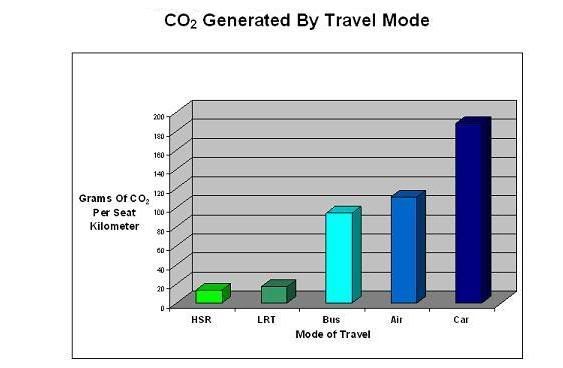
And HSR provides a VAST carbon emissions savings over other forms of transportation:


(Image from Alberta High Speed Rail)

HSR can be powered entirely by renewable energy sources, a goal the California High Speed Rail Authority recently adopted. HSR will provide a guaranteed buyer for renewable energy projects, making their construction more likely and more economical.

Sustainability is also a smart economic strategy. We have talked repeatedly about the economic stimulus it will provide. It will also provide a Green Dividend to Californians in the amount of several billion dollars at least.

Sustainable transportation is both economical and necessary for California's 21st century future. Sure, we have a temporary respite from the worst of the oil price hikes. But does anyone here really want to gamble that such price increases will never return? That we can continue the 20th century sprawl model indefinitely?

If you don't want to make that sucker bet, then vote Yes on Prop 1A.

Friday, October 24, 2008

Their Past vs Our Future

NOTE: We've moved! Visit us at the California High Speed Rail Blog.

With just over a week until the votes are counted we are about to learn whether California will embrace the 21st century or go down with the sinking 20th century ship.

Proposition 1A and high speed rail are a cornerstone of California's efforts to build prosperity for the 21st century. The infrastructure that built 20th century prosperity - including those paid for with bonds approved by voters in the depth of the Depression - has taken us as far as it can. California's 20th century prosperity was based on cheap oil, which is beginning to run out.

And yes, it is still running out. Neither the summer price spike nor the current price collapse change the underlying facts - we are reaching peak oil which means long-term supply shortages and price increases. The current decline in prices is due to demand destruction, which means that if people take advantage of lower prices by driving more...the price will again rise. And of course OPEC isn't going to take this lying down - the last time gas prices dropped dramatically, in 1999, was merely prelude to a steady, 8-year, 1300% increase in the price of oil.

Well before gas prices hit $4 this summer they had destroyed the American economy. The housing bubble burst in 2006 - at precisely the moment gas prices hit $3. And which areas have seen the steepest home value declines and the highest foreclosure rates? The car-dependent suburbs. Which areas have held their values and had the lowest foreclosure rates? City centers and neighborhoods with mass transit options.

This was clearly illustrated by a recent episode of NOW on PBS, Driven to Despair. The episode contrasted two young couples - one living in Hemet (east of Riverside) and one living in South Pasadena near the Gold Line. The family living in Hemet was facing serious financial distress and a lower standard of living owing to their dependence on oil. The family living in South Pasadena had more disposable income and a happier life because they were free from that dependence.

On a macro level we have already demonstrated the green dividend that results from building mass transit - a multibillion dollar economic shot in the arm. In the case of high speed rail this will be compounded by the significant economic stimulus of HSR - just as the Golden Gate Bridge and Shasta Dam were in the Depression. 160,000 construction jobs is nothing to sneeze at.

We also need to remember the environmental benefits of high speed rail. It seems global warming and carbon emissions have faded a bit from the public's consciousness which is a shame - pollution and carbon emissions cost money and the longer we delay in reducing them and building a sustainable alternative, the more expensive life will ultimately become here in California.

To ignore all of this and embrace the status quo is to look at a broken economy and shrug and hope we somehow magically recover, and that somehow the conditions that caused the economic downturn will magically disappear. They won't. If California wants to enjoy the kind of widely shared prosperity in the 21st century that we had in the 20th we need to reorient this state away from oil and sprawl and toward urban density and sustainable transportation. HSR will stimulate both.

It's no accident that those lined up to oppose Prop 1A are from that shrinking group that still benefits from the 20th century status quo. The right-wingers at the San Diego Union-Tribune don't want to see their anti-government, anti-transit dreams get shot down by voters. Dan Walters is one of the state's leading defenders of sprawl and small government, so it makes sense that he'd oppose Prop 1A as well.

Then there is the Reason Foundation, which is swimming in oil money. They have every reason to want to kill HSR, which would undermine their anti-government, pro-oil, pro-sprawl agenda. Sure, their arguments are riddled with factual errors and their flagship study lacks credibility. But it's all well and good in the service of defending the status quo, which has failed for America but succeeded for their oil company buddies.

It would seem to me that when a project's opponents are the far right and the oil companies, you're doing something right, you've got a winning idea.

But that's not why HSR and Prop 1A are a good idea. They are the gateway to a more secure, more prosperous California in the 21st century. I do not see why we would listen to those who helped create the current economic failure when they pontificate against Prop 1A.

Sunday, October 12, 2008

SacBee Gets Bonds Wrong

NOTE: We've moved! Visit us at the California High Speed Rail Blog.

A few days after editorializing against Prop 1A, the Sacramento Bee has committed themselves even more deeply to the argument that bonds are bad. Today's paper offers an article on bond funding that contains some major flaws, and provides an unbalanced and incomplete picture of the overall cost of Prop 1A to readers. The result is an article that could mislead readers about the basic facts of high speed rail and its impact on California.

The beginning sets the tone:

The dozen measures on California's Nov. 4 general election ballot would cost taxpayers – and their children and grandchildren – $78.9 billion over the next 30 years, a Bee analysis has found.

The entire article proceeds from this premise, which is unimaginably flawed. The article assumes that Californians will get nothing in return for this - that it's basically a money pit. Nowhere are the 160,000 construction jobs that Prop 1A will create discussed. Nowhere is discussed the income and sales taxes that high speed rail will generate. Nowhere discussed is the 12 million barrels of oil saved, or the 12 billion pounds of carbon emissions (which will either be taxed or subject to cap-and-trade costs before much longer).

Nowhere does the article discuss the cost of doing nothing - the article assumes it is zero. And as we know, the article assumes wrongly. The cost of expanding roads and airports to cover the same demand HSR will serve has been pegged at $80 billion. That's *four times* the cost of the bond even when interest costs are considered. The cost of upgrading Highway 99 alone is pegged at $6 billion.

Nowhere does the article discuss the Green Dividend - the savings that mass transit creates, money that can be reinvested elsewhere in the economy.

What the article does is provide merely half the story. If Prop 1A was merely a way to grab money from people and toss it to the four winds, perhaps the article would have a point. But if you are going to talk about costs - especially long-term costs - it is incumbent upon you as a journalist to provide a balanced equation. To weigh the bond cost against the tangible benefits of the project.

It is especially ironic because the article DOES describe that equation for Proposition 5, which would expand drug treatment programs:

But there is a fiscal flip side to the measure: If the rehab programs worked, they could drop California's prison costs by more than $1 billion annually, plus save more than $2.5 billion by reducing the need to build more prisons.

The same calculation must be made for Prop 1A. Otherwise the article does not do justice to its readers.

As Pete Stahl explains the cost of bonds to the general fund, as a percentage, typically declines over time as the general fund revenues increase due to inflation and population growth. This, too, is entirely absent from the article.

The article does go on to mention the political prospects of bonds at this time:

"I think with the way things are, many people are going to vote 'no' on almost everything," said Bob Stern, president of the Center for Governmental Studies in Los Angeles. "It's a bad time to be asking for money for anything."...

Mark DiCamillo, director of the Field Poll, has charted the success rate of California bond proposals since 1976.

In normal times, DiCamillo found, voters have approved a minimum of 68 percent of bond proposals.

During the economic recession of the early 1990s, however, it dropped to 23 percent.

"Voters have generally been receptive to debt financing," DiCamillo said, "but the immediacy of the current economic troubles, plus the presence of other high-cost initiatives on the ballot, may make it much more difficult to support them this time."

Stern and DiCamillo are probably right, and it seems clear that the prospects for Prop 1A are not as solid as they were a few months ago. The problem is that Californians have forgotten their own history. As we've been explaining here, bonds were used during the Great Depression to build some of California's cornerstone infrastructure projects, from the Golden Gate Bridge to Shasta Dam. Shasta Dam in particular provides ongoing benefits to Sacramento residents, from flood control to electricity to agriculture. The federal Bureau of Reclamation has estimated that Shasta Dam has provided over $300 billion in economic growth since it opened in the early 1940s.

So the Sacramento Bee is quite wrong to suggest that Prop 1A is going to cost me and my progeny billions of dollars. It is going to save billions of dollars and put more money in our pockets by providing sustainable, clean, non-oil based mass transportation for our state. It will provide immediate economic stimulus, which economists like Nouriel Roubini have been calling for as a necessary part of getting our country out of the serious economic and fiscal crisis we find ourselves in.

Californians deserve to hear about those aspects of bond funding. It's neither fair nor justifiable to only present half the story.

Tuesday, October 7, 2008

SF Chronicle Endorses Prop 1A

NOTE: We've moved! Visit us at the California High Speed Rail Blog.

This one isn't really a surprise, since they've been supporters of high speed rail for many years now, but today the San Francisco Chronicle endorsed a Yes vote on Prop 1A:

The passage of Prop. 1A would generate an estimated 160,000 construction-related jobs at a time when the state could use an economic stimulus. But its even greater long-term value to the state will be the economic and environmental benefits of connecting urban centers with growing inland cities that don't have major airports - and providing an alternative to the cattle-call flights between the Bay Area and Southern California.

They're absolutely right - and even understating the case. The long-term value isn't just in providing alternatives to cattle-call flights, nice though that will be. The long-term value comes in providing an alternative to oil, period. Our state's dependence on oil is causing financial and economic havoc. Those who make baseless criticisms of Prop 1A's financing are ignoring the far more risky and damaging impacts of "staying the course" and doing nothing in the face of a climate and energy crisis that is strangling our economy.

The editors had a good response to those fiscal critics:

Opponents have seized on the understandable anxiety about a venture of this magnitude and have questioned everything from its cost projections to ridership estimates to its environmental benefits. In a meeting with our editorial board this week, they suggested the money would be better spent on relieving gridlock on regional roadways.

However, the fiscal safeguards on Prop. 1A were toughened substantially with the Legislature's recent passage of AB3034. It limited the amount of money that could be spent on administration or other items unrelated to construction. Also, construction could not begin on any segment of the project until it was certified that the funding for it had been secured. State funding would account for about half of the project; the balance would come from the federal government and private sources.

HSR deniers want Californians to believe that if this passes that we're going to be DOOMED, doomed I tell ya, especially in our state budget. But the Chronicle points out this is nonsense. If the feds and private enterprise come through as they have consistently indicated they will then we build it and everyone's happy. If they don't come through, we don't build it, no money spent, no harm done.

They close well:

Prop. 1A presents an ambitious vision that is well tailored to the state's transportation and environmental needs. We recommend its passage.

We strongly agree.

Of course, to give the "other side" a chance to get their message across, the Chronicle published an op-ed by longtime HSR denier Richard Tolmach. That deserves its own takedown which will be provided tomorrow morning Wednesday evening (sorry guys, busy day).

Thursday, October 2, 2008

LA Times Endorses Yes on Prop 1A

NOTE: We've moved! Visit us at the California High Speed Rail Blog.

The largest newspaper in the state has come out in favor of high speed rail:

There's something undeniably alluring about a bullet train -- the technology is so powerful, the speed so breathtaking, it makes quotidian trips seem exotic. Perhaps that's why proponents of Proposition 1a, which would authorize $9.95 billion in bonds for a high-speed rail line connecting Northern and Southern California, think it would be wildly successful. They predict the line could draw 117 million riders a year by 2030, compared with 3 million now taking the high-speed Amtrak train in the densely populated Northeast. And they say it will turn a billion-dollar profit by then even as it keeps ticket prices remarkably low.

The projections by the measure's opponents, led by the libertarian Reason Foundation in Los Angeles, are much less sanguine and more persuasive. If voters approve Proposition 1a, it seems close to a lead-pipe cinch that the California High-Speed Rail Authority will ask for many billions more in the coming decades, and the Legislature will have to scrape up many millions of dollars in operating subsidies.

And yet, we still think voters should give in to the measure's gleaming promise, because it's in their long-term interest. Weaning travelers from gas-powered, road-choking cars is critical to the state's health and competitiveness. A high-speed rail line would not only provide a cleaner and faster alternative to automobiles, it would encourage transit-friendly development.

The measure isn't as big a risk as it would be if the state were footing the entire bill. The "backbone" segment from Los Angeles to San Francisco is projected to cost $33 billion, with about 75% from federal and private sources. Until those funds are secured, the state won't issue most of its bonds. If the line never gets built, the state's losses will be well under $2 billion. That's not too much to wager on a visionary leap that would cement California's place as the nation's most forward-thinking state.


I could do without the citation of the Reason Foundation study that we thoroughly discredited here. It is far from a "lead pipe cinch" that the Authority will ask for "many billions more" - and it is highly unlikely that they'll need ongoing operating subsidies.

But what I find so interesting about this editorial is their argument that even if the discredited Cox-Vranich study were right, HSR is still worth doing. They are absolutely right that "weaning travelers from gas-powered, roads-choking cars is critical to the state's health and competitiveness." I would add airlines to that as well, something we have to develop an alternative to anyway.

The editorial also nails it at the end - if the matching funds don't come through, then we don't issue the bonds, California loses at most $2 billion, and we survive just fine. The LA Times editorialists saw right through all the baseless, factless, nonsensical claims that HSR will cost us upwards of $100 billion and instead focused on this state's dire need for just such a system to revive our economy and improve our environment.

The LA Times should be congratulated for shifting public focus to the "gleaming promise" of high speed rail. It is the most important infrastructure project this state has considered in 50 years. We will be kicking ourselves very soon if we reject Prop 1A. The LA Times gets the big picture. About time someone in the media did.