The Brookings Institution has released a report today showing that the nation's busiest air routes are growing more congested over time, a condition almost certain to worsen once the economy recovers. And the second busiest corridor in the entire nation is Los Angeles to San Francisco (second only two Miami/Ft. Lauderdale to New York), with one of the main airports in that corridor, SFO, experiencing "worse than average delays."
The Brookings report recommends that these air-travel statistics be used to prioritize investment in high-speed rail. At 400 miles or less, high-speed rail can been air travel in time, typically with less pollution. That makes Los Angeles-San Francisco, Las Vegas-Los Angeles, Los Angeles-Phoenix and Dallas-Houston the most likely candidates for high-speed rail, in that order.
More than 6 million people fly between the Los Angeles basin and San Francisco Bay per year, the study said. In the northeast corridor, Amtrak carried 11.7 million people on Acela and Northeast Regional lines in fiscal 2008, hitting 14 metropolitan areas. The Amtrak ridership suggests high-speed rail would be viable in out busiest air corridors, the study concluded.
This study dovetails with numerous other studies, including not just that of the CHSRA's consultants, but that of SNCF as well, which show the LA-SF corridor as an ideal spot to build high speed rail. We've already seen HSR have stunning success on other busy air corridors: from the AVE on the Madrid-Barcelona corridor, long one of the world's busiest air corridors; to the Acela, which had 40% of the market share of the Northeast Corridor in March 2008. There is every reason to believe HSR will have similar success here in California, especially since it will link the city centers - i.e. the job and business centers - of the state, from SF's Financial District to San José's own growing downtown, to downtown LA and the hub of the city's growing mass transit system.
Every time we discuss HSR and air travel, we usually have to explain yet again the reasons why HSR almost always thrives in competition with airlines on busy corridors. Especially here in California, where people usually say "but I can get a ticket on Southwest to LA right now for $49! why would I take your stupid train?"
And as usual we explain patiently that when you combine total travel time - door to door, including getting to the non-centrally located airport, airport security, time on the runway, and getting from the non-centrally located airport to your final destination, you're about on par with the door to door travel time of HSR. We also explain that Southwest won't be able to offer those fares for much longer - they locked in their fuel costs at $55/bbl through the use of complex fuel hedges that will soon expire and leave them vulnerable to rising oil prices.
Which, we should add, must never be forgotten. Earlier this week Deutsche Bank predicted $175/bbl by 2016 (mark my words: it will happen well before that date) and that such a price rise will "put the final nail in oil's coffin." The key is what happens here in the USA:
US demand is the key. It is the last market-priced, oil inefficient, major oil consumer. We believe Obama’s environmental agenda, the bankruptcy of the US auto industry, the war in Iraq, and global oil supply challenges have dovetailed to spell the end of the oil era.
Deutsche Bank's analysis assumes that electric cars will radically change how we use oil in this country. I hope it does. But electric cars are no substitute for oil-fueled jets for getting people from LA to SF and vice versa. We need electric cars AND electric trains, both for local and statewide travel.
California is poised to lead the path forward. We will use high speed rail to unshackle ourselves from a failing and suicidal dependence on oil, and produce a sustainable economic prosperity, shared broadly, for the remainder of this century.
A couple of weeks ago, the Ventura County Star published an article on California HSR that we mentioned, but only in the context of a negative response to it. What sort of fell through the cracks are these intriguing paragraphs in the original article and their possible implications for Amtrak Pacific Surfliner (APS):
Because the stimulus plan defines "high-speed" as trains capable of traveling at least 110 mph, more traditional rail systems in the Northeast and Midwest might be able to qualify for some of the funding — as might commuter systems in California.
"Some trains in Southern California corridors are pushing 110 mph," said Darren Kettle, executive director of the Ventura County Transportation Commission. "Some of my peers in Southern California are looking at that stimulus money to improve the Los Angeles-to-San Diego line and get that up to 110 mph."
Pacific Surfliner: Service Frequency, Speeds and Punctuality
The Pacific Surfliner route is primarily a semi-local train service between San Luis Obispo and San Diego via Santa Barbara, Los Angeles Union Station and Anaheim. The full route is 350 miles long, but the schedule shows that only a single daily train serves all of it. The LA - San Diego section is served by 11 daily trains (12 on Friday through Sunday), Santa Barbara - LA by 5, Santa Barbara - San Diego by 4 and San Luis Obispo - LA by 2. Many trains skip some of the smaller stations.
To get a sense of the speed profile along the route, I looked at the line haul times for a slow semi-local train (#774 southbound), which takes 8 hours 41 minutes from SLO to San Diego. Typical average speed between stations is 35-55mph. The busiest section, LA - SD, takes 2h40min to 2h50min, regardless of which train you take, at an average speed of 45-50mph. Average speed for SLO-Santa Barbara is comparable, the slowest section is Santa Barbara - LA at ~36mph average.
The upshot is that APS isn't really time-competitive against car travel in terms of speed, so its modal share of total trips along the South Coast is probably less than 1% right now. Its popularity relative to other Amtrak services is probably due to population density, the fairly long distances, the cost of driving if you're alone and, avoiding the stress of stop-go traffic in some sections. For business travelers, the most important factor may be punctuality, which for LA - Fullerton (BNSF section) has improved from 92% in the 2007 (Aug YTD) to 95% in 2008 (Dec YTD) and 97% in 2009 (Mar YTD).
Unfortunately, Amtrak's figure for the route as a whole was only about 85% in the last 12 months. According to the Glossary of Terms link off that page, Amtrak defines "on time" as less than 10 minutes late for routes up to 250 miles long and less than 30 minutes for routes of 550 miles or more. Interpolating linearly, the threshold for the full 350-mile Pacific Surfliner route is presumably 17 minutes. However, since many Surfliners actually implement part of the route, it's possible that the the threshold is computed separately for each train. If so, it would be closer to 10 minutes for most. That would mean 15% of all trains arrived more than 10-17 minutes late at their final dstination in the last 12 months. These details are relevant because rail operators in other countries use their own thresholds, so the numbers aren't directly comparable.
The primary causes listed are train interference, i.e. lack of capacity and - somewhat alarmingly - tracks and signals, i.e. infrastructure failures and maintenance impacts. Note the relatively high fraction of passenger-related delays, which would be reduced with improved on-time performance generally (reducing knock-on effects at transfer points) and level boarding platforms. These three leading causes reflect 84% of the total number of minutes of delay.
The most troublesome section is Moorpark to LA Union Station (not LAX airport), mostly because of Metrolink has to maintain the infrastructure and run a lot of trains on a shoestring budget. The San Clemente - San Diego section is a close second, because NCTD has to do the same. Only the top three segments contributing to each type of delay are listed, they don't add up to 100%.
Amtrak Ridership Statistics and Oil Prices
In FY 2008, Pacific Surfliner was the nation's second most popular Amtrak service with 2.89 million passengers (up 7%), after 3.3 million for Acela Express (up 6.5%). However, the revenue numbers paint a very different picture: $51 million for APS (up 6%) vs. $468 million for Acela Express (up 16%). APS serves a larger number of stations per mile than Acela Express, many passenger trips are probably shorter. Nevertheless, the numbers suggest that US consumers - at least those on the East Coast - are willing to pay a hefty premium for rapid over conventional rail service when short-hop flights become unattractive, as they did last summer. For 2009, Amtrak is offering discounted fares on Acela Express in a bid to sustain ridership. This is a reflection of reductions in short-hop air fares in response to falling jet fuel prices.
The Pacific Surfliner trains compete primarily against car travel rather than short-hop flights, but gasoline prices are nearly as exposed to oil price volatility as jet fuel due to the relatively low level of taxation (compared to Japan and Europe). Diesel is exposed as well, but trains make more efficient use of the energy at comparable seat capacity utilization rates.
Any high speed rail proposal in the US must therefore consider forecasts of future oil prices. In the coming months and even years, prices will remain depressed as the world economy deals with the aftermath of a massive burst asset bubble in US mortgages and derivative products. However, in the medium and long term, prices will rise again as China, India and other emerging economies achieve higher living standards. This will be exacerbated by peak oil considerations, i.e. the notion that the world will gradually run out of easily produced oil going forward.
Eligibility for Federal HSR Funding
If you take a really long view, as anyone contemplating upgrades to rail infrastructure ought to, it's a fairly safe bet IMHO that prices of oil-based fuels are going to rise faster than purchasing power in coming decades - exactly the opposite of the long-term historic trend. That's precisely why California has chosen to hedge its future by building an all-electric bullet train network that can run off a wide variety of primary energy sources, including the renewables favored by CHSRA.
Prop 1A reserved $950 million for HSR feeder services, with a generous slice of that reserved for the Amtrak California routes.
However, the federal concept of HSR is broader than the one promoted by CHSRA. Rapid rail, with top speeds of 110-125mph and some grade crossings retained, is also potentially eligible for federal funding. The South Coast is arguably an excellent candidate for such an upgrade, even though CHSRA has planned bullet train service between LA and San Diego for phase II. That's because funding for phase II extensions will depend on the commercial success of the starter line, which in turn depends in part on effective feeder services. Besides, no direct bullet train service is planned between Anaheim and San Diego so the two would not exactly compete against one another. In addition, plans do not include bullet train service to Santa Barbara.
Note that as e.g. Caltrain has shown with its "baby bullet" semi-express service in the SF peninsula, it isn't actually necessary to increase top speed to attract new ridership. Passengers care much more about line haul time and punctuality. Nevertheless, HR 110.2095 redefines HSR as follows:
"The term ‘high-speed rail’ means intercity passenger rail service that is reasonably expected to reach speeds of at least 110 miles per hour."
In addition, only applications for capital improvements to meet this new federal definition in one the 11 federally designated corridors are eligible for any part of the $1.5 billion that HR 110.2095 allocates for the purpose. Note that FRA's map is out of date with regard to the California system, Texas T-bone and other proposals. Chances are, Congress will fix that in this year's omnibus transportation bill now that there's federal money on the table. I wouldn't be at all surprised if e.g. LA - Las Vegas were added, hopefully as a spur off the California network.
As p136 the Joint Explanatory Statement Division A - part of the conference report - for HR 111.1 makes clear, the $8 billion in the stimulus bill for HSR use the same definition to determine eligibility.
Fortunately, this is vague enough to give USDOT a lot of leeway: neither bill specifies that 110mph or more needs to be sustained over a long distance. In practice, that means Pacific Surfliner would be eligible even if 110mph could only be reached in one short section, e.g. in Camp Pendleton. However, I suspect USDOT bureaucrats would then need to see a strong business case based on realistic forecasts of incremental ridership and fare box returns as a result of significantly improved line haul times and ideally, the provision of terrestrial WiFi on Board (cp recent trial on the Amtrak Capitol Corridor route). In addition, they would presumably want insight into the opportunity costs of sticking with the current service parameters: demand for more highway lane-miles, continued severe exposure to oil price volatility and, productivity loss due to time spent driving.
Potential Improvements
To get a sense of what might be achievable with appropriate investment, I assumed the primary strategy for improving line haul times would be express service between the primary population centers along the way, i.e. SLO, Santa Barbara, LA, Anaheim and San Diego. Let's call this Pacific Surf Express in analogy to Acela Express.
Next, I figured an express service might achieve an average speed of roughly 2/3 of the specified top speed. That's a very rough model, no more than a first order approximation. At the present top speed of 79mph, that would translate to a minor increase in average speed from ~40mph over the entire 350 miles to just ~53mph.
Nevertheless, even that would worthwhile: 19min gained from SLO to Santa Barbara, a whopping 53min gained between Santa Barbara and LA and a further 19min between LA and San Diego. Closer examination reveals that the largest single gain (~23min) would result from investment in the six-mile section between Glendale and LA Union Station. Average speed there is currently an abysmal 11.6mph, perhaps because of wait states associated with congestion in the throat of LAUS.
Run-through tracks for FRA-compliant equipment would benefit not just Amtrak Pacific Surfliner but other Amtrak and Metrolink services as well. These would be separate from those for the bullet trains. Considering the final EIR/EIS was completed over three years ago, the problem appears to have been a lack of funding. In a joint press release last May, Gov. Schwarzenegger announced that the state of California would invest $290 million into this and closely related rail projects as part of the Strategic Growth Plan. Of course, the state's finances are now in worse shape than ever, so it's unclear if the related appropriation of prop 1B (2006) bonds will happen in 2009.
All the more reason then to re-label those $290 million as a state contribution toward making Amtrak Pacific Surfliner an HSR service in the federal sense of the word. Other sections with low average speeds include:
Moorpark - Van Nuys (37mph)
Burbank Airport - Glendale (32mph)
Fullerton - Santa Ana (33mph)
San Clemente Pier - Oceanside (50mph, Camp Pendleton section)
Solana Beach - downtown San Diego (36mph)
In most of these cases, double tracking and/or signaling upgrades would be the primary approaches to improve line haul times. In Fullerton - Santa Ana, noise mitigation and bypasses at stations may be needed to increase existing speed limits. CHSRA also has a vested interest in that, because the last section to Anaheim is too narrow to accommodate dedicated bullet train tracks and, FRA currently permits mixed traffic only if there is sufficient and guaranteed time separation. South of Solana Beach, a short tunnel between Torrey Pines and University city would rectify and shorten the route.
North of Burbank, two approaches are conceivable for a Pacific Surf Express: a second tunnel bore between Chatsworth and Simi Valley or, switching the route to run through Santa Clarita and Santa Paula (CA-126 corridor).
The ROW along CA-126 also belongs to UPRR but is probably little-used and in fact, abandoned between Fillmore and Santa Clarita. It contains some tight curves that would need to be rectified in order for trains to run through this mostly rural valley fast enough to overcompensate for the greater distance. Note that both the regular Pacific Surfliner and Metrolink would continue to serve the Simi Valley. Once the starter line for the bullet trains is operational, a Pacific Surf Express service via the CA-126 corridor could add a stop in Sylmar.
All of the above applies for an express service with a top speed of 79mph, except in the Camp Pendleton section (and that only to become eligible for federal HSR funds). If the entire 350 miles were upgraded such that average speed jumped from ~40mph for semi-local to 73mph for express service, there would obviously be even greater time gains relative to the present situation: 58 minutes less between SLO and Santa Barbara, 86 minutes less between Santa Barbara and LA Union Station, 14 minute less minutes between LAUS and Anaheim and 47 minutes less between Anaheim and San Diego. That last section would then take 1h20m and LA - San Diego 1h45m. Improvements on this order of magnitude would be game changers.
For comparison, CHSRA is promising 20min for LA - Anaheim and 1h15m for LA - San Diego via Riverside. Considering that dirt probably won't be turned on phase II of the bullet train network before the 2023-2025 time frame, wouldn't it make a lot of sense to avoid the regulatory complication of mixed traffic in the Fullerton-Anaheim section? Is it wise for California to equate HSR with bullet trains at a time when the federal government is offering money for rapid rail projects as well?
In closing, this video shows how long all Surfliners might have to be to satisfy demand, if only they were substantially faster. The second locomotive is only needed because FRA compliance adds a lot of mass to passenger trains; enable mixed traffic via appropriate signaling, buy some lighter cars and one loco will be plenty for a Pacific Surf Express. Note that smoke and other emissions from diesel locomotives will be down sharply once EPA Tier 3/4 locomotive engines become available and operators switch to ULSD. As for those infernal bells and horns - mercifully brief in this case - quiet zones and grade separations, please!
On Monday the Ventura County Star ran a good article on high speed rail. That prompted on Daniel Goldberg, who writes a blog for the VC Star's website, to write one of the silliest pieces of HSR denial I've ever seen. Even though it's absurd on its face, it's worth deconstructing these arguments which are likely to be with us for some time, especially as contentious debates over HSR implementation continue.
Goldberg starts with:
On Monday's front page there was an article about $8 billion in stimulus funds that might be allocated to high speed rail. My initial response was "why can't we stop wasting money?" The high speed rail debate has been going on for years, I think if it really was worth it, we would have dont it by now.
Obviously Goldberg has no clue about how major infrastructure projects are designed and permitted in this country, nor is he aware that we were supposed to vote on this in 2004 but Arnold Schwarzenegger insisted on delaying the vote for HSR bonds to 2006, and then to 2008.
Yes, building the fancy train set might create some jobs, but what about the long run.
Does he assume the train will vanish after 10 years? That it's got some sort of Mission: Impossible self-destruct system? In fact the HSR system will be a central part of California's long-term economic strategy, providing jobs and savings for decades to come. One estimate was that 450,000 jobs would be created by 2030 by the system - nothing to sneeze at.
Our state is already equipped with airports in every major city. And most minor cities also have small airports.
This is more of the usual "air travel means trains aren't necessary!" nonsense we usually see from HSR deniers, people who have probably never actually used some of these small airports. Many, like San Luis Obispo airport, are seeing declining passenger levels and carriers are abandoning the small airports in droves. Of course, peak oil means that the cost of flying will continue to rise - $49 fares from SF to LA will be a thing of the past in 2018.
Furthermore, let us not forget about our current rail system. Besides the Metrolink accident that occurred late last year, the current system works. Trains run daily all over the state and in an efficient manner. This brings me to the old saying, "If its not broken, don't fix it." Lets hope the wiseguys up in Sacramento subscribe to it.
Obviously Goldberg has never actually used a passenger train in California. They run daily, and are efficient given their enormous constraints. But they are wholly inadequate to the task of meeting California's overall transportation needs in the way they can and should. It shouldn't take 12 hours to get from SF to LA via train. It shouldn't even take an hour to get to LA from Santa Ana on a train. California's passenger trains, especially the intercity trains, have attracted a lot of riders and dedicated supporters, but I doubt any of them would say that the present situation is adequate or acceptable.
Especially given the need to boost non-oil based forms of travel, for environmental, economic, and energy reasons. But then I'm guessing Goldberg doesn't believe in global warming either.
He concludes his ill-informed rant:
Back to the $8 billion at hand. I am plenty sure it can be used for a better purpose. What about all those teachers who were just laid off or buying books for students. I imagine it would be better to invest the stimulus money into education rather than on infastructure, and especially for infastructure we DO NOT NEED.
And in the actual version, the "DO NOT NEED" is in a much bigger font than the rest of the text, as if we're too stupid to understand that's his point without being shouted at.
As to the issue of other needs, like schools - we've actually discussed that very issue before, back in May 2008, and ironically based off another ill-informed bit of HSR denial that ran in the Ventura County Star.
The points are still valid today. HSR isn't taking money from schools. The state contribution comes from general obligation bonds, paid out over 30 years at what's probably going to be an annual cost of around $600 million (and that's the higher end of the estimate). Our K-12 schools, however, face a $9 billion cut this year.
If you want to fix our schools, we need to raise taxes. There's no way around it.
But the issues go deeper. Why is California's budget in a mess? For 30 years now we have had a structural revenue shortfall - in other words, for the last 30 years we have not raised enough tax revenue to pay for our basic needs. The solution to this is NOT to turn to bonds - a structural problem needs a structural solution, and bond debt isn't such a solution.
Bonds are properly used to build long-term infrastructure. To pay for ongoing costs like education, we need more tax revenue.
Further, the economic crisis - what I believe to be a Depression, but what many are now calling the Great Recession - is sending tax revenues into the tank. That economic crisis is largely due to the effects of high oil prices on an economy based on sprawl and automobile commuting. If we want to recover from this crisis, grow the economy, generate new tax revenues, and pay for schools, then we need to get off of oil NOW. High speed rail helps get us there.
Unfortunately, HSR deniers refuse to acknowledge any of this, and that means they and their silly arguments will be with us for many years to come.
...but gas prices are creeping back up again. At the corner station nearest me in Monterey we've seen an increase of about 30 cents over the last couple of weeks. Sure, $2.40 is a far cry from the $4.60 peak we saw last July, but it's a reminder that as this site has consistently argued, the long-term trend is up, up, up. HSR remains a key part of the essential project of moving California and ultimately the nation toward energy independence.
The underlying causes have much to do with peak oil. Long-term forecasts still call for price increases as demand inexorably begins to exhaust the cheaply available supply. It's worth noting those forecasts don't just come from peak oil activists - unless you consider General Motors to be a "peak oil activist":
If this doesn't show the need for greater and immediate investment in mass transit and passenger rail I don't know what does.
It seems clear to me that the long-term increase in oil prices, which climaxed in the great spike of 2008, have fundamentally changed American attitudes toward passenger rail in particular. If the price spike had been sudden and confined to 2008, perhaps nothing would have changed. But since gas prices had been steadily rising since 2005 (and some could argue since 1999) that laid the seeds for a new way of thinking about transportation, and a new appreciation for linking mass transit and energy independence.
Times like these I'm glad it's Obama in the White House.
UPDATE by Robert: Sen. Kit Bond, Republican from Missouri, is offering two anti-transit amendments - including one that would kill the $2 billion in high speed rail funding currently in the Senate version of the stimulus. Contact both Dianne Feinstein and Barbara Boxer to let them know those amendments must be defeated - and while you're at it, ask Boxer's office why the hell they're advancing the cause of carbon pollution and global warming denial by helping Inhofe.
Dianne Feinstein DC office: (202) 224-3841 Barbara Boxer DC office: (202) 224-3553
Obama's silence on all this is also rather deafening. He has allowed Republicans to narrowly define what is stimulus and what is not - he hasn't mounted a strong defense of including mass transit funding as stimulus, and hasn't spoken out against Republican demands to gut the stimulus package. A new president with extremely high approval ratings should not be letting his administration get tied down by these Lilliputians, yet here we are.
UPDATE 2 by Rafael: Right now, Republicans are playing hardball. There will be no broad bipartisan majority because House Democrats will not accept a completely watered down bill in conference. The idea of stripping down the bill to the elements the GOP already agrees with in order to pass something, anything, Real Soon Now is a bad one because it does not require Republicans to voting for less palatable policies down the road.
Democrats may be able to bribe at least one Republican Senator into breaking ranks this time or, they may succeed in calling the GOP's bluff by forcing them to read telephone books for a while while thousands are losing their jobs every day. I'd quite like to see the latter happen just to underline how anachronistic the whole concept of filibusters is in the 21st Century.
However, given the gravity of the situation, it might make more sense for President Obama, Sen. Reid, a small group of Rockefeller Republican Senators and Speaker Pelosi to hammer out a European-style formal coalition agreement for a two-year legislative agenda. It would be more diplomatic to show deference to Senate Minority Leader McConnell, but this isn't about playing nice. It's about cobbling together a narrow, filibuster-proof majority. This is also why I didn't include House Minority Leader Boehner in the above list - his job for the next two years is to articulate the GOP alternative to the Democratic agenda, not to govern.
The alternative to a stable coalition agreement is to fight over each and every amendment of each and every bill, wasting precious time while the economy is tanking. Consumer and business confidence will only recover once there is visible evidence of a coherent strategy going forward, one that absolutely should include HSR as a means to gradually wean the nation off its addiction to oil.
Original post begins here:
Streetsblog SF warns that Sen. Barbara Boxer (D-CA) is about to enter into an unholy alliance with Sen. James Inhofe (R-OK). They plan to introduce an amendment to add $50 billion for highway construction to the stimulus bill (h/t to Robert Cruickshank). This comes on the heels of the GOP blocking a $25 billion amendment sponsored by Sen. Dianne Feinstein (D-CA) for highways, water and mass transit, ostensibly because no compensating cuts in other spending were offered. The Senate did pass one amendment: "Most consumers who buy new cars, minivans or light trucks by the end of the year would get tax deductions for the sales or excise taxes and the interest on their loans. Sponsor Barbara Mikulski , D- Md. , estimated that a family would save about $1,500 on a $25,000 vehicle. The key vote on the $11 billion measure was 71-26".
It is understandable that lawmakers are worried about the deteriorating state of the economy and focusing on the short-term issue of preserving and/or creating jobs. The DOTs of many states have a lot of planning expertise in highway projects, so most of their "shovel-ready" projects relate to roads. It's quite likely that there are at least $80 billion worth of road and road bridge repair projects around the country. If the bill contains verbiage targeting the funds that specifically, the Boxer-Inhofe amendment may make sense. However, it is not in the long-term interest of the country to substantially expand highway capacity in the context of this stimulus bill.
Similarly, it may make sense to provide tax breaks that generate demand for new cars, lest one of the Big Three goes belly-up. If that were to happen, it would amount to more than just job losses. The domestic automakers opted out of social security and Medicare decades ago, when that seemed like a good idea. Instead, they committed to providing pensions and health care to their retirees themselves. With Chapter 11 unlikely to succeed for an industry that depends on long-term relationships with its customers, bankruptcy would quickly lead to Chapter 7 a.k.a. liquidation. That would saddle the Pension Benefit Guaranty Corporation and either Medicare or Medicaid with the burden of providing a taxpayer-funded safety net for hundreds of thousands of retired auto workers that never contributed a dime towards these programs during their working lives.
However, the devil is once again in the details. A blanket tax break for the purchase of just any new car encourages the purchase of cheap gas guzzlers. Germany has taken a different approach: it limits its incentive to new car buyers who agree to scrap their old jalopies. The idea is to finally take cars without catalytic converters or with antiquated diesel engines off the roads to improve air quality. The US has a different problem: low average fuel efficiency. Therefore, any tax break for new car buyers should be limited to models that get at least e.g. 30mpg in the 2008 combined drive cycle and then only if the old vehicle was both rated at less than e.g. 22mpg in the old combined drive cycle and is scrapped.
The excessive dependence of the US transportation sector on fuels derived from oil exposes the economy to volatility in the price of that commodity. In particular, it was the assumption that gasoline would always be cheap that prompted cities to promote low-density urban sprawl in favor of high-density transit-oriented development. Combined with generous tax breaks and exotic mortgages for home buyers, this led to a large asset bubble that was massively reinforced by the securitization of mortgages by investment banks and insurance companies. The run-up in the price of oil, triggered by a combination of robust worldwide growth, a temporary lack of reserve production capacity plus rampant speculation, caused that bubble to burst.
In other words, the most obvious approach for a stimulus in the short term - perpetuating the status quo - risks cementing the same car culture that enabled the current economic meltdown in the first place. There were many other contributing factors, but creating funds and incentives for highway expansion and purchases of gas-guzzlers would simply set the scene for a repeat performance in the future.
It is essential that strings be attached to the stimulus measure to ensure long-term strategic objectives are not sacrificed on the altar of short-term expediency. Moreover, it would be extremely foolish to raid transit and intercity rail funds to expand those for highway construction and new car purchase incentives. Diversification of primary energy sources for the transportation sector is a national security issue, as is tackling wasteful congestion on the nation's roads.
Electric trains remain the only proven technology for moving large numbers of people over long distances safely with a small land use footprint, zero tailpipe emissions and without using a drop of oil. Blind faith in the holy grail of advanced automotive batteries is a risky bet and does nothing to address land use and congestion issues. It would be better to hedge by promoting the development of transit networks, folding electric bicycles and bicycle lane/path infrastructure to complement high speed intercity rail. Of course, as Trains4America reports, there will be conflicts over how to use the limited rights of way that remain after half a century of disinvestment in passenger rail services. Atlanta is one such case, the whole Altamont HSR vs. BART extension controversy in the Bay Area is another.
Bottom line: if funds are added to boost road and road bridge repairs and incentives to improve the average fuel economy of the nation's car fleet, there should be concomitant increases for electric rail and bicycle infrastructure funds to facilitate long-overdue changes in land use policies and oil consumption patterns. Note that vehicles running on grid electricity will only yield reductions in CO2 emissions if that electricity is generated from renewable sources. The stimulus bill already contains funding to build up that capacity, but the real value of electrification is that it dissociates primary energy sources and energy use in the transportation sector.
That means increases in the transportation infrastructure portions of the bill - including incentives to buy more efficient and/or electric vehicles - can be paid for either by deferring tax breaks or, by deferring the construction of renewable electricity generating and distribution capacity (or a combination of the two). As always, the art is to find an appropriate balance without breaking the bank.
I had hoped we'd dealt with this when it popped up at Daily Kos yesterday - the commenters there gave it a thorough smackdown - but unfortunately it's appeared across the blogosphere today, helped by the credulous and fundamentally uninformed Kevin Drum (I still don't understand why Mother Jones would hire a moderate to blog for them) who reproduced "it" on his site today.
"It" is an email being peddled by the daughter of James Mills offering criticism of Prop 1A. Mills is another one of these "rail supporters" who are offering truthiness and outright lies to try and convince people Prop 1A is a bad idea. To the uninformed masses - which unfortunately include some bloggers - anyone who claims to have rail credentials apparently is given the benefit of the doubt when we who actually understand rail policy know that James Mills, Richard Tolmach, Wendell Cox, and Joseph Vranich are fundamentally anti-rail.
Mills and Tolmach co-authored an HSR denier op-ed in the San Francisco Chronicle earlier this month. I gave it the usual thorough deconstruction here on the blog when it appeared, although I focused my fire on Tolmach, since I'd never heard of James Mills. Now Mills' daughter is circulating Mills' own arguments to the bloggers, and some of the more gullible bloggers, like Kevin Drum, have taken the bait. As a result Ezra Klein and now Atrios are discussing its contents.
So, time to try and kill the Zombie Lies.
The email starts like this:
I am passing on an analysis of California's Prop 1A ballot initiative from one of the leading experts and advocates of mass transit in the state of California, James Mills.
Mills' daughter writes:
I'd like to suggest you vote "No" on Proposition 1A, the "Safe Reliable High-Speed Passenger Train Bond Act," on the basis of the following insider, expert information: my dad says it's a bad idea.
My father, James Mills, spent his entire career in the California state legislature (1961-1983) working to promote public transportation in the state. He was President pro Tem of the Senate for a decade. He was chairman of the Amtrak board under president Carter. Since retiring he has worked as a consultant on transit issues, and in the 1990's he served on the High Speed Rail Commission for the State of California . My dad is hard-core in favor of rail. If he says a proposal to fund a rail project is no good, then that proposal has to be a real turkey.
Notice the sleight of hand here. James Mills is not a well-known figure even in California political circles. His specific policy positions are completely unknown. But just like the notoriously anti-transit Wendell Cox, and the equally anti-rail Joseph Vranich, Mills trades on a 30-year old association with Amtrak to try and gain credibility when he passes on flawed HSR denials. The last sentence is designed to solidify the assumed expertise of Mills, but to me it just sets off alarm bells.
Which are justified when we read the specific objections:
1. Prop 1A raises about ten billion dollars in a bond issue. This is a down-payment on a project which was estimated in 2006 to cost 45 billion dollars but will probably cost more if it is ever built. Remaining funding will be sought from the federal government (10-15 billion) and private investors (15-20 billion).
Notice that, as always, no specific reason is given as to "probably cost more". It is blind speculation. No specific figure of cost overruns is given either. Lacking those details or underlying explanations this claim lacks credibility. Rail projects around the country, including LA's Metro Gold Line extension, have been delivered on time and on budget in recent years.
Further, and this is ironic, that $45 billion is the figure for the ENTIRE system - which in point #5 Mills claims is unplanned.
2. The federal government has never invested any amount even close to $10 billlion in a transit project.
The federal government had never spent $700 billion on a bank bailout either. Before 1971 they'd never operated passenger trains. Before 1956 they'd never spent hundreds of billions on freeways. Shall we go on?
But we have better evidence. John Kerry and Johnny Isakson are working on a bill to provide about $10 billion for HSR projects around the nation. Both Barack Obama and Joe Biden are strong supporters of HSR and want to fund it.
3. If private investment were found, the bill says that investors would make money NOT from a the profit of the transit system, but from a percentage of ticket sales. In other words, the profit of investors is guaranteed, regardless of the operating costs of the system. The Legislative Analyst estimates that the OPERATING AND MAINTENANCE COSTS of the system will be one billion per year -- the State of California will cover any deficit not covered by ticket sales. It is rare for a public transit system to run in the black: normally, not all costs of the system will be covered from the fare box.
This is a bit misleading. As I understand it from what Rod Diridon explained today, those same investors also have to satisfy their own bond to the state/CHSRA and a "franchise fee" to the same. That's quite a bit different than saying "their profit is guaranteed" - a misleading statement designed to imply that California is going to be left holding the bag while private investors light cigars with our money.
This claim also misleads Californians on the Legislative Analyst's estimate - she has said the $1 billion figure is a worst-case scenario.
And of course, it is not rare for high speed rail systems to run in the black. In fact, they ALL run in the black. Every last one. In France the TGVs are so profitable they subsidize other slower rail services. SNCF had so much money they actually gave some to the French treasury earlier this year.
4. Premises on projected ridership are false. The only high-speed rail system in the US is Amtrak's "Acela" service between NY-Washington and NY-Boston. This system is well established and serves large population centers with excellent public transportation tie-ins to feed it such as subways, and they carry 3 million riders a year. The French have the best high-speed rail system in the world, and their busiest line is Paris to Lyon, again large cities with major subway systems, and it carries perhaps 15 million riders a year. In contrast, proponents of Prop 1A rely on a projection of 100 million riders per year between Los Angeles and San Francisco, a figure provided by a paid consultant that happened to be Lehman Brothers. This projection of patronage is a fantasy.
This paragraph is full of outright lies. Yes, lies.
First, Acela is not true HSR and is much slower than our system will be. Anyone trying to compare the Acela to CA HSR either does not understand Acela or is deliberately misleading readers. It does not speak very well of James Mills' vaunted "rail knowledge."
Second, these arguments about ridership come directly from the oil company funded Reason Foundation. It is a libertarian lies being passed off as fact. Those ridership claims - specifically about Paris-Lyon - are complete nonsense. We thoroughly debunked the "not enough riders" claim last month. The key portion of our mythbusting:
Cox-Vranich's [the Reason Foundation study] ridership figures are wildly inaccurate. Using C-V's preferred measure, JR Central reported 2007 ridership of 80 million passenger km per Shinkansen route km (44.5 billion passenger km / 552 km route). In the "high" scenario, CA HSRA is forecasting roughly 27 million passenger km per HSR route km (30 billion passenger km / 1,120 km route). So C-V's claim that CA HSRA is using numbers higher than those achieved on any other system in the world is absurdly false - in fact, CA HSRA's numbers are only 1/3rd of what has been previously achieved.
JR Central's Shinkansen is the densest ridership in the world. A more informative comparison would be the TGV or the new Taiwan HSR (THSR). We don't have passenger-km ridership for those lines, but we can compute passengers per route-km. The TGV Paris Southeast (PSE) line gets 45k passengers per route-km (20 million pax / 448 route-km) while the THSR gets 101k passengers per route-km (34 million pax / 335 route-km). CA HSR is forecasting a high of 80k passengers per route-km in 2030, or around 56k passengers per route-km at today's populations. This is slightly above TGV PSE but well below THSR. It does not seem unreasonable since the LA Metro Area is larger than Paris Metro Area or the Taipei Metro Area. And more importantly, the SF Bay Area is twice as large as the Kaoshiung Metro Area and four times as large as the Lyon Metro Area.
On to the fifth and final lie, which is the most ridiculous of them all:
5. Promises of future extension to Sacramento, Orange County and San Diego are empty in that no concrete plan of any kind is offered other than the unrealistic plan for a Los Angeles-San Francisco line.
Mills is just showing off his ignorance here. Prop 1A would fund a line from SF to Anaheim - which, last time I checked, was still in Orange County. SD and Sacramento plans are in existence in full detail and can be found at the California High Speed Rail Authority website.
It's worth closing by reminding people of the big picture here. High speed rail will create badly needed green jobs and economic stimulus while providing Californians with sustainable transportation that reduces dependence on oil and cuts carbon emissions. It is supported by virtually the entire California progressive community.
It is being opposed by the Howard Jarvis Association and the Reason Foundation. The former are the keepers of the right-wing flame here in California. The latter are a group of rabid anti-government nuts who are funded by oil companies and other leading right-wing foundations. They have been using an ignorant and pliant media to push out their "omg boondoggle not enough riders" nonsense over the last six weeks or so.
It would be a shame for folks in the blogosphere - folks who usually know better - than to repeat the high speed rail version of the "Obama is a Muslim" email.
For those of you in the Monterey Bay or San José areas, I will be part of a panel discussion on Proposition 1A at UC Santa Cruz at noon today, in Cowell Conference Room 132. Rod Diridon of the California High Speed Rail Authority will also be there. RSVP here.
Then at 2pm I will be a guest on Deborah Lindsay's show Tomorrow Matters, broadcast on KRXA 540 AM here in Monterey. Deborah Lindsay focuses on sustainable communities, peak oil, and other environmental solutions to our ongoing ecological crisis. You can listen live online if you don't live in the Monterey Bay area.
UPDATE: Now that was fun. The event at UCSC was a great success - thanks go in particular to Cynthia Burrage Armour and Dan Xie for helping to put it together. I gave a good overview of HSR and the reasons why it is so vital to our future as Californians, and then Rod Diridon gave a really compelling and detailed explanation of HSR around the world and of our own system. He was asked some very good questions by the audience and answered them quite effectively. Diridon gave some key details on the financing of high speed rail that I had not known and that I hope to pass on to you all tomorrow or Wednesday once I can get them written down and confirmed.
The discussion on Deborah Lindsay's show also went well. We got some good calls from folks with questions, some critical, of the HSR project and I thought I did a good and thorough job of responding to them. KRXA is a small operation and doesn't have complete audio archives, otherwise I'd offer you an MP3 here. I was surprised that none of the usual HSR deniers called into the show!
Earlier this summer the price of a barrel of crude oil hit a record $147. Since then the price has declined dramatically to about $64. Gas prices here in Monterey have fallen from a high of about $4.60 to just under $3. Some might be tempted to argue this makes alternatives to oil less necessary, but that would miss the point - the current decline in oil prices is strictly a product of demand destruction.
What that means is we're in between a rock and a hard place. Our economy has been built on growth made possible by cheap oil. More cars need to be sold, more suburban sprawl needs to be built, more goods need to be hauled by truck in order for the 20th century economic model to continue. If you can't do any of that without risking a crippling oil price increase like that which burst the housing bubble, you are stuck in an economic trough that has no visible way out.
Unless, of course, you start building an alternative to oil.
Besides, the phenomenon of peak oil is going to rather quickly necessitate such alternatives, if OPEC doesn't do so first. If this current respite in oil prices is to be anything other than the eye of a hurricane, we must build our way out of oil dependence.
Just as the oil crisis has not gone away, neither has the climate crisis. Arctic sea ice nearly reached a new record minimum. Global warming continues unabated, as the carbon-burning industry merely takes a short breather.
2008 is therefore an opportunity to start transitioning away from a failed economic model, one that became so dependent on burning fossil fuels that the economy nearly collapsed and severe ecological crisis has taken place. If we are to turn the 21st century into a sustainable century - with sustainable prosperity, built on renewable resources and a better, more sensible ecology, we need to start NOW on producing alternatives to oil.
California High Speed Rail is one of those alternatives. It will:
-Reduce carbon dioxide emissions equivalent to removing 1.4 million cars from the road, and take the place of nearly 42 million annual city-to-city car trips (Final EIR)
-Reduce CO2 emissions by up to 17.6 billion pounds/year (HSR fact sheet)
-Reduce California’s oil consumption by up to 12 million barrels/year (same as above)
According to the Final EIR 63% of intercity trips over 150 miles in California are taken by car (scroll to page 12). This is a major factor in causing most of California to be out of compliance with state clean air goals. Given that HSR would be much faster than driving between California's major metro regions, and will likely be less costly as well by 2018, HSR would make a significant dent in those car trips and therefore in the pollution they spew.
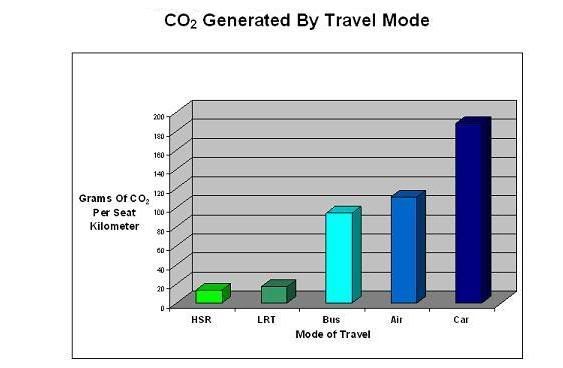
And HSR provides a VAST carbon emissions savings over other forms of transportation:
HSR can be powered entirely by renewable energy sources, a goal the California High Speed Rail Authority recently adopted. HSR will provide a guaranteed buyer for renewable energy projects, making their construction more likely and more economical.
Sustainability is also a smart economic strategy. We have talked repeatedly about the economic stimulus it will provide. It will also provide a Green Dividend to Californians in the amount of several billion dollars at least.
Sustainable transportation is both economical and necessary for California's 21st century future. Sure, we have a temporary respite from the worst of the oil price hikes. But does anyone here really want to gamble that such price increases will never return? That we can continue the 20th century sprawl model indefinitely?
If you don't want to make that sucker bet, then vote Yes on Prop 1A.
With just over a week until the votes are counted we are about to learn whether California will embrace the 21st century or go down with the sinking 20th century ship.
Proposition 1A and high speed rail are a cornerstone of California's efforts to build prosperity for the 21st century. The infrastructure that built 20th century prosperity - including those paid for with bonds approved by voters in the depth of the Depression - has taken us as far as it can. California's 20th century prosperity was based on cheap oil, which is beginning to run out.
And yes, it is still running out. Neither the summer price spike nor the current price collapse change the underlying facts - we are reaching peak oil which means long-term supply shortages and price increases. The current decline in prices is due to demand destruction, which means that if people take advantage of lower prices by driving more...the price will again rise. And of course OPEC isn't going to take this lying down - the last time gas prices dropped dramatically, in 1999, was merely prelude to a steady, 8-year, 1300% increase in the price of oil.
Well before gas prices hit $4 this summer they had destroyed the American economy. The housing bubble burst in 2006 - at precisely the moment gas prices hit $3. And which areas have seen the steepest home value declines and the highest foreclosure rates? The car-dependent suburbs. Which areas have held their values and had the lowest foreclosure rates? City centers and neighborhoods with mass transit options.
This was clearly illustrated by a recent episode of NOW on PBS, Driven to Despair. The episode contrasted two young couples - one living in Hemet (east of Riverside) and one living in South Pasadena near the Gold Line. The family living in Hemet was facing serious financial distress and a lower standard of living owing to their dependence on oil. The family living in South Pasadena had more disposable income and a happier life because they were free from that dependence.
On a macro level we have already demonstrated the green dividend that results from building mass transit - a multibillion dollar economic shot in the arm. In the case of high speed rail this will be compounded by the significant economic stimulus of HSR - just as the Golden Gate Bridge and Shasta Dam were in the Depression. 160,000 construction jobs is nothing to sneeze at.
We also need to remember the environmental benefits of high speed rail. It seems global warming and carbon emissions have faded a bit from the public's consciousness which is a shame - pollution and carbon emissions cost money and the longer we delay in reducing them and building a sustainable alternative, the more expensive life will ultimately become here in California.
To ignore all of this and embrace the status quo is to look at a broken economy and shrug and hope we somehow magically recover, and that somehow the conditions that caused the economic downturn will magically disappear. They won't. If California wants to enjoy the kind of widely shared prosperity in the 21st century that we had in the 20th we need to reorient this state away from oil and sprawl and toward urban density and sustainable transportation. HSR will stimulate both.
It's no accident that those lined up to oppose Prop 1A are from that shrinking group that still benefits from the 20th century status quo. The right-wingers at the San Diego Union-Tribune don't want to see their anti-government, anti-transit dreams get shot down by voters. Dan Walters is one of the state's leading defenders of sprawl and small government, so it makes sense that he'd oppose Prop 1A as well.
Then there is the Reason Foundation, which is swimming in oil money. They have every reason to want to kill HSR, which would undermine their anti-government, pro-oil, pro-sprawl agenda. Sure, their arguments are riddled with factual errors and their flagship study lacks credibility. But it's all well and good in the service of defending the status quo, which has failed for America but succeeded for their oil company buddies.
It would seem to me that when a project's opponents are the far right and the oil companies, you're doing something right, you've got a winning idea.
But that's not why HSR and Prop 1A are a good idea. They are the gateway to a more secure, more prosperous California in the 21st century. I do not see why we would listen to those who helped create the current economic failure when they pontificate against Prop 1A.
The op-ed opens by retelling a tragic story of a UC Berkeley student from Pasadena who was killed on her way back to campus while driving near Gilroy - one of the numerous automobile fatalities that can be prevented by fast, efficient, plentiful intercity rail:
Improvements in auto safety have helped reduce the rate of automobile fatalities. However, that gain is largely negated by increases in the number of miles Americans typically drive. This is a reflection of bad public policy that favors sprawl and freeways over modern rail systems and transit-oriented development. It causes our traffic nightmares, fouls our air, takes far too many lives and makes us dependent on triple-digit prices for crude oil.
California High Speed Rail would initially stretch from Anaheim to San Francisco, with future branches to Sacramento and San Diego. The system would be completely separated from automobile traffic and freight trains. The tracks would be fenced in and monitored by earthquake sensors and cameras. Safety would even exceed that of airplanes, since high-speed trains don't carry volatile fuels that can be touched off by explosives in a shampoo bottle or shoe.
But the most important safety feature is that millions of people annually will take the train instead of driving. Europe and Japan have far fewer transportation-related fatalities than the United States - due mostly to their lower dependence on the automobile for local and intercity transit. California could potentially save thousands of lives lost per year in auto accidents if it built a state-of-the art intercity rail system.
Dennis' points are excellent and have not been made often enough. The safety features that HSR offers are not available to drivers or those taking planes. The system's safety will save lives over driving and will make the trains a more attractive option to travelers within California.
Dennis also reminds us of the fuel efficiency of HSR:
High-speed rail is the greenest way to move people ever invented. Trains consume only one-third of the energy used by an airplane and one-fifth the energy of an automobile trip. Nearly all of the electricity of HSR's trains could be produced from renewable energy sources. High-speed rail would reduce carbon dioxide emissions by up to 17.6 billion pounds per year. It would reduce California's oil consumption by up to 22 million barrels per year (1,100 million gallons per year). At a price of $125 a barrel, savings in oil costs alone would approach $2.75billion annually. Oil costs will rise in the long run, as oil geologists agree that we are entering an age of declining oil reserves that will be ever harder to extract.
Which gives me the opportunity to repost one of my favorite images:
Now I'm sure the usual HSR deniers are clucking, "but oil prices have fallen!" That's true - for now. When Dennis originally wrote this op-ed the price of a barrel of oil was at $125. They're now at $66. Of course, it is common for oil prices to decline in the autumn and winter months, only to rise again in the spring and summer. But here's the thing - that does NOT mean we can rely on oil to serve our travel needs.
The only reason oil prices have declined is demand destruction. Meaning that fewer people are using gas to travel. If lower gas prices spur an increase in gas consumption, the price will rise again, as many economists have recognized. The only way to produce affordable, sustainable, long-term growth independent of the vagaries of oil price fluctuation is to build rail projects such as high speed rail.
As we've seen here, HSR is a successful method of travel around the world. It operates without subsidies, attracts millions of new train riders, and provides badly needed jobs and economic growth. Thanks to Dennis Lytton we are also reminded that it provides safer and more fuel efficient travel. The case for Prop 1A could not be clearer.
In the comments to Thursday's post we saw an old claim get revived - that somehow Prop 1A and HSR would induce sprawl. The entire argument is absurd.
If you were concerned about sprawl in the first place, you're likely to also understand the need to reduce carbon emissions, reduce pollution, and wean California off of oil. So why on earth would you argue against a project that will cut 12 billion pounds of carbon emissions per year or save 12.7 million barrels of oil every year? The Sierra Club endorsed Prop 1A after a very thorough and detailed discussion. They were satisfied that Prop 1A will not add to sprawl, and understand that we would be crazy to miss this vital opportunity to build sustainable mass transit.
This opportunity is not likely to return anytime soon if we miss it. High speed rail will help bring millions more Californians on ALL our passenger rail systems, from bullet trains to Amtrak California to commuter and urban rail. Prop 1A will provide Amtrak California and Metrolink with badly needed additional funding. Voting against Prop 1A means voting against improving alternatives to oil.
But we can go further. Sprawl is NOT a force of nature. It is a product of three factors: cheap oil, cheap credit and favorable land use laws. Cheap oil is a thing of the past. Cheap credit is, as we all know from this last week, gone as well. Even with a bailout, we are highly unlikely to see a return to the lax lending practices, fueled by cheap credit, that enabled the most recent binge of Central Valley sprawl.
As to the last point, land use rules are going to have to change regardless of Prop 1A's fate. Defeating Prop 1A isn't going to eliminate sprawl, far from it. But to eliminate sprawl, you need to provide opportunities for urban density and transit-oriented development. Portland, Oregon provides the model. Portland has strict anti-sprawl rules, but these were only successful because Portland promoted urban density. Providing passenger rail has been the key to that. In short, if you want to stop sprawl, you need to give people another option.
HSR is that other option. Without HSR Central Valley cities will have less incentive to channel development to city centers and will lack the infrastructure to make it happen even if they chose to do so.
That's not all. The state legislature is also planning to link land use, sprawl, and global warming via Sen. Darrell Steinberg's SB 375. Prop 1A contains a provision forbidding construction of a station at Los Banos, a key demand of anti-sprawl advocates. Some HSR deniers claim that doesn't mean much since the Legislature could reverse it - but the Legislature can reverse virtually anything, including CEQA, including the AB 32 global warming reduction bill. That doesn't stop us from rightly pursuing strong legislative action and defending it once we get it.
Environmental justice activist Van Jones recently explained the need to move from opposition to proposition. If you want to stop sprawl, you need to propose something better. HSR is that "something better." Folks who hate sprawl will love Prop 1A and high speed rail, one of the most revolutionary anti-sprawl measures in California history.
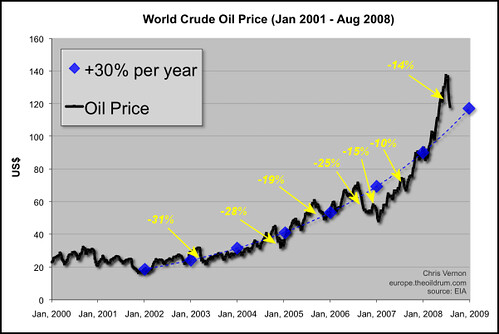
Even if oil prices were to level off around $100/bbl high speed rail would be a good deal for Californians. But what this recently rally reminds us is that upward pressure is still there and the days of $100/bbl are probably over. We've seen 30% year over year increases in the price of oil since 2002. As we know, this has a dramatic ripple effect throughout our transportation system. The airline crisis is one of them, as higher fuel costs lead airlines to cut routes, flights, and raise fares.
The only way out of this is to build sustainable mass transit that is fast, reliable, and not dependent on oil. High speed rail meets all those needs. We've already waited long enough - time to get started by passing Prop 1A.
Sitting here on the northbound Coast Starlight contemplating the past, the present, and the future. Off to the left is the Santa Barbara Channel with its oil rigs, representing a past that some believe, against all evidence, is still viable. The train is the present - a slow yet beautiful way to get from south to north, but reaching the limits of present capacity and stock. And I'm reading about the future - a high speed train that is not only a fast and efficient way to move people around our state, but that can provide massive benefits to our environment through the use of sustainable and clean technologies.
Back in the spring the California High Speed Rail Authority commissioned a study on powering high speed rail with a fully renewable electricity source. That study is now complete. Produced by Navigant Consulting, it will be discussed at tomorrow's board meeting in San Diego.
The report makes clear that California high speed rail can be powered by 100% renewable energy at an affordable cost - but only if the Authority is "committed early to renewable energy." In other words, to achieve the maximal environmental and economic benefits that 100% renewable energy provides, the Authority must decide soon whether it will commit to that goal.
While the details matter, and will surely be hashed out here on the blog and elsewhere in the state, it is my recommendation that the Authority pursue an all-renewable option and make it a priority in system planning.
Carbon Emissions: The report notes that HSR will save 12 billion pounds of CO2 annually, but the electricity it generates will produce about 5 billion pounds of CO2 per year. That's still a net reduction of 7 billion pounds of CO2 above where we're at today, which is laudable. Certainly there will be some HSR deniers who will point to the 5 billion pounds figure and say "omg this is going to wreck the environment" - but that attitude is akin to refusing to abandon a sinking ship for a lifeboat out of fear you might get cold. Still, HSR should maximize its carbon savings potential, and 100% renewable energy is worth pursuing for that reason alone.
Long-term savings: It's also economically sensible to pursue it - the report notes the "volatile" cost of natural gas, and considering the likelihood that fossil fuel costs will continue to rise over the coming years, 100% renewables is likely to provide a significant long-term savings to the Authority and to the state.
Affordable to the passenger: The report looked at how much renewable energy would add to fares, and found that it would be quite affordable, even without assuming greater innovations in solar energy that would bring down its cost. They considered three scenarios:
100% wind: 86 cents per ticket (on average) 80% wind/20% solar: $1.68 100% solar: $4.92
These numbers reflect the fact that wind is a "mature" technology whereas solar is not. Given the increasing amount of research being done on solar technology it's likely that its cost will decline by the time the system opens. But even if it doesn't, $5 per ticket is quite affordable.
Those costs are an average - shorter trips will see a smaller charge and longer trips will see something more, but even the long term trips will not be significantly more costly than the average.
Further, the cost to the passenger of renewable energy is likely to be much less than a carbon tax or cap-and-trade fee, either of which is highly likely to be in place in California by 2030. And the total ticket price even with renewables included will still be cheaper than airfare or multiple gas fillups will cost by 2030.
Stimulus to renewable energy generation: As a "reliable customer" the high speed rail project would provide a big boost to renewable energy developers, providing a stable and guaranteed purchaser of their product. It would boost California's efforts to achieve greater proportion of electricity generation from renewables - currently the goal is 33% by 2030. Proposition 7 on the November ballot would accelerate that to 50% by 2030, and even if that fails we are likely to see further efforts to achieve a more accelerated schedule. High speed rail would help the state meet those goals by providing a reliable customer, especially as the train will comprise about 1% of the state's daily electricity load.
Issues to resolve: The report identified two main issues that need to be resolved for high speed rail to be powered by 100% renewables. The first is that currently neither solar nor wind provide the full amount of energy needed at peak load times - which for HSR will be from 7-8 AM and 6-7 PM. Wind comes pretty close, and solar gets most of the way there but needs more refinement. Better storage technology, which is a central focus of renewables research right now, would alleviate that issue.
The second is logistical. The high speed rail route crosses areas served by twelve different utilities. The Authority will have to work to ensure that all of them are working together to meet a 100% renewables goal if the Authority adopts it (which they should). This isn't impossible, but to make this work they will have to start negotiating and planning now. The Authority's issues with Union Pacific have been overblown by the project's opponents, but it does suggest the need for the Authority to be proactive and diligent in bringing all 12 utilities on board with a 100% renewables goal. State and federal legislation could also help that process along, and here again, sooner is better.
Van Jones rightly called upon Americans to move "from opposition to proposition" - that the only way we will defeat ludicrous calls for more drilling is by giving America a better option. Not only is high speed rail that better option, but high speed trains powered 100% by renewable energy are an ideal option. Adopting a 100% renewables standard would make an already compelling project even more valuable and would help show Californians the value and importance of sustainable transportation.
The Authority should adopt a 100% renewables goal as soon as possible.
Via the passenger rail blog I discovered a fantastic documentary titled Retraining America (scroll to the bottom of the page; film is a 34 min Quicktime file) made by students at Guilford College in North Carolina. It's a good overview of the state of passenger rail in America, including the history of rail in the 20th century, the rise of freeways, and the starvation diet trains have faced.
Matt Melzer, of NARP and a frequent contributor to this site, is featured and as usual he makes some solid arguments about trains in America. He makes the point that America has been "socially engineered" to the point that cars are the only viable form of transportation for most people, leaving them without the freedom to choose another way to travel. Of course, this also leaves them vulnerable to crippling increases in the price of gas, which in turn damages the economy, as we're witnessing right now.
The problem we face today is that a transportation system that worked for a while, from around 1960 to 2000, is no longer working. The end of cheap oil and the massive congestion of airports and freeways both indicate the desperate need to give Americans more choices and to guarantee prosperity through a revival of rail. Freeways in particular were the product of a massive federal subsidization effort; roads don't pay for themselves and never have.
What the HSR deniers are asking California to do is shackle itself to this failing model. They believe, against all available evidence, that the post-1960 model of freeways and flights is still sufficient for our travel and economic needs. The increasing rail ridership belies their arguments, as does the move of California industries like Salinas Valley agriculture to revive rail freight.
Partly for those reasons, alongside the environmental and climate benefits of HSR, I argue that high speed rail is the most important project California has considered in the last 50 years. Just as the bay bridges and the State Water Project were necessary for a prosperous 20th century California, so too is HSR necessary for a prosperous 21st century California.
PS: I have added a link at the right to the ActBlue page for the official Prop 1 campaign. Help make high speed rail a reality in California by kicking in a few bucks to the campaign.
That's the latest polling numbers from JMM Research on our high speed rail project, as quoted on the front page of the Wall Street Journal today:
California has long talked about a high-speed rail line to connect the San Francisco Bay Area to Southern California. After years of chatter about the project, a $10 billion bond measure to start construction will be put to a vote this year. Last month, 62% of voters polled by JMM Research said they would support the bond measure, up from 52% in November. Voters cited having an "affordable" transportation alternative, "reducing dependence of foreign oil" and "reducing traffic congestion" as reasons for supporting measure. "You could start seeing [voter opinion] turn in May, when gas was $4.50 to $5 a gallon here," says JMM Research President Jim Moore.
JMM Research is the in-house pollster for the official HSR campaign, but their previous polls were confirmed by the Field Poll, the state's most respected polling outfit, last month. 62% is a wonderful number, but I'm not overconfident - Prop 1(A) is going to be hard-fought struggle going into the November election. It's going to take a lot of effort and work to win this.
The poll is quoted in the context of a much bigger article on how high gas prices are changing the American economy. The article makes many of the same points I made on Sunday - that only long-term demand destruction, accomplished through the provision of alternatives, is going to allow us to handle this crisis without economic disaster.
Those who would point to the recent easing of gas prices as evidence that the crisis is over have missed the point entirely - gas prices have eased only because Americans started cutting back on their consumption. What that means is if the reduced consumption is not sustained and expanded, prices WILL rise again.
The WSJ article isn't perfect, though. Right after the section quoted above on HSR comes this:
Harvard University urban economist Edward Glaeser says there are limits to how much the U.S. can be expected to follow Europe and Japan. The U.S. population grew nearly fourfold in the 20th century, an increase that coincided with the rise of the automobile. Motor travel reshaped the country, allowing people to move away from the old coastal cities and transport hubs. In Europe and Japan, much of the population growth occurred before car travel took hold, so people are still clustered around old transport hubs. That makes it easier to forgo car travel.
However, as the article points out, high gas prices are destroying exurban growth and sprawl and driving people into the "old coastal cities and transport hubs." And as Matt Melzer pointed out last month, California's population distribution patterns closely resemble those of Spain, where HSR has been an outstanding success.
The WSJ article doesn't examine peak oil but it does suggest that the cost of oil isn't coming down anytime soon:
Demand from rapidly growing economies of China and India make lasting oil-price declines less likely these days. Despite the market's recent fall, prices remain above the prior inflation-adjusted peak of $106.15, set in April 1980.
The high prices have been a drag on an economy already sagging due to the housing downturn and shaky credit markets. Auto sales have fallen, airlines are cutting back on flights, small trucking firms are going out of business, and transportation costs are eating into corporate profits.
Much of the way America has come to live and do business is predicated on low energy prices.
It's becoming clear to businessmen and government leaders around the world that HSR is necessary for a prosperous 21st century economy. But those in California who complain about grade separations in Menlo Park, or the Pacheco alignment, or the possibility of small cost overruns here and there, are deliberately ignoring those fundamental, big picture issues.
California has lots of transportation needs, let there be no doubt about it. HSR won't solve them all. But by providing faster in-region commutes and faster in-state travel, using a sustainable, cheap, and potentially renewable energy source not dependent on high oil costs, HSR will help Californians reduce their oil consumption. As the WSJ explained, that in turn produces savings, jobs, and economic growth.
Ten years from now when HSR is up and running we'll look back on this debate and wonder why there was any hesitancy at all.
As expected, gas prices have begun falling. I will admit I did not think this would start until after Labor Day, as the fall is usually when the declines occur. But it began in July, and now we have some folks in the comments crowing that this means the crisis is over and HSR is no longer necessary.
If only.
Gas prices are on a long-term trend upward. As with any "trend" in economics there is typically a great deal of fluctuation along the way, with price spikes and price collapses. But as this chart from Chris Vernon at The Oil Drum shows, the trendline is quite clear:
One point that needs to be made again is that demand destruction in the US (or even in Europe, where it is hapoening too) is not enough on its own to bring prices down, because it needs to be larger than the supply growth in the rest of the world to limit the requirement for further demand destruction and price rises, given that production is still largely stagnant. And the problem is that demand is not growing just in China and India, thanks to rapid growth, it is also growing massively in oil producing countries themselves (Saudi Arabia, Iran, Russia, Venezuela), which often subsidize gas and which can afford it given that they have a natural hedge against (the subsidy gets bigger when oil prices are higher, ie when their own income is bigger, and the income growth is larger than the subsidy growth for those that export any volumes).
The phenomenon of peak oil is what's at work here, and it helps explain what's going on. As the supply of oil peaks, it becomes more difficult to boost production to satisfy growing demand. The price of oil will rise unless supply matches it - which as peak oil demonstrates, it can't - or demand will be destroyed. Demand destruction is good, but only if it happens through the provision of sustainable alternatives. Without alternatives to driving or flying, demand destruction is merely destructive, throwing economies into severe recession as people must reduce their oil consumption but cannot turn to anything else to make up for it.
What happened recently is that for various reasons in early 2008 - concerns about war with Iran, the declining dollar, and perhaps some speculation, the price of oil rose above the trendline. Now we're seeing some of those pressures ease and the price is starting to fall, especially due to evidence of demand destruction in the US. Problem is, if people start upping their gas consumption, prices will resume their upward march. The only solution is long-term demand destruction.
But it's STILL above $4 in most of California. And that's still far too high for most people to afford. It's been my belief that $3/gal was the true tipping point - when that price was reached and sustained for the first time in California, in 2006, the housing bubble began to collapse. And the downturn began in the places most dependent on cheap oil - exurbs like Modesto, Moreno Valley, Stockton, etc.
Jérôme goes on to explain what is really needed to deal with high gas prices:
In fact, I'll say again that our energy policies should focus on one thing first and foremost: demand reduction. Any reduction in demand that we manage in excess of what market forces would (precisely) force us to do will get prices down, and will save us a lot of money - and the smartest demand destruction is the permanent kind, that brings savings every month and every year rather than one-offs like giving up a trip.
We have to reduce our demand. Let's do it in an organized way rather than a panicked, haphazard, inconsistent way. And that's where government can help, by providing longer term pespective, informing citizens, pushing infrastructure in the relevant direction, and bringing up standards that apply to all equally and guide individual behavior in the right (Energy Smart) direction.
Price mechanisms work, but they are brutal, hurt the poor the most, and cause unnecessary disruption to economic activity, and pain to many. And they are fickle, as the current volatility (which, as I explained above, is likely to remain) causes rapidly changing signals which prevent decisions from being taken.
High speed rail is one of those long-term solutions that will provide "good" demand destruction - the provision of alternatives to oil that enable economies to grow and people to move around. We don't support HSR because gas prices spiked in 2008, we support it because gas prices are on a permanent, long-term increase, despite whatever intermediate fluctuations occur - and the only solution to this that saves us money and sustains a prosperous economy is non-oil mass transit like high speed rail.
In the summer of 2004 gas prices soared to the record level of $2.50 in Seattle, where I was living at the time. By January 2005 it had dropped to $1.95. But that didn't change the long-term upward trend, and so in summer 2008, in both Seattle and California, gas prices hit $4.50. We may see $3.50 or even $2.99 by the November election, but the next increase always wipes out that savings. Next summer may well see us break the $5 barrier (diesel already did so this year). Three steps forward and one step back is still forward movement.
So to those who point to $4.15 gas and say "neener neener," the joke is unfortunately going to be on you when we hit $5 in 2009. I don't know about you all, but I'd rather we got to work building high speed rail so that we have an alternative to oil sooner, not later. We've already wasted three decades. We have no more time left to lose.
But what's really disturbing about this move is that it suggests the Sierra Club and the PCL have lost their focus - instead of looking at the big picture of high speed rail and emphasizing the game-changing environmental benefits it brings, they're focusing on a small non-issue instead. They've lost sight of the forest for the trees and instead of providing leadership on this issue they may instead cast their lot with the far right and leave Californians with no viable alternative to soaring fuel prices and a transportation system that is making our environmental problems far worse.
First, their criticisms as reported by E.J. Schulz:
But the environmentalists are still seething over the selection of relatively undeveloped Pacheco Pass as the route to connect the Central Valley to the Bay Area. They favor the more urban Altamont Pass to the north because they say it would induce less sprawl....
Environmentalists would rather see trains run farther north in the Valley before heading west so that more populated cities are served. They like the Altamont route because it would bring trains closer to Modesto, Dublin, Pleasanton and Livermore in the first phase.
By contrast, the Pacheco route -- roughly following Highway 152 -- is in a less populated area. Environmentalists worry that a planned station in Gilroy would induce sprawl in surrounding rural areas.
These worries are baseless. Gilroy and much of southern Santa Clara County have strict urban growth boundaries. If those places were going to sprawl they would have already done so given their proximity to the job center and hot housing market of Silicon Valley. HSR doesn't change that dynamic.
Nor does it change the fact that sprawl is facing hard times. Sprawl is bad, but it isn't a force of nature. It is instead a product of three major factors: cheap oil, cheap credit, and favorable land use laws. The first is disappearing for good, thanks to peak oil. The second doesn't exist now, and may never return. Certainly land use policies need to change to limit sprawl, but those changes have long ago been made in southern Santa Clara County. Why should HSR alone carry that burden? AB 32 carbon reduction goals should be applied to new housing developments, and ultimately, localities will have to change their ways.
The loss of cheap oil and the shortage of cheap credit together will lessen sprawl dramatically in the coming decades. I fully support land use changes to further kill off sprawl, but it's not worth holding HSR hostage to produce the changes that need to happen anyway at the state and local level.
The death of sprawl has already made itself manifest in Gilroy. The Westfield shopping center developers had a plan to convert a significant amount of farmland acreage east of Gilroy along Highway 152 into a huge mall. The plan aroused the opposition of the community and it was dropped earlier this year. High fuel prices, the credit crunch, and public defense of urban growth boundaries all combined to kill that sprawl project. Those factors will do so again.
A Gilroy HSR station would produce strong incentives for transit-oriented dense development in Gilroy, the kind of development that California cities need to focus on instead of sprawl. Gilroy is already partway there, and an HSR station where the current Caltrain station is located at 8th and Monterey would actually discourage sprawl because there would be viable alternatives to building on new farmland. The combination of infill development and strict urban growth rules are what have made Portland's anti-sprawl plans a success - you need both for the anti-sprawl measures to work. And high capacity mass transit is a necessary component.
Further, since the Authority has rejected plans for a Los Banos stop, and since as Mehdi Morshed explained in the Fresno Bee article that the communities along the Altamont route were not supportive of HSR, what on earth explains the ongoing refusal of the Sierra Club and the PCL to throw their support to Prop 1?
The only answer is a very depressing one, but an answer that is becoming more widely accepted among many environmental activists, sustainability activists, transportation activists, and folks on the left more broadly: the Sierra Club and the PCL have lost their way, and have lost sight of the big picture. In case folks haven't been paying attention, this country faces a climate crisis and an energy crisis. It's not like we have a whole lot of time to be fighting over objections that are not grounded in fact. At Netroots Nation two weekends ago Al Gore explained that we need to stop burning carbon and make a bold move to power our society with renewable energy. An electrically-powered high speed train system won't achieve that 100% renewables goal itself, but it would provide significant environmental benefits:
-Reduce carbon dioxide emissions equivalent to removing 1.4 million cars from the road, and take the place of nearly 42 million annual city-to-city car trips (Final EIR p. 92)
-Reduce CO2 emissions by up to 17.6 billion pounds/year (Quentin Kopp op-ed)
-Reduce California’s oil consumption by up to 22 million barrels/year (same as above)
According to the Final EIR 63% of intercity trips over 150 miles in California are taken by car (scroll to page 12). HSR would provide a huge dent in that figure.
High speed rail is one of those game changing proposals. How can the Sierra Club and the PCL overlook the cars taken off the road? How can they overlook the CO2 reductions? How can they overlook the reduction in pollution, especially in the Central Valley?
Four years ago Michael Schellenberger and Ted Nordhaus criticized the Sierra Club directly in their seminal essay The Death of Environmentalism. In their view the environmental movement, by focusing on small battles, has totally failed to address global warming, and that organizations like the Sierra Club "have little to show" for nearly 30 years of environmental activism after the big victories of the late '60s and early '70s. One of their specific criticisms is that the Sierra Club, for example, often eschews big policy changes for a niggling incrementalism that has done nothing to arrest the rate of warming. This has led them to refuse to articulate a bold vision for addressing the global warming crisis that of course hurts the natural environment, and it has led them to ignore the politics of producing change.
The Sierra Club's failure on high speed rail proves each of Schellenberger and Nordhaus' controversial charges. Instead of helping change the way Californians get around their state, shifting them away from oil-burning methods of travel to clean methods of travel that limit sprawl and generate urban densities, they are focusing on a small objection that doesn't even hold up on close examination. They have endorsed the concept of high speed rail in the past but if they don't endorse Prop 1, what other opportunity will they have to get it passed? If the HSR bonds don't pass this year, they aren't coming back anytime soon. It might take 10 years to revive the project - it's taken 15 in Texas - and that means completion of the line wouldn't happen until close to 2030.
By then it may be too late. Instead of refusing to support Prop 1 out of pique that they lost the Altamont vs. Pacheco argument, the Sierra Club and the PCL should follow Van Jones' advice and move from opposition to proposition. We have a proposition - literally - before us. Instead of being on the constant defensive the Sierra Club and the PCL can help California take a bold step in the right direction with Proposition 1. If we pass these bonds in November it will then be a signal to other states and to Congress that HSR is a politically popular project and it will spur similar projects around the country - projects that we desperately need.
Why would the Sierra Club and the PCL oppose these things? They have let their opposition to the Pacheco alignment blind them to the bigger picture. That decision has been made and even though the Sierra Club and the PCL lost, they can still be big winners. Let's hope they recognize the pressing environmental need for high speed rail before it's too late.
The California High Speed Rail Blog is a creation of Robert Cruickshank. The articles posted here are the opinion of their respective authors and no other entity. To contact Robert, send an email to his last name at gmail dot com.


 A couple of weeks ago, the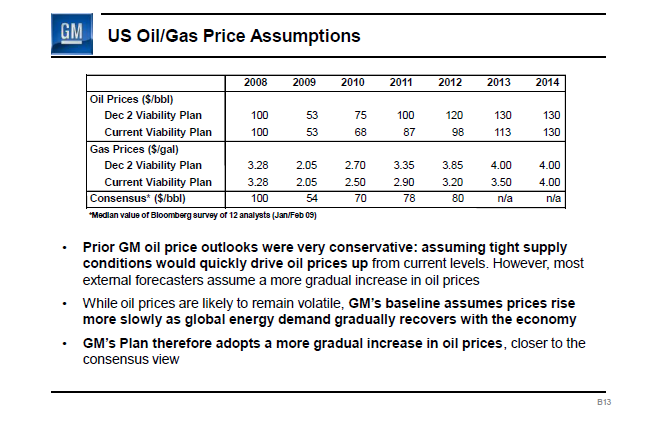
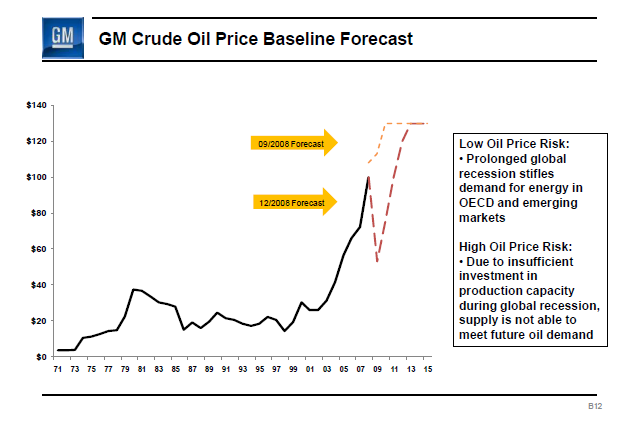
 This comes on the heels of the