Showing posts with label air quality. Show all posts

Sunday, March 8, 2009

The View From the Valley

NOTE: We've moved! Visit us at the California High Speed Rail Blog.

I've spent two very interesting days here in Fresno organizing for another issue, but have had some time to talk to people about high speed rail (because really, what sort of HSR activist would I be if I didn't?!). I've found that the project actually has a fairly high profile here - most of the diverse group of people I've talked to actually know about it and support it. As there are at least 2.5 million people living along the HSR route between Merced and Bakersfield, their backing of the system is crucial - lest we forget, Merced, Fresno, and Kern Counties ALL voted FOR Prop 1A back in November.

What's behind the support? In my conversations there are some common reasons given:

  1. Desire to connect to the rest of the state. Whether they love living in the Valley or not, most people here want to be able to get to and from the bigger parts of the state quickly. They may have family or friends going to school in LA, or want to see a show in SF. Typically they're going to drive, which is usually at least 3 hours in each direction. A rapid train will help make that easy.


  2. Desire to cut pollution. Even though it's an early spring day, the air quality here in Fresno hasn't been so great this weekend. It reminds me of the 1980s in Southern California, where smog was commonplace. The San Joaquin Valley has some of the worst air pollution in the entire nation. Asthma and other respiratory diseases are extremely common, and given the frequent traffic on Highway 99 it's no surprise. People here WANT a method of travel that will not make their health problems worse.


  3. Desire to stop sprawl. To hear some people tell it Valley residents love sprawl. That's always been a debatable point; in reality it's the Valley's political leaders who have promoted it, along with the inexorable logic of having built an entire national, even global economy on sprawl. With the housing bubble collapse, which has hit the Valley harder than probably any other place on the globe, there is a clearer desire for preserving farmland, stopping sprawl, and channeling growth inward. The people I talked to get this.


  4. They're sick of being ignored. With at least 2.5 million people along the initial HSR route, and with over 5 million in the Valley as a whole (including Sacramento), Valley residents have watched state funds and projects go to the "cities" - SF Bay Area, Southern California, while Highway 99 has been ignored. And that enables opponents of mass transit, for example, to demagogue on the issue - "don't vote for this project, it's just going to help those Bay Area liberals who don't care about you." Which in turn emboldens those voices here that tell Valley voters "the cities will just take your tax money and give nothing in return" (if the Valley elected more Dems the 2/3 rule would no longer be an issue). San Joaquin Valley residents feel, quite reasonably in my view, that they deserve to be part of this system.

    And it makes practical sense in this case to include them. The flattest route between SF and LA involves the Central Valley. The 2.5 million people who live along the San Joaquin Valley portion of the LA-SF route are an important part of the potential ridership base of a financially viable HSR system. And it will play an essential role in achieving the kind of long-term shift in land use policy in California, a shift that cannot succeed unless the Valley is included. Otherwise the Valley plays the role of a kind of China, undercutting the efforts at higher labor and environmental standards elsewhere in the state.


I know that there have been some comments suggesting that we just bypass the Highway 99 corridor when building the LA-SF route, that the inclusion of Fresno and Bakersfield was just a political ploy, that it's just not necessary to build HSR in these places. I could not disagree more strongly. California High Speed Rail will not be successful unless it includes the Valley.

Saturday, September 27, 2008

Prop 1A and HSR's Role in Fighting Sprawl

NOTE: We've moved! Visit us at the California High Speed Rail Blog.

In the comments to Thursday's post we saw an old claim get revived - that somehow Prop 1A and HSR would induce sprawl. The entire argument is absurd.

If you were concerned about sprawl in the first place, you're likely to also understand the need to reduce carbon emissions, reduce pollution, and wean California off of oil. So why on earth would you argue against a project that will cut 12 billion pounds of carbon emissions per year or save 12.7 million barrels of oil every year? The Sierra Club endorsed Prop 1A after a very thorough and detailed discussion. They were satisfied that Prop 1A will not add to sprawl, and understand that we would be crazy to miss this vital opportunity to build sustainable mass transit.

This opportunity is not likely to return anytime soon if we miss it. High speed rail will help bring millions more Californians on ALL our passenger rail systems, from bullet trains to Amtrak California to commuter and urban rail. Prop 1A will provide Amtrak California and Metrolink with badly needed additional funding. Voting against Prop 1A means voting against improving alternatives to oil.

But we can go further. Sprawl is NOT a force of nature. It is a product of three factors: cheap oil, cheap credit and favorable land use laws. Cheap oil is a thing of the past. Cheap credit is, as we all know from this last week, gone as well. Even with a bailout, we are highly unlikely to see a return to the lax lending practices, fueled by cheap credit, that enabled the most recent binge of Central Valley sprawl.

As to the last point, land use rules are going to have to change regardless of Prop 1A's fate. Defeating Prop 1A isn't going to eliminate sprawl, far from it. But to eliminate sprawl, you need to provide opportunities for urban density and transit-oriented development. Portland, Oregon provides the model. Portland has strict anti-sprawl rules, but these were only successful because Portland promoted urban density. Providing passenger rail has been the key to that. In short, if you want to stop sprawl, you need to give people another option.

HSR is that other option. Without HSR Central Valley cities will have less incentive to channel development to city centers and will lack the infrastructure to make it happen even if they chose to do so.

That's not all. The state legislature is also planning to link land use, sprawl, and global warming via Sen. Darrell Steinberg's SB 375. Prop 1A contains a provision forbidding construction of a station at Los Banos, a key demand of anti-sprawl advocates. Some HSR deniers claim that doesn't mean much since the Legislature could reverse it - but the Legislature can reverse virtually anything, including CEQA, including the AB 32 global warming reduction bill. That doesn't stop us from rightly pursuing strong legislative action and defending it once we get it.

Environmental justice activist Van Jones recently explained the need to move from opposition to proposition. If you want to stop sprawl, you need to propose something better. HSR is that "something better." Folks who hate sprawl will love Prop 1A and high speed rail, one of the most revolutionary anti-sprawl measures in California history.

Wednesday, September 10, 2008

Menlo Park Wants To Decide For California Whether We Have HSR

NOTE: We've moved! Visit us at the California High Speed Rail Blog.

Menlo Park and Atherton, two of the most affluent cities in the entire state, apparently believe it is their right to make decisions for the other 36 million people in California. At a study session last night in Menlo Park city officials and residents spouted off reasons why HSR was a bad idea for California as justification for their lawsuit and resolution against the project. While one might understand the city's desire to mitigate the impact of HSR on their landscape, the tone of the debate made it clear that HSR's impact on Menlo Park wasn't the issue. Instead the forum was a chance for HSR's few opponents in this state to push their anti-HSR arguments to the media in hopes that they could use Menlo Park residents for their own purposes.

The San Mateo County Times article on the session noted that Menlo Park and Atherton are the ONLY two cities along the proposed route that oppose the project. All others support it. Further, as Rod Diridon noted, the cities along the Altamont route oppose HSR as well - yet Menlo Park wants to saddle them with a line they don't want. Cities like Fremont and Livermore are more middle- and working-class, but the wealthy residents of Menlo Park and Atherton are quite happy to override their objections to keep the trains out of their own backyard.

Menlo Park in particular also seems interested in ignoring the fundamental reality that they are, and have always been, a railroad city. The tracks that currently carry Caltrain cars have been there since before the city was founded. Caltrain runs nearly 100 trains through Menlo Park and Atherton every day. But city staff and elected officials behave as if that doesn't exist:

The staff's consistent point has been that the train should not run through the heart of a residential city, splitting east from west and forcing the removal of old-growth trees and perhaps even city and private property.

That was the argument of Elizabeth Blois, who spoke for members of the Felton Gables Homeowners Association on Tuesday in pleading for the rail association to consider the impact on their homes.


Someone should inform city staff of Caltrain's existence. The other part of this argument should be turned around on Menlo Park - if preserving a residential city is their concern, why do they support dangerous at-grade crossings? Why do they support pollution-spewing diesel trains? The loss of a small part of city and private property seems a small price to pay for safety and clean air.

Blois and others who made similar comments revealed their true motives - classic, dictionary-definition NIMBYism. Not in their backyard - but it's apparently OK to force it onto someone else, someone poorer.

Menlo Park and Atherton also are taking a stand for global warming and against carbon reduction. They are telling Californians that the property and aesthetic values of a small group of people is more important than solving our climate and energy crises. The 160,000 construction jobs and 450,000 long-term jobs that HSR would create don't faze a community that enjoys a unique level of economic security, towns that can afford to reject a green dividend.

Some of the other comments at the meeting were of the usual, uninformed HSR denier sort:

Other arguments from the public were more far-reaching. Jerry Carlson, vice mayor of Atherton, said the high-speed rail project as a whole is a waste of transit resources.

"I think a much better approach would have been to put that money into regional plans," he said.


Now, perhaps I'm missing something, but a train that whisks passengers from SF to SJ in 20 minutes sounds like a regional plan. A train that gets commuters from Anaheim to LA in 30 minutes is a regional plan.

Atherton resident Jack Ringham said the project would probably run far over budget, take years longer than predicted and attract far fewer riders annually than the 117 million the rail authority's consultants predict.


We dealt with Ringham's nonsensical claims back in June - anyone who thinks ridership on HSR will not be high is just demonstrating their lack of knowledge about passenger rail.

Vice Mayor Heyward Robinson conceded the city may not be able to stop the project altogether. If that's the case, he said, it should work with the rail authority to get key concessions. For instance, he suggested the high-speed portion of the line could stop at San Jose, and those continuing to San Francisco could simply take Caltrain.


In other words, Robinson wants to break the entire project and force people to have slow commutes just because he wants to pretend his community is not the railroad town that it has always been.

Some HSR supporters showed up to fight the good fight:

Roxanne Rorhpaugh said "the time has passed'' for debates about the Pacheco vs. Altamont alignments. She said she's certain the train can come through Menlo Park without serious damage to nearby property, but even if there were damage, "It's 12 houses versus 117 million" riders. "Do the math."


Amen to that. Menlo Park is trying to dictate terms to the rest of the state, claiming that the interests of 12 million-dollar homes are more important than fighting high gas prices, global warming, and the energy crisis. Menlo Park's neighbors Palo Alto and Redwood City aren't opposed to the train yet they too have wealthy homeowners who live near the tracks, and Redwood City in particular has a downtown that will be rather directly affected by the trains.

They understand the need to build a sustainable 21st century future that allows all Californians to share in our prosperity, allows all Californians to travel around their state. It's a shame that Menlo Park and Atherton prefer to make the state bend to the will of a few wealthy individuals. If that's not aristocracy I don't know what is.

Tuesday, August 19, 2008

It Shouldn't Have To Be A Choice

NOTE: We've moved! Visit us at the California High Speed Rail Blog.

A British organization, Friends of the Earth, released a report calling for greater investment in high speed rail in Britain as a way to reduce reliance on air travel and eliminate the need for further expansion of Heathrow Airport. One of the articles about the FOE report quoted an "industry-lobby group" as saying something interesting in response:

However, voters are more concerned with the cost of living than with the environment, according to a poll commissioned by industry-lobby group Flying Matters last year.


Flying Matters appears focused on promoting Heathrow expansion so their claims aren't surprising. And they may not be wrong. Certainly here in the United States we don't have to strain to see examples of people seeing this as a choice between keeping a low cost of living or helping the environment. We can expect the HSR deniers to continue arguing that HSR will cost Californians too much money as part of their effort to kill the project.

But it shouldn't have to be a choice. In fact, it is a false choice. High speed rail is a perfect example of this, because it shows that the environmental option IS the the low cost of living option. Sure, gas prices are on the temporary downswing, but they will continue to rise over the long-term. By the time high speed rail opens around 2018, it will likely be the more affordable option than driving or flying. Even if gas prices increase at a slower rate, it will still be affordable anyway, create jobs, and promote business development.

Nor should we forget the environmental benefits, which also save money in the long run in reduced pollution, reduced carbon emissions, and reduced oil consumption. The notion that helping the environment was an economic loser was never an accurate claim, but it holds even less water than usual with regard to high speed rail.

High speed rail benefits both the environment and the economy. In fact, it's probably time we started seeing the two as fundamentally linked. We who support high speed rail here in California would do well to emphasize those connections.

Thursday, August 7, 2008

Perspective

NOTE: We've moved! Visit us at the California High Speed Rail Blog.

The most important news of the week isn't about a lawsuit. It's the report from a top British government climatologist arguing that global warming is going to happen faster and at a higher temperature than previously assumed. A 4C increase - equivalent to 7° Fahrenheit - would have a devastating impact on rainfall patterns, agriculture, and sea levels. Even if 4C is the upper end of the scale, the more widely accepted 2C figure is damaging enough, and a sign that we need to delay no further on implementing global warming solutions.

California has just such a solution on the November ballot - Proposition 1. It's worth reviewing just what the true environmental impact of high speed rail will be:

-Reduce carbon dioxide emissions equivalent to removing 1.4 million cars from the road, and take the place of nearly 42 million annual city-to-city car trips (Final EIR p. 92)

-Reduce CO2 emissions by up to 17.6 billion pounds/year (Quentin Kopp op-ed)

-Reduce California’s oil consumption by up to 22 million barrels/year (same as above)

According to the Final EIR 63% of intercity trips over 150 miles in California are taken by car (scroll to page 12). This is a major factor in causing most of California to be out of compliance with state clean air goals. Given that HSR would be much faster than driving between California's major metro regions, and will likely be less costly as well by 2018, HSR would make a significant dent in those car trips and therefore in the pollution they spew.

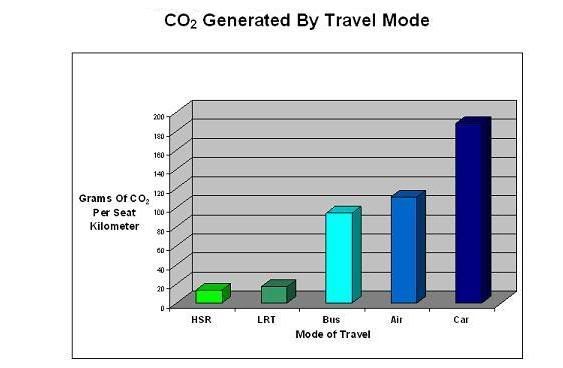
HSR provides a VAST carbon emissions savings over other forms of transportation:


(Image from Alberta High Speed Rail)

HSR will also help reduce air pollution. A 2006 Fresno Bee article explained that lung problems have soared among residents in recent years, and the San Joaquin Valley Air Pollution Control District estimated that to counter this trend, the region needed to eliminate 400 tons of pollution per day by 2011. High speed rail would help accomplish that task.

The California Air Resources Board in June issued its draft scoping plan for implementation of the AB 32 carbon reduction goals. They cited high speed rail as one of the methods the state will need to use to achieve the targeted reductions.

Those who are willing to jeopardize passage of Prop 1 by suing because they didn't get their way on the alignment decision or because they don't want safer, cleaner tracks in their neighborhood are overlooking all of these benefits. This isn't anything like oil rigs on the Alaska North Slope or on the California coast. The worst that might happen are tracks through some ranches near Pacheco Pass. The trains will tunnel beneath the pass itself and Pacheco Pass State Park. If that's the price we have to pay for achieving important carbon reductions, I think it's well worth paying.

Because California has failed for decades to act on climate change and energy independence, we are past the point where we can make easy choices. Everything we do to solve the energy-environment-climate crisis will have a possible downside. What we need now is leadership and action. We need to get started on our long-overdue high speed rail project and pass Prop 1, because if it fails at the polls, it's not coming back to the ballot for a long time.

Van Jones, who knows a thing or two about environmental policy, is exhorting audiences to move from opposition to proposition. Without it, he argues, we have no hope of stopping the right-wing's destructive environmental policies. We don't have the political room to be fighting each other over the small differences, and we certainly don't have the time to be suing because someone didn't get their way.

It's not easy to advocate for mass transit in California. Anytime a project is proposed, parochial concerns often derail even valuable projects - witness LA County's MTA tax plan. We have a pathetic rail infrastructure partly because few are willing to accept a compromise in the interest of investing in a better system. How long will we go around in these circles before we finally decide to act?

HSR is one of the most environmentally friendly projects California has considered in a very long time. It won't solve all our problems, but it's the necessary first step. It's time we rallied together to support the passage of Proposition 1 and take the lead in fighting for a better 21st century environment for all Californians.

Wednesday, August 6, 2008

Frivolous Lawsuits

NOTE: We've moved! Visit us at the California High Speed Rail Blog.

In a move they've been telegraphing for weeks, a group of wealthy NIMBYs have convinced the cities of Menlo Park and Atherton to join forces with the Planning and Conservation League, the California Rail Foundation (which has all of 3 members) and "lawsuit-happy activist" David Schonbrunn of TRANSDEF and sue to block high speed rail. Their claim is that the EIR/EIS that was adopted last month by the California High Speed Rail Authority violates the California Environmental Quality Act (CEQA) - but what is really going on is that a small coterie of long-time HSR deniers are greenwashing themselves and using the courts to stop one of the most important projects in state history.

Menlo Park and Atherton's objections are perhaps the most absurd. Driven by a handful of wealthy landowners, including Morris Brown and Martin Engel, their argument is that HSR would harm the aesthetics of their wealthy enclave:

The proposed route of the project runs down the heart of Menlo Park and Atherton on a narrow corridor occupied by CalTrain. The necessity of 4 tracks, where there are currently only 2 as well as needing the high 15 foot berm for the rail bed to accommodate grade crossings is of concern to both communities. With a minimum of 100 feet of width needed , as well as overhead catenaries for the electrical power to power the train, the impact in both communities is severe.


This is a comical, classic NIMBY objection. They're arguing that clean, sustainable mass transit, which California so desperately needs, should be stopped because it might not look pretty in two of the state's wealthiest communities?! That they're making an environmental argument is even more ridiculous. Currently Caltrain is powered by diesel trains and has a high rate of accidents caused by cars and people wandering onto the tracks. HSR would solve both problems by electrifying the tracks and physically separating them from the surrounding landscape, eliminating air pollution and making the entire corridor much safer.

Morris and Engel are inherently opposed to this project, and have spent months trying to dredge up any thin reed they can find to kill HSR. They never have proposed alternatives to how California can deal with the energy and climate crisis, and seem to prefer the failed status quo. And why not? They've got their land already, who cares about the masses?!

NIMBYism is one thing. The involvement of the PCL and TRANSDEF, two groups that have done good work in the past on containing sprawl, in this lawsuit is another. It's a profound disappointment to see them engaged in an effort to kill the HSR project. Surely they realize that a lawsuit filed three months out from the election jeopardizes the passage of Proposition 1. They don't have an alternative political strategy either on this, either for passing the HSR bonds or for dealing with our state's transportation issues.

Their reason for suing involves the choice of Pacheco Pass to connect the Bay Area to the Central Valley instead of the Altamont Pass. As this blog has repeatedly argued, both alignments had their good points and their bad points - but neither was clearly superior to the other. The most important thing for those who truly want to see HSR built in California is that we make a choice and stick with it. The California High Speed Rail Authority chose Pacheco, and so these Altamont supporters are choosing to sue.

The arguments against Pacheco are weak and by no means enough to suggest HSR should not be built. We dealt with the sprawl issue on Sunday but more detail is warranted. Much of the Pacheco Pass region cannot be built upon for topographical or legal reasons. A station at Los Banos has been permanently canceled. Gilroy has an urban growth boundary that could be stronger, but it exists. Moreover, HSR as a station-oriented system would primarily encourage growth near the station itself, not in far-flung exurban areas. Finally, these critics have consistently ignored or dismissed the reasons why sprawl is in mortal danger - without cheap oil and cheap credit, sprawl is simply not possible.

More to the point, sprawl is a problem whether we build HSR or not. So why hold HSR hostage to an issue that we have to solve no matter what? This really is a case of the perfect being the enemy of the good. HSR would mitigate against sprawl, would reduce carbon emissions, save on oil consumption, and promote mass transit riding habits. Why on earth would two organizations who are usually supportive of mass transit try to kill HSR?

The Altamont option isn't perfect either. It would require a new rail bridge across the bay, which would bring environmental problems of its own. The cities of Fremont and Pleasanton promised to sue if it were built, while the cities along the Pacheco route are supportive. On the whole there is no clear and compelling case to choose Altamont over Pacheco - and besides, if we really want HSR to be built, we need to rally around the project and ensure it passes, not drag this out forever. It's like Hillary vs. Obama all over again.

The deeper problem is that these groups have no sense of urgency. Al Gore and Van Jones have both explained the need for environmentalists and conservationists to come up with solutions NOW if we are to blunt the momentum of the "drill now, drill everywhere" crowd. We cannot build the public momentum for mass transit solutions if environmental groups spend their time in opposition, It is time to start showing Californians that high speed rail is a better deal for them than relying on wallet-busting oil prices, a failing airline industry, or carbon-spewing methods of travel.

The last group involved in the suit is the California Rail Foundation, headed by Richard Tolmach. Their opposition sounds dire, but the CRF has all of three members. The much larger - and therefore more representative - California rail organizations have chosen not to join the suit, such as TRAC, or openly support high speed rail and Prop 1, such as RailPAC and the National Association of Railroad Passengers (TRAC's decision on whether to endorse will be made later this month). Several chapters of the Sierra Club, including many in Southern California, are also supportive of high speed rail, suggesting something of the broad support HSR has around the environmental community.

So it's deeply unfortunate that a small group of people upset that their favored route wasn't picked, or upset that their wealthy communities will have safer and cleaner trains, are choosing to sue. They don't represent the California environmental movement, they don't represent the California transit movement, and as the election results in November will surely demonstrate, they don't represent Californians period. Their frivolous lawsuit is a nuisance, but it won't stop us from making the case to Californians that high speed rail is a good and necessary project.

Sunday, August 3, 2008

The Sierra Club Loses Focus

NOTE: We've moved! Visit us at the California High Speed Rail Blog.

It wasn't the article I was hoping to read upon my return from my honeymoon, but it's not that surprising to read in the Fresno Bee that the Sierra Club and the Planning and Conservation League are hesitating on backing Prop 1 and even considering a lawsuit - and for the nonsensical reason that the choice of the Pacheco route might "induce sprawl." That objection is bad enough, for reasons I'll discuss in a moment.

But what's really disturbing about this move is that it suggests the Sierra Club and the PCL have lost their focus - instead of looking at the big picture of high speed rail and emphasizing the game-changing environmental benefits it brings, they're focusing on a small non-issue instead. They've lost sight of the forest for the trees and instead of providing leadership on this issue they may instead cast their lot with the far right and leave Californians with no viable alternative to soaring fuel prices and a transportation system that is making our environmental problems far worse.

First, their criticisms as reported by E.J. Schulz:

But the environmentalists are still seething over the selection of relatively undeveloped Pacheco Pass as the route to connect the Central Valley to the Bay Area. They favor the more urban Altamont Pass to the north because they say it would induce less sprawl....

Environmentalists would rather see trains run farther north in the Valley before heading west so that more populated cities are served. They like the Altamont route because it would bring trains closer to Modesto, Dublin, Pleasanton and Livermore in the first phase.

By contrast, the Pacheco route -- roughly following Highway 152 -- is in a less populated area. Environmentalists worry that a planned station in Gilroy would induce sprawl in surrounding rural areas.


These worries are baseless. Gilroy and much of southern Santa Clara County have strict urban growth boundaries. If those places were going to sprawl they would have already done so given their proximity to the job center and hot housing market of Silicon Valley. HSR doesn't change that dynamic.

Nor does it change the fact that sprawl is facing hard times. Sprawl is bad, but it isn't a force of nature. It is instead a product of three major factors: cheap oil, cheap credit, and favorable land use laws. The first is disappearing for good, thanks to peak oil. The second doesn't exist now, and may never return. Certainly land use policies need to change to limit sprawl, but those changes have long ago been made in southern Santa Clara County. Why should HSR alone carry that burden? AB 32 carbon reduction goals should be applied to new housing developments, and ultimately, localities will have to change their ways.

The loss of cheap oil and the shortage of cheap credit together will lessen sprawl dramatically in the coming decades. I fully support land use changes to further kill off sprawl, but it's not worth holding HSR hostage to produce the changes that need to happen anyway at the state and local level.

The death of sprawl has already made itself manifest in Gilroy. The Westfield shopping center developers had a plan to convert a significant amount of farmland acreage east of Gilroy along Highway 152 into a huge mall. The plan aroused the opposition of the community and it was dropped earlier this year. High fuel prices, the credit crunch, and public defense of urban growth boundaries all combined to kill that sprawl project. Those factors will do so again.

A Gilroy HSR station would produce strong incentives for transit-oriented dense development in Gilroy, the kind of development that California cities need to focus on instead of sprawl. Gilroy is already partway there, and an HSR station where the current Caltrain station is located at 8th and Monterey would actually discourage sprawl because there would be viable alternatives to building on new farmland. The combination of infill development and strict urban growth rules are what have made Portland's anti-sprawl plans a success - you need both for the anti-sprawl measures to work. And high capacity mass transit is a necessary component.

Further, since the Authority has rejected plans for a Los Banos stop, and since as Mehdi Morshed explained in the Fresno Bee article that the communities along the Altamont route were not supportive of HSR, what on earth explains the ongoing refusal of the Sierra Club and the PCL to throw their support to Prop 1?

The only answer is a very depressing one, but an answer that is becoming more widely accepted among many environmental activists, sustainability activists, transportation activists, and folks on the left more broadly: the Sierra Club and the PCL have lost their way, and have lost sight of the big picture. In case folks haven't been paying attention, this country faces a climate crisis and an energy crisis. It's not like we have a whole lot of time to be fighting over objections that are not grounded in fact. At Netroots Nation two weekends ago Al Gore explained that we need to stop burning carbon and make a bold move to power our society with renewable energy. An electrically-powered high speed train system won't achieve that 100% renewables goal itself, but it would provide significant environmental benefits:

-Reduce carbon dioxide emissions equivalent to removing 1.4 million cars from the road, and take the place of nearly 42 million annual city-to-city car trips (Final EIR p. 92)

-Reduce CO2 emissions by up to 17.6 billion pounds/year (Quentin Kopp op-ed)

-Reduce California’s oil consumption by up to 22 million barrels/year (same as above)

According to the Final EIR 63% of intercity trips over 150 miles in California are taken by car (scroll to page 12). HSR would provide a huge dent in that figure.

High speed rail is one of those game changing proposals. How can the Sierra Club and the PCL overlook the cars taken off the road? How can they overlook the CO2 reductions? How can they overlook the reduction in pollution, especially in the Central Valley?

Four years ago Michael Schellenberger and Ted Nordhaus criticized the Sierra Club directly in their seminal essay The Death of Environmentalism. In their view the environmental movement, by focusing on small battles, has totally failed to address global warming, and that organizations like the Sierra Club "have little to show" for nearly 30 years of environmental activism after the big victories of the late '60s and early '70s. One of their specific criticisms is that the Sierra Club, for example, often eschews big policy changes for a niggling incrementalism that has done nothing to arrest the rate of warming. This has led them to refuse to articulate a bold vision for addressing the global warming crisis that of course hurts the natural environment, and it has led them to ignore the politics of producing change.

The Sierra Club's failure on high speed rail proves each of Schellenberger and Nordhaus' controversial charges. Instead of helping change the way Californians get around their state, shifting them away from oil-burning methods of travel to clean methods of travel that limit sprawl and generate urban densities, they are focusing on a small objection that doesn't even hold up on close examination. They have endorsed the concept of high speed rail in the past but if they don't endorse Prop 1, what other opportunity will they have to get it passed? If the HSR bonds don't pass this year, they aren't coming back anytime soon. It might take 10 years to revive the project - it's taken 15 in Texas - and that means completion of the line wouldn't happen until close to 2030.

By then it may be too late. Instead of refusing to support Prop 1 out of pique that they lost the Altamont vs. Pacheco argument, the Sierra Club and the PCL should follow Van Jones' advice and move from opposition to proposition. We have a proposition - literally - before us. Instead of being on the constant defensive the Sierra Club and the PCL can help California take a bold step in the right direction with Proposition 1. If we pass these bonds in November it will then be a signal to other states and to Congress that HSR is a politically popular project and it will spur similar projects around the country - projects that we desperately need.

Why would the Sierra Club and the PCL oppose these things? They have let their opposition to the Pacheco alignment blind them to the bigger picture. That decision has been made and even though the Sierra Club and the PCL lost, they can still be big winners. Let's hope they recognize the pressing environmental need for high speed rail before it's too late.

Sunday, July 20, 2008

From Opposition to Proposition

NOTE: We've moved! Visit us at the California High Speed Rail Blog.

Netroots Nation is winding down here in Austin and I'm headed back to the West Coast later this evening. Outside the convention center the road is closed for construction of the Cap MetroRail Downtown station. Texas High Speed Rail is revived and planning their "t-bone" system, including an Austin stop. Inside the center, however, is where the real action was.

The speakers and the panels showed an increasing emphasis on energy and the environment. For a group of people who became bloggers primarily to react against the Bush Administration and the Democrats' failure to respond, it was a striking shift. If this weekend produced anything it was not just recognition that our country faces a major crisis, not just that it is time to begin solving those problems. What we are beginning to recognize is the linkage of democracy and public action to deal with the energy and environment.

Obviously Al Gore's surprise visit was one of the highlights. Gore emphasized the need for the public to hold elected officials accountable on the climate crisis - politicians can't be allowed to put parochial and short-term concerns to distract us from the larger tasks at hand. We can surely relate, as California politicians have been slow on the high speed rail uptake. Whether it's Mike Machado casting a spite vote against AB 3034 or Roy Ashburn using 11th hour objections to rally Republicans against the same bill, we in California are plagued by politicians who don't seem to grasp the need for bold and dramatic change.

It's not that we have no leadership at all - Fiona Ma, for example, has done some crucial work on this. But if high speed rail, or action on climate change, energy, the environment is going to be successful, we need to get Californians informed and involved. WE are the ones who are rallying the public to that end. This blog isn't going to achieve that alone on high speed rail, but we have built a bottom-up network of supporters, particularly at the Facebook group where we have over 33,000 supporters.

Debbie Cook, Democratic candidate for Congress in the 46th district (Huntington Beach and environs) gave an excellent presentation at the Energize America panel. She reviewed the public's understanding of peak oil, that we still have a long way to go. But she also made some deeply insightful points that nobody else made.

First, that America functioned just fine without reliance on oil. She showed a series of images of urban American life from the early 20th century, including communities that were dependent on rail, and explained that people living in those days were quite functional. We have become so used to cheap oil that we have a hard time envisioning a life without it. But it wasn't so long ago that we were able to live that way. Of course we've made enormous technological strides in the last 100 years, and that enables us to build a rail network that outclasses anything we had prior to 1950, as well as maintaining some amount of automobile usage.

Second, and much more important, was her point that we need to craft solutions that help Americans change the way they live to be more energy efficient. It's not enough to put LED lights on city streets or give everyone a hybrid, useful as those can be. Nor is it enough to have a "new Apollo Program" or a "new Manhattan Project." We don't need some government project where only scientists are involved, we need long-term solutions that get EVERYONE involved.

High speed rail is just such an example of that program. It will help make major reductions in carbon emissions and reduce our oil consumption by around 22 million barrels a year. And it does so by providing a form of transportation that all Californians can participate in daily, monthly, annually - whenever they want to. Getting people to be participants in change and not just passive recipients of change is key.

But the moment that brought the house down was Van Jones' speech this morning. Jones runs Green For All, a nonprofit focused on environmental justice and green jobs.

Jones was on fire talking about what we as a nation need to do to change the politics around energy, the environment, and the economy. He rightly pointed out that conservatives and the right frequently claim to be acting to the benefit of the poor and the middle class by opposing new spending and taxes - but that this is an outright lie. Providing green jobs and green technologies HELP these people in extremely significant ways, providing jobs, a healthy environment, and long-term stability in transportation and energy costs. He specifically targeted the right's ridiculous push for oil drilling - a solution that will do NOTHING to lower prices at the pump and would merely provide oil in ten years' time to China and India at a massive cost to American jobs and health.

He also exhorted the audience to become more assertive in their goals and their activism. He hit a crescendo when he said we need to "move from opposition to proposition" - to reclaim the initiative and the agenda in this country from the drillers and those who would have us continue the failed policies of the 20th century. We know those policies have failed. It is time for us to propose something better - not just better for some, but better for everyone.

It was a stirring speech and even though he did not specifically mention it, Proposition 1 is a great example of what Jones told us. High speed rail's critics are not the friends of California's working people. Working people in LA and San José and Fresno need good, green jobs. They need cleaner air. They need affordable transportation. Even if the bonds cost them each $750 that would be more than made up for by the impact of new jobs, higher wages, and fast affordable transportation that, as we have repeatedly discussed here, is essential to this state remaining competitive in a global economy.

California is poised to lead a significant breakthrough in how our country deals with the environmental, energy, economic, transportation crisis. Passage of Prop 1 would be a signal to the rest of the nation that it is possible to take bold yet sensible action within our existing and largely broken political system. It offers Californians hope that there is a way out of this crisis, that we are not going to be permanently stuck with the consequences of 50 years of bad decisions.

High speed rail is just the start. But it's a necessary start. The journey begins in November when we pass Proposition 1.

Thursday, June 26, 2008

CARB Endorses High Speed Rail to Meet Global Warming Targets

NOTE: We've moved! Visit us at the California High Speed Rail Blog.

The California Air Resources Board has released its draft scoping plan for implementation of the AB 32 greenhouse gas reduction law. This is the law that was passed in 2006 that requires California to reduce carbon emissions by 25%, to 1990 levels. It is rightly seen as a landmark national, even global law.

And as CARB recognized, its goals cannot be accomplished without high speed rail.

The cornerstone of the CARB plan to implement AB 32 is to use a cap-and-trade system. I prefer an outright carbon tax, but cap-and-trade is what we're likely to see initially here in California. This is where the overall amount of carbon emissions is capped, and credits are created to allow pollution up to that cap limit. Those credits can be traded - so if, say, a factory wants to pollute, it must purchase more credits, causing those who sell them to reduce their emissions. Over time the number of available credits is steadily reduced to achieve lower emissions.

Transportation is one of the capped sectors of the economy - meaning we can no longer just fly around or drive around endlessly; there will be increasing limits and at the same time rising costs as the cost of the credit purchase is passed on to consumers. To achieve the required lower emissions, and to provide sustainable and cleaner forms of transportation CARB endorsed high speed rail as one of its recommendations.

Their explanation was not particularly detailed - basically an endorsement of the concept of HSR and a projection that it would save around 1 million metric tons of CO2 in 2020. That's around 22 billion pounds per year, close to the figure of 17.6 billion pounds that Quentin Kopp has been quoting.

This also gives me a chance to reuse one of my favorite graphics, from Alberta High Speed Rail:


The amount of carbon emissions savings for HSR is really quite dramatic. And let's put this in context. Airline emissions are much higher than initially believed. CARB doesn't mention airline emissions, which is one of several reasons I believe their plan will ultimately be inadequate. But that just makes HSR all the more important a method of greenhouse gas reduction - if we are to have any hope of making the AB 32 targets, which are modest targets, we need to be constructing alternatives such as HSR. Without HSR it just will not be possible to make meaningful reductions in transportation emissions - and those emissions are the single largest category of emissions in the state.

Some might ask about the electricity generation for the HSR project. The CHSRA is currently undertaking a study of how to power the system with zero greenhouse gas emissions that should be ready any moment now. Given the potential for thermal solar in the Central Valley and wind power in some of the mountain passes and the Delta, a carbon neutral high speed rail system is entirely possible.

These facts are more than compelling. They demonstrate why high speed rail is an absolutely necessary part of California's solution to the great crisis of the 21st century - global warming and its effect on our environment. Although there are several other important reasons for HSR, on the environmental basis alone this project is something California cannot afford to reject.

Monday, June 23, 2008

Mind the Gap

NOTE: We've moved! Visit us at the California High Speed Rail Blog.

I've been running this site for just over three months now - the first post was on March 6 - and one thing has become extremely clear to me.

There is an enormous gap in this state between those who support the HSR project and those who do not. It's not really about HSR. It's about what kind of state, what kind of economy, what kind of society we will have.

This blog has consistently argued that we must assess HSR in context. We need to consider the of high oil prices on transportation and the economy. We need to consider the ongoing airline crisis caused by the high oil prices and what it means for intercity travel in our state. We need to realize that the cost of doing nothing isn't zero. We need to make realistic ridership assessments that include the high cost of oil instead of assuming against all available evidence that folks won't ride trains. We need to keep in mind the importance of cutting pollution and dealing with global warming. We also need to consider the economic stimulus HSR construction will provide to our economy.

Those who oppose the project never discuss any of the above. At all. It just doesn't figure into their thinking. To these opponents it is forever 1995. Oil prices are cheap, folks won't ride trains, global warming is something to doubt, the economy is doing fine. Instead of the energy-environmental-economic crisis facing our state, to them everything's just fine, so how dare HSR advocates threaten a handful of Peninsula homeowners with HSR? How dare we ask the state to drop $10 billion on this project? While the state faces a crisis as deep as any we've faced since the 1930s, the opponents seem to think we shouldn't do anything at all to meet the challenges of our day. They don't even acknowledge their existence.

California needs to be dragged kicking and screaming into the 21st century. HSR will be a neat system with lots of cool bells and whistles but that's no reason to support it. No, the reason to support it is that without HSR California will not meet the challenge of the 21st century, and we will fall behind the rest of the world. Hell, we might even fall behind Texas!

We owe it to Californians to ensure this system is built right - with the right routing, the right equipment, and the right oversight. But we also owe it to Californians to be honest about what this state must do to survive in the 21st century. Our recent prosperity, now coming to an end, was enabled by earlier massive infrastructure projects, from the bay bridges to the State Water Project. It is time for California to show foresight - or be left eating dust.

Over the next few weeks we will be rolling out more activist opportunities to help HSR to victory in November. If you have not already done so, fill out the pledge form to the right. Tell your friends what HSR is and why it matters. Together we will rebuild California.

Tuesday, June 10, 2008

Britain's Wrong Turn on HSR

NOTE: We've moved! Visit us at the California High Speed Rail Blog.

We're bound to hear about this from our local HSR deniers, so might as well deal with it ourselves. The British government has killed a plan to link London to Scotland because HSR supposedly is "not a green option":

In a letter obtained by The Times, Tom Harris, the Rail Minister, said: “The argument that high-speed rail travel is a ‘green option’ does not necessarily stand up to close inspection. Increasing the maximum speed of a train from 200kph [125mph – the current maximum speed of domestic trains] to 350kph leads to a 90 per cent increase in energy consumption.”


It's a controversial rationale, one that will be repeated by the usual folks who argue HSR isn't necessary. It's already drawing fire from British environmental groups:

[Chris Davies, Lib Dem MEP] said that Mr Harris had failed to acknowledge the environmental benefits of persuading domestic air passengers to transfer to high-speed rail. He added: “It is very disappointing to see the minister scrabbling around for excuses for the Government’s inaction on high-speed rail, especially when those excuses are so weak.”

A high-speed train produces about 90 grams of carbon dioxide per passenger-kilometre, compared with just over 50g/km for a conventional electric train. But a domestic flight produces 225g/km.


Moreover, the claims that British HSR would increase carbon emissions assume Britain will never move away from coal-fired electricity, and that HSR would not draw more passengers away from airlines, creating a net carbon savings. The British government's decision is completely ass-backward, although such things are now standard with the Labour government.

The situation here in California is even more stark. Intercity trains in California are all diesel-powered. And of course most intercity travel is still made with cars and airplanes, which spew enormous amounts of carbon into the atmosphere. High speed rail, powered by electricity, is estimated by the CHSRA to reduce carbon emissions by 17.6 billion pounds per year - a truly stunning savings. Compared to the other transportation systems we use in California HSR is by far the most environmentally friendly, as this image from Alberta High Speed Rail shows:


Additionally HSR is expected to reduce carbon dioxide emissions equivalent to removing 1.4 million cars from the road, and take the place of nearly 42 million annual city-to-city car trips and reduce California’s oil consumption by up to 22 million barrels/year. According to the Final EIR over 63% of trips over 150 miles in California are taken by car, and HSR would help take a significant chunk of those trips off the road, a significant carbon savings.

That in turn will also help the San Joaquin Valley in particular meet its air quality goals - the Valley has some of the most polluted air in the state, due largely to vehicle trips.

Of course, the most carbon emissions savings would be realized if HSR could be powered by renewable and sustainable resources. The CHSRA is undertaking a study on exactly that issue and it should be ready shortly.

What all of this demonstrates is not just that the British government is wrong - but that their rationale is completely inapplicable to California. HSR deniers, like their global warming denier cousins, prefer to ignore or dismiss the truth and the need to reduce carbon emissions. We know that Californians reject global warming denials. It's my belief they'll reject HSR denials too. California needs HSR if we are to meet our carbon emissions reduction goals, and I am confident that voters will recognize that fact this November.

Monday, May 19, 2008

Fiona Ma: It's Now or Never

NOTE: We've moved! Visit us at the California High Speed Rail Blog.

As you probably know by now, we here at the California High Speed Rail blog are HUGE fans of Fiona Ma. She has taken the lead on high speed rail in the state legislature, and her trip on the record-breaking TGV journey in April 2007 was the turning point in public awareness for high speed rail in our state.

Last month Ma attended the Ecocity 2008 conference in San Francisco, and gave a powerful speech explaining the environmental and economic benefits of high speed rail. Among the points she mentioned was that transportation is the largest source of California's carbon emissions, and that the only way we will meet our AB 32 targets is to build high speed rail. The video below covers the speech, at around 10 minutes long (Ma's remarks begin at 00:45).


One of the key points she made was that California's leadership is crucial for the rest of the country to embrace high speed rail. "If we do not pass it in November, we will never have high speed trains in the US," she told the audience to loud applause. She is probably right - California is seen as a national leader, especially on technology and global warming action. But if California doesn't pass the bonds this November, it will embolden HSR deniers and discourage HSR supporters - and even more importantly, might derail the momentum currently building in Congress to drop billions of dollars on HSR. And even if momentum continued in DC, we might find that places such as Texas, the Northeast Corridor, and the Great Lakes states will move ahead on HSR while California is left behind. A defeat of the bond this November WILL kill our chances for HSR for the next ten years.

But Fiona Ma was confident that we will win in November. As she told the audience:

I think this is the perfect storm. The high cost of gasoline, the congested roadways, the long lines at the airports, and now with the airline crisis, I really believe that this is the time that Californians will pass this bond in November.


The HSR deniers don't want to discuss any of these problems - but Californians understand these problems very well. No wonder 58% of voters back the high speed rail bonds. They get it, just as Fiona Ma gets it.

Fiona Ma also called on the bloggers to help publicize high speed rail - and we've been doing exactly that for two months now. The California High Speed Rail Blog: We Do Our Part!

Sunday, May 18, 2008

The Cost of Doing Nothing is not Zero

NOTE: We've moved! Visit us at the California High Speed Rail Blog.

One of the points I have repeatedly tried to make on this blog is that the choice is not between spending $40 billion on HSR or spending $0 and doing nothing. The cost of not building the high speed rail project is very high - at least double the cost of building HSR, if the $80 billion figure for road and airport expansion that the CHSRA has offered is accurate.

So it's good to see this crucial point get picked up by the state's media, including the Fresno Bee. In today's excellent editorial they write:

High-speed rail makes sense for a number of reasons -- economic development, environmental improvements, reducing highway congestion, smarter growth patterns -- but here's one more: The cost of not building the system would be much greater than $40 billion.

Opponents of the high-speed system often sound as if this is a choice between spending the $40 billion or spending nothing. That notion is just dead wrong.

Take just one instance. Expanding existing highways and airports to meet the transportation needs projected to come with growth in the state's population would cost two or there times as much -- and would make air quality and congestion even worse. In some cases -- San Francisco, Los Angeles -- existing airports can't be expanded. Bigger and better freeways? Expanding Highway 99 in the Valley to an eight-lane interstate would cost as much as $25 billion alone -- and that's just to serve the Valley, not the entire state.


And as that editorial rightly suggests, the cost of not building HSR isn't limited to the construction costs on new freeway lanes - but should also include the cost of pollution that is already causing health problems in the San Joaquin Valley. To that we can add the cost of fuel for drivers and airline passengers, the cost in lost economic development, and the cost of carbon taxes or passed-on cap-and-trade fees.

It is possible that through no fault of the CHSRA - as global inflation in construction materials continues and as the US dollar loses value - the overall tab for HSR might rise above $40 billion. Of course, Californians will only be asked to front $10 billion, in the form of long-term bonds to be repaid from fares. Can the same be said of the alternative? Without HSR Californians will have to shell out billions in higher fuel costs, freeway and airport expansion, and will have to do so from the worsening environmental and economic position that would result from not having built HSR.

As countries around the world - including Iran, Morocco, and Vietnam - plan high speed rail systems, surely Californians would want to remain economically competitive AND save themselves money by building HSR. Of the many good reasons for building the system, fiscal responsibility and economic common sense are among the strongest.

Thursday, May 15, 2008

"Air Quality is the Key" to the Central Valley's Future

NOTE: We've moved! Visit us at the California High Speed Rail Blog.

The Central Valley has long been the forgotten region of California - as Southern California and the Bay Area dominate the state's media and politics, the Central Valley's needs often appear to go unmet. Yet this region is one of the fastest-growing parts of our state, and will make up the bulk of the high speed rail route. The Central Valley needs economic development assistance, major transportation infrastructure development, and a program of smart transit-oriented development to replace the growing reliance on sprawl. And as rail advocate Alan Kandel reminds us, the high speed rail project will help with another core need of that region - cleaning up the notoriously polluted air of the San Joaquin Valley:

Here’s what’s puzzling. With as bad as the air in the Central San Joaquin Valley is alleged or purported to be, there isn’t a single Central Valley based municipality that has even a semblance of passenger rail service above and beyond what’s provided by Amtrak California, except maybe in Stockton and Tracy which are served by the hugely successful Altamont Commuter Express to and from the south Bay Area. To those folks, that must be a godsend.

What’s amazing is, over the years patronage numbers on Amtrak’s “San Joaquin” trains – right up there with their “Pacific Surfliner” and “Capitol Corridor” train counterparts – have soared! These three services are ranked in the top six in the national Amtrak system. These didn’t attain these noteworthy spots by accident either. And, I’ll bet an even greater number of Valley (and state) residents will be traveling via Amtrak in the days, weeks, months and years ahead even, given gas prices going up the way they are. Yet, understanding this and with as much as people embrace and use the passenger train service, why, it seems, the thinking isn’t directed to electrified light- and/or heavy-rail intracity services in Central California boggles the mind.


In fact, a 2006 Fresno Bee article explained that lung problems have soared among residents in recent years, and the San Joaquin Valley Air Pollution Control District estimated that to counter this trend, the region needed to eliminate 400 tons of pollution per day by 2011. High speed rail would help accomplish that task.

High speed rail is going to be a godsend for the Central Valley. It will link Sacramento, Stockton, Modesto, Fresno, Visalia and Bakersfield to the rest of the state, bringing jobs and economic opportunity to its residents. It will make travel much easier for them - and cheaper as well. Most importantly, it will help clean up the region's worsening, polluted air.

Instead Arnold Schwarzenegger and freeway advocates propose to drop $6 billion on modernizing and upgrading Highway 99 between Stockton and Bakersfield. With soaring gas prices - and diesel nearing $5 a gallon - is this the best use of money for upgrading Central Valley transportation?

In contrast to Southern California and Bay Area HSR critics like Martin Engel, the Central Valley is very strongly supportive of the project. Central Valley politicians like Cathleen Galgiani have helped provide leadership at the state level, and Rep. Jim Costa (D-Fresno) has been a strong advocate of HSR, helping create the project when he was in the state legislature and helping build support for it in Congress. Virtually all of the chambers of commerce up and down the Valley support the project, and local governments in towns like Fresno and Visalia are already beginning to plan their downtown developments and transportation strategies around high speed rail.

But it may have been a comment on Alan Kandel's post that said it best:

Being concerned about what you breath is the ultimate quality of life issue, and people who can leave some times do. I left due to the lack of any meaningful effort to address the issue. The Great Valley Center was talking about new towns of 80,000 to 100,000 people on the far western side of the valley and I knew AQI was only going to get worse.

You can defend yourself or at least take some action to limit your exposure to crime, or blight or school quality, or any number of issues in the community, but you can't take a break from breathing the air.

I said it at the time to my classmates in Leadership Fresno and here it is again; air quality is the key to nearly every issue in Fresno and the SJV.