Showing posts with label Riverside. Show all posts

Saturday, November 21, 2009

CA4HSR Submits LA-SD Scoping Comments

NOTE: We've moved! Visit us at the California High Speed Rail Blog.

Yesterday was the deadline to submit scoping comments to the California High Speed Rail Authority for the Los Angeles to San Diego project segment. Californians For High Speed Rail submitted the following comments to the CHSRA regarding the route and station choices. You can read the whole document here, and below I excerpt the main elements.

CA4HSR - Los Angeles to San Diego Scoping Comments

Note that the first part of the comment letter are planning guidelines that emphasize station locations should be considered with respect to walkability of surrounding area, opportunities for transit-oriented development (TOD), and easy connectivity to existing and planned mass transit. These principles guided the comments on stations and alignments.

Inland Empire

  • All corridors from LA to Riverside County should be studied, except Metrolink corridor from LAUS to Ontario Airport. City of Industry station should be considered for elimination - not a good site for TOD nor is it easily walkable for residents. Locate Ontario Airport HSR station adjacent to air terminal.


  • Continue to study stations in downtown San Bernardino (Santa Fe Depot) and downtown Riverside, due to surrounding population, TOD opportunities, transit connectivity.


  • Do not further study I-15 alignment/Corona Station due to lack of large urban centers, higher population along I-215 alignment. Do not further study March AFB station due to lack of walkable, dense, TOD opportunities.


San Diego

  • Study both Escondido options (city center and I-15). For I-15 alignment, however, move transit center and Sprinter station to I-15 adjacent location and promote TOD around it.


  • Do not further study or include station in University City along existing Rose Canyon rails. Consider University Towne Center station, and consider a bored tunnel under it to bypass Rose Canyon. However, also consider eliminating this station due to 24 station limit.


  • Consider new alignments to bring HSR from I-15 to I-5 corridor, including SR-56, SR-163 to SR-52, and SR-163 to I-8.


  • Qualcomm Stadium should only be studied if it is part of an alignment to downtown San Diego (Santa Fe Depot), significant TOD at Qualcomm Stadium, and elimination of possibility of sending trains to Tijuana via I-805. This would basically be another route to downtown, and downtown SD is the key in these comments.


  • Opposes ending HSR at airport terminal. Instead proposes "dual stations" - one at airport and one downtown (Santa Fe Depot); or just downtown SD without an airport stop.

Thursday, September 24, 2009

Routes to San Diego

NOTE: We've moved! Visit us at the California High Speed Rail Blog.

by Rafael

Dave Schwab reports in the LaJolla Light that CHSRA has postponed the Sep 29 project-level scoping meeting in University City to the following date and time:

University City, Tue Oct. 13, 3-7pm
Lawrence Family Jewish Community Center
4126 Executive Drive

There will be two additional scoping meetings held in the San Diego area:

San Diego: Wed Oct. 14, 3-7pm
Ramada Limited San Diego Airport
1403 Rosecrans St.

Escondido: Thu Oct. 15, 3-7pm
Escondido Center for the Arts
340 N. Escondido Blvd.


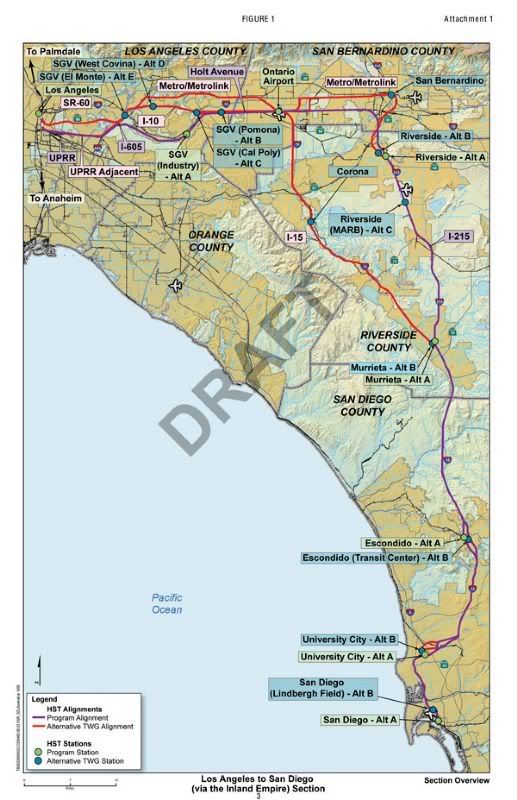
Of particular interest to readers of this blog are the route options that CHSRA is now looking at (cp. our earlier post LA - San Diego: Quo Vadis). In the draft map shown below, the original route is shown in purple.

LA2SD_TWG

However, since UPRR doesn't look like it will sell any of its rights of way or air rights above them the San Gabriel Valley, the technical working group (TWG) for the segment headed up by consulting firm SVG has had to look into alternatives. Note that the purple line now includes a section along I-605 and and aerial above Holt Ave, a city street in Pomona.

The TWG has also been looking at several alternative routes. A promising candidate would use hwy 60, hwy 57, I-10 and head south on I-15 via the city of Corona, well west of Riverside UC. In that scenario, the HSR station would apparently end up well south of the hwy 91 interchange and not be intermodal with established Metrolink services. Except for a short section south-west of Pomona where highways 60 and 57 codeshare, these highway medians are still available.

A second alternative would eliminate Metrolink's San Bernadino line to free up a right of way to reach an HSR station there. That city has always lobbied for one, but the sharp curves in the transition up from Ontario Airport would be problematic. The continuation down to Riverside also looks challenging. Note that leveraging SBD isn't even being considered, LAWA has clearly insisted on a station for ONT to relieve LAX, after deciding to shelve plans for PMD. With a good HSR connection, Ontario Airport might also provide limited relief to Lindbergh Field (SAN).

Further south, there is the issue of the I-15 managed lanes project between Escondido and Miramar (already under construction, VIDEO), which is eliminating the wide freeway median CHSRA had hoped to use. However, SANDAG's Linda Culp has been in the loop on HSR planning since 1999. It's not immediately clear if HSR tracks are now supposed to run next to I-15 in this stretch or, on an aerial made possible by extra-tall on/off ramps to the managed lanes.

Note also that I-10 and hwy 57 were originally penciled in for the Las Vegas to Anaheim maglev, but that increasingly looks like it will never be more than a paper tiger. Like it or not, California decided in favor of steel wheels HSR last November. Nevada would be wise to set aside its petty internal squabbles and push for electrified DesertXPress at 220mph plus a connector between the towns of Mojave and Barstow.

In San Diego county, there are apparently a few route details left to be sorted out near Escondido and past/through Miramar, in addition to exact station sites. In particular, the Lindbergh Field vs. Santa Fe Depot downtown question is still unresolved, as is the location of a yard for overnight stabling and minor maintenance.

Keep in mind that there has been and continues to be a great deal of negotiation regarding the route and station placements in the LA to San Diego spur. The situation is still very fluid and the map shown above could already be slightly out of date in some respects. The LA-San Diego spur was included in the statewide program EIS/EIR, but CHSRA has always sought to position it as phase 2 of the entire project. Even so, the fact that this the route and station options are still under discussion underscores that the program-level planning effort did not include actual right of way acquisition.

Sunday, July 5, 2009

Making Tracks Down South

NOTE: We've moved! Visit us at the California High Speed Rail Blog.

by Rafael

while CHSRA continues to face widely publicized opposition in the SF peninsula, there is active competition for the alignment that the phase 2 spur from LA Union Station to San Diego will follow. We already discussed the ROW issues in an earlier post.

The Riverside Press-Enterprise explains that the City of Riverside is competing with the much smaller City of Corona for a station, as both recognize the economic value of having a stop on the network. The Corona concept is based on an alignment alternative down I-15 and is supported by Riverside county as well as Lake Elsinore and Temecula. This would be the shortest option that still allows for a station close to Ontario airport, but the proposed station at Cajalco Rd would be several miles south-east of downtown Corona; an old freight spur could be leveraged for new Metrolink routes, but most passengers would presumably drive or take a bus to a giant parking lot in the middle of nowhere (cp. Victorville). The city could probably improve its chances by proposing instead a new station for both HSR and Metrolink at the intersection of the BNSF Transcon line and I-15, between Quarry St. and the CA-91 interchange in Corona proper.

On the other hand, CHSRA's completed and certified program-level EIR/EIS calls for trains to run further east past UC Riverside, before joining I-15 by way of I-215. Three separate connectors down from the I-10 corridor near Colton are being studied, but running above or below Iowa Ave, Chicago Ave or S Riverside Ave/Main Street is non-trivial. Note that the existing Riverside Metrolink station is located approx. 1.5 miles south of the CA-91/CA-60/I-215 interchange, rendering it useless as a regional feeder service to the HSR station for Corona, Perris and San Bernardino. This last city would very much like to have an HSR station of its own, but its downtown is out of the way of the preferred route described in the program-level EIR/EIS.

There is, of course, one heretical idea that might be worth considering now that DesertXPress looks like it may go ahead: continuing HSR along the BNSF Transcon line and/or CA-91 past the phase 1 section to Fullerton. Bullet trains would then run to San Diego via Corona without any need for additional HSR tracks along I-10. Eventually, a connector would put Riverside and San Bernardino on the spur to Victorville and Las Vegas. Anaheim ARTIC would also be on a spur, though there is a railroad ROW running north from Orange that could perhaps be used to allow a subset of trains to include that station on a run-through detour. The biggest problems are NIMBYs in the Santa Ana Valley and, the fact that this route would not run anywhere near Ontario airport. That would mean redoing part of the program-level EIR/EIS for this phase 2 spur, something I am sure CHSRA would prefer to avoid.

The above is meant to illustrate how integrated planning of the California network and DesertXPress line could open up new and possibly superior alternatives for HSR development. One slide at the recent press conference announcing the inclusion of Las Vegas in the federally designated California HSR corridor already included a connector between Palmdale and Victorville, though frankly one between Mojave and Barstow would be more useful for SF-LV and hew close to an existing road/rail traffic corridor (CA-58) The latter point is relevant for CEQA. For the moment, though, all of this remains wishful thinking: there appears to have been zero formal contact between CHSRA and DesertXPress to date and, neither planning body has taken ownership of getting any such connector funded and built.

Thursday, March 12, 2009

The Keys to the Magic Kingdom

NOTE: We've moved! Visit us at the California High Speed Rail Blog.

One of the relatively late changes to the definition of the HSR starter line was the inclusion of the segment from LA Union Station to Anaheim ARTIC, OCTA's planned multimodal transit hub. Nothing wrong with that at all, after all Orange County is the second most populous in the state. Besides, OC needs the grade separations along BNSF's core "91" line to support future capacity growth for container freight out of the LA/LB harbors. A similar billion-dollar project is to improve grade crossings with UPRR's lines in the San Gabriel valley, dubbed Alameda Corridor East, is already underway. Grandiose plans for using fancy, unproven freight maglev technology to shuttle containers to a new Inland Port in Mira Loma appear to have bitten the dust and those for maglev to Vegas along with them.


Anaheim ARTIC on YouTube

The hoped-for quid pro quo for grade separation is that BNSF will offer CHSRA enough land to run dedicated tracks between Redondo Junction - the northern terminus of the successful Alameda Corridor - and Fullerton. To date, BNSF has been receptive to CHSRA overtures, but that was in the Central Valley. The company's ROW between Richmond harbor and Bakersfield is arguably not fully utilized, much of the alignment is single track.

The "91" line, named - this is Southern California for you - after the adjacent freeway through the Santa Ana river valley, is a whole different ball of wax. It is the only ROW out of California that BNSF actually owns outright. All its other routes out of the state depend on trackage rights on competitor UPRR's network. Up to a point, those could be restricted or canceled without falling foul of anti-trust laws. The price for the trackage rights is also subject to change.

Therefore, we should expect BNSF to take a much tougher line in negotiations regarding the sale of part of the "91" ROW. The Alameda corridor currently carries about freight 40 trains a day, but sooner or later that may double, even triple. With prescient investment in modern signaling, diligent track maintenance and professional operations, two track ought to be enough for BNSF to handle its share of that. But what if there is an accident or an earthquake. UPRR has multiple rights of way that it can use to re-route its trains. The companies may well have secured mutual emergency trackage rights on each other's lines. Still, BNSF risks putting itself at something of a competitive disadvantage if it sells part of its most precious asset in California. Once you give up a right of way, you never get it back. Not ever. BNSF may want to be a good corporate citizen and it knows that grade separation will reduce the risk of accident-related disruptions to its own service. But does that mean CHSRA will get to lay down tracks? We'll see.

Between Fullerton and the OC/SD county line near San Onofre, the right of way is owned by the Southern California Regional Railway Authority (SCRRA) which operates Metrolink. Amtrak Pacific Surfliner and some BNSF freight trains also use this alignment. BNSF owns the connector that runs north from Orange to the "91" line as well as the bit from National City to San Diego. The harbor down there is not a container terminal, it appears to be used for importing cars. All of these trains use FRA-compliant locomotives and rolling stock.

The SCRRA ROW in Orange County is quite narrow, really only wide enough for two tracks in most places. Widening it via eminent domain for the sake of laying down dedicated HSR tracks would be massively unpopular and ruinously expensive. The plan is therefore to seek FRA approval to operate mixed traffic, i.e. to add a limited number of non-compliant bullet trains to the mix via time separations guaranteed by signaling upgrades that prevent engineers from running red lights by accident. Top speed for this last stretch would be down to 79mph, but it's so short that presents no object. After last year's disaster at Chatsworth, HR 2095 mandated the installation of positive train control technology on busy rail corridor and those carrying hazardous materials by 2015.

The request for the mixed traffic exemption will be rolled into that for a "rule of special applicability" that CHSRA will anyhow need for its entire network. FRA currently has no rules at all for passenger train operations at speeds in excess of 150mph, nor any for the safe design and operation of 25kV AC overhead catenary systems. The agency had already begun to draft such rules for Florida HSR some years ago but they were shelved when Gov. Jeb Bush killed that project. They will soon be dusted off and completed, presumably many will be cribbed from the regulations Asian and European countries have already drawn up.

However, there's always a chance that one or more domestic - or at least North American - would-be HSR vendors will emerge. They might seek to gain a competitive advantage by getting FRA to draft rules that would force more established global players to modify their designs. That would be foolish from a safety/reliability/cost point of view, but protectionism-by-red-tape is one of the oldest games in town. Bureaucrats, too, love to draft special rules under the guise of "special conditions" that supposedly exist in the territory they are responsible for. In the US, some freight operators may well seek some regulatory overkill to push back against states that suddenly want to acquire part of their ROW, just so they can benefit from the federal largesse that is now being heaped - ok, spooned - onto high speed rail projects. Well-connected organizations that oppose HSR in principle, a particular project or impacts on their back yard might also try to lobby FRA, in the hope that this might kill or at least delay HSR implementations. We should be vigilant and push back against such selfish efforts.

The rules for California will set a national precedent for both true bullet trains running at well over 125mph on dedicated tracks and, for rapid rail below that speed, with freight and passenger trains each using the equipment best suited to their business model yet sharing a ROW and even tracks. Let's hope President Obama and Secr. of Transportation LaHood realize the importance of FRA's rulemaking on HSR in the years to come.

Clem Tillier over at the Caltrain-HSR compatibility blog has published the following diagram in his analysis of SF Peninsula Rail Traffic in 2030. It shows statewide train traffic on the HSR network, based on CHSRA's 2008 business plan. It does not include non-HSR trains that HSR will share track with in sections such as Fullerton-Anaheim.


Hi-Resolution Version

For Anaheim, CHSRA is apparently forecasting 2-3 trains in each direction per hour during a six-hour peak window. Of those, 60% would head up to the SF peninsula and 40% to Sacramento. There appear to be no plans to terminate trains in Los Angeles. Today, Metrolink's Orange county line between LA and Oceanside is served by up to 3 trains per hour each way during rush hour, but far fewer during the day. Amtrak Pacific Surfliner adds one more. If there were a 100% increase in legacy train operations by 2030, we'd still only be talking about 10-11 passenger trains running on the existing dual track alignment between Fullerton and Anaheim. That's a 6-minute headway, quite busy but not extremely so, provided that all trains run pretty much on time. I don't know how many freight trains run through Anaheim station today, let alone in 2030. That's a wildcard.

In a comment on the March 10 post entitled LA - San Diego: Quo Vadis?, yeson1a suggested that CHSRA might want to keep it simple and stupid (KISS): continue on to San Diego by staying on the 91 corridor from Fullerton through Corona and switching to the I-15 median there. This option has not been studied by CHSRA and would not be considered unless securing a ROW past Ontario airport proves impossible or too expensive. Yeson1a's alternative would leverage the investment already made for LA Union Station - Fullerton in phase I. A connector from Anaheim to Atwood would permit a capacity-defined subset of HSR trains to detour from the main line to Anaheim. If desired, some of the rest could stop at a no-frills auxiliary station in Fullerton. Norwalk/Santa Fe Springs would then only be served by some of the trains that make the detour into Anaheim. The route would probably feature and intermodal with Metrolink in Corona, with the option for a regular secondary station in Lake Elsinore, though Murietta would be fairly close by.


View Larger Map

The principal downside of this idea is that neither Ontario airport not Riverside are on the route. However, a possible phase II/III spur up to Las Vegas could give the downtown areas of Riverside, San Bernardino and Victorville HSR stations. Passengers hailing from Northern California would likely prefer a shorter spur off the starter line at Mojave. Perhaps both will end up getting built someday, with tracks joining up in Barstow. Such a full build-out would, however, require quite a bit of magic dust from the money fairy.

Tuesday, March 10, 2009

LA - San Diego: Quo Vadis?

NOTE: We've moved! Visit us at the California High Speed Rail Blog.

Note: commenter calwatch, a member of the Technical Working Group for the LA - San Diego segment of HSR, kindly contributed to the research for this post.

We recently discussed plans to completely remodel the overburdened Lindbergh Field airport and before that, the possibility of extending HSR to Mexico, because the SD Trolley Blue Line to the border is so busy.

Of course, both of these presumed that the planned HSR spur from LA Union Station to San Diego Santa Fe depot - or perhaps, a new multimodal transit hub at Lindbergh Field - will actually be built as intended. This requires that the starter line attract enough ridership to generate an operating profit that will permit the sale of non-state bonds to raise capital for phase II, which also includes extensions to Irvine and Sacramento. It also requires that CHSRA secure a suitable right of way, which will not be easy and needs to be done now, more than a decade before phase II construction will even begin.

Here is a map showing the principal railroad rights of way in Southern California (and their owners) plus several of the currently unused freeway medians. Despite appearances to the contrary, it does not represent a smorgasbord of options for HSR - the majority of them are already reserved for freight (expansion) and local/regional transit. At least the risky maglev project through the Inland Empire appears to have shrunk to just a gleam in a number of politicians' eyes: Sen. Harry Reid, Gov. Schwarzenegger and Gov. Gibbons. Rapid transit service between Anaheim ARTIC and Ontario airport via hwy 57 might be more easily implemented via a sexy bus styled by an F1 aerodynamicist and running at elevated speeds (90-150mph) on dedicated lanes and possibly even batteries. HSR is great, but it's not always the most appropriate option.


View Larger Map

Passenger rail service between LA and San Diego is currently provided by the popular Amtrak Pacific Surfliner that runs through Orange County and down the San Diego county coast. The trip takes about 2 hours.

HSR would cut that to 1h 15m, even though CHSRA has selected a preferred route via Riverside county that adds around 30 miles. There were three reasons for this preference:


  1. LAWA desperately wants to relieve California's largest airport LAX, where a project to add a third runway had to be canceled after protests from nearby communities. That is the primary reason why the HSR network includes both Palmdale and Ontario airports.
  2. San Bernardino, Riverside and other inland towns are currently only connected to LA via Metrolink, if at all. However, none of lines has a stop next to the airport terminals, the nearest large airport in the region.
  3. An HSR alignment along the coast ROW was ruled out because that is too narrow to support four tracks south of Fullerton in Orange County, because of the visual clutter an overhead catenary system would bring to San Clemente and Del Mar in particular and, because of concerns about weather-related and geological hazards that NCTD has had to deal with in the past. CHSRA recommended an upgrade to 110mph diesel-based service be considered but did not pursue the corridor any further.

The preference for a detour past Ontario airport and Riverside introduces several critical ROW issues:

  • CHSRA is proposing expensive run-through tracks (zoom in on LA please) for a new upper deck at LA Union Station. We have already discussed several alternatives that would require fewer eminent domain takings on this blog. For a variety of reasons, most commenters insisted that HSR trains should stop at Union Station, not at any separate station connected by a local shuttle service - especially one anywhere near the new State Historical Park. Any run-through tracks for HSR would be separate from the ones already planned for FRA-compliant Amtrak/Metrolink equipment on the lower deck. The objective is to secure alignments that allow trains to run from SF/Sacramento to both Anaheim and San Diego without having to waste time reversing direction in LA. Note that there are no plans for direct HSR service between Anaheim and San Diego because Amtrak Pacific Surfliner already serves that market.

  • Securing a ROW from LA Union Station to Riverside

  • Securing a ROW from Riverside to San Diego

  • Avoiding ROW conflicts with freight capacity expansion in Southern California. Fortunately, analysis to date suggests that a combination of expanding conventional rail freight and adding dedicated truck lanes on selected freeways would be a lot more more effective than an inland port served by a bleeding-edge electricity-guzzling freight maglev system in dealing with congestion and even air quality problems that are constraining growth in shipping volume.

This last point is really important, because 1 in 7 jobs in LA county depends on the ports. The majority of all manufactured goods imported from Asia into the US flows through the container terminals there and to point east via the Inland Empire. Already, rail freight up to Redondo Junction near downtown Los Angeles has been consolidated via the fully grade separated Alameda Corridor, freeing up old rights of way for projects such as the Harbor Subdivision Transit Corridor.

The success of freight consolidation has spawned a sequel dubbed Alameda Corridor East, with phase I already in progress. Its scope are improvements to 39 grade crossings the UPRR rights of way in the San Gabriel Valley between Redondo Junction and Pomona. The grade separation projects already completed did not anticipate the construction of HSR tracks, something CHSRA's consultant engineers HNTB (also selected for the SF peninsula) are aware of. Later phases will address the eastern section of the UPRR corridors out to Colton and beyond as well as the "91" corridor owned by BNSF, which CHSRA has identified as the preferred corridor between Redondo Junction to Fullerton. South to Anaheim and Irvine, the ROW is narrow and owned by Metrolink.

San Gabriel Valley
At this point, it looks increasingly unlikely that CHSRA can obtain land on the preferred UPRR Colton/Riverside and Colton ROWs for the purpose of constructing HSR tracks. The ROW choice is very much in flux, but right now leading candidates for alternatives out to Riverside appear to be, in no particular order:

  • I-10 median on an elevated alignment. The section between LA Union Station and El Monte is already occupied by a single track used by the Metrolink San Bernardino line. The most likely route would therefore involve air rights over UPRR's Colton/Riverside ROW between Redondo Junction and the I-605/hwy 60 interchange, then cutting up to I-10 alongside I-605. The all-essential connecting transit to cover the ~1/2 mile to the three Ontario airport terminals would likely be implemented either via shuttle buses or an elevated people mover.

    One big problem is that there is no easy way to cut across from Colton to the I-215 median, the preferred route down to San Diego. Colton, San Bernardino and Riverside all very much want a station in the area, but residents near March AFB in Moreno Valley are objecting. Note that Metrolink has plans for a new service out to Perris, Hemet and San Jacinto.

    An alternative would be to cut across to the I-15 median just east of Ontario instead, perhaps even via the long-term parking lot at Ontario, S Haven Ave and a short section of UPRR's Colton/Riverside ROW (e.g. via air rights). The alignment would then continue south to Murrieta via Corona and Lake Elsinore. An intermodal station with Metrolink might be possible if the existing one for Corona were moved about a mile east.

  • Hwy 60 median east of the 710 interchange. It is still unused all the way out to Riverside UC and connected to the preferred route down to San Diego via the I-215 median. Reaching it from Redondo Junction would be difficult if UPRR refuses to cede at least air rights on its Colton/Riverside ROW . Moreover, there are two competing applications for the hwy 60 median: the Eastside Light Rail project and, dedicated truck lanes to haul freight out of the LA/LB ports (though other freeways are also under consideration).

    For HSR, a bigger issue with this option is that hwy 60 runs a couple of miles south of Ontario airport. However, a sufficiently fast high-capacity shuttle bus service or people mover up S New Haven could link the HSR station, the East Ontario Metrolink station, the long-term parking lots and all three terminals. A suboptimal solution, but better than nothing.

    Both the I-15 and the I-215 medians are more easily reached via hwy 60 than via I-10.


Note that both solutions involve obtaining some co-operation, e.g. air rights, from UPRR to proceed south-east from Redondo Junction. The same safety/liability issues that railroad raised in the context of a serious derailment with debris fouling an adjacent HSR track also applies to air rights. What if a derailment were to damage a support column or portal? How would the accident be communicated fast enough to avoid a potentially catastrophic follow-on accident involving a high speed train with hundreds of people on board?

Earthquake safety may be more manageable, though land would be needed to install the support structures. That could prevent UPRR from laying down another track and/or jeopardize the safety of its employees hanging off railroad cars. UPRR may be a crufty old-fashioned railroad compared to BNSF, but they are profitable and they have been in operation for 146 years. They've almost certainly forgotten more about day-to-day railroad operations and off-design conditions than CHSRA's board members will ever know.

HSR isn't being built in a vacuum, it is being introduced into the pre-existing US railroad ecosystem (for lack of a better term). If it has not yet done so, CHSRA would be wise to retain the services of a recently retired senior railroad operations manager, because neither civil engineers like Mehdi Morshed nor foreign HSR vendors nor foreign HSR operators will be able to bring local knowledge of (antiquated) operating practices to bear in CHSRA's negotiations with the freight rail companies and FRA. You can't reach consensus until the other side is persuaded that you fully understand the concerns they are raising. Operations guys tend to trust their own, because nothing focuses the mind on safety like an injury or death on your watch.

I-15 Managed Lanes
Unfortunately, getting past Ontario is only half the battle. SANDAG is already constructing additional managed lanes in the I-15 median that CHSRA was counting on in the 20-mile stretch between Escondido and south of Miramar. This video animation shows how this "freeway within a freeway" will be accessed via high overpasses. To date, no provision has been made to accommodate HSR. One option now under consideration would use even taller overpasses to permit tracks running on an aerial alignment.

A third option would rely on a covered trench below the center lanes, supported by columns in the middle. If this visually and mechanically more appealing variation is chosen, it would be prudent to anticipate those future trenches now rather than destroy nearly 40 lane-miles of perfectly good freeway lanes later on. One option would be to deploy prefabricated concrete slabs that could be removed during and re-installed after HSR construction. Another option would be to bite the bullet now and construct those trenches sans tracks in anticipation of HSR construction a decade hence. Worst case, HSR does not happen and they would be re-purposed for some other transportation application (zero emissions lanes? water pipes?) The question is: who would pay for digging trenches now rather than later? Note that the spaces between the on- and off-ramps would serve as emergency access points every few miles, eliminating the need for a service tunnel. The Escondido station should probably be sited north of where the managed lanes begin.

Note also that might be possible to obtain land just west of I-15 to avoid having to deal with the managed lanes complication, but 20 miles is a long stretch.

Miramar, Lindbergh Field and beyond
Further south, yet more pitfalls await our intrepid HSR planners. There is as yet no easy solution for cutting over from the I-15 median to the existing railroad coast ROW owned by the San Diego Northern Railway. The closest approach is at Miramar, a Marine Air Corps Station. County voters rejected a proposal to ask the Marines to leave so the field could be converted to a new airport far from downtown.

That ROW is wide enough for four tracks near Lindbergh Field, of which two are already in use for FRA-compliant equipment operated by Amtrak, NCTD and BNSF. The other two are used by SD Trolley, i.e. light rail. Unless FRA grants a rapid rail waiver along the same lines as the one that will be needed in Orange County, the HSR tracks will most likely have to run on an aerial, see slide 22 of this presentation. It seems highly unlikely that this would introduce any clearance problems for aircraft if wind conditions force them to take off to the east or, that wake turbulence and jet exhausts would even be noticeable to HSR trains. However, the authors appear to have include HSR at the last minute as an afterthought: there is no 400m (1/4 mile) island platform for the HSR trains nor any pedestrian overpass to reach them - three would be needed. Fixing this at a later date would require a massive change to the transit terminal's signature wave roof, so it should be elevated some 25-30' before the architectural plans are finalized.

Otherwise, CHSRA will have to stick with plan A and somehow site its station at the beautiful historic Santa Fe Depot near downtown or else further south, e.g. near Petco Park.


View Larger Map">

Finally, HSR will need a yard for overnight train storage, perhaps even maintenance. If BNSF are amenable to the idea, one possible location would be all the way down in near the salt ponds near Main St/I-5 in Castle Park. That location would double as an HSR station for communities near the border.


View Larger Map

Tuesday, February 24, 2009

Mary Bono Mack and Darrell Issa Attack Vegas HSR

NOTE: We've moved! Visit us at the California High Speed Rail Blog.

Congresswoman Mary Bono Mack, who owes her seat to having been married to Sonny Bono when he died, is launching a new criticism of the Vegas HSR project: that it would come at the expense of the Inland Empire. Obviously Mack, like John Boehner before her, is oblivious to the fact that many of her constituents will benefit from Vegas HSR, particularly the construction jobs. But she's concerned about the Indian casinos, like Casino Morongo, that might lose out to Vegas when Californians find it's easier to get to Vegas than ever before via a high speed train:

But Bono Mack, R-Palm Springs, said Reid -- a longtime proponent of a Southern California-to-Las Vegas rail line -- stands to gain from the provision at her district's expense. With a fast train in place to take people from Los Angeles to the Vegas Strip, the Inland area would likely lose out on tourist revenue, particularly at the region's Indian casinos, she said....

"He's stifling our economy," Bono Mack said. "We're just going to shuttle people away from the Inland Empire."

So wouldn't one solution to this be to build HSR to Palm Springs? Funny how she doesn't propose that.

As the article notes Mack voted with her party against the stimulus and against the $8 billion in HSR money. Which, it must be noted, will benefit the California High Speed Rail project most of all. A project that many of her constituents will directly benefit from. Look at a map of the 45th district - much of it includes the I-215 corridor, the corridor along which HSR is likely to run on the LA-SD portion of the route.

I guess this is a marginally less ridiculous form of HSR denial, but not by much. The solution here isn't to attack the Vegas HSR project, but to expand mass transit options so that Palm Springs and its casinos are included as well.

And to remind Mack, and everyone else in the Inland Empire, that high speed trains run in two directions.

UPDATE: Thanks to my Calitics co-blogger David Dayen for bringing my attention to this priceless smackdown of Darrell Issa, a Congressman from San Diego, who attacked the "earmark" for Vegas HSR which, as David Shuster points out in the clip, doesn't actually exist:


Worth noting that Issa too represents a district that will benefit from HSR. God, these people are idiots.

Thursday, December 11, 2008

Two Quick Ones

NOTE: We've moved! Visit us at the California High Speed Rail Blog.

Busy day, busy week. Winter break cannot come quickly enough. Two stories for your perusal:

1. The California Air Resources Board (CARB) has approved the scoping plan for the implementation of the AB 32 carbon reduction goals. As we explained in June CARB sees high speed rail as an important part of their overall goal of reducing carbon emissions 30% by 2020. With the Obama Administration showing its commitment to global warming action this move is all the more important, reminding the state and the country of HSR's role in promoting renewable, carbon-neutral energy.

2. The Press-Enterprise looks at the debate over HSR routing in the Riverside-Perris area - should the I-215 corridor be used, or does the proposed Metrolink Perris Valley Line make this problematic or unnecessary? One problem is that the article is really unclear - it suggests that the discussion over the I-215 corridor is over a connection TO the HSR route and thus the $950 million in Prop 1A funds is at stake. But as the board-approved route map shows the plan is to run HSR itself along the Perris Valley/I-215 corridor. So either I'm missing something or the article is missing something.

Still, it is an opportunity to discuss the Inland Empire, which we've almost never discussed here - but should.