by Rafael
The LA Times has published an article on Metrolink's safety record, charting the 244 grade crossings deaths on its far-flung network over the past 15 years. On average, that works out to more than one a month.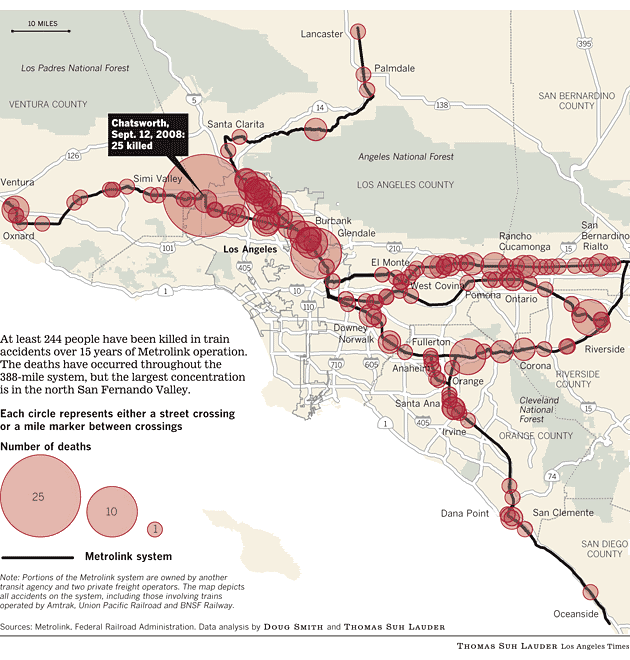
Source: LA Times Sep 26 2009
While it is true that Metrolink has suffered safety lapses, most notoriously the case of a train engineer who was texting on a cell phone when he should have been paying attention to trackside signals at Chatsworth, it is also true that the agency has to operate on a shoestring budget. The article complains bitterly about a corporate culture that supposedly prioritizes ridership growth over grade crossing safety, comparing it to MTA. That agency is far better funded precisely because it has higher ridership. Metrolink is caught in a Catch-22.
The article also cites the example of a confused elderly lady driver who made a right turn at the Buena Vista Street intersection in Burbank. When the crossing gate came down on her car, she panicked and stepped on the accelerator. Tragically, she was killed in the ensuing train crash. Metrolink concluded it was a clear case of driver error and have made only minimal changes to the intersection in response to the fatality. Without additional public funding, there's not a whole lot it can do.
Up in the SF peninsula, Caltrain has a program for rail safety enforcement, but this public outreach effort hasn't made a significant dent in the grim statistics. It seems that in addition to suicidal persons, there will always be a small contingent of motorists who either don't know how to behave at railroad grade crossings or flout the rules.
What both commuter rail services have run up against is that the only proven way to eliminate or at least massively reduce grade crossing fatalities is full grade separation plus sturdy fences for the rail corridor.
Caltrans did promise to grade separate the aforementioned Buena Vista Street in Burbank against the single rail track in the context of a project to widen I-5, but that's just one one grade crossing among hundreds. Elsewhere in Southern California, a large number of grade crossings were eliminated or had their rail traffic sharply reduced by the Alameda Corridor project. More are either planned or under construction in the context of the Alameda Corridor East project in the San Gabriel Valley. For its part, OCTA is lobbying Congress to close a funding gap for 19 new grade separations on the BNSF Transcon line in Orange County, a critical artery for getting goods in and out of the LA and Long Beach harbors.
One of the reasons the California HSR project is so expensive is that it will feature all-new fully grade separated tracks. In the SF peninsula, part of the Central Valley and in the Lancaster-Anaheim section of the Metrolink service network, the starter line will run immediately next to existing regional and commuter as well as freight trains. While AB3034, the bill made law by the passage of prop 1A(2008) last November, does not explicitly require CHSRA to grade separate any but the HSR tracks, also including adjacent tracks for legacy services should be a high priority wherever that is technically and economically feasible and, it is not already done or planned in another context.
Voters/taxpayers should demand nothing less, even if it doing so entails exercising strictly limited and generous eminent domain against a relatively small numbers of businesses and home owners. This applies in Fullerton just as much as it does in the SF peninsula, Fresno, Bakersfield and elsewhere in the state. The benefits extend well beyond safety, e.g. to rail corridor capacity, reduced dependence on oil in the transportation sector plus the elimination of train horns and warning bells.
Saturday, September 26, 2009
LA Times On Metrolink Grade Crossing Safety


Wednesday, July 29, 2009
At Least the Above-Grade Tracks Are Quiet
So the Peninsula is having a hard time making up its mind - do they dislike above-grade tracks more than they dislike the loud horns that are an inherent part of at-grade passenger rail?
It’s not just you — Caltrain’s horns are indeed louder and the transit agency is working hard to tweak its “toots” and “tweets” to bring the noise level down and keep in line with federal law at the same time.
Federal regulations require the horns to produce distinct, separate and sequential blasts and a recent safety inspection revealed the horns were not making the unique “toot” and “tweet.”...
Caltrain moved the horns to the underside of locomotives and cab cars in response to previous complaints from the community.
But since the powerful air horns weren’t making the distinctive “toots” and “tweets” the horns have returned to their original location on top of the trains.
I can see why this would rile up the neighbors. The train horns are already pretty loud, as we demonstrated back in May:
And here's one of many videos of above-grade HSR, in this case an AVE trainset in Catalonia:
Which one would you rather live next to? I found it instructive that in this video, the barking dog was louder and more persistent than the passing train. Sure, sure, the dog was probably closer to the videocamera than the train, but that would be the experience of most residents along the corridor, who will live closer to passing cars, barking dogs, teenagers blasting loud music, etc, than they'd live to a far quieter train structure that is grade separated using electric trainsets.
The horns are clearly getting noticed:
Burlingame resident Lynn Hawthorne said her entire neighborhood has noticed the louder horns.
“It’s just terrible. The horns got much louder. I live two blocks from the track but it feels like I’m living on the tracks when the train passes,” Hawthorne said. “I’ve got double-pane windows but I might as well not have windows at all.”
You just don't hear this from people living next to above-grade high speed tracks. HSR trains aren't silent, and we're not claiming they are. But neither are they anything close to this loud. It's instead an occasional "woosh" that won't sound appreciably louder than the truck that just rumbled down my street here in Monterey.
Which brings me to the real issue here. Living in a city means dealing with noise. It is right to want to minimize the most offending and loud noises. But you can't eliminate it entirely, especially when your community is built around a major passenger rail corridor.
Despite the fact that the Caltrain corridor has been handling passenger trains for much longer than any resident along the route has been alive, there are still people living there who seem to think they can make the train corridor silent and invisible. That's just not possible, unless these cities have billions of dollars lying around to spend on a tunnel. So instead you should find ways to ensure that the trains are well-integrated into the community, including finding ways to minimize the noise.
Above-grade tracks are the most cost-effective way to do this - and they come with the added benefit of making what is already an extremely dangerous corridor much safer by separating the trains and the cars and people passing by the tracks.
In short, if folks in Burlingame are upset at the horns, they should be asking their city councilmembers and city staff why they've joined with Menlo Park and Atherton to fight the above-grade solution that can affordably solve this rather loud problem.
Saturday, June 6, 2009
Corridor of Death
There is an unfolding and horrifying story coming out of Palo Alto that directly impacts not only the high speed rail project, but the whole community. In the last two months two students at Gunn High School have committed suicide by throwing themselves in front of passing Caltrains. Last night passersby helped stop a third student from doing the same:
The 17-year-old boy, a student at Gunn High School, apparently walked to the East Meadow Drive crossing at about 7:45 p.m. Thursday and was contemplating suicide when he his mother came on the scene, police Agent Dan Ryan said. The motorist saw the mother pleading with her son and stopped to help, as did a Palo Alto police officer, Ryan said.
Police called Caltrain dispatchers, and an approaching northbound train was stopped in Mountain View, Ryan said.
It's difficult for transit infrastructure to be designed in a way that can stop someone truly determined to kill themselves from doing so, as the Golden Gate Bridge and BART have discovered. That being said, this rash of suicides reminds us of the inherently dangerous nature of grade crossings where fast, heavy trains are operating. (Light rails and streetcars have potential issues - but then so does any other vehicle operated on the roads.)
This is particularly the case on the Caltrain corridor, where people are routinely hit or killed along the at-grade tracks, despite an intensive public education campaign by Caltrain.
So why are Palo Alto NIMBYs fighting to preserve such a deadly situation? I have less objection to those supporting a tunnel - they're being unrealistic, but aren't calling for the preservation of a clear untenable situation. For those who argue from a "tunnel or nothing" position, or who claim that the status quo should be preserved, I'd like to hear their thoughts on why the deadly corridor isn't worth doing something about.
Obviously grade separations on the Caltrain corridor aren't a cure for teen suicide, nor are they going to ensure that there is never a deadly accident of any kind ever again in Palo Alto. But shouldn't the death toll be as much a part of the conversation, if not moreso, than a bunch of people whining about property values?
Saturday, May 30, 2009
Better Modeling of the Above-Grade Peninsula Caltrain/HSR Project
One of the most unfortunate parts of the debate on the Caltrain/HSR project on the Peninsula is the lack of accurate information. NIMBYs and other project opponents have already convinced many people that an above-grade solution would be a sort of "Berlin Wall" through the city, and Jim McFall's video reinforces that errant conclusion. The problem is that McFall's video has been the only attempt to visualize what the corridor would look like with above-grade tracks.
Until now.
Mike, who brought us the point by point refutation of the notorious Cox-Vranich HSR denier report last year, is back to inject some sense and fact into the debate over HSR. He has put together a YouTube video of simulations of the Churchill Avenue crossing in Palo Alto - including the existing at-grade model, the proposed CHSRA above-grade solution, and the flawed McFall model. Mike added authentic sounds of the crossing - a recording of Caltrain crossing at-grade, and of the Acela. Here's the video:
You can see clearly that McFall's model is misleading on several counts. He has the dimensions all wrong - the structure is higher in McFall's model than is actually proposed, and the catenary poles are too densely packed together. More importantly, McFall's video doesn't include existing landscaping that would mitigate much of the visual impact of an above-grade solution. There are no trees in the McFall video, whereas Mike's video makes clear that trees are indeed part of the solution.
The results of misleading misinformation on the Caltrain/HSR project (such as the McFall video) could be seen in Atherton on Thursday night, where a crowd came to speak in favor of the city's avowed "tunnel or nothing" stance:
Duncan Jones, Atherton's public works director, laid out the town's case for both joining the lawsuit and still participating in the high-speed rail planning process. "We need to hedge our bets," he said.
Mr. Jones, a former rail consultant, said that the town's fallback position -- if the route doesn't change, put the high-speed trains in a tunnel, rather than on a raised berm -- isn't as far-fetched as it sounds.
The rail corridor in Atherton is lined by expensive homes, and widening it to accommodate high-speed rail would require purchasing swaths of private property.
"When (the authority) looks at all of the costs and impacts, they may find out that going underground may be cheaper," Mr. Jones said.
Jones's comments are barely credible. I cannot imagine that buying a few strips of backyard will cost a billion dollars - which would be the minimum estimate for tunneling through Atherton, even with a cut and cover model. The San Jose Mercury News article on the meeting noted that Hatch Mott MacDonald executives estimated a tunnel through Atherton would cost:
A tunnel on the Peninsula would likely follow the same model as the San Jose BART extension, Townsend said, because both areas have soft ground. A high-speed rail tunnel would likely cost somewhere between $100 million to $250 million per mile, compared to less than $100 million for an at-grade system, he said.
I have a difficult time imagining that the cost of eminent domain for a few backyards would be $100 million. I am also skeptical of the lowball cost of an HSR tunnel that Townsend offered, but even if these estimates are accurate, it represents a doubling of the cost of building on the Peninsula.
Such is the fact-free nature of the debate on the Peninsula, unfortunately. Let's hope Mike's more accurate animation gets spread far and wide, and that people on the Peninsula can actually make informed choices about the Caltrain/HSR project.
Wednesday, May 27, 2009
Two Thursday Meetings
Tomorrow, Thursday May 28th, will see two meetings on the high speed rail project. I can't attend either of them, but hopefully you can!
First up is an FRA meeting in Rancho Cordova (Sacramento suburb) from 1PM to 4:30PM:
FRA’s High-Speed Intercity Passenger Rail Workshops
Start May 20, To Tour Nation
Dear Stakeholders:
As we begin to implement President Obama’s vision for developing a cohesive national intercity and high-speed passenger rail network. This vision was set forth in FRA’s Strategic Plan for High-Speed Rail (HSR) announced by President Obama, Vice President Biden, and U.S. Transportation Secretary LaHood, and sent to Congress that same day on April 16, 2009.
The workshops will be led by FRA Deputy Administrator Karen Rae or myself. Through these workshops, FRA is reaching out to the rail community in seven regions across the country to seek your input on the Interim Guidance we are required to issue on or before June 17, 2009, for the $8 billion in grant funds provided by the American Recovery and Reinvestment Act of 2009 (ARRA) for the high-speed rail corridors program, intercity passenger rail grants, and congestion grants. The workshops will enable FRA to discuss the HSR Strategic Plan with key stakeholders such as state departments of transportation, regional planning authorities, metropolitan leaders, associations and labor groups (under the ARRA, these workshops exclude the participation of lobbyists).
We seek your input not only to provide us with your regional vision of high-speed and intercity rail networks, but to enable stakeholders to focus on the critical factors that will make this program a success for generations to come.
The goal of the workshop is to take the first steps toward determining how we can best partner together to make the Strategic Plan a reality. During the workshop, you will have an opportunity to share experiences, raise concerns, provide insights, and make recommendations on several key issues and questions, as well as hear those of your colleagues and representatives from a regional perspective. The workshop schedule will include the following:
Introduction 10 minutes
Overview of FRA strategic plan and next steps 30 minutes
Amtrak presentation 15 minutes
Q & A 35 minutes
Regional presentation 30 minutes
Break 15 minutes
Working group break-out 1 hour
Wrap-up 15 minutes
The workshops will be held 1:00 p.m. 4:30 p.m. on the following dates and locations:
California Corridor: Sacramento May 28; Sacramento Marriott Rancho Cordova, 11211 Point East Drive, Rancho Cordova, CA 95742
In addition to participating in the workshop, I am inviting you and other members of the public to submit written comments to FRA by June 5, 2009, on issues that should be addressed in the Interim Guidance and specific recommendations on the criteria to be used in evaluating grant applications. FRA has created a public docket (Docket No. FRA-2009-0045) for the receipt of written comments. Please visit FRA’s Web site at: www.fra.dot.gov/us/content/2236 for information regarding the various ways in which you may submit comments to the public docket.
Please note, additional sessions to aid states with the mechanics of applying for ARRA funds will be scheduled after these workshops, as will informational sessions for industry, labor, intergovernmental and other interested parties.
I look forward to working with you over the coming months to ensure the grant programs funded by ARRA are implemented successfully.
Sincerely,
Joseph C. Szabo
Administrator
The Federal Railroad Administration
The other meeting is in Atherton at 7PM:
The meeting is open to the public, and will be held at the Jennings Pavilion in Holbrook-Palmer Park, 150 Watkins Ave. in Atherton.
Atherton officials, and many of the town's residents, have grave worries about the local effects of the state plan to run high-speed trains along the Caltrain corridor that bisects the town. If the high-speed rail line can't be rerouted to avoid the town, Atherton officials would rather have the train run through a trench or tunnel, instead of on an elevated berm.
The scheduled speakers at the meeting are: Mike Garvey and John Litvinger, public outreach consultants working for the California High Speed Rail Authority; John Townsend, executive vice president of Hatch Mott Macdonald, a leading tunnel-engineering and construction firm; Duncan Jones, Atherton's public works director; Gary Patton, attorney and former director of the Planning and Conservation League; and Jim McFall, who will present a digital model of elevated high-speed rail tracks going through Palo Alto.
I'm really curious about this "digital model" that will be shown. Is it going to be an accurate representation of what an elevated solution could look like, or is it going to be a biased depiction of some kind of Berlin Wall? I hope that the CHSRA has been able to generate some more accurate and realistic digital images of their own.
Update: Thanks to Clem in the comments who links to Jim McFall's video - videos that put the worst possible spin on this, making the HSR grade separation look like an Orange County freeway.
Additionally, I'm curious what the tunneling exec will have to say. Will he explain the price tag of a tunnel? Will Atherton residents have their checkbooks and credit cards ready to go to pay the multi-billion cost of such a tunnel? Only one way to find out - go to the meeting!
If anyone does attend, and wants to write up their impressions of the meeting(s), I'll be happy to post it here unedited.
Monday, March 2, 2009
Grade Separations Done Right
One of the core claims of the HSR deniers that are trying to kill the system on the Peninsula is that an above-grade set of rails will look like a freeway - like some sort of "Berlin Wall". Here's what one group of deniers claims will result in Menlo Park from above-grade HSR:
The only thing missing from this image is barbed wire, gun towers, and a GDR flag.
But how are grade separations for HSR trains in urban areas accomplished in Europe? A quick glance shows that the "omg Berlin Wall!" claims are nonsense and that elegant above-grade solutions that enhance the character of cities are possible.
Here's a train from Monterosso, Italy: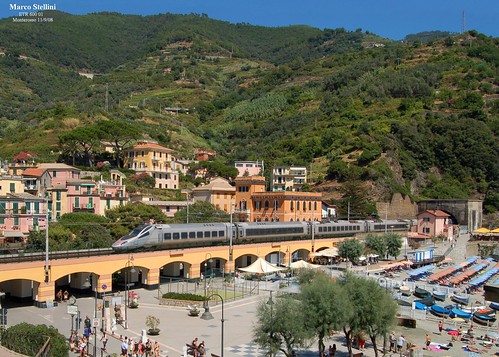
Notice the elegant use of archways to break up the elevated structure and to integrate with the surrounding landscape. This also offers many more opportunities to cross the ROW than even exist with the current at-grade Caltrain tracks.
Here's an image from Berlin. Notice the shops that have been integrated into the elevated structure: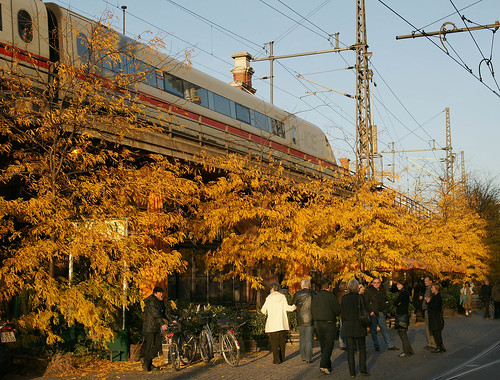
And another image of ICE trains in Berlin:
To Britain now, with a Eurostar train at Lambeth Road in London: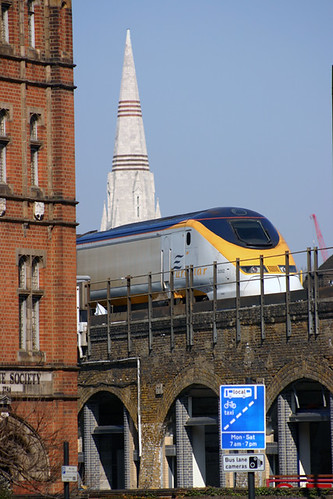
This is obviously a much older elevated structure but it too uses the multiple archway concept to both provide separate tracks but also opens up the structure to light, pedestrians, and other methods of keeping a community together.
Too bad there's no examples on the Peninsula of how arches help make structures look better and more open. Oh, wait, what's this?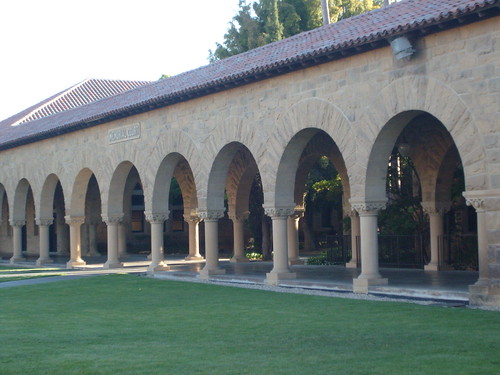
(Stanford University, for those of you who aren't aware.)
It is my sincere hope that the cities along the Caltrain/HSR route will consider suggesting these kinds of solutions to grade separating the tracks in their communities, and refuse to follow a small but loud group of anti-HSR forces in opposing one of the most important projects California has considered in decades.
Palo Alto, Menlo Park, Atherton and other cities should use European HSR systems as models for how to successfully implement improved passenger rail in their cities. It's not a choice between a "Berlin Wall" or a tunnel or nothing.
Sunday, March 1, 2009
Help Palo Alto Make the Right Choice
On Monday night the Palo Alto City Council will meet to consider the comments it wishes to submit to the California High Speed Rail Authority on the Peninsula portion of the HSR line. Although this seems like a small point, Palo Alto has become a major flashpoint in the attempt by a small but vocal group of HSR deniers to kill the high speed rail project outright. Unfortunately, a recommendation by Palo Alto city staff appears to bolster these NIMBYs. It is therefore extremely important that all HSR supporters around California mobilize to ensure that Palo Alto does not suddenly decide to undermine the project in order to satisfy a few ignorant claims.
If Palo Alto succumbs to the NIMBY HSR denier crowd it will be a severe blow to not just high speed rail, but to mass transit, action to mitigate and reverse global warming, smart growth, energy independence and economic recovery. It would deal a blow to President Barack Obama's plans and give a boost to conservative Republicans like Bobby Jindal and Sean Hannity who claim that high speed rail is bad for America.
The basic issue is this: a few people in Palo Alto, who are almost totally uninformed as to the details of the project (whether this is deliberate or not isn't clear and depends on the individual), have become convinced that high speed rail is going to "destroy their community." They are spreading numerous lies and falsehoods about what HSR will do for Palo Alto. And although the Palo Alto City Council unanimously endorsed Proposition 1A last year, they are coming under intense pressure to join the frivolous lawsuit filed by Menlo Park, Atherton, Stuart Flashman, and other opponents of high speed rail.
One of the core arguments is that somehow an above-grade set of HSR tracks will ruin the community - harm property values, bring "blight". Some are even taking to calling the HSR tracks a "Berlin Wall" - an offensive claim that cheapens the lives of those Germans who died trying to cross the Berlin Wall to freedom.
In fact, along most of the Peninsula there is already sufficient ROW to add two tracks to the existing Caltrain tracks. This is true for much of Palo Alto, despite claims to the contrary.
More importantly, the HSR grade separation project would vastly improve the quality of life in Palo Alto. Electrified tracks mean no more polluting and smelly diesel fumes. Grade separations mean no more loud train whistles. They also mean no more accidents, making it safer for families to cross the corridor. Far from "dividing" communities it actually unites them.
Still, the huge levels of support in Palo Alto for Prop 1A and HSR would normally suggest to me that these ignorant claims from NIMBYs wouldn't be worth worrying about. Unfortunately, the City of Palo Alto staff are making a series of recommendations that could fundamentally undermine the HSR project if the City Council approved them. It is imperative that we let the Palo Alto City Council know that some of these recommendations are not only inappropriate, but deeply flawed and ought to be rejected. Instead the council should support HSR, and submit comments to the CHSRA indicating a desire to produce a sensible solution that will implement the HSR system as approved by California voters in November.
The objectionable recommendations include:
• Reopen the Altamont vs. Pacheco debate
• Explore routing HSR down Highway 101 or Interstate 280
• Consider terminating the HSR route at San José Diridon and forcing intercity travelers to transfer to Caltrain to complete their journey to San Francisco
Each of these are problematic, but it is the last point that is especially heinous. Let me explain.
First, Altamont is dead. That option isn't coming back. Californians voted for Prop 1A knowing that Pacheco Pass was the choice. That ship has sailed. An Altamont alignment means cutting out San José from the system, one of the state's largest cities.
It also means dumping the problem in the laps of Fremont and Pleasanton. Who are Palo Alto residents to say "we're too good to accept some small improvements in a rail line - some other town has to deal with it?"
The recommendation to build HSR along 101 or 280 is also deeply flawed. That would be a very bad move that violates almost every rule regarding sound transportation planning principles. HSR along the Caltrain route means stations in city centers, instead of along freeways. It would reduce ridership and seriously retard efforts to make California less car-dependent. In fact, the Palo Alto staff report notes that according the the CHSRA:
Station locations must have the potential to promote higher density, mixed use, pedestrian accessible development
By moving the line to 101 or 280 - which will never happen but I'm humoring the staff here - it ensures that these goals are impossible to meet. Further, it would embolden Palo Alto resistance to items necessary to improve Caltrain service - including electrification and grade separation.
Palo Alto staff are implying that it may well oppose efforts to improve Caltrain service as well. The city's draft scoping comments include asking to eliminate overhead catenaries in Caltrain electrification and preventing "visual impacts" that above-grade crossings would present. How many people are killed along Caltrain tracks? How many accidents have there been at grade crossings? If the goal is to eliminate any grade separations short of a tunnel - as this report appears to imply - then what city staff are proposing is an attack on any and all efforts to move more Bay Area residents to trains, all because they feel it would make their community look less pleasant.
The staff report suggestion of terminating HSR at San José and forcing riders to transfer to Caltrain is perhaps the most damning and foolhardy proposal of them all. This would severely undermine the HSR system as it would cause ridership numbers to plummet below the levels needed for the system to be financially viable. Caltrain is a commuter rail system and is not designed to handle intercity travelers. It does not have luggage facilities. It does not have spacious seats or a cafe car. Transfers reduce ridership, and cutting off the line at San José therefore constitutes a mortal threat to the entire system.
The staff recommendation is an implicit attack on California's strategy to finally build a 21st century model of transportation, and a de facto embrace of inaction on the multiple crises we face - a desire to maintain a failed status quo that is harming the environment, increasing dependence on fossil fuels, and blocking the development of sensible and sustainable alternatives.
Palo Alto's city council voted to endorse Prop 1A and the construction of HSR. They should reject this staff recommendation as both unrealistic and inappropriate, ask staff to strip those elements that constitute an attack on passenger rail and sustainable transportation, and instead submit more constructive comments, that would reflect the following realities:
• Very little if any eminent domain will be needed as much of the necessary ROW already is in Caltrain's hands
• Grade separations improve the community by making crossing the corridor far safer
• Most of the breathless "Berlin Wall!" comments are deliberate lies that ignore the landscaping and other design elements that will ensure an above-grade line will not look unappealing.
It must also be noted that the CHSRA has been a very good partner with the Peninsula on discussing this project, extending the comment period by a month (to April 6) in order to allow cities to have more time to produce their comments and feedback.
Palo Alto has previously shown support for both HSR and passenger rail. It is time for the cooler heads in that city to prevail. Palo Alto residents who both support HSR and who want to build this the right way need to speak up in support of a more constructive approach and against this staff report. Otherwise their city may wind up with nothing but a significant backlash that will cost the city more than it gains.
The 20th century is over. Palo Alto, which was built around an existing rail line, cannot reasonably expect that the conditions of the 1980s or 1990s will continue indefinitely. The HSR project calls for modest changes to the rail corridor and will leave most of Palo Alto untouched and leave the rest improved. Palo Alto should not join Bobby Jindal, John Boehner, and Sean Hannity in attacking the kind of mass transit solutions that we all need to meet the crisis of the 21st century and come through that crisis with better, more prosperous, and more sustainable communities.
And this is where you come in.
I have started an online petition that asks the Palo Alto City Council to endorse HSR and reject the inappropriate and anti-HSR staff recommendations. Please sign it, and make sure your friends sign it too. I am going to post this petition on major websites like Calitics and Daily Kos to help increase the number of signers, and to show Palo Alto that HSR has widespread public support that they should not ignore in order to keep a few fools happy.
As I said right after our election victory, the passage of Proposition 1A was just a first step. It is time to mobilize the network of HSR supporters to win another battle - a battle for mass transit, economic recovery, and environmental action, a battle against those who would sustain a failed status quo because of their selfish and ignorant beliefs.
This is not the equivalent of the Century Freeway, and Quentin Kopp is not Robert Moses. Palo Alto must do its part in helping California and America escape the failed policies of the 20th century. They can do so by endorsing HSR and rejecting the inappropriate staff recommendations that are designed to attack the project itself.
Help Palo Alto make the right choice. Sign the petition. And let's show Palo Alto that we want to work together, in a spirit of cooperation, to ensure HSR works for their community - and that none of us, Palo Alto residents or otherwise, will allow a small group of people to destroy our future.
Thursday, February 26, 2009
Debating Peninsula HSR
Wow, 70 comments and counting on the last post - hardly any of which were about Sir Richard Branson and private operators! (I'm sure Branson's ego won't mind.) I think I know what's on some folks' minds regarding HSR, and it's the debate over how to build HSR on the Peninsula.
We haven't had contentious discussions here for a while - not since October - and so perhaps some folks have forgotten the rules of etiquette around here. I'll delve into that first, and then offer some more general comments on the debate.
First, I ask that all users post with a username. It can be a pseudonym. Call yourself Ishmael if you want, I don't care. It's impossible to follow which anon said what. Blogger doesn't offer a way to ban just anonymous comments - I'd have to force everyone to register either with Google or with OpenID or something else. I would prefer to not do that, but will do so if necessary.
Second, I ask that comments have some basis in fact and evidence. If someone persists in making stuff up, I'll delete the comments. Same goes for any comments that are abusive or contain personal attacks on other commenters.
Other blog platforms offer more functionality, like WordPress. I'll be honest that I simply do not have the time to implement that system, though if anyone wants to help I'll work with you on that (and I mean that this time!).
Now, the discussion on the peninsula. I think Clem at the Caltrain-HSR Compatibility Blog put it well when he made this comment on his blog's most recent post:
HSR has strong political backing from SF, SJ, Sacramento and Washington DC. I don't believe the city or the developer will be allowed to delay the project. While the process may indeed be acrimonious, I believe it will be short.
Anyone on the Peninsula who thinks they can kill this project is nuts. By "kill the project" I mean cut it off at San José, try and reroute it through Altamont (where cities like Fremont and Pleasanton will put up a huge fight), or stop its construction altogether.
None of that is going to happen. It's not possible. HSR has solid support from the highest level in American politics - President Barack Obama - and is widely supported in Sacramento, Los Angeles, San Francisco, and the Congress. This line will be built and it will be built as is currently routed: along the Caltrain line on the Peninsula.
Let's be clear about what the political effect of trying to kill HSR via lawsuit, street protest, or whining on a blog will be. Californians will look at you as if you've signed on to Bobby Jindal's 2012 campaign. You will be seen as attacking a popular president and a popular project and will very quickly become isolated. I don't know if that's fair, but it's the reality.
Peninsula residents have the right and the responsibility to speak up about this project and seek to work out the best methods for constructing HSR in their communities. But there needs to be both a sense of collaboration, of working for the public good, and supportiveness of the HSR concept. When that is absent, concerns will be ignored. Again, that may not be fair, but it is reality.
There appear to be three camps on the Peninsula regarding HSR. The first is likely the largest: outright supporters who just want this thing built. Over 65% of San Mateo County residents voted for Prop 1A, after all. The second are people who are a bit concerned about this or that aspect of the project, but who are willing to work constructively to ensure the project is built in a way that meets their needs. The third are HSR deniers who never accepted Prop 1A's passage and who are using the fight over how to build it on the Peninsula to try and kill high speed rail outright.
The problem is that the local media on the Peninsula likes to feed the trolls in the third group, and blows the opposition out of proportion. And that's how HSR denial and NIMBYism works - shout really loudly and hope those in power decide to placate you. That isn't going to happen this time. Again, HSR will be built. The question is how to build it the right way.
I would set out some key points for everyone to understand in this debate:
1. HSR is going to be built along the Caltrain route from SF to SJ.
2. We want to build this in a way that works for all the communities affected. But we're not going to give into NIMBYism or HSR denial.
3. If people on the Peninsula want a trench or a tunnel they must pay for it themselves. We're going to focus on raising money to build the entire system and can't devote systemwide funds to give Palo Alto a trench.
4. HSR will benefit all communities along the line by providing faster, safer, and cleaner transportation options that do not rely on the automobile.
Bil Paul's column on trenching is a welcome bit of sensibility on this debate, although he conveniently avoids the issue of payment.
Let's hope that we can have a more reasonable discussion among the first two groups I described above. Those who just want to refight the Prop 1A battle, or the Altamont vs. Pacheco battle (which Bil Paul rightly said is "final" and "futile" to try and reopen) should leave the debate to those of us who actually want to do this thing the right way.
So, get your Peninsula fix in here. Tomorrow I'm writing about something totally different.
Friday, February 20, 2009
Of Lawsuits, Tunnels, and Tall Trees
This Friday night brings our attention back to the Peninsula, where some of the first battles over HSR are being fought. First up is the frivolous lawsuit filed by Stuart Flashman, Menlo Park, Atherton, and others. Now they are claiming that the CHSRA ignored Menlo Park's letter about potential loss of property along the route:
The California High Speed Rail Authority ignored Menlo Park's comment letter that outlined how their proposed bullet trains would force Peninsula homeowners to lose their property, according to opening arguments filed Thursday in the city's lawsuit against the state....
The most significant claim in the brief was that the authority never received Menlo Park's comments that were made before the Pacheco Pass route was approved. State environmental law requires government bodies to review comments from cities and residents before a planning decision of this kind is made.
Now the fate of that specific comment letter is important, but let's not kid ourselves - it was never any secret that some in Menlo Park were worried about this. The "Derail HSR" crowd was based out of Menlo Park and those activists and the Menlo Park city council had been vocal about these worries. It is not credible to claim that the CHSRA was "never aware" of Menlo Park's concerns, as the lawsuit claims.
Further down the tracks, Palo Alto residents are falling in love with the tunnel:
On Tuesday, residents voiced two clear messages: They want a bigger say in the design process and they would much rather have a rail line that zips through tunnels than one that whooshes past over their heads on raised tracks, which some city officials are calling a "Berlin Wall" dividing Palo Alto.
It would be "the difference between blight and Park Avenue," Judith Wasserman, a member of the Palo Alto's Architectural Review Board, said of the tunnel-versus-elevated tracks alternative.
"If somehow the High-Speed Rail Authority decides to put it above ground anyway, is there recourse or do we all just have to lie down on the tracks?" Wasserman asked the crowd gathered in a Palo Alto Unified School District conference room at 25 Churchill Ave.
This is starting to get silly. "Berlin Wall"? Lying down on the tracks? Are they serious? Have they ever been to San Carlos, which doesn't exactly resemble East Berlin circa 1980? Neither is anyone talking about a concrete-sided structure; it can be landscaped to fit better with the surrounding community. I understand that Palo Alto wants to figure out how to best integrate HSR within their town, but statements like that just make them look ridiculous. They also make it more difficult to have a sensible and evidence-based discussion of how to design and build HSR. Those who refer to a "Berlin Wall" are showing that they see HSR as some kind of ruinous imposition designed to not only divide their community but take away their freedom. It's language intended to harden positions, and not come to sensible compromises or smart design solutions. (Besides, the people who risked and in some cases lost their lives crossing the Berlin Wall might object to this cheapening of their experiences.)
Nor does it help when some reporters make sensational claims that lack evidence, such as the Daily Post's argument that El Palo Alto would have to be chopped down to make way for HSR. Clem at the Caltrain HSR Compatibility Blog debunked this claim:
Sounds pretty dire, but so far, nobody has suggested excavation near the tree, excepting a few Palo Alto residents who are advocating the entire railroad be buried in a tunnel. The great alarm over HSR impacts to El Palo Alto is out of proportion with the concrete piers poured in recent years near the tree for a bicycle bridge, and certainly overlooks the pressing need to replace the more than 100-year-old rail bridge over the San Francisquito Creek, regardless of HSR.
It's a ridiculous situation when people have to resort to sensationalism to try and get their point across. Unfortunately stories like "omg they're going to kill El Palo Alto!!!" have a nasty way of becoming zombie lies that everyone believes to be true despite the lack of evidence.
If Palo Alto residents want a tunnel so badly, they can pay for it. If they don't want to pay for it, then they should find ways to constructively pose suggestions to make the project a success. Too much of the NIMBY criticism of the HSR plan on the Peninsula is very thinly veiled HSR denial, as Martin Engel's prominent place in the debate shows. Peninsula residents have every right to make suggestions and proactively try to influence the HSR design and implementation. But they have no place trying to destroy a project California voters approved. HSR will be built and it will use the Caltrain corridor down the Peninsula. It's time the debate on the Peninsula became less hyperbolic and more constructive.
Sunday, February 15, 2009
California HSR Stimulus Project List
On January 28 Quentin Kopp sent a letter to Senator Dianne Feinstein's office listing potential HSR construction projects that "can currently be commenced". Included grade crossings in the La Mirada area of Southern California that Metrolink has planned and that HSR would use, although as Kopp notes, "a certain amount of additional engineering will be required to accommodate our project." Also listed is work at San Bruno, ROW acquisition and site prep in the Central Valley, and Caltrain electrification. You can read the letter here (PDF), and the list of proposed projects is below:
LA-Anaheim grade separations:
Passons Blvd/Serapis St: $43.4 million
Pioneer Blvd: $45 million
Norwalk Blvd: $150 million
Lakeland Rd: $40 million
Rosecrans Ave: $150 million
Valley View Ave: $72 million
San Bruno projects: $250-$300 million
Includes separations at San Bruno Ave, San Mateo Ave, and Angus Street; Pedestrian crossings at Euclid and Sylvan Avenues, and an elevated station
Also included:
By September 2011 the Authority will have underway the right-of-way purchase and construction grading of a heavy maintenance facility in the Central Valley and two storage "layover" facilities, one in the Bay Area and one in the Los Angeles Basin at an estimated cost of $200 million.
Additionally, the Caltrain Electrification Project is scheduled to commence by fall 2011. That includes design and procurement for the electrification of the system from San Jose to San Francisco, train controls, and commuter vehicles at an estimated cost of $1.5 billion.
Others in comments on recent posts have noted that San Jose Diridon Station is in line for some of the HSR stimulus funds, but that wasn't specifically included in this one letter.
It's worth noting that this letter was written before it was known that the final stimulus figure for HSR would be $8 billion, or that the deadline on spending that money would actually be September 2012. That may change things somewhat, but at least the letter gives us an idea of what we might see the stimulus pay for in terms of California high speed rail.
Thursday, February 5, 2009
What, Palo Alto Worry?
A few days ago the San Jose Mercury News ran a story suggesting Palo Alto residents were full of worry about the high speed rail project's impact on their town. I don't know how accurate a reflection of public opinion the report is, but the media has long demonstrated their own power to shape public opinion, so it's worth thinking about this for a moment:
Until recently, the notion of a bullet train from Los Angeles to San Francisco seemed far off to Tom D'Arezzo, a high-tech product manager who lives in Palo Alto's Southgate neighborhood. He knew it was on the November statewide ballot, but wasn't sure of the specifics.
Now that the $10 billion bond measure has passed, however, the project's full impact is beginning to hit home — almost literally. Like his neighbors on Mariposa Street, D'Arezzo has a yard that backs up to a portion of the Caltrain tracks that might have to be widened to accommodate the high-speed electric trains.
D'Arezzo now fears he could lose up to 10 feet of his property to eminent domain. But he's been frustrated in his attempts to find out for sure. Rail officials will neither confirm nor rule out the possibility, repeating a mantra that is beginning to irritate some Peninsula residents even though it's meant to soothe them: "It's early in the process."
Groundbreaking on the planned $40 million line is years away. The California High Speed Rail Authority is in the first stages of public outreach, holding "scoping meetings" in the Bay Area to get residents' thoughts on what should be studied in the environmental reports.
But D'Arezzo, and a handful of leaders in mid-Peninsula cities, worry that by the time they get the detailed information they would need to participate in the decision-making process, the big decisions will have already been made.
The fact is that, yes, it IS "early in the process." Some key questions have yet to be resolved, such as the configuration of tracks (F-S-S-F or S-S-F-F or some other combination), the design of grade crossings, and of course, where the mid-Peninsula station will go. All of that then impacts how much ROW is needed, what can or will be done to separate the tracks from its surroundings, whether it's a home or Palo Alto High School, etc. That's why these meetings are being held - to start the public conversation, to get these residents thinking about how they'd like to integrate HSR into their community.
There's no reason why Palo Alto or any other city has to treat the CHSRA like an invading army of space aliens that plans to cut a huge gash in their community with their lasers. In fact, Palo Alto actually has an opportunity to help determine how best HSR can exist in their town. If they decide they want to pay for a tunnel, there's nobody stopping them. If they decide that they would prefer this much ROW to be used here and that much ROW to be used there, they can organize and give that feedback to the CHSRA which can then use it to help make some engineering decisions.
Obviously Palo Alto can't design the entire thing themselves, but this notion that they're consigned to wander in the dark is really just not credible. They're not at the Authority's mercy. Palo Alto should instead treat this as an opportunity to help build a sustainable community oriented around passenger rail, and model to the rest of the state (and especially to their neighbors on the Peninsula) how to integrate HSR into their urban landscape.
The best cure for worry is to take action. Hold some community workshops, hire some consultants, talk to planners, send someone to visit some European cities, and take the knowledge and come up with a plan. That would be the best thing Palo Alto can do not just for HSR, not just for the state, but for themselves.
(I'm sure some or all of this is already happening, but let's make sure it gets the emphasis it deserves.)
Monday, January 19, 2009
HSR Deniers to California: Pay For Our Tunnel!
As the Peninsula scoping meetings begin this week local media is starting to take notice - which is a Good Thing, as public awareness of and involvement in HSR planning is a necessary prerequisite to project success. It also means the battle in the mid-Peninsula (is that what you all call it? correct my terminology, please) over a tunnel is starting to heat up. One of the leading HSR deniers, Martin Engel, is championing the cause of burying the HSR tracks in a tunnel through at least Menlo Park and Atherton, and potentially through neighboring cities as well should they be interested. Engel is circulating a letter, which he has helpfully posted in the comments to the Almanac News article I just linked, in which he asks the California High Speed Rail Authority to provide a tunnel at "no additional cost burden to localities" on top of the cost burden he claims is already imposed by Proposition 1A:
There can be no question that the CHSRA has an obligation to mitigate the negative impact of the train corridor development. That means not elevating the rail grade in any way, either by berm, retaining walls, or viaduct. Although there will be claims that tunneling is far too expensive and cannot be afforded by the rail authority, the fact is that not to do so will be far too expensive to the residents and cities adversely impacted by the elevated system. The harm and costs with elevated alternatives will be irreparable.
Whenever someone says "there can be no question" that's usually a sign that, in fact, there can be and usually ARE lots of questions. The CHSRA's mitigation obligations apply to NEPA and CEQA rules, not to Martin Engel's concept of urban design. Engel would need to demonstrate that grade elevation is an inherently and universally negative impact, and would need to show in particular the specific costs to residents and cities as a result of this. Instead all he has are assertions and claims, which of course are all he's ever had. Engel of course assumes that there will be no cost benefits to grade elevation - that the absence of diesel emissions and the safety improvements (no more trains hitting pedestrians or autos) will not bring significant savings.
Asking (or not even asking, but imposing upon) the residents of Atherton and Menlo Park to accept the horrendous and costly burden to be imposed by the rail authority is unacceptable. All of us in California, and in the United States, will already be required to make major financial contributions for the construction of this rail system through demands placed on our taxes. So will our children. This intrusive and deleterious imposition adds further injury to injury. We cannot accept it.
This would be Engel's "we have not yet begun to fight!" statement. The only financial burden that would be involved with HSR is if we don't build it - the cost of traffic, global warming, air pollution, and lost jobs that all would result from not having HSR. Engel includes this to argue that Menlo Park and Atherton are already paying for HSR, so it's not fair to ask them to pay for undergrounding, though it was quite fair for BART to insist it of Berkeley.
Engel finally gets to the point:
What are we saying is this:
1. No elevated structures on the Caltrain corridor through Atherton and Menlo Park.
2. No additional cost burden to localities for the construction.
3. Only acceptable solutions to involve below-grade-level alternatives.
4. Unambiguous negative impact of construction easements, shoofly tracks, business closings, eminent domain takings, and revenue loss for the cities of Menlo Park and Atherton due to property devaluation, to be clearly acknowledged in the EIS/EIR.
5. Acknowledgement of unambiguous negative impact of any elevated rail-supporting partitioning of Menlo Park and Atherton. Required plans for and commitment to construct definitive mitigation.
It is my hope that the residents of the Peninsula do not share this extremist and impractical position. By asking the CHSRA to pay for undergrounding, Engel is in fact asking for everyone else in California to subsidize his vision of what a city should look like. That East Oakland and Fresno and San Bernardino should not worry about education cuts and health care and jobs but direct money to a vanity tunnel through one of the wealthiest neighborhoods in the entire state. I'm sure that's going to go over quite well with the voters.
We want HSR to be built the right way through the Peninsula, and believe that a grade elevated structure can be constructed in a way that complements the cities of Menlo Park and Atherton. We hope that the residents of those cities pursue those options, or find the money themselves to pay for a tunnel. We're not going to do it for them.
Thursday, January 15, 2009
Silly Fearmongering on the Peninsula
In today's San Mateo County Times John Horgan paints a ridiculous picture of an HSR project doomed to destroy Peninsula communities. Of course, since this is the same guy who confused Colma and Bayview I suppose we should take his brand of HSR denial with a grain of salt. Still, he's not likely alone in his opinion, and any opportunity to explain how HSR will benefit the Peninsula is worth taking.
Horgan writes:
THERE is a fresh sense of urgency in some San Mateo County communities as plans for high-speed electrified rail along the Peninsula proceed faster than originally anticipated.
Passage of Proposition 1A last November, which provides an infusion of nearly $10 billion to get the project rolling, was just the start. Now, it appears entirely possible that the federal government, which is printing money faster than anyone can spend it to counter a very tough recession, will inject more billions into California, some of it for transportation infrastructure....
The deadline for local comments, concerns and suggestions regarding these efforts is now less than six weeks away.
OMG doom! They're coming to bulldoze your communities tomorrow!!1!!1
Well, nevermind the fact that HSR construction won't begin until 2010 at the earliest, and even then it'll be focused on the test track in the Central Valley. Construction on the Peninsula is several years away at best. We keep hoping here that Obama will include HSR in the stimulus, but that's not a sure thing, and regardless of how the Obama Administration goes about fulfilling its HSR promises, federal money isn't going to accelerate the CHSRA's timetables.
That didn't stop Horgan from trying to create some sense of crisis, and so he goes on:
There is already considerable worry in places such as Menlo Park, Atherton, Burlingame, portions of San Mateo and other hamlets that the new system will dramatically alter their small-town ambiance by widening the rail corridor, walling it off (thus dividing communities in half), exercising eminent domain and installing unsightly overhead electric wires.
They may not have much choice. The high-speed rail poobahs, in concert with the state of California, have a great deal of authority to forge ahead, regardless of cries of outrage from individual municipalities impacted by what's ahead.
Horgan's revisionism here is hilarious. The rail corridor was there before most of those cities were. (And funny how he uses the term "hamlet" to describe one of California's most highly urbanized corridors.) The "small town ambience" is a modern-day fiction, existing only because of the decline of freight traffic along the route and the desire of some residents to pretend they're in rural New England as opposed to urban California.
The litany of horrific things the HSR project will do to these communities is interesting in what it leaves out - an end to diesel pollution, an end to loud train whistles, an end to deadly collisions between train and automobile and train and man.
Peninsula residents will benefit greatly from those amenities as well as the HSR service itself. No wonder cities like Menlo Park, far from expressing "outrage", voted for Prop 1A as did San Mateo County as a whole. The margins were not close.
There's lots to consider. Take the sensitive matter of placing the rails underground, much as BART has done south of Daly City and Colma.
One high-speed rail honcho has warned privately that going underground will be a doubtful and quite expensive alternative here.
"It would cost three times as much (as a surface option)," he said recently. "If the cities want it underground, they are going to have to pay for it themselves."
Lots of luck. But the guy is probably speaking a frank and depressing truth, or at least something close to it.
Finding a fiscal mechanism for miles worth of a pricey underground approach seems like something of a long shot at this point. But you never know.
Maybe the feds can print even more lucre. Hey, why not? What's another trillion among friends? Hope springs eternal.
Anyone who thinks the federal government would pay for undergrounding the HSR/Caltrain route through the Peninsula is out of their mind. The cities most certainly will have to pay for it themselves, as Berkeley did with BART - and as you might say San Mateo County did with BART, as the cost of undergrounding the line south of Colma was one reason among many for the ongoing cost to the county of the SFO extension.
Besides, there's no better way to cause problems for federal HSR funding than to give HSR deniers the notion that the money is going to help rich folks near Stanford have their own Big Dig. Even if that wouldn't properly describe the project, such nuances escape our opponents.
If these cities want to preserve their late 20th century version of "small town ambience" rather than look to how European cities have built quite livable cities with HSR, or to how their own cities lived for nearly 150 years with a busy rail line, then let them pay for it themselves.
Friday, September 26, 2008
Palo Alto: Prop 1A is "Opportunity of a Lifetime"
As their neighbors to the north spend waste their time and taxpayer money on lawsuits, Palo Alto has chosen a more sensible yet visionary reaction to high speed rail. An article in the Palo Alto Weekly explains how the city is looking to Prop 1A as an opportunity to reshape and improve the rail corridor that splits Palo Alto:
The disruption happens more than 55 times a day along Alma Street: Bells clang, crossing-guard arms lower, and people and cars grind to a halt as hundreds of tons of locomotive steel approach.
The train thunders by, horn wailing, leaving wind and dust in its wake. Then life returns to normal.
One day, all that could be history if an idea being floated by some Palo Alto leaders becomes reality.
Call it visionary or call it far-fetched: They think the railroad could be put underground — in tunnels 50 feet below the surface.
If that were to happen, drivers might experience Alma as a grand boulevard in the European tradition rather than a commute corridor flanked on one side by railroad tracks and bushes.
Where tracks now lie, bicyclists would glide on paths along a greenbelt, while office workers would look out their windows as commuters drive by.
And in the tunnels underground, bullet trains would silently whisk their passengers to destinations along the Peninsula.
No more street-traffic delays due to the rail system. No more train-on-car accidents. No more fatalities.
Atherton and Menlo Park would have Californians believe that HSR will destroy their communities, but Palo Alto points out how it will help make these communities more livable. No more accidents, no more diesel emissions, no need for a wailing horn. And if Atherton and Menlo Park wish to follow Palo Alto's model, a tunnel could provide either a lovely boulevard or an opportunity for new development.
How would Palo Alto pay for this? The Palo Alto Weekly article explains it like this:
The idea could also raise a lot of money, the group contends. By selling or leasing "air rights" — rights to build on the land, without acquiring the land itself — the Peninsula Corridor Joint Powers Board in theory might garner enough funding to pay for the added cost of undergrounding. The board owns the right of way and manages Caltrain.
"If you go along with our estimates, we get to about a half billion dollars of land value, which hopefully is the marginal difference in cost between what high-speed rail would pay for above-grade [rail] and the cost of undergrounding," Carrasco said.
The article goes on to reference Grand Central Terminal in NYC and BART through downtown Berkeley as examples of how undergrounding rail can provide financial and developmental benefits. Berkeley did wind up having to use redevelopment money and a sales tax to pay for the costs. Obviously Palo Alto residents will have to debate the details of this proposal and determine what's best for them.
Already some of the comments on the article are getting into these details. Some argue that this isn't a good use of government money in a recession, but those are the same folks who probably would have thought the Golden Gate Bridge and SF-Oakland Bay Bridge shouldn't have been built during the Depression. Californians need to start thinking about how to produce economic recovery, how to create jobs and new investment opportunities. High speed rail and Prop 1A provide those to not just Palo Alto, but to downtown San Francisco, Mountain View, San José, Fresno, Bakersfield, downtown LA, and Anaheim - and ultimately to the state as a whole.
Even if Palo Alto residents decide they can't or won't pay for undergrounding, at least they're thinking positively and constructively about their community's future. Trains have been part of Palo Alto for the city's entire history, they are the reason it exists. Passenger rail is now an obvious and necessary part of our state's future and we ought to be thinking about how we can make it work effectively and affordably. Prop 1A will provide just that kind of train service, and Palo Alto should be lauded for showing us how it can improve communities, as well as our economy, environment, and mobility.
Wednesday, September 10, 2008
Menlo Park Wants To Decide For California Whether We Have HSR
Menlo Park and Atherton, two of the most affluent cities in the entire state, apparently believe it is their right to make decisions for the other 36 million people in California. At a study session last night in Menlo Park city officials and residents spouted off reasons why HSR was a bad idea for California as justification for their lawsuit and resolution against the project. While one might understand the city's desire to mitigate the impact of HSR on their landscape, the tone of the debate made it clear that HSR's impact on Menlo Park wasn't the issue. Instead the forum was a chance for HSR's few opponents in this state to push their anti-HSR arguments to the media in hopes that they could use Menlo Park residents for their own purposes.
The San Mateo County Times article on the session noted that Menlo Park and Atherton are the ONLY two cities along the proposed route that oppose the project. All others support it. Further, as Rod Diridon noted, the cities along the Altamont route oppose HSR as well - yet Menlo Park wants to saddle them with a line they don't want. Cities like Fremont and Livermore are more middle- and working-class, but the wealthy residents of Menlo Park and Atherton are quite happy to override their objections to keep the trains out of their own backyard.
Menlo Park in particular also seems interested in ignoring the fundamental reality that they are, and have always been, a railroad city. The tracks that currently carry Caltrain cars have been there since before the city was founded. Caltrain runs nearly 100 trains through Menlo Park and Atherton every day. But city staff and elected officials behave as if that doesn't exist:
The staff's consistent point has been that the train should not run through the heart of a residential city, splitting east from west and forcing the removal of old-growth trees and perhaps even city and private property.
That was the argument of Elizabeth Blois, who spoke for members of the Felton Gables Homeowners Association on Tuesday in pleading for the rail association to consider the impact on their homes.
Someone should inform city staff of Caltrain's existence. The other part of this argument should be turned around on Menlo Park - if preserving a residential city is their concern, why do they support dangerous at-grade crossings? Why do they support pollution-spewing diesel trains? The loss of a small part of city and private property seems a small price to pay for safety and clean air.
Blois and others who made similar comments revealed their true motives - classic, dictionary-definition NIMBYism. Not in their backyard - but it's apparently OK to force it onto someone else, someone poorer.
Menlo Park and Atherton also are taking a stand for global warming and against carbon reduction. They are telling Californians that the property and aesthetic values of a small group of people is more important than solving our climate and energy crises. The 160,000 construction jobs and 450,000 long-term jobs that HSR would create don't faze a community that enjoys a unique level of economic security, towns that can afford to reject a green dividend.
Some of the other comments at the meeting were of the usual, uninformed HSR denier sort:
Other arguments from the public were more far-reaching. Jerry Carlson, vice mayor of Atherton, said the high-speed rail project as a whole is a waste of transit resources.
"I think a much better approach would have been to put that money into regional plans," he said.
Now, perhaps I'm missing something, but a train that whisks passengers from SF to SJ in 20 minutes sounds like a regional plan. A train that gets commuters from Anaheim to LA in 30 minutes is a regional plan.
Atherton resident Jack Ringham said the project would probably run far over budget, take years longer than predicted and attract far fewer riders annually than the 117 million the rail authority's consultants predict.
We dealt with Ringham's nonsensical claims back in June - anyone who thinks ridership on HSR will not be high is just demonstrating their lack of knowledge about passenger rail.
Vice Mayor Heyward Robinson conceded the city may not be able to stop the project altogether. If that's the case, he said, it should work with the rail authority to get key concessions. For instance, he suggested the high-speed portion of the line could stop at San Jose, and those continuing to San Francisco could simply take Caltrain.
In other words, Robinson wants to break the entire project and force people to have slow commutes just because he wants to pretend his community is not the railroad town that it has always been.
Some HSR supporters showed up to fight the good fight:
Roxanne Rorhpaugh said "the time has passed'' for debates about the Pacheco vs. Altamont alignments. She said she's certain the train can come through Menlo Park without serious damage to nearby property, but even if there were damage, "It's 12 houses versus 117 million" riders. "Do the math."
Amen to that. Menlo Park is trying to dictate terms to the rest of the state, claiming that the interests of 12 million-dollar homes are more important than fighting high gas prices, global warming, and the energy crisis. Menlo Park's neighbors Palo Alto and Redwood City aren't opposed to the train yet they too have wealthy homeowners who live near the tracks, and Redwood City in particular has a downtown that will be rather directly affected by the trains.
They understand the need to build a sustainable 21st century future that allows all Californians to share in our prosperity, allows all Californians to travel around their state. It's a shame that Menlo Park and Atherton prefer to make the state bend to the will of a few wealthy individuals. If that's not aristocracy I don't know what is.
Sunday, August 24, 2008
Mountain View's High Speed Future
While some cities on the Peninsula waste taxpayer money on lawsuits, others are adopting a more constructive approach to dealing with the impact of high speed rail on their cities. One such city is Mountain View:
To allow the high speed trains to safely flash through the Caltrain corridor means numerous design challenges, some of which residents may not like. Trickiest of all is downtown, where there is little room at the train station for two additional tracks. As for Castro Street, either a grade crossing must be built or the street will be closed off.
"Something has got to give or something has to go up or down," said Bob Kagiyama, senior public works engineer.
That something could be Castro Street itself, which, according to an old city report, would have to be below-grade for half of Castro's historic 100 block if it were to go under the train tracks.
This is the same issue that wealthy homeowners in Menlo Park and Atherton claim as grounds for a lawsuit, but Mountain View is instead trying to plan ahead and open up a public dialogue on what the best solutions will be, that will both integrate high speed rail and Caltrain service with the city's landscape.
Despite all the speculation, city officials say it's way too early to say exactly what will happen in Mountain View.
To have the new rail line tunnel under the whole downtown area is a very expensive solution, Kagiyama said. And going overhead "isn't going to happen."
Also, Rengstorff Avenue and Central Expressway could be lowered to allow cars to pass under both Caltrain and the high speed rail tracks, which would remain at-grade.
The High Speed Rail Authority would likely pay for the expensive projects, which could relieve the city of a heavy fundraising burden for the Rengstorff crossing. But the City Council made the Rengstorff grade separation a top goal earlier this year -- with no talk of high speed rail paying for it -- and funded preliminary studies on the project. The city aims to make the intersection safer.
Kagiyama said the city is anxious to talk to a contractor being hired within the next few weeks by the High Speed Rail Authority. This contractor would do local design work, and the city is eager to begin ironing out local concerns, such as the downtown train station's replica 1887 Train Depot and the light rail tracks, both of which may have to be moved.
The Peninsula is likely to be one of the most expensive parts of the project owing to the grade crossings required, and determining financial arrangements is going to be a central part of the project's politics after November. By starting to think about this now, cities like Mountain View are going to save themselves and the CHSRA time and money - there will already be detailed studies and a public process.
It's especially important that this work start now in order to build public support not just for HSR, but for specific solutions in cities like Mountain View. Such support is best built with frequent consultation with residents and an open planning process. Many hard decisions are going to have to be made about where the tracks and grade crossings will go and a consistent process can help reduce tensions and frictions.
Rather than fight reality and pretend that a 1950s-era urban landscape is tenable, Mountain View is looking to the future, to a sustainable mass-transit future. They're not alone - cities like Fresno are making similar plans. Most cities along the proposed route support the project and some, like Visalia, wanted it so badly that they tried pressuring the Authority into giving them a station. It's good to see that California's cities want a better future, rather than deluding themselves that the past is still viable.
