Showing posts with label Fiona Ma. Show all posts

Sunday, September 20, 2009

Sunday Open Thread

NOTE: We've moved! Visit us at the California High Speed Rail Blog.

by Rafael

  • Shortly before USDOT is due to decide how to allocate the $9.5 billion Congress has already approved for HSR nationwide in two separate bills, a new America2050 study analyzes and ranks 27,000 city pairs to determine Where HSR Works Best. Its recommendation: priority should be given to upgrading speeds in the NEC, upgrading the Chicago-Minneapolis/St. Louis/Detroit routes and, to building the first "express HSR" route in the country between SF and LA/Anaheim. Note that the study did not factor in cost, it only looked at transportation benefits.

  • The Transport Politic discusses SNCF's 1000-page response to USDOT's RFEI on HSR projects nationwide. The state-owned French railway zeroes in on opportunities for express HSR at up to 220mph in California, Florida, Texas and the Midwest. It refers to these as "HST 220". Note the complete absence of the NEC in SNCF's response and, the subtle differences relative to the phasing map America2050 has produced.

    UPDATE: the California HST 220 document is now online (24.5MB, h/t to commenter Alon Levy)

  • CA State Assemblywoman Fiona Ma (D-SF) and Speaker Karen Bass are lobbying for ARRA funds for California. In her meeting with Joel Szabat, Deputy Assistant Secretary at the US Department of Transportation, he hinted that the state might get as much as $4 billion for its HSR starter line. The decision will ultimately be up to his boss, Secr. Ray LaHood.

  • Las Vegas-Anaheim maglev project to get $45 million for environmental studies on the Nevada section after all. Supporters cite lack of commitment to onward connection from Victorville in DesertXPress proposal.

  • USDOT credit council recommends granting a $171 million TIFIA loan to help build the SF Transbay Terminal Center. This will cover 14% of the phase I capital investment. Estimates for total cost including the DTX tunnel and train box are now at $4 billion.


HEADS UP: CHSRA is hosting three Alternatives Analysis Open House meetings for SF peninsula.

San Carlos, Wed Sep 30, 6:00-8:00 pm
SamTrans Auditorium
1250 San Carlos Avenue

Sunnyvale, Fri Oct 9, 6:00‐8:00 pm
Sunnyvale Recreation Center (Ballroom)
550 E. Remington Drive

San Francisco, Tue Oct 13, 6:00‐8:00 pm
Milton Marks Conference Center
455 Golden Gate Avenue – Lower Level
San Diego A/B/C Rooms

Tuesday, June 23, 2009

Tuesday Open Thread

NOTE: We've moved! Visit us at the California High Speed Rail Blog.

It´s mid-afternoon here on the Algarve in Portugal. Beautiful weather, cool clear water, and a nice breeze making the last week of my visit here quite enjoyable. So what am I doing online? Other than being a total nerd, and taking a kind of siesta, I´m catching up on HSR stuff. Thanks so much to Rafael for his ongoing work in keeping the blog updated.

Some quick HSR related items:

  • AB 153 by Fiona Ma will be heard in the Assembly Transportation and Housing Committee today - the bill would clarify the eminent domain power of the CHSRA, to emphasize the agency does indeed have such power.


  • Apologies if this has been discussed before - it is a few days old - but the Mercury News has an article on two Menlo Park/Atherton moms who have organized to fundraise for the anti-HSR lawsuit, having collected over $30,000 (note: the original version of this post misstated the sum as $300,000) toward the legal bills. I´m really pleased to see that in this economic crisis there are people with that much money to waste, especially mothers who apparently don´t have to worry about the severe attacks on public education taking place in this state. Wouldn´t $30,000 be rather useful to local schools or to help feed the hungry?!

Wednesday, November 5, 2008

All Aboard!

NOTE: We've moved! Visit us at the California High Speed Rail Blog.

There are still some votes to be counted in the Inland Empire, and my own home county of Monterey still has not fully reported, but with 95% reporting and a 422,000 vote lead Proposition 1A looks to have passed. Remaining votes in San Bernardino and Riverside counties will have to run much more strongly against Prop 1A than the current results indicate for us to lose.

I have to admit my joy at this is somewhat tempered by the abomination of Prop 8 passing as well, but Prop 1A's passage is an enormous victory for Californians and their future. We stood up to the NIMBYs, the new Hoovers, the oil companies, the right-wing think tanks, and told them "you can't take away our future."

It is especially nice to see Prop 1A joined by other successful transit measures, such as Measure Q - the SMART passenger train from Sonoma to Marin, and Measure R which will provide passenger rail expansion in the LA area (including new connections to Union Station, which will become one of the busiest HSR stations in the state).

The $950 million contained in Prop 1A will also provide immediate benefits to other passenger rail service in the state, from Caltrain and Metrolink to existing Amtrak California lines. It will also likely help get the Coast Daylight service funded, which will serve the SF-LA corridor via the coast (Salinas, San Luis Obispo, Santa Barbara).

Several folks need to be thanked for their work in getting Prop 1A approved, especially the staff of the California High Speed Rail Authority - Mehdi Morshed and Dan Leavitt in particular. Quentin Kopp and Rod Diridon did an excellent job explaining the project to the public and defending against some ridiculous criticisms from HSR deniers in the Legislature. Emily Rusch at CALPIRG also did excellent work helping build a coalition for Prop 1A, as did that entire organization and their on-campus supporters - I'm sure Dan and Cynthia at UC Santa Cruz are celebrating this morning. The Sierra Club deserves thanks, especially those who ensured that the statewide organization endorsed Prop 1A.

The last-minute campaigning by Speaker Nancy Pelosi and Senator Dianne Feinstein was a needed shot in the arm, reassuring Californians of the project's soundness and showing that it is very likely to get the federal funding it needs, especially under President Obama. Fiona Ma has been a key figure here in California for high speed rail, from her high profile public activism to her work in the state legislature. The folks at the "official" campaign are to be congratulated as well for putting together this victory. The Fresno Bee has been a great source of pro-HSR commentary and they should be pleased that Fresno County approved Prop 1A by a 10 point margin.

And of course everyone who helped make this blog the center of Prop 1A and HSR activism online. Matt Melzer and Dennis Lytton have provided invaluable support and information over the last few months. Bart Reed of The Transit Coalition has much to celebrate this morning and I thank him for all his support and help with this site.

Our commenters deserve a special shout-out. rafael has forgotten more about trains than I'll ever know, and has been a key resource for all of us with his information and insight on the technical details and the big picture. Michael Kiesling has provided useful information as well and informed commentary. "mike" has provided some valuable commentary, especially his smackdown of the Reason Foundation's lies. Nikko, spokker, bossyman15, tony d., and other commenters have kept our spirits up and also helped spread pro-HSR information as it was needed.

Now it's time to think about the next steps. This blog isn't going anywhere, although we will move to a unique URL and install a better blog software, which will happen by the end of the year. There is still a lot of work to be done for California High Speed Rail, especially securing federal funding and maintaining a close eye on the planning decisions that will be made in the coming years. We can also expect to see a raft of lawsuits; every major project has them, and we'll be here to provide insight or debunking as needed.

I look forward to being on that first high speed train rolling out of the Transbay Terminal, destination Anaheim, and hope to see as many of you as possible on there with me.

UPDATE: There are still absentee and provisional ballots out there. We don't yet know where or exactly how many, which is why the news outlets have not yet called it for Prop 1A. We are confident of victory but I felt I should make that note. The Secretary of State expects to have these reported tonight or tomorrow.

UPDATE 2: LA Times calls it for Prop 1A. We very nearly won San Diego County - 48%-52%, with a 35,000 vote difference.

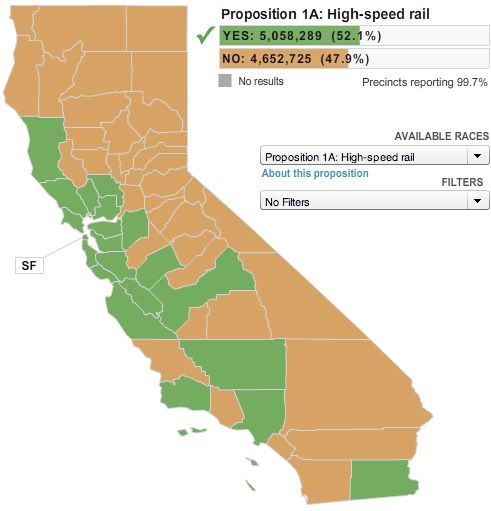
UPDATE 3: The LA Times map of Prop 1A:


Apparently Del Norte County's early reporting was flipped, so no they didn't vote for the SUPERTRAIN. But every county that is getting a station in Phase I did vote for it, except Orange County. That's OK, we'll give them a station anyway. San Bernardino and San Diego counties were fairly close, and the vote was extremely close in Riverside County. The county with the widest margin of victory was SF, 80-20. The strong pro-HSR vote here in Monterey County (58-42) bodes well for when it comes time to fund the Monterey Branch Line.

Thursday, September 25, 2008

Fiona Ma Ramps Up Prop 1A Campaign

NOTE: We've moved! Visit us at the California High Speed Rail Blog.

As you probably know by now, we here at the California High Speed Rail blog are HUGE fans of Fiona Ma. She has taken the lead on high speed rail in the state legislature, and her trip on the record-breaking TGV journey in April 2007 was the turning point in public awareness for high speed rail in our state.

Fiona Ma is now ramping up her involvement in the campaign for Proposition 1A. This week she unveiled High Speed Rail For California. The website is a good overview of the HSR project, including a route map, a petition link, and perhaps most usefully a letter to the editor tool. We know that the Menlo Park NIMBYs have been taking a shotgun approach to LTEs, writing them to newspapers in far-flung places like Eureka. HSR supporters need to push back, especially in their local papers. Fiona Ma has given us a great tool to do that.

It's part of a wider project Fiona Ma is launching, California Rising, which describes itself as follows:

California Rising envisions a bright future for a growing, more diverse California: increased quality of life, better schools and affordable colleges, cleaner environment and the utilization of green technologies, accessible healthcare, modernization of our State's infrastructure, and an improved economic climate that creates high wage jobs.

Fiona Ma is reviving the Pat Brown vision for California. When Brown was governor in the late 1950s and the 1960s, he helped create the infrastructure that enabled California to become a global leader in innovation, where prosperity was broadly shared. Brown emphasized aqueducts, colleges, and freeways, but didn't focus much on rail. We've been living off those investments for nearly 50 years, and unless we renew them - in the context of 21st century needs - we're going to fall behind.

Fiona Ma gets that. Back in May I posted her remarks at the Ecocity 2008 conference where she explained that "it's now or never" - California must provide national leadership on sustainable transportation. It's worth putting that video up again:


Speaking of websites, you'll be soon seeing a few changes here. The pledge form is going to go away - we've had over 1200 people sign up using it and we're about to deploy some emails to those on the list informing them about various Prop 1A related activism opportunities. If you haven't filled out the form yet, go do it now!

In its place will go a kind of "greatest hits" - links to the best posts of the last six months, the posts that explain the value of HSR in the most clear and direct way.

After November 4 this site will move to its own URL, and a new blog software - either drupal or WordPress, I haven't yet decided which one. The reason I'm not doing it sooner is we have excellent search engine optimization (SEO) on this site - #3 on a google search for "california high speed rail" and the brilliant takedown of the Cox-Vranich study, Truth vs. Truthiness on Prop 1A is #4 for a "prop 1a" search. No need to mess with a good thing!

Sunday, August 31, 2008

Labor Day Open Thread

NOTE: We've moved! Visit us at the California High Speed Rail Blog.

Busy here in SoCal for the weekend, and heading back up to Monterey tomorrow on the Coast Starlight. So this post will have to suffice for Sunday and Monday. I'm sure you all can manage.

  • Bart Reed of the Transit Coalition was on LA CityView earlier this week defending the pro side on Prop 1A against Joel Fox, former head of the Howard Jarvis Association and predictable train hater. Click "Roundtable 48" to see the video. Reed made an excellent case for Prop 1A. Definitely worth watching. I'll have more detailed responses to Joel Fox's claims in a post later this week.


  • Cathleen Galgiani was the subject of a positive piece in the Stockton Record about her work in getting AB 3034 shepherded through the legislature. This bill was originally going to be carried by Fiona Ma, probably the best HSR advocate we have in Sacramento, but when Ma's legislative calendar got too full she handed it off to Galgiani, whose persistence helped get the bill passed. This blog hasn't been totally supportive of Galgiani's approach to HSR, as we disagreed with her efforts to weaken the LA-SF "spine," but she has become a key HSR figure in the state and deserves to have her fine work recognized.


Anything else you guys want to discuss? Put it in the comments. Enjoy the rest of your holiday weekend, everyone.

Wednesday, June 25, 2008

Oooo! Shiny Maglev Toy!

NOTE: We've moved! Visit us at the California High Speed Rail Blog.

One constant feature of HSR activism are the folks who don't think it's a good enough idea. These people turn up their noses at HSR as being too mainstream, too boring. No, what we really need is some gee-whiz technological solution that has never really been tried successfully on a large scale anywhere, but looks cool. Personal Rapid Transit (PRT) is one of these - the Facebook HSR groups often get visited by these folks who try to convince us we're wasting our time with HSR and that PRT is going to solve all our problems.

Even more common than PRT acolytes are the maglev promoters. They like the idea of fast passenger trains but conventional HSR technology just isn't fast enough for them (I guess 200 mph trains are old hat to some). So they insist on exploring maglev technology - and for some it's maglev or nothing.

Maglev is an interesting concept, but notoriously difficult to construct, and a real budget-buster (the HSR deniers really should focus their attention on maglev, where they might actually have a point). Such was the fate of Munich's maglev project - intended to link central Munich to the airport, the project costs doubled and when the German government refused to increase its contribution, private backers pulled out. Shanghai's maglev line is experiencing ridership problems and China has chosen to use conventional HSR technology to connect Beijing to Tianjin (which is set to open on August 1).

But that doesn't stop the American media from fawning all over maglev. They've been doing it for as long as I can remember - it was in the late '80s or early '90s that the Southern California media was all over a proposal to link Anaheim to Vegas via maglev. The media loves nothing more than a neato piece of technology, which seems to explain MSNBC's maglev article:

Could America’s fastest train whisk us away from $4-a-gallon gas guzzlers?

Thanks to a $45 million infusion from a transportation bill signed by President Bush in early June, there could someday be a magnetic levitating train, or “maglev,” soaring from Disneyland to Las Vegas at a maximum speed of 310 mph — 180 mph on average.

After the research phase is complete in about three years, the private partnership behind the effort, American Magline Group, comes to its biggest crossroads: obtaining $12 billion in funding for construction.


The article goes on to discuss some of the pros and cons of maglev, selling it as a solution to high gas prices but concerned about the construction cost and the routing. But nowhere are the other HSR lines on the American drawing board - including ours here in California - discussed, even though they're much closer to reality.

And it's not like HSR lacks for technological interest. Assemblywoman Fiona Ma was on the record-setting Alstom TGV journey in 2007, reaching a top speed of 574 kmh, or 357 mph. The California system is planned to hit 220 mph, which would be the fastest train in North America by far.

It's unfortunate, though not surprising, that it's the shiny new toy that gets the media attention. Californians deserve to hear more information about high speed rail, especially realistic explanations about what it is, how it works, and how it has succeeded around the world. I guess we'll just have to do that on our own.

I'm not against PRT or maglev per se. But Americans need high speed rail to connect their cities, especially with the environmental and energy crises we face. HSR is a tried and true technology, and 220 mph isn't anything to sneeze at. Let's focus on the task at hand, and if folks want to continue researching and testing maglev, have at it - but it doesn't need to compete with HSR.

Sunday, June 15, 2008

Close But Not Quite in Modesto

NOTE: We've moved! Visit us at the California High Speed Rail Blog.

It's HSR editorial season, it seems, and the latest entry comes from the Modesto Bee. It's certainly not the sad joke of an editorial the Contra Costa Times put out, but it still demonstrates many of the common flaws the state media uses to assess the project - particularly an inability to examine the project in context. The Modesto Bee at least opens the editorial mentioning $4.50 gas, but unfortunately they don't consistently apply that all-important point in their commentary. A quick examination follows.

the Senate Transportation Committee conducted hearings on the rail concept in December and January, and recently released a report with six recommendations -- none of which are yet addressed in Galgiani's bill. Perhaps the most important is to require the commission to produce a business plan "consistent with a standard financial prospectus." We also agree with the committee that construction needs to take place on regional segments before the long-distance rail is built.


I've consistently been arguing against using that report as a guide for assessing the HSR project - the report is very deeply flawed, especially in its total failure to assess HSR in the context of permanently high fuel costs and the financial risk that poses to the state. I also have argued against lowering the priority of the long-distance segments unless there are ironclad guarantees that those WILL be built after the regional segments. Without such guarantees there is no point to approving the bond.

Quit low-balling. The cost for this all-new railroad has been set at $33 billion, with $7 billion more needed to add service from Merced to Sacramento and from Anaheim to San Diego. These estimates haven't changed in six years -- and no one believes them. A 2005 World Bank policy study shows that major rail projects usually cost 44 percent more than budgeted.


This is not a useful statement. What did the World Bank study point to as the cause for the increased costs? Rail projects in California such as the Metro Gold Line are being delivered on-time and on-budget. Without an understanding of the mechanisms behind those cost increases it is dishonest to use that study to predict the HSR project will go over budget.

Who will pay? Proponents say the federal government will be an important partner, but Wednesday the House of Representatives approved only $1.75 billion -- $350 million a year over five years -- for all the nation's high-speed rail projects. The rest, say backers, will come from private investors. But large banks and hedge-fund investors are reeling from the mortgage crisis. That leaves taxpayers and riders.


This is deeply misleading - and I'm putting that generously. The House bill was an Amtrak bill. The HSR money was gravy, unexpected and unplanned. It was thanks to the work of Jim Costa, Fiona Ma and Nancy Pelosi that the money is there at all - but it is NOT intended to be the final amount of funding Congress will give HSR. In April we reported that Congress is anticipating $60 billion for HSR in the 2009 transportation bill. Barack Obama is a vocal supporter of HSR and would likely support and help pass such an investment. There is NOTHING to suggest $1.75 billion is all Congress will give to HSR. The Modesto Bee surely knows this, or they should have done their research before publishing that part of the editorial.

As to the banks and large investors, the credit crisis won't help. But neither is it crippling. There is a lot of overseas capital looking for long-term stable investments, and CAHSR would be a natural site for them to park their money. And if they don't then we can and should sink more money into it. Of course the Modesto Bee, like every other media outlet that has pontificated on HSR, has refused to ask what the cost of doing nothing is - it is certainly higher than the cost of building HSR.

Get real about ridership. Proponents say that by 2030, they expect to generate $1 billion in profit based on 100 million riders a year. That means every Californian would have to ride the train three times a year. When asked about the validity of such numbers, a person familiar with the details whispered, "crazy." Another called them "black box" figures.


This is more of the anonymous sourcing and vague reporting that the media is way too often passing off as journalism. Who claimed the numbers were "crazy"? How is the public to assess the validity of such a statement? The Modesto Bee is irresponsible in not sourcing or explaining that claim.

Further, who says HSR will only be used by Californians? We do still get a lot of tourists, many of whom will use the system. Business travelers will use it far more often than three times a year.

But the most important aspect of the ridership question is fuel costs. The Modesto Bee led off the editorial mentioning high gas prices - so why ignore it here? Ridership may not hit exactly 100 million by 2030 - though I am certain that it will, as ALL HSR lines around the world have rapidly hit their ridership expectations - but with permanently high fuel prices and the resulting airline crisis it strains credibility to not expect ridership to be sufficient and high.

Be careful where you dig. The commission has hired Parsons Brinkerhoff to manage the program. Earlier this year, the company was forced to pay $458 million for problems with its "Big Dig" project in Massachusetts, whose final cost ($14.6 billion) doubled original estimates.


I was not under the impression Parsons Brinkerhoff had been given any permanent contracts. We plan to watch this aspect of things quite carefully.

The Modesto Bee concludes "High-speed rail is a good idea that should be pursued." We strongly agree. But we wish the Modesto Bee would take a more informed approach to assessing the project - and stop trafficking in unsourced, unverified, specious claims in order to raise doubts about the project.

Monday, May 19, 2008

Fiona Ma: It's Now or Never

NOTE: We've moved! Visit us at the California High Speed Rail Blog.

As you probably know by now, we here at the California High Speed Rail blog are HUGE fans of Fiona Ma. She has taken the lead on high speed rail in the state legislature, and her trip on the record-breaking TGV journey in April 2007 was the turning point in public awareness for high speed rail in our state.

Last month Ma attended the Ecocity 2008 conference in San Francisco, and gave a powerful speech explaining the environmental and economic benefits of high speed rail. Among the points she mentioned was that transportation is the largest source of California's carbon emissions, and that the only way we will meet our AB 32 targets is to build high speed rail. The video below covers the speech, at around 10 minutes long (Ma's remarks begin at 00:45).


One of the key points she made was that California's leadership is crucial for the rest of the country to embrace high speed rail. "If we do not pass it in November, we will never have high speed trains in the US," she told the audience to loud applause. She is probably right - California is seen as a national leader, especially on technology and global warming action. But if California doesn't pass the bonds this November, it will embolden HSR deniers and discourage HSR supporters - and even more importantly, might derail the momentum currently building in Congress to drop billions of dollars on HSR. And even if momentum continued in DC, we might find that places such as Texas, the Northeast Corridor, and the Great Lakes states will move ahead on HSR while California is left behind. A defeat of the bond this November WILL kill our chances for HSR for the next ten years.

But Fiona Ma was confident that we will win in November. As she told the audience:

I think this is the perfect storm. The high cost of gasoline, the congested roadways, the long lines at the airports, and now with the airline crisis, I really believe that this is the time that Californians will pass this bond in November.


The HSR deniers don't want to discuss any of these problems - but Californians understand these problems very well. No wonder 58% of voters back the high speed rail bonds. They get it, just as Fiona Ma gets it.

Fiona Ma also called on the bloggers to help publicize high speed rail - and we've been doing exactly that for two months now. The California High Speed Rail Blog: We Do Our Part!

Wednesday, May 7, 2008

Anaheim-SF by 2014, and more Altamont-Pacheco

NOTE: We've moved! Visit us at the California High Speed Rail Blog.

Today's Modesto Bee reports on efforts by Asm. Cathleen Galgiani to address the Altamont corridor and generate more support in the Stockton-Modesto region for the fall high speed rail bond vote. It's got a ton of information in it, but before I get to the Altamont vs. Pacheco nitty gritty, there's this rather stunning item:

High-speed rail supporters say eventually they'll run tracks north from Merced to Sacramento, passing through Modesto. That could happen by 2020, assuming the Bay Area-Anaheim line is done by 2014, Galgiani said.


That's a game-changing statement. Most public statements on HSR - my own included - have anticipated 2018 to 2020 as the opening date for the system. Galgiani is instead saying just six years out - 2014 isn't that far away. It's much easier for voters to envision a system that opens in five or six years, instead of ten to twelve years. Assuming this is accurate, it could be the deal-clincher with California voters. We should certainly begin playing it up, if we can get some further confirmation (not that I don't trust you, Asm. Galgiani, I just want to be certain).

Once you're done absorbing that, the bulk of the article focuses on the ongoing fight over Altamont vs. Pacheco. Personally I see this like Obama vs. Hillary - the decision has been made so let's move on to the big fight in November instead of dragging this out any further. Unfortunately not everyone sees it that way:

The $950 million carrot "was in the bond from the start," said David Schonbrunn, president of Transportation Solutions Defense and Education Fund. He said his group will sue to force reconsideration of the Altamont route, which was rejected, he said, because land along the Pacheco alignment is much cheaper.

"This is a real estate deal," Schonbrunn said, "not transportation. We think high-speed rail is the future of California, we think it's crucial and we think they're screwing it up badly."


I'm sorry, but if you consider yourself an environmentalist, or that HSR is the future of California, suing over the alignment runs directly against both goals. It will be immeasurably more difficult to win funds and a public vote for HSR if we have already rejected it - does anyone see Texas and Florida hard at work on an HSR system after they canceled their projects? Didn't think so.

The TRANSDEF arguments on HSR are disingenuous at best. On their site they claim that:

The Pacheco alignment (blue on the map below) would provide no additional public benefits for our region, doing nothing for congested corridors. In controversial (and we suspect corrupt) actions, the Pacheco alignment has nonetheless been recommended by both MTC and the High Speed Rail Authority staff. The only substantial beneficiaries of Pacheco we can see are speculators, who would open up vast areas of undisturbed wetlands habitat for sprawl development (the dark areas in the map below). For these people, public investment in High Speed Rail in the Pacheco Corridor would shower windfall profits on their holdings.


This is bunk. The Pacheco alignment provides service for the Monterey Bay region and provides faster travel times between SF and LA. Moreover, the map on their HSR page falsely implies that an extension to Stockton and Sacramento isn't planned, when instead it will be in the second phase and remains an integral part of the overall proposal.

But the claims of corruption are really too much. I have no reason to defend the CHSRA staff and board but there is no evidence to suggest land speculation. Galgiani's bill will prevent a station from being built at Los Banos, and anyone who bought land around that region expecting an HSR windfall is going to be very disappointed. Of course, as I have argued before, sprawl is an endangered concept thanks to the end of cheap oil. The fears TRANSDEF is trying to stoke here are not supported by any available evidence.

Further, other California environmental groups, like the Sierra Club, appear to have come around and are working constructively with the CHSRA to ensure the best, most environmentally friendly system possible:

Some environmentalists, however, are appeased by the amendment to Galgiani's bill prohibiting stops from Merced to Gilroy, to protect expansive waterfowl habitat. The Sierra Club of California continues to negotiate for resources to help valley agencies plan for transit-oriented development, or growth focused around depots to reduce vehicle trips.

"The role high-speed rail will play will push the valley either toward being more sustainable or less sustainable," Sierra Club advocate Tim Frank said.


Credit where it's due: I was critical of the Sierra Club for not being fully on board, but if their statements in this article are representative, they've made the right choice in working to improve the plan. TRANSDEF should follow suit.

Asm. Galgiani is working instead to improve service along the ACE Altamont corridor to build political support in the Stockton-Modesto region for the fall HSR vote:

Democratic Assemblywoman Cathleen Galgiani is pushing a bill that could win about one-tenth of the bond money, or $950 million, to upgrade Altamont Commuter Express trains taken by some valley workers to the East Bay. Bullet trains could use improved ACE rails to zip from the valley to the Bay Area in a fraction of the time required by cars, Galgiani said....

Galgiani notes that a recent bill amendment "elevates the focus" of Altamont trains. She envisions ACE adding tracks and grade separations, or running rails over or under roads where vehicles now wait for trains to pass.

"Essentially, we're preparing the ACE system so that it could share tracks with high-speed trains," she said.

ACE trains carry about 3,500 riders daily, including about 350 from Stanislaus County, spokesman Thomas Reeves said. Delay complaints because of conflicts with Union Pacific freight trains could be reduced if ACE had money to build more and longer "sidings," or turn-out spurs, used to let other trains pass, he said.


Galgiani's bill is AB 3034, mentioned in yesterday's post and is coauthored by Fiona Ma of San Francisco. AB 3034 deserves our support. CALPIRG has a online tool to lobby the Assembly to pass AB 3034. Look for this site to step up its activism around this bill, which should help get the bonds passed this fall.

And remember: Anaheim-SF by 2014. Wow.

Thursday, April 24, 2008

High Speed Rail Is Simply a Better Way to Travel

NOTE: We've moved! Visit us at the California High Speed Rail Blog.

John Addison publishes the Clean Fleet Report, a newsletter devoted to renewable automobiles. For Earth Day 2008 he wrote an excellent overview of the California high speed rail project that not only reinforces many of the major points in favor of high speed rail, but does so in a particularly clear and convincing manner.

The article opens with an anecdote about Fiona Ma's trip on board the record-breaking TGV trip in 2007, about how her initial worries were quickly overcome:

Fiona Ma was nervous about getting on a train that was about to set a world speed record. Just before Easter 2007 in the countryside outside Paris, she saw the people lining the green and flowered route. The French were flying flags, waving, and cheering. Less reassuring were those of faith who crossed themselves as the new train accelerated past 200 miles per hour. The people blurred into a collage of spring time colors. The train vibrated much as when a jet plane roars down the runway and starts to ascend. Fiona hoped that this train would not leave the tracks.

At three hundred miles per hour, the train was still on the tracks, accelerating. Out the window, only one image was distinct. A plane that was filming the historic event flew along side the train. Surrealistically, Fiona and the eleven other dignitaries could see what was filmed from the plane on a screen inside the train. Another LCD displayed their world record - 357 miles per hour on a train. Everyone cheered. The train slowed over the next few miles. Fiona took a deep breath, exhaled, and smiled; she took part in history.


It's a great framing device for Addison's article, especially as it mirrors some of the initial hesitancy that some Californians have about the project. By now we should be familiar with most of them - it's going to cost too much, Californians won't ride it, the budget deficit means we can't do it, construction will hurt the environment. These are the usual doubts and worries folks have before embarking on a major, transformative project. But once we look at how HSR works in practice - and once we evaluate the specific proposal - it is impossible to avoid having the same feelings of excitement and confidence that Fiona Ma felt on that train in France last year.

Addison goes on to describe the environmental benefits of HSR and the growing demand from Californians for this kind of system. He closes his article with a personal anecdote showing just how useful, efficient, and valuable HSR systems already in place - even quasi-HSR systems like the Acela - are in contrast to our decaying and sclerotic oil-based transportation systems:

As a manager covering several states, I used to travel weekly on airplanes. Point-to-point always required at least four hours to get to the airport, get thru security, taxi in the runway, fly, taxi in the runway, then rent a car. In contrast, when taking a train from Washington D.C. to New York, I found that train travel was faster than airlines and better integrated with public transportation. With high-speed rail, airline travel to cover a few hundred miles would never be a personal option.

Travel between Washington D.C. and Boston is now even faster with speeds of up to 150 miles per hour on Amtrak’s Acela, the only high-speed rail in the United States. Now you can get from the nation’s capital to downtown Manhattan in less than three hours; an impossibility with airline travel and the fastest taxi driver in New York history. Over ten million passengers road this Northeast Corridor in 2007, making it the most popular train route in the U.S. Acela is now profitable.

In 12 years, 32 to 68 million passengers may be riding on an even faster system in California. The high-speed rail will keep California’s economy moving forward, with more jobs, more energy security and far less emissions.


The US Capitol to downtown Manhattan in three hours. Downtown San Francisco to downtown LA in 2.5 hours. These are travel times that airlines simply cannot match - once you factor in total travel time including the trip to and from the airport.

Millions of Californians have stories such as this - whether it's of their travels on the Acela, the Shinkansen, the AVE, or like Fiona Ma, the TGV. While it certainly seems like the major political issues surrounding HSR will be financing and environmental impact, perhaps the most compelling and convincing arguments in its favor are those that come from personal experience. From Californians who know first-hand just how effective and valuable high speed rail really is.

What these personal accounts make clear is that high speed rail is simply a better way to travel. It offers advantages that the airlines cannot, and has a brighter, more affordable future that the airlines cannot hope to offer. HSR isn't a dragon-slayer - it's not going to put the airline industry out of business overnight - and nor is that its goal. Instead it will offer modern transportation that meets our 21st century needs - from cost to economic growth to global warming.

It just makes sense.

Thursday, April 3, 2008

High Speed Rail Polling Details

NOTE: We've moved! Visit us at the California High Speed Rail Blog.

Posting has been a bit light this week as I recover from one of the nastiest flu bugs I've had in some time. (Note to my readers: don't read The Stand during flu season - if you do read it and get sick afterward, you will be freaked out.) I'm also waiting on some reports to come in from yesterday's CHSRA board meeting in Sacramento, where an apparently "lively" discussion on transit-oriented development took place.

In the meantime I thought I would share some details of the high speed rail polling data I discussed last week. At the time all we had was Quentin Kopp's statement of a statewide 58-32 split in favor of the bonds, which was confirmed to me over the weekend by Fiona Ma and her staff. This week the San Francisco Examiner has provided some crucial details of that poll:

A statewide survey of 800 registered voters shows that 67 percent of Bay Area residents plan to vote “yes” on a $9.9 billion high-speed rail bond in November, an approval rating higher than any other California region.

Statewide, 58 percent of voters approved of the bond measure, and 61 percent said “yes” in the Los Angeles and San Joaquin areas, the study said.


Those are stunning numbers. The massive support in the Bay Area and the significant majorities in LA and the San Joaquin Valley would more than make up for whatever opposition might exist elsewhere in the state. Typically, to win a statewide election of any kind, you need to run up big numbers in the Bay Area and LA and break even in the Central Valley and the other parts of Southern California. This poll suggests we are in a good position to accomplish that goal.

Of course, the other important piece of California political wisdom is that support for an initiative always drops the closer we get to Election Day, as negative attacks begin to take their toll on public support. It is therefore crucial that a ballot measure be polling well above 50% in the early stages, and that is exactly what this poll shows.

We still have seven long months to go, and these poll numbers will almost certainly change in that time. But the situation looks very good for the high speed rail plan. November 2008 will see an enormous turnout of voters likely to support something like high speed rail, overwhelming the anti-government spending, anti-transit voters that tend to dominate low-turnout elections. And even as the negative attacks begin in earnest after Labor Day, we appear to have a strong reserve of support that can carry us to victory on November 4.

Sunday, March 30, 2008

HSR at the Democratic Convention

NOTE: We've moved! Visit us at the California High Speed Rail Blog.


Yours truly with Fiona Ma, who was sporting a CALPIRG High Speed Rail Spring Break t-shirt

So I spent the weekend up in San José at the California Democratic Party Convention. It was my first convention and a great experience overall. And in between some of the official meetings, I got a chance to talk to some present and future Democratic elected officials about high speed rail and our state's energy future.

As you saw above, I spoke with Assemblywoman Fiona Ma, who has taken a strong leadership role on this issue. We had a good conversation about high speed rail, and she told me about her recent trip to Japan to tour the Shinkansen. She pointed out the Japanese trains' phenomenal on-time record - averaging within six seconds of the scheduled time - and mentioned the Spanish AVE trains' guarantee of a full trip refund if the train runs more than 5 minutes behind schedule (which rarely happens). She has a clear grasp of the necessity and the value of the project, and is a very good public advocate for what is too often seen as an "esoteric" idea. Fiona Ma is definitely one of our most important allies in the Legislature on high speed rail.

This morning I met with Debbie Cook, who is running for Congress down in Orange County, challenging right-wing incumbent Dana Rohrabacher. Debbie Cook is the mayor of Huntington Beach, and she is also active in the Association for the Study of Peak Oil and Gas (ASPO), perhaps the world's leading group of experts and activists dealing with our looming energy crisis - she is planning their September meeting up in Sacramento. Debbie Cook made it clear that one of the driving forces behind her campaign will be sustainable transportation - Orange County, like the rest of the state, remains dependent on oil-based transportation systems, and she did a great job of explaining why that must change. Her candidacy for Congress will help give this state a much greater awareness of peak oil, and will also help spotlight another advocate of high speed rail.

HSR did not otherwise have a very high profile at the convention, which was mostly focused on endorsement fights, the presidential campaign, and the usual schmoozing. But it was good to encounter these two Democratic officeholders who will be likely playing important roles in our high speed rail campaign this year.

Many of my fellow bloggers, especially those from Southern California, expressed the wish that we had high speed rail up and running. The San José stop will be just one mile from the convention center, connected to it by the VTA's light rail line, and HSR would have made it a lot easier for folks to travel to and from the convention. Especially on a Sunday afternoon, exhausted from the weekend's revelry.

Monday, March 17, 2008

Legislators to Tour European High Speed Rail Systems

NOTE: We've moved! Visit us at the California High Speed Rail Blog.

The California legislature takes its spring break this week, and 12 of them are going to Spain and Japan to learn more about successful high speed rail systems:

Eight California lawmakers are traveling overseas this week to study high-speed rail systems and other matters as the Legislature takes an 11-day spring break.

Assembly members Charles Calderon, D-City of Industry; Mary Hayashi, D-Hayward; Jared Huffman, D-San Rafael; and Roger Niello, R-Sacramento, are on a trip to Spain sponsored by the California Foundation on the Environment and the Economy.

Sen. Jim Battin, R-Palm Desert, and Assembly members Anthony Adams, R-Monrovia; Bonnie Garcia, R-Cathedral City; and Fiona Ma, D-San Francisco, are part of a delegation visiting Japan.

One reason for the trips is to study the development of high-speed rail systems in both countries. A measure on the November ballot would authorize California to sell nearly $10 billion in bonds to help pay for a 700-mile high-speed rail system linking the state's largest cities.


I post this because it reminds me of last year's spring break trip, where Fiona Ma was aboard the record-setting TGV run - the train topped out at 574 kmh (357 mph).

It's worth noting that Spain's AVE trains were promoted by both the right and the left. Originally begun as a kind of vanity project by the PSOE (Spanish Socialists) to connect Madrid to the 1992 World's Fair in Sevilla, the line turned out to be extremely popular and profitable. PSOE lost the 1996 elections, but their right-wing successors, the Partido Popular, embarked on a major expansion of the system, including lines to Barcelona, Valladolid, Malaga, and a planned line to Valencia. PSOE is back in power in Spain and has completed these plans and announced further ambitions to connect to the Basque Country and to the Portuguese capital, Lisbon.

If Spain's bitter political rivals can agree on the value of HSR, surely California Republicans and Democrats are capable of doing the same. Republicans constantly proclaim themselves to be better for the economy and for business. As I explained yesterday, the economic stimulus that HSR would provide California is considerable. Let's hope that the Republicans on these trips come to their senses and see the need to support this fall's HSR bonds.

Thursday, March 6, 2008

Will High Speed Rail be Built in Pieces?

NOTE: We've moved! Visit us at the California High Speed Rail Blog.

Ever since the California High Speed Rail plan was published in 2002, the proposed bond funding plan has always insisted that the first section to be opened would be the link between LA and SF. Although the full buildout would include lines to Sacramento and San Diego, LA-SF was rightly seen as the backbone of the system, providing a sustainable, reliable, and rapid transportation option linking the state's two main centers. As with European HSR lines, a successful first line generates political support, public enthusiasm, and financial resources to expand the network.

With that in mind I am a bit hesitant to embrace a proposal from Fiona Ma and Cathleen Galgani that would, according to an AP report:

allow the bonds to be used for all segments of the proposed 700-mile rail system. The bond's current language dedicates the money only for the proposed segment between the Los Angeles and San Francisco areas.


I think this is a bad idea, but first, some background.

Significantly, the bill not only has Arnold's backing, but was drafted by the administration's advisers and the California High Speed Rail Authority board of directors. Quentin Kopp, chair of the board, "said he had been told by Schwarzenegger's chief of staff, Susan Kennedy, that the Republican governor supports the bond proposal." Which is certainly welcome news after years of delayed votes (the plan was originally to have been voted on in 2004, and then in 2006).

Ma and CHSRA director Mehdi Morshed explained the new bill this way:

Ma and Mehdi Morshed, the rail board's executive director, said the bill could broaden public support for the bonds by allowing all areas served by the project to compete for money.

The bill would require the board to give top priority for bond funding to segments of the project that could attract the most federal, local government or private financing and that also could be used by other passenger trains.


What is happening here is the resolution to a months-old conflict between the rail board and the governor's office. Arnold had been trying to undermine the project by, as I explained at Calitics in June 2007, insisting that federal and private funding be secured first, *before* going to the ballot - even though that is ass-backward, as a state funding commitment is necessary for the feds and investors to commit. The Ma-Galgani proposal seems to satisfy Arnold's insistence on leveraged funding by privileging those portions of the route that can find it.

Further, it may satisfy a political need. Back in May 2007 I wrote about concerns that the LA-SF priority was going to lose votes in other parts of the state. I didn't buy that thinking then, or now, but it does appear to have combined with the desire to buy Arnold's support at whatever cost to produce this proposal.

And it's not a good proposal. The core selling point - the "killer app" if you will - of the high speed rail plan is that it offers an alternative to flying and driving between the Bay Area and Southern California. Instead of a hassle-filled, expensive, environmentally ruinous flight, or a long, expensive, unsustainable drive, Californians could hop a train in downtown SF and be in downtown LA in 2 1/2 hours.

As we enter the age of peak oil and global warming, perhaps our greatest transportation need as a state will be long-distance intercity service. We will not be able to fly and drive between the two great metropoles of our state for much longer.

But with this plan, it is precisely that portion - LA-SF - that is *least* likely to get bond funding. There are no other local services that can be leveraged, and federal funding is still uncertain (especially if noted train-hater John McCain wins the White House). What this proposal will produce is HSR along the Caltrain line from SF to San Jose, HSR along the Metrolink line from Santa Clarita to LA and Anaheim, and leave an enormous gap in between. A missing link that will hurt ridership and limit political support for the project, while the costs of filling the link continue to soar.

The Ma-Galgani plan is well-intentioned - but wrong. We need to instead make the case to Californians that our state cannot survive without HSR. Emphasize the environmental and sustainability benefits, as well as the convenience. A winning coalition is built not through gimmicks, but through showing people the underlying value of the system.